Executive Overview
In the high-stakes theater of Business-to-Business (B2B) software and artificial intelligence, a quiet philosophical debate has raged for decades: Are startup founders inherently builders driven by a vision of creation, or are they combatants in a zero-sum war for market dominance?
To hear most founders tell it, they are visionary architects. They view their primary missions through a lens of constructive optimism: envisioning a future 100 times larger than the present, assembling internal pieces to bridge that gap, cultivating resilient teams, and dragging their squads through the trench warfare of early-stage scaling. They want to take the hill, serve their customers with distinction, and protect their people. Total annihilation of the enemy rarely ranks as the primary emotional driver.
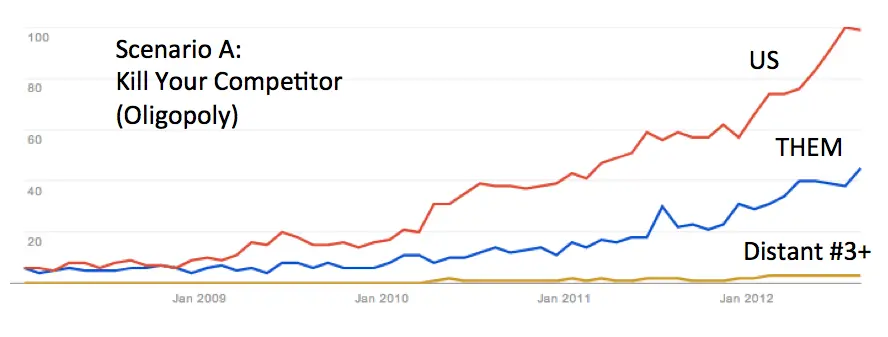
Yet, this gentle builder mentality can obscure a harder commercial reality. While coexisting in a polite, semi-equilibrium—where the #1, #2, and #3 players all carve out comfortable revenues—feels safe, it leaves immense value on the table. History shows that in most major B2B categories, the ultimate financial rewards do not belong to those who merely secure a podium finish. They belong to the category king who systematically, strategically, and tactically annihilates their top competitor.
Think of Zoom’s definitive neutralization of WebEx, Slack’s relentless campaign against HipChat, Datadog’s displacement of New Relic, or modern challengers like Clay taking direct aim at ZoomInfo. These were not polite skirmishes; they were deliberate efforts to render primary rivals irrelevant.
This report investigates the psychology of the B2B founder, examines the comfort trap of the "coexistence illusion," outlines the strategic and tactical imperatives of category dominance, and establishes a framework for when—and when not—to unleash the killer instinct.
Detailed Chronology: The Evolution of Market Dominance
To understand why modern B2B founders hesitate to adopt a "killer" mindset, one must examine how startup ecosystems have historically valued market structures.
Phase 1: The Era of Polite Oligopolies (Pre-2010s)
For a long time, traditional enterprise software was defined by high switching costs and fragmented IT budgets. Giants like Oracle, SAP, and Microsoft established sprawling empires through acquisition and enterprise lock-in, leaving smaller players to fight over niche verticals. In this era, being #2 or #3 was a comfortable, highly lucrative destination. Companies could survive for decades on a stable base of maintenance revenue and regional dominance without ever needing to destroy their nearest rival.
Phase 2: The SaaS Blitzscaling Wave (2010s–2020)
With the arrival of cloud computing and Software-as-a-Service (SaaS), the velocity of software deployment accelerated dramatically. Venture capital flooded the market, encouraging startups to "blitzscale." During this period, iconic SaaS battles played out in real time.
- Slack vs. HipChat: Atlassian’s HipChat was an early pioneer in enterprise chat, but Slack’s aggressive product-led growth, cultural branding, and uncompromising feature execution ultimately forced Atlassian to concede defeat, sunset HipChat, and pivot to a partnership.
- Zoom vs. WebEx: Cisco’s WebEx was the incumbent enterprise standard, weighed down by legacy architecture. Zoom entered with a radically simpler, video-first cloud product that made meetings frictionless, effectively hollowing out WebEx’s market share among modern tech companies.
Phase 3: The Decacorn Era and the AI Arms Race (Present)
In today’s hyper-accelerated market—fueled by generative AI and unprecedented venture liquidity—the stakes have shifted again. We have entered the age of the "Decacorn." When AI leaders routinely achieve valuations in the tens of billions overnight, even the #3 player in a category can theoretically be worth billions. This has given rise to the "Postmates Effect"—the comforting notion that you don’t need to be #1 to win big; being a well-funded #2 or #3 is financially life-changing.
Examples like Replit versus Lovable, or Claude versus Codex/OpenAI, demonstrate that multiple players can thrive simultaneously while the broader market expands at a breakneck pace. Yet, this abundance breeds complacency. Founders look at the vast total addressable market (TAM), see rising tide lifting all boats, and forget that market consolidation is inevitable once growth curves inevitably flatten.
Supporting Context & Metrics: The #1 vs. #2 Dynamic
To evaluate whether a founder should pursue total category dominance, we must dissect the psychological safety nets that keep companies at #1, #2, and #3.
The #1 Position: The Momentum Trap
If you are #1 in your category and growing steadily, the operational mandate feels straightforward: Keep building on the lead.

- The Advantage: You command more capital, secure broader distribution channels, attract top-tier talent effortlessly, and capture the lion’s share of customer mindshare. Success breeds success. The market expands, and your market share compounds organically.
- The Risk: Complacency. Market leaders often fall victim to the innovator’s dilemma, prioritizing incremental improvements over disruptive leaps because they have too much to protect.
The #2 Position: The Scrappy Challenger
If you are #2 in your category and experiencing healthy growth, your position often feels uniquely advantageous.
- The Advantage: By definition, you possess a superior product for a specific subset of customers—otherwise, everyone would choose #1. You have a crystal-clear target ($1) to benchmark against. Chasing and winning deals against the market leader provides immense cultural energy for sales teams. Furthermore, #1 often cannot match your agility in your specific beachhead zone.
- The Risk: Getting stuck in perpetual runner-up status. While it is fun to nip at the heels of the giant, fighting an entrenched #1 without a strategy to displace them permanently leaves your business vulnerable to macroeconomic downturns or shifting customer preferences.
The Mathematics of Scale
Why does killing your top competitor matter? Because in B2B software, winner-take-most dynamics dictate long-term profit margins.
| Market Position | Typical Margin Profile | Valuation Multiplier Risk | Defensibility Against New Entrants |
|---|---|---|---|
| #1 Category King | Highest gross and net retention rates | Premium pricing power; lowest risk | Extremely high due to ecosystem lock-in |
| #2 Scrappy Challenger | Healthy growth, higher acquisition costs | Moderate risk during market contractions | Vulnerable if #1 aggressively clones features |
| #3 / #4 Participant | Prone to margin compression | High risk; dependent on acquisition exit | Low; easily disrupted by emerging startups |
Even in the Age of AI, scale remains an insurmountable moat for early-stage challengers. Consider how difficult it is today to unseat category-defining pioneers like ElevenLabs, Harvey, LegalOS, or Sierra. These companies have accumulated proprietary data, deep enterprise integrations, and brand equity that make catching them an uphill battle, even for well-funded newcomers.
Official Perspectives & Strategic Frameworks
To bridge the gap between "builder" empathy and "killer" execution, industry veterans advocate for a balanced psychological approach.
Jason Lemkin, prominent SaaS investor and founder of Saastr, frequently highlights the arduous realities of being a first mover—a journey defined by missing roadmaps, tiny initial markets, customer skepticism, and institutional resistance:
"Top advantages to being a first mover: No roadmap, tiny market, customers aren’t sure, limited legitimacy, never budgeted, VCs don’t get it, many VPs don’t get it, tiny TAM at first, seems minor to many, why wasn’t it already done if it’s so important. It’s great."
Building from scratch requires immense vulnerability and resilience. Because founders spend years nurturing this empathetic, community-driven builder mindset, flipping the switch to a predatory "killer" mode can feel unnatural, if not countercultural.
The Two Reasons to Neutralize Your Top Rival
According to seasoned enterprise strategists, pursuing the outright elimination of your primary competitor serves two distinct functions:
- The Strategic Imperative: In oligopolistic markets, customer confusion scales with the number of viable alternatives. When a market is deadlocked between two equally matched titans, enterprise buyers stall purchase decisions while evaluating endless feature comparisons. Eliminating the primary competitor removes friction from the buyer’s journey, instantly positioning your solution as the default industry standard.
- The Tactical Imperative: Sales teams thrive on clarity. When a sales organization knows that a specific competitor is actively being hunted out of existence, morale shifts from defensive positioning to aggressive expansion. Win-rates climb, pricing pressure eases, and top-tier enterprise talent rallies around the shared narrative of undeniable market conquest.
Implementing the Killer Instinct Without Toxic Culture
Adopting a competitive edge does not require toxic internal behavior or scorched-earth tactics. Founders must avoid common pitfalls that dilute scarce capital and energy:
- Avoid Legal Quagmires: Endless frivolous lawsuits against competitors drain legal budgets and distract executive focus from product innovation.
- Refrain from Unethical Sales Tactics: Spreading misinformation or threatening customer relationships damages long-term brand equity.
- Timing is Everything: Many founders deploy the killer instinct too late—waking up to the threat only after their competitor has scaled beyond reach.
Future Outlook: The Next Wave of Category Warfare
As artificial intelligence compresses product development cycles, software differentiation is harder to maintain through features alone. Code can be replicated overnight; proprietary workflows and entrenched enterprise trust cannot.
In this hyper-competitive landscape, the traditional luxury of polite coexistence is eroding. While the "Postmates Effect" proves that secondary players can still achieve massive exits, the founders who capture generational wealth—the true category kings—will be those who master both halves of the CEO equation.
They will remain empathetic builders for their teams and customers, while retaining the sharp, strategic clarity required to hunt down their primary adversary. In B2B software, you don’t need to spend half your waking hours destroying the competition. But if you operate in an oligopoly and fail to challenge yourself to win outright, you may wake up to find that the competitor you refused to kill was the one sharpening a knife for you.