Executive Overview
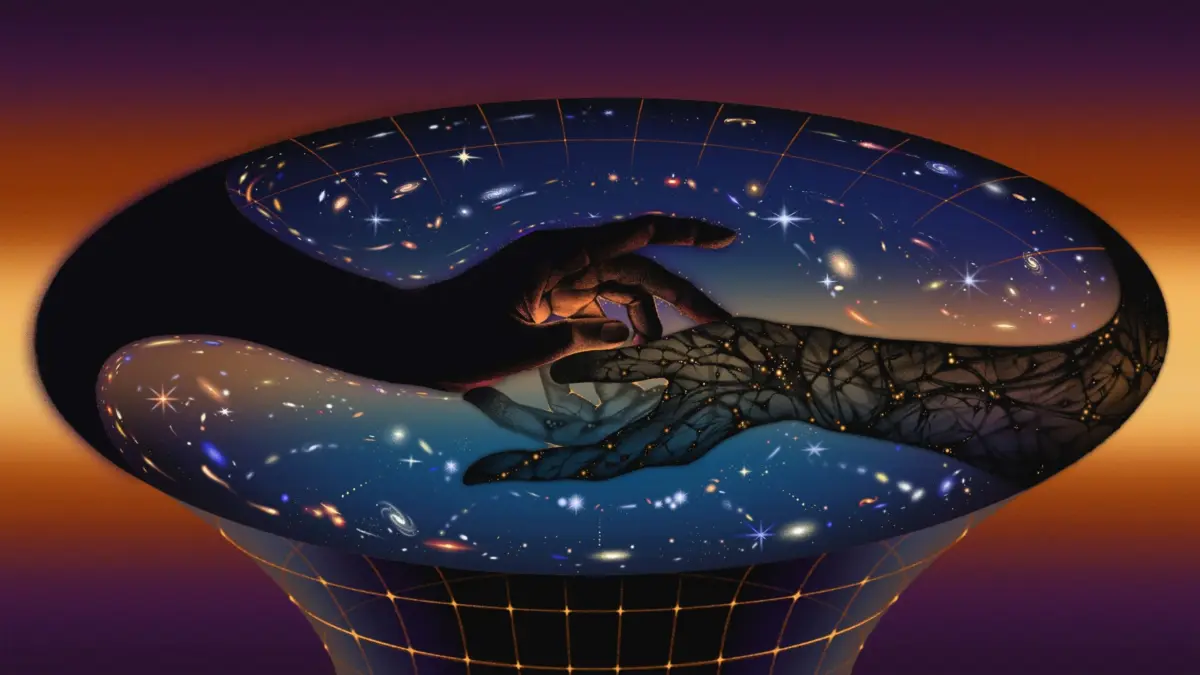
For centuries, humanity has gazed up at the night sky, seeking to decipher the grand design of the cosmos. Yet, contemporary astrophysics presents a humbling paradox: everything we can see, touch, and interact with—every star, planet, glowing nebula, and grain of sand—constitutes a mere 5 percent of the universe. The remaining 95 percent is shrouded in a profound, invisible veil. Roughly 70 percent of the cosmos is made up of dark energy, an unrelenting force driving the accelerated expansion of space, while approximately 25 percent consists of dark matter, an elusive cosmic scaffolding holding our galaxies together.
For generations, mainstream cosmology has treated these two phenomena as entirely separate entities. Beyond their shared elusiveness and their invisibility to the electromagnetic spectrum—meaning they neither emit, reflect, nor absorb light—they were thought to inhabit completely different theoretical boxes.
However, a wave of groundbreaking astronomical data, spearheaded by the Dark Energy Spectroscopic Instrument (DESI) in 2024 and 2025, has shattered this comfortable assumption. The data strongly suggests that dark energy is not a static "cosmological constant," as Einstein once posited, but is actively evolving over time. This revelation has sent shockwaves through the physics community, forcing theorists to resurrect and rigorously test a once-marginalized hypothesis: dark energy and dark matter are physically intertwined.
If substantiated, this coupling could resolve one of the most stubborn crises in modern science—the Hubble tension—while offering a profound bridge between everyday astrophysics and the ultra-subatomic realms of string theory. By invoking a revolutionary concept known as the "dark dimension," researchers are beginning to piece together a unified theory of the dark universe, transforming how we understand the past, present, and ultimate fate of reality itself.
Detailed Chronology: From Static Constants to Dynamic Evolution
To understand why physicists are suddenly rethinking the foundational assumptions of the cosmos, one must trace the timeline of recent discoveries that brought us to this juncture.
The 2005 Seed: Early Speculation on Dark Interactions
The notion that dark energy and dark matter might converse with one another is not entirely new, though it long languished on the fringes of theoretical physics. In 2005, physicist Justin Khoury of the University of Pennsylvania, alongside collaborators, posed a radical hypothetical question: What if there existed a form of dark energy whose energy density dynamically increased over time?
At the time, standard cosmological models strictly forbade this. Yet Khoury’s team demonstrated that if dark energy and dark matter were permitted to exert physical influence on one another, they could produce mathematical behaviors that mimicked an escalating energy density—without breaking fundamental physical laws. It was a mathematically elegant solution, but in the mid-2000s, observational data lacked the precision to test it. For nearly two decades, the standard model of cosmology reigned supreme, treating the two dark sectors as isolated phenomena.
The 2024–2025 DESI Revelations
That complacency came to an abrupt end with the operational success of the Dark Energy Spectroscopic Instrument (DESI). Mounted on the Mayall 4-meter Telescope at Kitt Peak National Observatory, DESI began mapping millions of galaxies and quasars, peering deep into the cosmic past to chart the expansion history of the universe with unprecedented fidelity.
In 2024, the DESI collaboration released preliminary findings indicating that the strength of dark energy was losing its presumed constancy. These ripples of doubt turned into a tidal wave in 2025, when a follow-up study analyzing more than twice as much data confirmed that dark energy is indeed changing over time.

The implications were staggering. The data suggested that after reaching a maximum value roughly 2 billion years ago, dark energy began to weaken. More peculiarly, in earlier cosmic epochs, dark energy appeared to have grown stronger—a behavior that seemingly defied the inviolable law of conservation of energy. Theorists scrambled to describe this anomalous phase, dubbing it the "phantom regime." In physical terms, it was the equivalent of watching a ball roll uphill; it is entirely possible, but only if an unseen force outside of standard gravity is pushing it.
The 2025 Theoretical Resurgence
Prompted by the DESI results, theoretical physicists immediately went to work to rescue the data from physically unacceptable "phantom" paradoxes.
- In May 2025, David Andriot of the French National Center for Scientific Research (CNRS) introduced a coupled dark energy-dark matter model, demonstrating that apparent phantom behavior is largely an artifact of accounting. "Any change or evolution of the mass of dark matter has been put into the box of dark energy," Andriot explained.
- In January 2026, a study published in Physical Review D by Elsa Teixeira and her colleagues at the University of Montpellier suggested that dark matter had transferred a fraction of its energy to dark energy during an earlier era. Because dark matter acts as the gravitational "brake" on cosmic expansion, easing off that brake naturally accelerated the universe’s outward rush.
- By July 2025, a powerhouse collaboration featuring Georges Obied, Cumrun Vafa, Alek Bedroya, and David Wu published a paper showing that a model rooted in string theory naturally accounted for the DESI data without resorting to unphysical anomalies.
Supporting Context & Metrics: Unraveling the Hubble Tension
Beyond explaining the shifting nature of dark energy, coupling the dark sectors offers a desperately needed lifeline for solving one of the most contentious debates in modern astrophysics: the Hubble tension.
The Expansion Rate Discrepancy
In the standard model of cosmology, the rate at which the universe expands—known as the Hubble constant—should be identical regardless of how it is measured. However, a profound discrepancy has emerged over the last decade:
- The Early Universe Measurement: By observing the Cosmic Microwave Background (CMB)—the residual glow of the Big Bang captured by satellites like Planck—astronomers calculate how fast the universe should be expanding based on its primordial state.
- The Local Universe Measurement: By observing local phenomena, such as Cepheid variable stars and Type Ia supernovas via instruments like the Hubble and James Webb Space Telescopes, astronomers measure how fast the universe is expanding right now.
The two methods yield values that differ by approximately 9 percent. This is not a minor statistical error; it represents a fundamental fracture in our understanding of cosmic evolution. It has sparked intense debates over whether undiscovered systematic measurement errors are to blame, or if we are witnessing the first clear cracks in the standard model, demanding entirely new physics.
A Natural Resolution
According to Teixeira and her co-authors, allowing dark matter and dark energy to interact elegantly dissolves this crisis. In their models, what appears to be a systemic contradiction in expansion rates is actually a predictable outcome of a universe where the dark sectors swap energy over time. The "crisis" vanishes, replaced by a dynamic, interconnected cosmos where early and late-universe measurements naturally diverge.
Official Statements and Expert Perspectives
The shift toward a unified dark sector has brought together particle physicists, cosmologists, and string theorists in a rare display of cross-disciplinary consensus.
-
Tim Tait (University of California, Irvine):
"Even though scientists have assumed that dark energy and dark matter don’t have anything to do with each other, you can imagine a case where one influences the other. And it would not be surprising if [they] were manifestations of a kind of unified theory of the dark universe."

-
Justin Khoury (University of Pennsylvania):
Commenting on his pioneering 2005 work, Khoury noted that allowing dark matter and dark energy to affect one another is “the most natural, simplest way of achieving this” dynamic behavior. If they interact, it strongly points toward a common origin.
-
Cumrun Vafa (Harvard University):
Vafa has been deeply critical of treating the two phenomena in isolation. “The notion that you can compute dark energy independently of dark matter is wrong,” he asserted. “That assumption, often made by cosmologists and also followed by the DESI team, led to the physically unacceptable phantom behavior.”
-
Elsa Teixeira (University of Montpellier):
Emphasizing the role of dark matter as the cosmic brake, Teixeira noted, “Dark matter is the main brake on the universe’s expansion, so easing up on that brake would have caused the expansion of the universe to accelerate.”
-
Georges Obied (University of Chicago):
Reflecting on the collaborative push to merge observational data with fundamental theory, Obied stated: “This is how people should do science. I mean, it’s the job of theoretical physicists to explore everything that’s possible, to get all the possibilities on the table. And eventually, the data will help us decide.”
The "Dark Dimension": Connecting String Theory to Reality
To find a truly fundamental explanation for how dark energy and dark matter interact, theorists have turned to string theory—the ambitious framework proposing that the most basic constituents of reality are not point-like particles, but tiny, vibrating loops of energy operating across multiple dimensions.

The Architecture of the Dark Dimension
Standard string theory posits that our universe possesses six or seven extra spatial dimensions beyond the familiar three dimensions of space and one of time. For decades, these extra dimensions were assumed to be curled up at the Planck scale ($10^-35$ meters)—so unimaginably small that they could never be probed.
However, in a series of papers starting in 2019 and culminating in 2022, Cumrun Vafa and his colleagues proposed a radical alternative: What if one of these extra dimensions is significantly larger than the others?
Dubbed the "dark dimension," this hidden spatial expanse is hypothesized to be on the order of a micron ($10^-6$ meters)—vastly larger than the Planck scale, though still microscopic.
Gravitons and the Dark Sectors
In this framework, hypothetical particles called gravitons—which transmit the force of gravity—can leak into this enlarged dark dimension. Once inside, they acquire mass, transforming into dark gravitons. While these heavy gravitons reside primarily within the dark dimension, their gravitational influence bleeds back into our familiar dimensions. In doing so, they fulfill the exact role traditionally ascribed to dark matter.
Furthermore, changes in the physical size of this dark dimension directly regulate both the energy density of dark energy and the mass of dark matter. As Obied explains, “There is a very natural coupling between dark energy and dark matter. Changes in the size of the dark dimension would affect both.”
Because the energy density of dark energy is extraordinarily small, Vafa notes that its rate of change must be excruciatingly slow:
“It’s not surprising that we didn’t see it until now… We had to wait the entire age of the universe to detect something that small.”
Future Outlook: Testing the Untestable
For decades, string theory suffered from a glaring critique: it was mathematically magnificent, but practically untestable. Critics argued it belonged more to philosophy than empirical science. The new models linking dark energy, dark matter, and the dark dimension are actively changing that narrative.
If dark matter is coupled to dark energy through a dark dimension, dark matter particles must interact with one another via a new, long-range force distinct from gravity. This opens the door to empirical validation through astrophysical observation.
%2C-and-the-Hubble-Heritage-Team-(STScI-AURA).jpg)
Astonishingly, early groundwork for such a test was laid years before the dark dimension hypothesis gained traction. In 2006, physicists Marc Kamionkowski (now at Johns Hopkins University) and Michael Kesden (now at the University of Texas at Dallas) calculated what would happen if dark matter possessed a stronger gravitational attraction to itself than to ordinary matter. They theorized that when two galaxies passed close to one another, this self-interaction would pull out a distinct "tidal tail"—an extended stream of stars, gas, and dust trailing behind the galaxies.
When Kesden and Kamionkowski searched observational data for these tidal tails and failed to find them, they were able to establish an upper bound on the strength of this extra attractive force. Today, that historical upper bound happens to be roughly 20 times larger than the values predicted by Vafa’s modern dark dimension models.
The theoretical prediction falls comfortably within observational limits. “It is interesting that we are now finding connections between that fairly abstract work and observational and experimental work,” Kamionkowski remarked.
The Road Ahead
As instruments like DESI continue to accumulate data, and as next-generation space telescopes and particle detectors come online, the margins for error will shrink. Whether the dark dimension hypothesis ultimately proves correct or falls by the wayside, it represents a triumphant return to the core tenets of the scientific method: theorists generating bold, comprehensive models, and observational astronomers gathering the hard data required to test them.
The universe may be 95 percent dark, but for the first time in modern history, the path toward bringing that darkness into the light is becoming clear.