Executive Overview
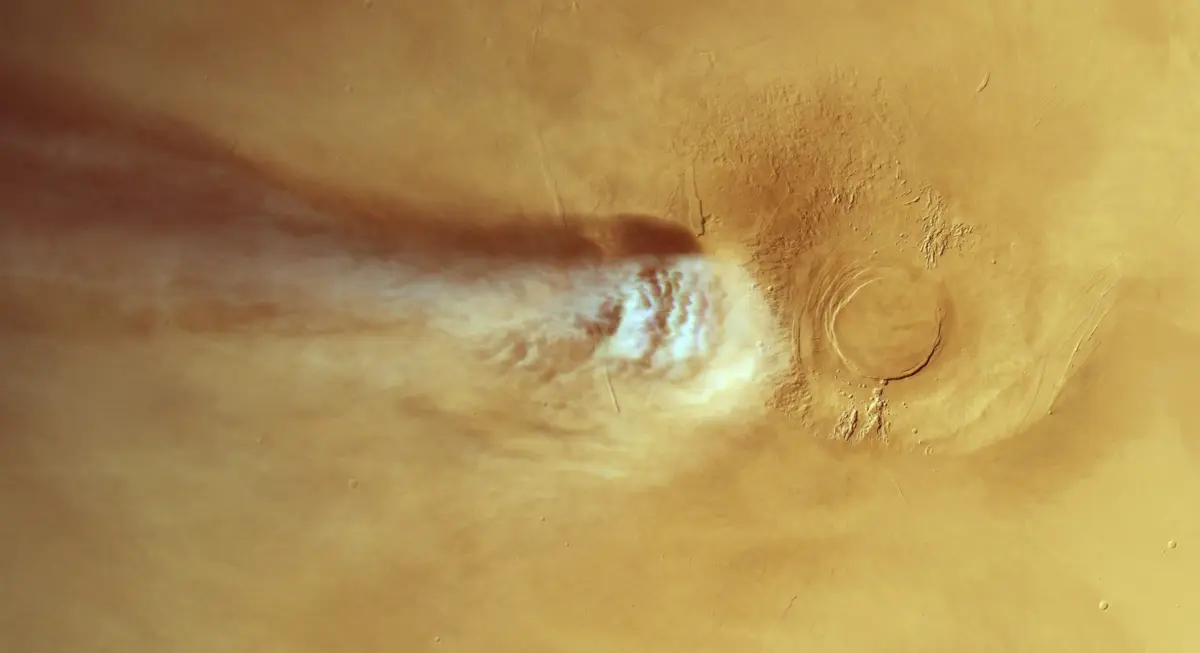
Every Martian spring and summer, a ghostly, elongated cloud materializes in the thin skies above the Red Planet, stretching an astonishing 1,000 miles—roughly the distance from New York City to Kansas City. First documented by orbiting probes in 2018, the Arsia Mons Elongated Cloud (AMEC) has since baffled planetary scientists. For years, the mechanism behind this ephemeral yet colossal morning formation remained an enigma, defying standard meteorological models derived from terrestrial atmospheric behavior.
Now, an international team of researchers has successfully modeled the cloud’s life cycle for the first time, revealing a discovery that extends far beyond Martian meteorology. According to a landmark study published in Nature Geoscience, the AMEC is driven by a physical process long predicted by theoretical physics but never before observed in action in any planetary atmosphere.
The phenomenon relies on "homogeneous nucleation," a process where water vapor transitions directly into ice crystals entirely on its own, bypassing the need for microscopic impurities like dust or salt particles that are typically required for cloud formation on Earth. Replicating this phenomenon in simulations required factoring in extreme atmospheric conditions, including a staggering 30-degree Celsius temperature drop in just 10 minutes and relative humidity levels exceeding anything ever measured on Earth by a factor of 100,000.
This breakthrough not only solves a years-long planetary mystery but also forces scientists to reconsider the boundaries of atmospheric physics across the solar system, offering tantalizing clues about weather dynamics on Mars, Venus, and beyond.
Detailed Chronology: From Discovery to Breakthrough
The 2018 Discovery and the Arsia Mons Anomaly
The story of the Arsia Mons Elongated Cloud began long before its formal scientific classification, appearing intermittently in historical images captured by various Mars missions. However, it wasn’t until 2018—when observations from the European Space Agency’s (ESA) Mars Express orbiter and other spacecraft captured the formation in high detail—that the astronomical community began tracking it systematically.
Astronomers quickly realized that the cloud was not a random weather event. It followed a strict, predictable daily schedule. Every morning during the Martian spring and summer, the wispy formation would emerge near the flank of Arsia Mons, a massive shield volcano standing an imposing 65,000 feet tall. As the morning progressed, solar heating and local winds would dramatically elongate the cloud westward until it stretched across 1,000 miles of the Martian sky. By midday, as temperatures shifted and atmospheric dynamics evolved, the colossal structure would entirely evaporate, only to repeat the cycle the following morning for several consecutive months.
Despite its predictable nature, the cloud defied conventional explanations. Standard cloud formation models failed to account for how such a massive, coherent structure could form so rapidly and persist in Mars’ notoriously thin, dry atmosphere.
The Modeling Breakthrough
For years, researchers attempted to replicate the AMEC using standard atmospheric circulation models, all to no avail. The simulated clouds either dissipated too quickly, failed to reach the required length, or required moisture levels that theoretical models deemed impossible for the Martian environment.
The turning point came when a research team led by Jorge Hernández-Bernal, a planetary scientist at Paris Sorbonne Université, decided to rethink the foundational physics governing the simulation. Instead of relying solely on established meteorological frameworks, the team incorporated theoretical physics textbooks—specifically, equations and principles that are typically treated as academic exercises and assumed not to occur naturally in planetary environments.
By integrating these "exotic" physical parameters into their high-resolution atmospheric models, the team achieved a breakthrough. The simulated AMEC emerged precisely as observed by orbiting probes, matching its seasonal timing, daily cycle, and staggering proportions.
Supporting Context & Metrics: The Physics of the Martian Mega-Cloud
The Mechanics of an Alien Sky
To understand why the AMEC is so revolutionary, one must first look at how clouds form on Earth. Terrestrial clouds are fundamentally dependent on condensation nuclei—tiny suspended particles such as dust, sea salt, pollen, or pollution. Water vapor gathers around these microscopic impurities to form liquid droplets or ice crystals. Without these seeds, cloud formation under normal conditions is virtually impossible.
On Mars, however, the AMEC operates under an entirely different set of rules. The new study suggests that the cloud is generated through homogeneous nucleation. In this process, water vapor transitions directly into ice crystals without the assistance of any foreign particles or debris.
"It’s akin to droplets of condensation appearing in the middle of a room, rather than on a window," explains lead author Jorge Hernández-Bernal. "It’s wholly unexpected."
Extreme Metrics of the AMEC
Replicating homogeneous nucleation in a planetary atmosphere requires a convergence of extreme environmental triggers:
- The Topography: The 65,000-foot-tall Arsia Mons volcano acts as an atmospheric ramp. When prevailing winds strike the colossal geological structure, they are forced upward, creating a powerful atmospheric wave that lofts moist air high into the upper atmosphere in a matter of minutes.
- Thermal Shock: The localized air mass experiences a precipitous temperature drop of 30 degrees Celsius within a mere 10-minute window.
- Unprecedented Humidity: The process demands relative humidity levels more than 100,000 times greater than any humidity value ever recorded in Earth’s atmosphere. Prior to this modeling, scientists had no indication that such extreme moisture pockets existed in the upper reaches of Mars’ atmosphere.
Official Statements and Expert Perspectives
The implications of the study extend far beyond the Red Planet, challenging long-held assumptions about how planetary atmospheres behave under extreme stress.
"We found that we needed to include some exotic physics—physics that, while included in textbooks, is treated as theoretical and usually thought not to happen in nature. It certainly hasn’t been seen in action before," Jorge Hernández-Bernal noted in an official press release detailing the findings. "Once we included this physics in our simulations, the AMEC emerged just as we hoped."
The success of the model highlights both the ingenuity of modern planetary science and the vast gaps that still exist in our understanding of alien weather systems.
"We don’t have nearly as much information about Mars’ atmosphere as we do about Earth’s, so reproducing the AMEC to this degree is a big success," Hernández-Bernal added, calling the final results "remarkable."
Independent atmospheric physicists not directly involved in the study have echoed these sentiments, pointing out that while similar phenomena have long been theorized to occur in the upper atmospheres of other rocky worlds—including Venus and potentially even Earth—they have consistently eluded direct observation due to the stringent physical thresholds required.
Future Outlook: The Next Frontier in Planetary Meteorology
The revelation that homogeneous nucleation can actively drive large-scale weather phenomena on Mars opens an exciting new chapter in planetary exploration. As space agencies continue to deploy advanced orbiters and surface rovers equipped with high-resolution atmospheric sensors, researchers will have unprecedented opportunities to test these models against real-time data.
Implications for Venus and Earth
Astrophysicists are now turning their attention back to Venus, where extreme temperatures and dense atmospheric layers create environments ripe for unconventional thermodynamic processes. While pyrocumulonimbus clouds and other violent terrestrial cloud formations are occasionally documented on Earth—such as those triggered by intense wildfires—none approach the physical constraints required for the type of homogeneous nucleation observed at Arsia Mons.
Preparing for Future Mars Missions
Understanding the fine-scale dynamics of the Martian atmosphere is not merely an academic exercise; it is crucial for future robotic and crewed exploration. As space agencies plan for long-term habitation and surface operations on Mars, predicting localized weather patterns, wind shears, and upper-atmosphere moisture shifts will be vital for ensuring the safety of landing craft, communications arrays, and astronauts.
The Arsia Mons Elongated Cloud began as a baffling visual anomaly in a spacecraft’s viewfinder. Today, it stands as proof that the universe still harbors fundamental physical processes waiting to be discovered—reminding us that even our closest planetary neighbors are capable of defying textbook physics.