Executive Overview
In the high-stakes arena of Vertical SaaS, few companies command the reverence and market dominance enjoyed by ServiceTitan. Widely recognized as the premier operational software provider for the trades—specializing in HVAC, plumbing, and electrical contractors—the company entered its fiscal second-quarter earnings report on September 8 (for the quarter ended July 31, 2026) with an enviable reputation for execution. On paper, the numbers were unassailable. ServiceTitan delivered $292.8 million in revenue, a robust 21% year-over-year increase that comfortably outstripped both its own internal guidance of 18% and consensus Wall Street estimates. Non-GAAP earnings per share (EPS) hit $0.40, topping expectations by $0.04. Operating margins expanded by 310 basis points, free cash flow reached record highs, net dollar retention (NDR) remained steadfastly above 110%, and management even modestly raised its full-year revenue forecast by $4 million.
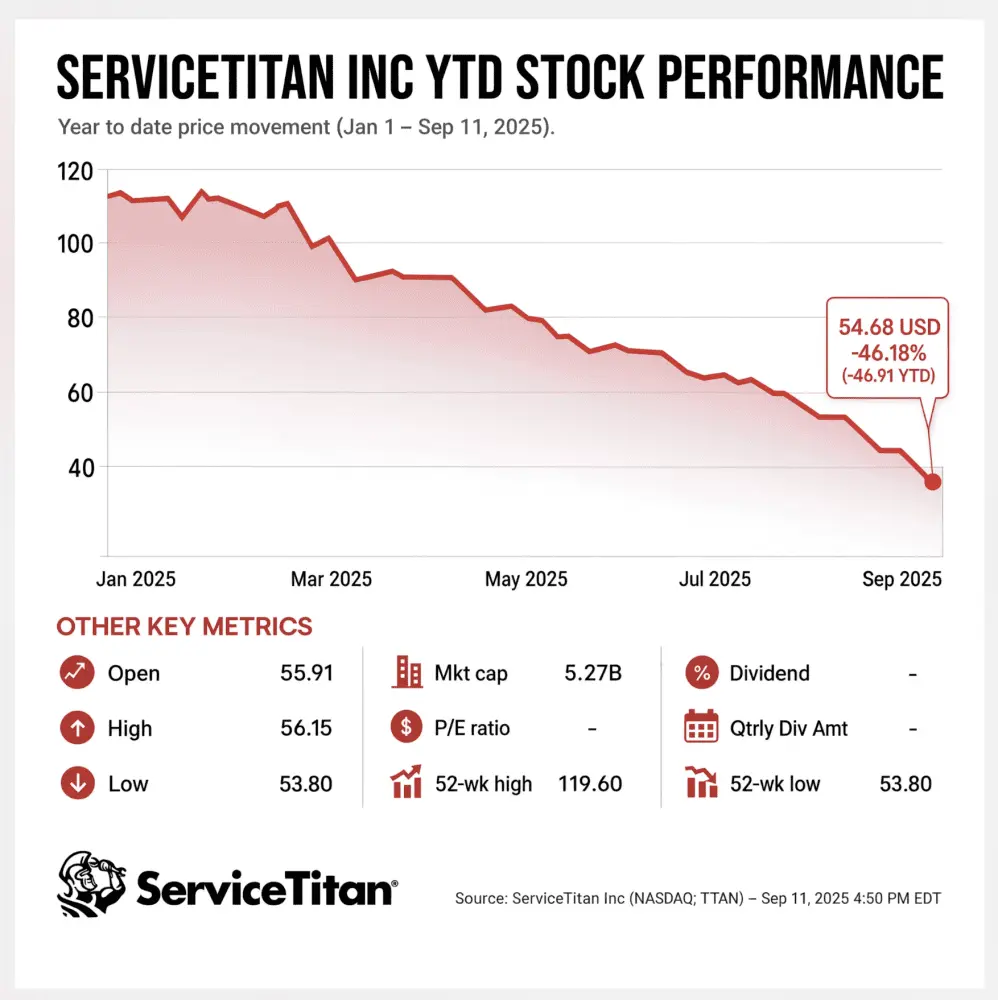
Yet, despite a financial print that most CFOs would frame and mount on a wall, Wall Street delivered a brutal verdict. The following trading session, ServiceTitan’s stock cratered by 30%, vaporizing more than $2 billion of market capitalization in a matter of hours. By the end of the week, the equity had plummeted to a 52-week low of $54.16, marking a staggering 52% collapse over the preceding twelve months.
The market’s violent reaction was not a rejection of the quarter that had just passed, but a terrifying glimpse into the back half of the fiscal year. Management’s forward guidance projected revenue growth slowing to roughly 15% for the remainder of the year—a steep drop from the 25% growth recorded just twelve months prior. Compounding the anxiety, the Q3 revenue guidance called for absolute dollar figures below those reported in Q2.
In the unforgiving climate of 2026 public markets, growth is oxygen. ServiceTitan’s earnings report laid bare a harsh reality: in modern software investing, ten points of decelerating forward growth can instantly override margin expansion, cash flow generation, and headline-beating performance. This in-depth analysis explores the anatomy of ServiceTitan’s historic sell-off, dissecting the intersection of macroeconomic headwinds, AI-driven billing model transformations, and strategic resource reallocation.
Detailed Chronology: The Anatomy of a Crash
The sequence of events surrounding ServiceTitan’s Q2 fiscal 2027 earnings release serves as a textbook study in modern equity valuation dynamics.
The Earnings Print
On Monday, September 8, 2026, after the market close, ServiceTitan reported its Q2 metrics. The headline figures were universally positive:
- Revenue: $292.8 million (up 21% year-over-year, beating consensus by approximately $8 million).
- Non-GAAP EPS: $0.40 (surpassing the $0.36 consensus estimate).
- Operating Margins: Expanded by 310 basis points, driven by disciplined cost controls.
- Free Cash Flow: Reached historic records, nearly doubling off its prior base.
- Full-Year Guide: Raised by $4 million.
The Market Reaction and Analyst Responders
When the opening bell rang the next morning, investors digested the fine print regarding forward guidance—specifically, the projection of mid-teens growth for the back half of the year and a sequential drop in absolute Q3 revenue. The market’s response was swift and merciless. The stock closed down $24.46, suffering a 30% single-day loss.
Within 24 hours of the print, Wall Street’s sell-side apparatus scrambled to recalibrate. Seven major financial institutions slashed their price targets within a single day:
- TD Cowen: Cut from $125 to $100
- Wells Fargo: Reduced to $105
- Piper Sandler: Lowered to $110
- KeyBanc: Lowered to $110
- BMO Capital Markets: Cut from $103 to $90
- Canaccord Genuity: Cut from $105 to $90
Notably, nearly all of these institutions maintained their "Buy" ratings, signaling that their fundamental thesis on ServiceTitan’s long-term enterprise value remained intact. However, they were forced to aggressively reprice the company’s forward growth rate. The market was no longer willing to pay a premium multiple for a company transitioning from a high-growth compounder into a mid-teens grower.
Supporting Context & Metrics: Unpacking the Numbers
To fully grasp why a company beating expectations could lose a third of its value in a day, one must examine the operational metrics underlying the P&L and the structural shifts in the broader trade economy.
Gross Transaction Volume (GTV) and Macro Softening
ServiceTitan’s business model is fundamentally tied to the economic health of its contractor base. The company monetizes its platform by taking a slice of the Gross Transaction Volume (GTV)—the total dollars invoiced by contractors through the software. In Q2, GTV reached $26.8 billion, representing a 17% year-over-year increase. ServiceTitan extracts approximately 1.09% of every dollar billed, up slightly from 1.06% a year prior.
While this take-rate expansion demonstrates strong pricing power, the underlying GTV growth rate decelerated sharply from 23% in Q1 to 17% in Q2. Management attributed this slowdown to a distinct softening in lead and job volumes across the industry during May and June, particularly within the HVAC sector. Furthermore, an early cooling season likely pulled demand forward into Q1, while a calendar anomaly (the July 3 holiday behaving like a weekend day) suppressed late-quarter activity.
Although usage revenue grew 24%—outpacing GTV growth as monetization efforts kicked in—the sheer weight of a six-point drop in GTV growth directly compressed the quarterly revenue growth rate from a historical 25% down to 21%.
The Sequential Revenue Dip and Margin Compression
The most alarming element of the guidance update was the sequential trajectory of the business. Based on management’s projections, Q3 revenue was guided to approximately $286 million—a noticeable step down from the $292.8 million reported in Q2.

For a software enterprise operating at a $1.17 billion run-rate to inform investors that its next quarter will generate fewer absolute dollars than its previous quarter is deeply unsettling to institutional holders. This revenue contraction carried operational margins down with it. Non-GAAP operating income for Q3 was guided to a range of $29 million to $30 million on $286 million in revenue, translating to an operating margin of roughly 10.3%, down precipitously from the 15.2% achieved in Q2.
When evaluated through the lens of the Rule of 40 (growth rate plus profit margin), ServiceTitan’s back-half profile dropped to approximately 27, compared to 36 in Q2 and 37 in the corresponding period of the previous year.
Official Statements & Strategic Shifts: The AI Max Transition and Trade Deferrals
Management’s earnings call and accompanying documentation revealed two pivotal strategic decisions that exacerbated the near-term growth slowdown: the aggressive rollout of their agentic AI operating system, "Max," and the intentional deferral of new trade expansions.
The AI Max Headwind
ServiceTitan’s agentic AI platform, Max, represents the cornerstone of the company’s future strategy. Adoption metrics are undeniably impressive: after closing Q1 with just over 100 enrolled locations, the company doubled that figure in Q2 and now projects surpassing 700 locations by the end of the fiscal year. Early adopters are reportedly experiencing revenue growth exceeding 45%.
However, success with Max comes with a heavy near-term financial penalty. ServiceTitan disclosed a deliberate billing structure that introduces two distinct revenue headwinds:
- Deferred Billing: Max does not bill for the first quarter of the contract, effectively offering a trial or implementation grace period to lower friction on complex change-management sales.
- Mix Shift: As customers transition to AI-enabled tiers, legacy billing mechanisms are disrupted.
Together, these factors create a $4 million to $5 million near-term revenue headwind. In essence, the faster Max sells, the more it suppresses reported revenue in the immediate reporting period. While this trade-off is logically sound—aiming to secure high-value, sticky long-term relationships—it introduces a P&L trough that will depress growth metrics for four to six quarters before the expansion flywheel takes full effect. In the hyper-sensitive market of 2026, investors punished the company for creating this artificial growth vacuum.
Sacrificing Expansion for Focus
To marshal the engineering and capital resources necessary to scale Max and support its internal software development factory, ServiceTitan made a calculated sacrifice: it deferred its planned expansion into new commercial and residential exterior trades.
A review of operating expense allocations demonstrates a clear strategic pivot:
- Capital and personnel were shifted away from aggressive sales acquisition in unpenetrated markets.
- Resources were redirected inward toward product development and deepening penetration within the existing, highly profitable customer base (where Net Dollar Retention remains above 110%).
While defending an existing base with superior AI tooling is a defensible capital allocation strategy, it effectively removed critical growth vectors from the forward model. Compounding these signals, ServiceTitan announced the appointment of a new Chief Revenue Officer, Rikus Pretorius, on the exact same day it guided growth down by 10 points. For the public markets, changing the head of sales while simultaneously lowering forward expectations sent a turbulent, uncoordinated message.
Future Outlook: Lessons for the Vertical SaaS Ecosystem
ServiceTitan remains an elite operator within the B2B software landscape. Boasting a $1.17 billion run-rate, 21% top-line growth, 81% platform gross margins, nearly $480 million in cash, positive and accelerating free cash flow, and a genuine, highly adopted AI product, the company possesses fundamentals that the vast majority of technology firms would envy.
Yet, the harrowing events of September 2026 serve as a cautionary tale for both public and private software companies navigating the current economic paradigm. Two fundamental lessons emerge from ServiceTitan’s crucible:
1. Model the P&L Impact of AI Transitions
Transitioning software billing models toward usage-based pricing, outcome-based pricing, or AI-driven deferred implementation structures inevitably pushes revenue recognition to the right. Founders and executive teams must accurately model the resulting revenue trough and ensure they have the balance sheet strength—or the psychological fortitude—to absorb the market’s reaction when top-line growth temporarily dips. If an AI product requires waiving initial fees, price that gap into your investor communications long before committing to the rollout.
2. Guard Your Growth Vectors Carefully
Strategic resource allocation often requires difficult choices. However, deferring new market expansions to fund internal product enhancements directly impacts the slope of your growth curve. When a company simultaneously experiences macroeconomic softening in its core verticals (such as HVAC volume declines) and voluntarily shelves new geographic or trade expansions, the resulting deceleration can be severe. In today’s market, investors trade primarily on the slope of growth, not the absolute destination.
Conclusion
ServiceTitan’s dramatic market repricing is a stark reminder of the "Grow or Die" mandate governing modern enterprise software. Delivering a solid beat-and-raise quarter was insufficient to insulate the company from the gravity of a decelerating forward guide. As ServiceTitan works through its AI transition and digests its operational adjustments, the broader SaaS industry is left watching closely—reminded that even market leaders must carefully balance the long-term promise of artificial intelligence against the unforgiving short-term demands of Wall Street.