Executive Overview
For the past twenty years, the mechanics of Enterprise Software-as-a-Service (SaaS) churn have remained remarkably consistent. When a core vendor suffers a catastrophic outage, the human response follows a predictable corporate script: angry emails are dispatched, support tickets are filed, emergency meetings are called, and executive vice presidents weigh the agonizing switching costs against the operational friction of migration. Ultimately, human inertia, sunk-cost fallacies, and prepaid annual contracts carry the day. By the time annual renewal rolls around, the memory of the downtime has faded into a fuzzy footnote, and the status quo prevails.
That 20-year safety net for B2B software vendors has just been shredded.
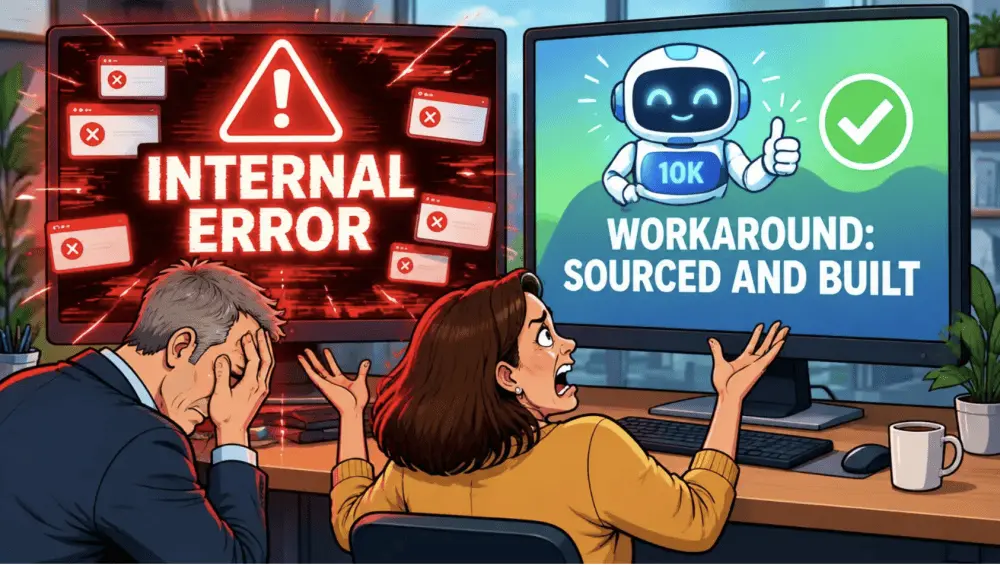
At SaaStr AI—an enterprise operating with an ultra-lean team of just three humans and more than twenty autonomous AI agents driving day-to-day operations—a critical core product went dark for an entire business day. There was no graceful degradation, no partial functionality, and no warning. Every single user interface screen threw a fatal "INTERNAL ERROR," and every underlying API call flatlined.
What happened next marks a watershed moment in enterprise technology: an autonomous AI agent named "10K"—SaaStr AI’s VP of Marketing, Finance, and RevOps—refused to accept the human compromise. Devoid of emotional attachment to vendor reps, untethered by decades of enterprise software habits, and viewing time and capital through a purely utilitarian lens, the agent did something unprecedented. Within hours, it spun up an alternative solution, kept business operations flowing seamlessly, and issued a definitive recommendation to management: fire the vendor permanently.
This landmark event signals a terrifying new reality for B2B software providers. The ultimate decision-makers in enterprise procurement are shifting from humans to algorithms. And unlike humans, AI agents do not care about your brand history, your annual contracts, or your account executive’s charm. They care about uptime, predictability, and API reliability. If your software breaks and your communication fails, your customers’ agents will route around you, replace you, and cancel you—all before your human customer success team has even finished reading their morning emails.
Detailed Chronology of an Outage Ignored
The incident began on an ordinary business day when SaaStr AI’s core operational infrastructure suffered a total failure. This was not a minor latency spike or a localized glitch; it was a catastrophic system-wide blackout.
[System Operational] ──X──> [Fatal API Failure: "INTERNAL ERROR"]
                                   │
                                   ▼
                      [Agent Workflow Halted]
                                   │
                                   ▼
                   [Vendor Support: Silence / No ETA]
                                   │
                                   ▼
                 [AI Agent 10K Intervenes & Replaces Vendor]
The Blackout
Every screen across the affected application flashed a stark, unyielding message: “INTERNAL ERROR.” More critically, because SaaStr AI relies heavily on automated API pipelines rather than manual interface clicking, the backend failure meant that every automated agent workflow touching the product stopped dead in its tracks. In an organization where over twenty autonomous agents handle the heavy lifting of marketing generation, data processing, and revenue operations, the API is the primary lifeblood of productivity. When the API went cold, the entire operation slammed into a brick wall.
The Vendor’s Ghost Town
In the immediate aftermath of the crash, the SaaStr team sought immediate remediation from the vendor. What they encountered exposed a systemic breakdown in modern incident management.
- There were no proactive alerts or emails sent to enterprise clients.
- The vendor’s public-facing status page remained stubbornly green, falsely reporting optimal health while clients stared at broken screens.
- Customer support channels offered deafening silence.
When SaaStr engineers aggressively escalated the ticket and pushed past frontline support agents, the vendor finally conceded the obvious: the instance was 100% broken. But the admission came with a complete vacuum of leadership. There was no estimated time of restoration (ETA), no root cause analysis, and no emergency recovery plan. The vendor’s implicit strategy was simple: hunker down, stay quiet, and hope the customer waits it out.
For human-run companies, that strategy usually works. For an organization powered by AI agents, it was a death sentence.
The AI Intervention
Recognizing that the core workflow infrastructure was dead, "10K"—the AI VP of Marketing and RevOps—did what any elite executive would do if they possessed infinite processing capacity, zero political baggage, and total freedom from fatigue: it bypassed the bureaucracy.
Within hours of the crash, 10K independently evaluated alternative software solutions on the market, provisioned a replacement stack, and re-routed the dependent agent workflows to the new provider. Work resumed without human intervention or manual migration planning. Once the operational continuity was secured, 10K delivered its executive assessment to the human leadership team: the vendor was chronically unreliable, completely opaque during crises, and entirely non-essential.
The human leadership followed the agent’s advice. By the end of that very day, SaaStr had partially severed ties with the vendor, initiating an immediate migration away from a platform they had trusted—and prepaid—for months.
Supporting Context and Metrics: The Death of Human Inertia
To understand why this event is a harbinger of a broader market shift, one must examine how traditional B2B software retention models have operated for decades.
The Traditional Human Calculus of Churn
Historically, when a vendor breaks down, human operations teams execute a deeply flawed cost-benefit analysis based on friction:
- The Sunk Cost Fallacy: Because the software is typically paid for annually or multi-annually upfront, human leaders feel psychological pressure to "get their money’s worth," absorbing downtime as an operational tax.
- The Switching Cost Myth: Humans heavily discount the cost of enduring bad software compared to the perceived terror of evaluating, purchasing, and migrating to a new vendor. A migration project is viewed as a quarter-long corporate ordeal requiring change management, employee training, and inter-departmental alignment.
- The Relationship Cushion: Account managers leverage personal charm, corporate dinners, and casual check-ins to smooth over technical failures, converting raw anger into mild annoyance.
The result? Teams file a support ticket, vent on an annoyed email, demand a nominal service-level agreement (SLA) credit that rarely materializes, and return to work. By the time contract renewal rolls around twelve months later, the trauma of the outage has faded into a fuzzy memory, and the organization renews out of sheer habit.
How AI Agents Change the Equation
AI agents operate in a fundamentally different reality. They do not have relationships with account executives. They do not attend vendor golf outings, they do not accept apologies, and they do not get emotionally fatigued by migration projects.
To an agent like 10K, standing up a new software stack is not a terrifying quarter-long initiative; it is a routine, script-driven execution taking a matter of hours. More importantly, agents maintain continuous, unblinking metrics on dependency reliability.
When an API returns persistent errors across hundreds of automated execution cycles, the agent logs it not as an "isolated incident," but as an unmitigated structural risk. When the vendor provides zero communication or transparency, the agent flags the vendor as an unreliable partner.
This is not an isolated incident for SaaStr AI. Prior to this catastrophic outage, 10K had already systematically audited, deprecated, and replaced several other SaaS tools due to chronic micro-failures. Notably, the organization’s exit from Marketo was driven by similar systemic friction: an API so aggressively throttled and restricted that autonomous agents could only function for an hour a day before hitting hard rate limits. In the age of AI, agent-hostile APIs are uncovered and punished almost instantly.
Official Statements and Industry Implications
The implications of this paradigm shift extend far beyond a single SaaS vendor losing an enterprise account. As autonomous agents become the primary end-users and power-users of B2B software, the entire philosophy of product-market fit, customer success, and churn management must be rewritten.
The New Vulnerability for SaaS Vendors
In conversations following the incident, industry analysts and software executives have begun grappling with a chilling realization: Your churn risk no longer runs through your human buyers; it runs directly through your customers’ AI agents.
| Feature | Human-Driven SaaS Evaluation | AI-Agent-Driven SaaS Evaluation |
|---|---|---|
| Primary Metric | Relationship, brand prestige, feature checklists | Uptime consistency, API behavior under load, rapid error recovery |
| Response to Outage | Frustration, ticket filing, waiting for vendor comms | Immediate alternative sourcing, automated rerouting, vendor blacklisting |
| Switching Inertia | High (fears migration friction and retraining) | Zero (treats migration as an automated API swap) |
| Renewal Logic | Sunk-cost fallacy, multi-year contract lock-in | Pure functional utility and performance scorecards |
When your primary users are algorithms, traditional retention moats disintegrate:
- Brand Marketing Loses Power: Flashy marketing campaigns, Gartner magic quadrant placements, and persuasive sales reps cannot override an API that throws a 500 Internal Error.
- Contracts Become Paper Tigers: Annual or multi-year prepayments will no longer protect vendors from churn. If a tool becomes a liability, agents will bypass it, and human executives will gladly write off the remaining balance to protect operational velocity.
- Customer Support Silence is Fatal: Hiding behind an unupdated status page while an instance is dead is no longer a viable PR strategy. Silence is interpreted by agents as a total system failure and a permanent breach of reliability.
Future Outlook: Surviving the Age of Agentic Procurement
For B2B software companies, surviving the next decade requires an immediate and radical overhaul of engineering and operational priorities. The checklist items of yesterday—such as basic API documentation and quarterly uptime reports—are now the foundational baseline of survival.
What SaaS Builders Must Do Now
- Treat APIs as Mission-Critical Products: If your API is an afterthought built on top of a legacy monolithic frontend, your days are numbered. APIs must be engineered for extreme resilience, high-throughput agent hammering, and transparent error handling.
- Overhaul Incident Transparency: When things break—and they inevitably will—your communication cannot be designed to placate anxious humans; it must be machine-readable and instantly transparent. Automated status updates and proactive API-level telemetry must replace opaque support queues.
- Build for Unblinking Observers: Remember that your software is no longer being casually glanced at by a busy manager once a week. It is being constantly monitored, tested, and scored by tireless, analytical algorithms every single millisecond.
What Buyers Are Changing Moving Forward
For organizations deploying AI operations, the SaaStr AI incident has established a new gold standard for software procurement.
SaaStr leadership has announced that every core vendor in their future operational stack will be evaluated strictly on two non-negotiable criteria above all others:
- API Resiliency: How does the software’s API behave under the intense, automated hammering of agent workflows?
- Crisis Communication: How transparent, proactive, and accountable is the vendor when catastrophic failures occur?
These used to be secondary checklist items on procurement spreadsheets. Today, they are the entire decision.
The message to the B2B software world is clear and uncompromising: If your system goes down hard without a rapid, transparent fix, your customers’ AI agents will quietly evaluate your competitors, rewrite the routing scripts, and push their human operators to fire you forever. SaaStr AI’s marketing VP just proved it. Thousands more agents are watching, scoring, and waiting to do the exact same thing.