An investigative analysis into five days of Claude Code transcripts reveals surprising truths about token economics, context bloat, and why raw model pricing is a deceptive metric for AI-driven software engineering.
Executive Overview
In the rapidly evolving landscape of AI-driven software development, engineering teams are constantly searching for the holy grail of agentic efficiency: lower operational costs without sacrificing code quality. A newly released empirical dataset, drawn from five days of intensive, real-world Claude Code transcripts between September 20 and September 25, challenges conventional wisdom about AI model pricing.
The core revelation? Raw token pricing is a deceptive metric. While higher-end models like Opus 5.5 may list at twice the price of Sonnet 5 per million input tokens, their overall cost-per-line-of-code can be radically lower. This paradox is driven by a fundamental truth of autonomous agent workflows: users do not merely pay for tokens; they pay for steps, context bloat, and the iterative rounds required to fix broken code.
By analyzing 203 implementer pull requests (PRs) and 411 reviewer agent runs across four distinct models (Sonnet 5, Opus 5, Opus 5.5, and Fable 5.1), this study demonstrates that intelligent task management, fewer operational steps, and optimized context retention easily trump cheaper base token costs. Opus 5.5 emerged not only as a superior code reviewer—replacing Fable 5.1 at roughly one-third of the price—but also proved to be twice as cost-effective per line of code in active coding agent pipelines.
Detailed Chronology of the Operational Testbed
To understand how these cost metrics materialized, it is essential to examine the workflow environment. The development process operated in automated waves managed by a lead model that ingested GitHub issues and partitioned them into discrete lanes affecting isolated files.
The Multi-Agent Architecture
Each engineering lane deployed a specialized infrastructure:

- The Implementer Agent: Spawned in its own git worktree, this agent wrote the required code and automatically opened a pull request.
- The Reviewer Agent: A separate verification entity that executed the test suite, intentionally broke the code to verify that tests failed appropriately ("went red"), and audited the claims made in the PR description.
- The Quality Gate: No code could be merged into production without receiving a passing grade from a reviewer. Failed reviews resulted in a "needs-fix" status, cycling the PR back to the implementer for iterative corrections.
Chronological Breakdown of the Test Period
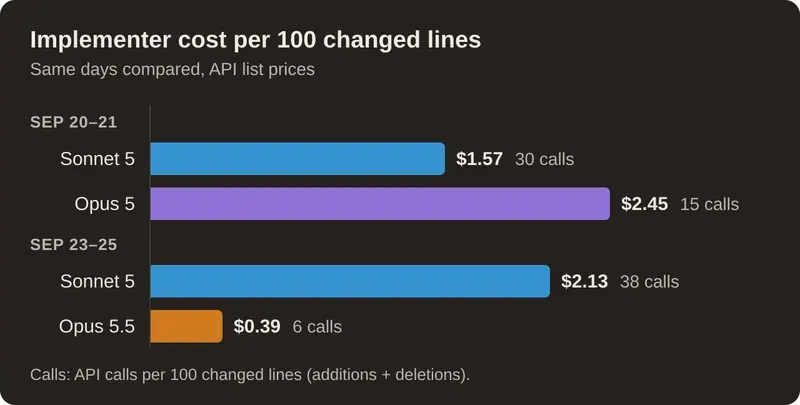
- September 20–21 (The Opus 5 Baseline): During the initial phase, Opus 5 was deployed alongside Sonnet 5. While Opus 5 demonstrated high reasoning capability, its strict 2.5x token price multiplier over Sonnet made it cost-prohibitive. Sonnet 5 averaged $1.57 per 100 changed lines across 30 API calls, whereas Opus 5 burned $2.45 per 100 lines despite executing fewer calls (15 per 100 lines). Opus 5 was not fundamentally wasteful in its engineering steps; rather, its pricing structure penalized its use.
- September 22 (Process Calibration & Task Routing): Recognizing that raw pricing comparisons were skewed by task allocation—where complex authentication and cryptographic protocols were routed to advanced models—the operational parameters were adjusted to isolate variables and establish fair-split comparisons within the same code repositories.
- September 23–25 (The Opus 5.5 Breakthrough): Opus 5.5 was introduced to the pipeline, featuring adjusted token pricing ($4 per million input tokens, $20 per million output tokens, and a cached read rate matching Sonnet at $0.20 per million). The results were staggering. Sonnet 5’s cost per 100 changed lines ticked up to $2.13 (across 38 API calls), while Opus 5.5 slashed the cost to a mere $0.39 per 100 changed lines (across just 6 API calls).
Supporting Context & Metrics: Unpacking the Financial Engine
To fully comprehend why Opus 5.5 outperformed its peers, we must dissect where engineering dollars are actually spent during an autonomous agent run.
The Anatomy of an Agent Call
An autonomous coding agent does not execute a task in a single API request. Every single step requires a new API call that resubmits the entire conversational history: the initial brief, every source file read, and all accumulated test logs.
An analysis of a six-hour telemetry window on September 24 revealed that agents consumed approximately $593 in API list-price value. The expenditure distribution was heavily skewed:
- 68% was consumed by cached reads.
- 22% went toward cache writes.
- 10% accounted for fresh model output.
Statistical correlation between cost, call count, and context size was nearly absolute ($r = 0.99$). The worst financial offenders were Sonnet implementers that drifted into 400 to 600 sequential calls while their context windows bloated from 600,000 to nearly 970,000 tokens. Because context compaction mechanisms failed to trigger before the 967K threshold, every subsequent call re-read the massive, accumulated history.
| Model | Input ($/M tokens) | Output ($/M tokens) | Cached Read ($/M tokens) | Cost per 100 Changed Lines | API Calls per 100 Lines |
|---|---|---|---|---|---|
| Sonnet 5 | $2.00 | $10.00 | $0.20 | $1.57 – $2.13 | 30 – 38 |
| Opus 5 | $5.00 | $25.00 | $0.50 | $2.45 | 15 |
| Opus 5.5 | $4.00 | $20.00 | $0.20 | $0.39 | 6 |
| Fable 5.1 | $10.00 | $50.00 | $0.25 | N/A (Reviewer) | N/A |
Why Cached Reads Change the Equation
Because cached reads cost an identical $0.20 per million tokens on both Opus 5.5 and Sonnet 5, the nominal 2x price multiplier for Opus input/output tokens becomes largely irrelevant for chat-heavy agent workflows. For a typical Sonnet implementer, cached reads accounted for roughly 75% of the total bill. Consequently, running the exact same call on Opus 5.5 represented only a 25% cost increase—not a 200% doubling—while delivering vastly superior logic that drastically reduced the total number of required steps.
The Myth of Reasoning Effort
The metrics also debunked assumptions regarding model "reasoning effort" settings. Running Sonnet 5 at medium, high, and extra-high effort levels yielded diminishing returns:

- Medium Effort: $1.72 per 100 lines (12% first-review pass rate)
- High Effort: $2.52 per 100 lines (17% first-review pass rate)
- Extra-High Effort: $2.56 per 100 lines (8% first-review pass rate)
Elevating Sonnet’s reasoning effort increased costs by 35% to 51% per line with zero discernible gain in first-review pass rates. Opus 5.5 achieved its stellar efficiency operating comfortably at medium effort.
Official Observations and Comparative Reviewer Analysis
When evaluating the transition from Fable 5.1 to Opus 5.5 for code review duties, the performance metrics reinforced the broader narrative of efficiency and precision.
Reviewer Benchmarks: Opus 5.5 vs. Fable 5.1
Operating on identical pull requests over the same date range—and normalized against Opus 5.5 pricing rates—a single review round cost $1.36 on Opus 5.5 compared to $1.50 on Fable 5.1.
However, at real commercial list prices, Fable was approximately 2.7 times more expensive and notably slower, taking a median of 9 minutes per review round compared to Opus 5.5’s brisk 6.5 minutes. Furthermore, Fable showed no signs of superior strictness: it blocked 17 of 19 first submissions on Sonnet-written code, while Opus 5.5 blocked 74 of 92—a statistically negligible variance.
When evaluating dual-reviewed PRs, both models successfully caught sophisticated security vulnerabilities that the other missed (such as specific directory-deletion paths following symbolic links). Rather than paying a 2.7x premium for Fable’s second opinion, engineers opted to integrate those specific bug signatures directly into the unified reviewer checklist.
The Reality of First-Review Failures
A sobering discovery across all models was that the vast majority of standard code PRs failed their initial review. Sonnet 5 and Opus 5 passed only 12% to 20% of first reviews. In a dedicated six-hour observation window on September 24, all 20 production-code PRs failed their initial inspection.

Many of these failures were structural edge cases—such as test suites remaining stubbornly green on broken code or PR descriptions making inaccurate claims. Recognizing that no frontier model can entirely eliminate human or architectural logic gaps in automated testing loops, engineering teams shifted their focus away from chasing unattainable first-pass rates and instead reformed the verification process itself.
Future Outlook: The Paradigm Shift in AI Development Economics
The empirical data gathered from these multi-agent transcripts offers a clear roadmap for the future of AI-assisted software engineering. As foundation models grow more capable, the primary cost driver in software development will no longer be the raw compute cost of a single token, but rather the architectural efficiency of the agentic loop.
Key Takeaways for Engineering Leaders
- Optimize for Steps, Not Tokens: Engineers must design agent workflows that minimize conversational bloat. Preventing runaway context growth (such as capping uncompacted context windows well below the 900K token threshold) yields exponentially greater savings than negotiating micro-cents on input token pricing.
- Embrace Higher-Tier Models for Complex Lanes: While premium models carry higher headline prices, their superior reasoning capabilities result in significantly fewer iterations, shorter command sequences, and dramatic reductions in costly fix-rounds.
- Redefine Quality Gates: Because first-review failure rates remain high across the industry, future efficiency gains will come from hardening automated test suites and expanding deterministic verification protocols rather than relying solely on probabilistic model checks.
As the industry matures beyond naive token-cost comparisons, organizations that adopt a systems-level approach to agent orchestration—measuring API calls and context retention per unit of completed work—will dominate the next generation of software development productivity.