By Richard Kersey
Special Dispatch / Building in Public Series (Part 3)
Executive Overview
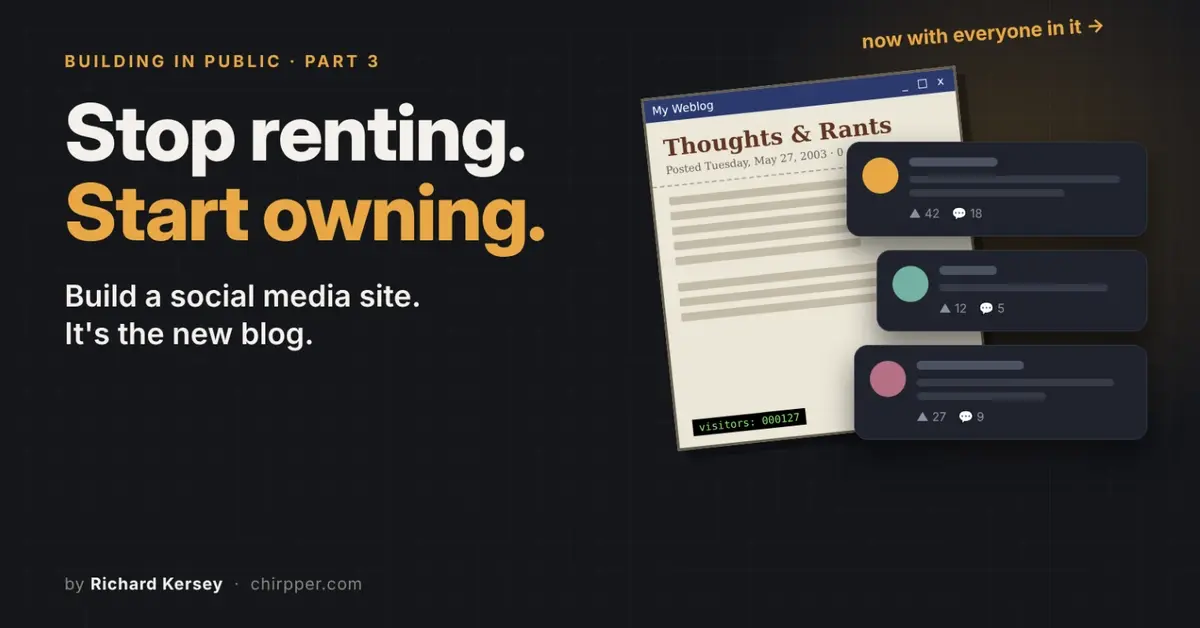
For nearly two decades, digital creators, writers, and thinkers made an implicit, frictionless bargain with the internet giants: we traded our sovereignty for their scale. We abandoned the cozy, decentralized blogrolls and RSS feeds of the early 2000s—the era of Blogger, LiveJournal, and early WordPress—and relocated our digital lives onto rented platforms. These digital landlords offered free hosting, massive built-in audiences, and polished user interfaces. In exchange, they owned the architecture, controlled the distribution algorithms, and dictated the terms of engagement.
That deal has officially collapsed.
Through relentless algorithm tweaks, plummeting organic reach, and sudden monetization shifts, centralized social media networks have transformed from vibrant public squares into unpredictable toll roads. Yet, just as the prospects of renting digital space have hit an all-time low, a quiet technological revolution has made the alternative not only viable, but effortless. Artificial intelligence has fundamentally collapsed the cost and complexity of software development, turning what once required venture capital, a dedicated engineering team, and months of labor into a weekend project for a single developer.
This is the story of that paradigm shift. Drawing from the frontline development of Chirpper—a custom social platform built entirely through AI collaboration since March 2026—this investigation explores why the economic and creative incentives have finally flipped back toward ownership. We will examine how modern serverless infrastructure makes independent hosting astonishingly cheap, confront the hard legal and marketing realities of running your own platform, and provide a clear roadmap for anyone looking to reclaim their digital footprint.
Detailed Chronology: The Evolution of Digital Real Estate
To understand how we arrived at the current renaissance of independent web development, we must trace the trajectory of digital habitation over the past twenty-five years.
Era 1: The Sovereign Web (1999–2008)
At the turn of the millennium, the internet was structurally fragmented and proudly decentralized. The launch of Blogger and LiveJournal in 1999, followed by WordPress in May 2003, democratized publishing. Creators picked a theme, wrote whatever they wanted, and built audiences organically through RSS (Really Simple Syndication) and mutual "blogrolls." While these communities were small by modern standards, they possessed a profound attribute: absolute ownership. Your content lived on a domain you controlled, untouched by algorithmic gatekeepers.
Era 2: The Great Migration to Rent (2009–2020)
As Web 2.0 matured, platforms offering "free" infrastructure emerged with irresistible gravitational pull. Why maintain a self-hosted server when a global tech giant could host millions of words, photos, and videos instantly—and hand you a readymade audience of billions? Creators made the trade without fully reading the fine print. We migrated our intellectual property to walled gardens, assuming the reach would be permanent.
Era 3: The Algorithmic Squeeze (2021–2025)
The trade steadily deteriorated. Platforms optimized for ad revenue and user retention altered their distribution models. Organic reach plummeted; algorithmic feeds prioritized outrage and engagement bait over substantive content; and platform policies shifted overnight, wiping out years of hard-earned audience access. Creators realized too late what renting truly meant: you can decorate the apartment, but the landlord can evict you or raise the rent whenever the quarterly earnings report demands it.
Era 4: The AI-Assisted Awakening (March 2026–Present)
The inflection point arrived not through legislative reform or a mass boycott, but through the democratization of software engineering via artificial intelligence.
On March 5, 2026, I sent a single, straightforward prompt to ChatGPT: Build a social site with no login or signup that still functions as a high-engagement community. Just forty-eight hours later, on March 7, a fully operational version of Chirpper went live in production. Users could post content, generate invites, and reply in real-time. As a solo developer working exclusively during nights and weekends, I crossed a threshold that would have been financially and temporally impossible just two years prior: I built a bespoke social network faster than it used to take to configure a standard WordPress theme.
Supporting Context & Metrics: The Economics of Independent Infrastructure
Skepticism is the default reaction when someone suggests abandoning mainstream platforms. Traditional arguments against self-hosting always center on two insurmountable barriers: prohibitive development costs and expensive server overhead. In the post-AI technological landscape, both arguments have evaporated.
The Cost of Modern Serverless Hosting
Running a modern web application no longer requires leasing expensive virtual private servers (VPS) or managing complex Linux environments. Chirpper, for example, is hosted on Cloudflare Pages, backed by a D1 SQLite database.
The financial footprint is negligible, though precision matters when scaling:
- The Free Tier Trap: Cloudflare’s free tier offers an impressive 5 million database row reads and 100,000 row writes per day. However, rigorous production testing reveals that once a community crosses those thresholds, queries abruptly fail.
- The Production Budget: Transitioning to Cloudflare’s paid Workers plan starts at a modest baseline of $5 a month. For the cost of a single artisanal coffee, a creator secures enterprise-grade global edge delivery, DDoS protection, and lightning-fast database queries.
Why a Social Site Beats a Standard Blog
A common counter-argument is: "Why build a social network when I can just start a blog?"
The distinction lies in the mechanics of community and conversation. A traditional blog is fundamentally a broadcast medium—a one-way megaphone. You write an essay, readers consume it, and perhaps a handful leave comments that languish at the bottom of the page, unseen by the wider world. The actual, vibrant discourse about your ideas inevitably migrates away to centralized platforms like Reddit, X, or Hacker News.
A custom social site brings the conversation directly into your own living room. By engineering a platform where readers can post, reply to one another, and invite peers into the fold, you own the entire ecosystem. It functions similarly to a self-hosted Reddit subreddit: the community guidelines, the moderation rules, the historical archive, and the domain name belong entirely to you. Furthermore, platforms like Chirpper bridge the gap by integrating structured article pages—complete with custom covers, metadata tags, and native RSS feeds—giving your long-form writing a permanent home inside an interactive community hub.
Official Insights: An Honest Checklist and Hidden Traps
Building your own digital space is an empowering endeavor, but it is not a silver bullet. Transparency requires examining both the ideal use cases and the severe operational traps that catch creators off guard.
Should You Build Your Own Platform?
It is an ideal fit if:
- You are exhausted by algorithmic volatility and want absolute control over your audience relationship.
- You write, create, or think in public and want a permanent archive that cannot be deplatformed.
- You enjoy experimenting with software and view your digital presence as an evolving creative canvas rather than a static billboard.
It is a poor fit if:
- You expect immediate, passive audiences without putting in the grueling groundwork of community cultivation.
- You have zero tolerance for technical debugging, security maintenance, or platform administration.
- You view your web presence purely as a top-of-funnel marketing asset and refuse to invest emotional or intellectual capital into community stewardship.
The Traps Nobody Mentions
-
The Empty Room Paradox:
Human psychology dictates that nobody wants to be the first person at an empty party. When you launch your own site, the initial silence is deafening. To combat this on Chirpper, a hybrid syndication strategy was deployed: original long-form articles are published natively on the owned site first, then strategically syndicated across distributed networks—such as dev.to, Hashnode, LinkedIn, Reddit, and Hacker News—with clear canonical links pointing back home. Borrowed audiences are systematically funneled into the owned ecosystem. It is a labor-intensive, hours-long process per article, underscoring the necessity of building automated syndication tools. -
The Hidden Legal Realities of Hosting User-Generated Content:
The moment you allow other human beings to post content on your infrastructure, you transition legally from a creator to a host. While comprehensive legal counsel should always be sought, US-based site operators must navigate two critical realities:- DMCA Compliance: You must formally register a Digital Millennium Copyright Act (DMCA) designated agent with the U.S. Copyright Office (a nominal $6 fee, renewable every three years) to secure your legal "safe harbor" protections against copyright infringement claims regarding user uploads.
- Mandatory Reporting Obligations: Under 18 U.S.C. § 2258A, online service providers are legally mandated to report child sexual abuse material (CSAM) to the National Center for Missing & Exploited Children’s (NCMEC) CyberTipline immediately upon gaining actual knowledge of it. If your platform accepts file or image uploads, these administrative safeguards must be accounted for before launch.
-
The Disconnect Between Building and Marketing:
AI has reduced the friction of software creation to near-zero, but it has done nothing to solve the timeless challenge of human attention. Building a platform takes days; convincing people to visit, engage, and stay takes relentless effort. If you are unwilling to champion your space, the most elegant serverless architecture in the world will sit in silent isolation.
Future Outlook: The Blueprint for This Weekend
The monopoly that centralized social media has held over human attention is fracturing. As generative AI continues to lower the barriers of technical execution, independent publishing is poised for a profound renaissance. Creators are waking up to the realization that renting space in a digital feudal system is a losing game.
For those ready to take back their corner of the internet, the path forward is straightforward. You do not need a venture capital seed round, a Silicon Valley advisory board, or a master’s degree in computer science. You need a weekend, a clear vision, and an AI collaborator to help write the boilerplate code.
How to Start This Weekend: A Four-Step Action Plan
- Define Your Core Use Case: Determine whether you are building a boutique long-form publishing hub, an interactive community forum, or a micro-blogging space. Keep the initial feature set aggressively minimalist.
- Leverage AI Prototyping: Utilize modern LLMs to sketch out the database schema and frontend architecture. Focus your energy on user experience and data portability rather than boilerplate syntax.
- Deploy to Modern Edge Infrastructure: Utilize serverless platforms like Cloudflare Pages, Vercel, or Netlify to launch your application globally for pennies a month. Ensure your database is backed up and portable.
- Establish Your Syndication Loop: Launch your content natively on your own domain first, then use established external platforms as distribution tentacles to slowly guide readers back to your sovereign digital home.
This concludes Part 3 of the "Building in Public" series. In the upcoming installations, we will dissect the reintegration of user authentication systems, review the foundational architecture of Chirpper, evaluate the realities of bringing on early collaborators, and open the platform up for public code critique. If you build your own independent site, reach out—we would love to feature and link to it.
Richard Kersey is the founder of Chirpper and an advocate for the decentralized, independent web.