Executive Overview
For the better part of three decades, the prevailing Silicon Valley archetype was clean, reliable, and practically set in stone. The playbook dictated a rigid sequence of events: a technical founder builds the core technology, hits a wall in commercialization, and hands the reins to a seasoned, battle-tested operator. This incoming chief executive—typically a veteran of enterprise sales organizations with a background in scaling regional quotas—installs a relentless, metrics-driven sales machine. The sales engine takes over, industrializes the GTM (go-to-market) motion, and scales the enterprise to a billion-dollar valuation.
Frank Slootman remains the poster child of this era. As the only chief executive in history to take three enterprise software giants public—Data Domain, ServiceNow, and Snowflake—Slootman’s peak market capitalizations surpassed $200 billion combined. He was the quintessential commercial operator. Yet, a meticulous look at modern software and Artificial Intelligence (AI) markets reveals a tectonic shift. Today’s fastest-growing B2B and AI enterprises—companies like Databricks, Replit, Harvey, Fireworks AI, Sierra, Decagon, Abridge, and OpenEvidence—are rewriting the playbook entirely.
An analysis of the top-tier AI and enterprise startups reveals an astonishing reality: zero of their chief executives came up through traditional sales channels. Instead, these organizations are led by computer scientists, research scientists, domain experts, and engineers who treat commercialization as an engineering problem. While legacy sales-led juggernauts like ServiceNow continue to post formidable numbers, the market’s valuation paradigms have irrevocably shifted. Investors are no longer underwriting the distribution multiplier; they are aggressively underwriting the core intelligence being multiplied.
Detailed Chronology: The Evolution from Sales-Led Operators to Technical Architects
The Archetype of the Past: Frank Slootman and the Era of the Operator
To understand how radically the software landscape has transformed, one must examine the baseline established over the last twenty years. Slootman’s career trajectory is often cited as the definitive blueprint for scaling enterprise software. He took ServiceNow from roughly $100 million in revenue at its IPO to $1.4 billion, and he was coaxed out of retirement in April 2019 to lead Snowflake to the largest software IPO in history.
However, popular narrative often misinterprets how Slootman reached the corner office. Despite his reputation as a master salesperson, Slootman never actually "carried a bag." His resume boasts no stints as a Vice President of Sales or a Chief Revenue Officer (CRO). Instead, his lineage runs through product management and technical operations: joining Compuware in 1993 as a product manager, managing UNIFACE in Amsterdam as a General Manager, heading the EcoSystems division in Campbell, and serving as SVP of Products at Borland from 2000 to 2003, where he directly oversaw engineering and product management functions. His legendary commercial reputation was forged by how he ran companies, not by how he climbed the corporate ladder.
Marc Benioff of Salesforce fits the classic commercial archetype more closely, boasting 13 years at Oracle across sales, marketing, and product, earning Rookie of the Year honors at age 23, and becoming the youngest VP in company history. Yet, even Benioff began his professional life as a programmer, founding Liberty Software at age 15 to write and sell Atari games, and writing assembly code for Apple’s Macintosh division during his college years.
The Modern Roster: Eight Companies, Eight CEOs, Zero Sellers
Fast-forward to the current era of hyper-growth B2B and AI infrastructure, and the traditional sales-centric executive has vanished from the top tier. Examine the leadership rosters of the sector’s bellwether companies:
- Databricks: Led by Ali Ghodsi, a career academic and former VP of Engineering.
- Replit: Led by Amjad Masad, a programmer and former engineer at Facebook.
- Harvey: Co-founded by Winston Weinberg, a former litigator deeply embedded in the legal workflows the product automates.
- Fireworks AI: Led by deep technical talent specializing in lightning-fast model inference.
- Sierra: Co-founded by Bret Taylor, a legendary programmer and former CTO of Facebook.
- Decagon & Abridge: Led by domain and technical specialists who understand the granular workflows of their industries.
Even among non-technical CEOs in this cohort, the background is distinctly non-commercial. Brendan Foody at Mercor is a Thiel Fellow; Victor Riparbelli at Synthesia combines a computer science and business background with deep academic co-founders; May Habib at Writer graduated with high honors in economics from Harvard. Not a single executive in the upper echelon of this new wave secured their role through a traditional background of carrying a quota, running a geographic region, or managing worldwide sales.
Supporting Context & Metrics: The Numbers Behind the Shift
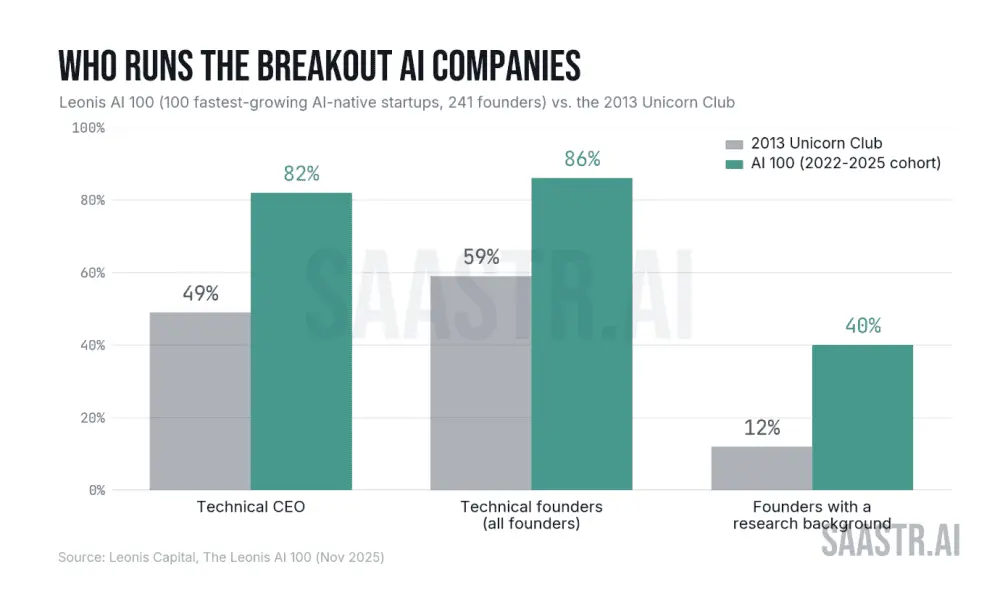
Empirical data compiled by venture firms such as Leonis Capital—which indexed more than 10,000 AI startups between 2022 and 2025—quantifies this massive generational shift.
1. The Domination of the Technical CEO
Across the 100 fastest-growing AI-native companies:
- 82 out of 100 are led by a technical CEO.
- 208 out of 241 founders (86%) possess a technical background.
This represents a staggering departure from Aileen Lee’s original Unicorn Club cohort from the previous decade, where only 49% of companies had a technical CEO and 59% of founders were technical. Furthermore, research pedigree has exploded. Forty percent (40%) of AI 100 founders boast a formal research background—ranging from Berkeley PhDs and OpenAI/DeepMind alumni to Olympiad medalists—compared to just 12% in the historic Unicorn Club. Over 58% of these modern companies feature at least one co-founder hailing directly from advanced research labs.
2. Youth and Velocity
These founders are also significantly younger. The median age at founding in the AI cohort is 29, compared to 34 in the previous cycle, with the single most common founding ages being 26 and 27. Rather than spending a decade climbing the corporate ladder of a legacy software vendor, these founders transitioned straight from university and corporate labs into building companies.
3. The Pivot Speed Advantage: 12 Months vs. 27 Months
The most crucial advantage of a technical CEO is not raw intelligence, but operational agility and pivot speed.
- Two-thirds of the AI 100 pivoted at least once, compared to 54% of the Unicorn Club.
- Researcher-led teams executed pivots in a median of 12 months, compared to 18 months for non-researcher teams.
- Companies led by technical CEOs executed pivots in 12 months, while companies led by non-technical CEOs took 27 months—more than twice as long.
In a hyper-accelerated market where underlying model capabilities leap forward every few months and entire product categories emerge and dissolve overnight, a 15-month lag is fatal. A non-technical CEO must commission studies, rely on second-hand interpretations, or wait for market feedback to understand a paradigm shift. A technical CEO can read a model release, evaluate weights, and re-architect the product stack within hours. Cursor’s founders, for instance, were building AI CAD software for mechanical engineers when they gained early access to GPT-4. Recognizing its extraordinary coding capabilities within minutes, they instantly abandoned months of work and pivoted the entire company into a coding assistant.
Official Statements and Industry Case Studies
Databricks vs. Snowflake: Two Divergent Paths
The contrast in leadership philosophy is starkly illustrated by the parallel journeys of Databricks and Snowflake. In January 2016, Databricks was floundering. Having raised approximately $174 million at a roughly $1 billion valuation, the company had generated almost no revenue, while AWS and Cloudera were aggressively absorbing Apache Spark into their own ecosystems. Founding CEO Ion Stoica agreed to step down and return to his Berkeley professorship.
The conventional Silicon Valley playbook demanded a seasoned, aggressive operator. Instead, the co-founders pushed for Ali Ghodsi, then the VP of Engineering—a career academic who had never run a business. Ben Horowitz, an early venture capital backer and board member at Andreessen Horowitz, initially balked at the idea, famously questioning the wisdom of swapping one founder-professor for another. The board compromised on a one-year trial.
That trial yielded one of the most successful leadership tenures in software history. Horowitz has since called Ghodsi the finest CEO across the hundreds of companies in the a16z portfolio. By August 2026, Databricks announced a massive $5 billion funding round at a staggering $190 billion valuation, growing at over 80% year-over-year with more than 1,000 customers spending over $1 million annually. Ghodsi has steadfastly declined to take the company public, maintaining a relentless focus on product and engineering velocity. While Snowflake built an exceptional business via the traditional operator playbook, the company that kept the professor ultimately grew to be significantly larger and faster.
The Engineering-Led Turnaround at Snowflake
Ironically, Snowflake’s own history provides further nuance. On February 28, 2024, Snowflake announced that Frank Slootman was retiring and Sridhar Ramaswamy was taking over. The market panicked; the stock dropped 20% in a single day, wiping out $15 billion in market value. Wall Street’s assumption was straightforward: the commercial operator who knew how to sell was leaving.
Ramaswamy is a computer scientist who previously scaled Google’s advertising business from $1.6 billion to over $100 billion and founded Neeva, an AI search startup acquired by Snowflake. Rather than letting the sales machine atrophy, Ramaswamy spent his first two years treating the sales organization as an engineering problem. He methodically rebuilt Snowflake’s sales apparatus into an AI-native go-to-market engine.
The results shattered market skepticism. Snowflake’s subsequent earnings reports demonstrated record-shattering sequential dollar growth, net revenue retention climbing to 126%, remaining performance obligations hitting $9.77 billion (up 42%), and product revenue guidance raised to $5.84 billion. The stock surged in response, proving that an engineer-CEO is fully capable of driving commercial excellence when they treat distribution with the same systematic rigor as code.
The Commercial Counterexample: Bill McDermott at ServiceNow
To maintain investigative balance, one must examine the counterexample where the traditional sales-guy CEO continues to put up elite numbers. Bill McDermott’s resume is a masterclass in enterprise sales: owning a deli at 16, spending 17 years at Xerox rising to President of the U.S. Major Account Organization, serving as president of Gartner, running worldwide sales operations at Siebel, and spending 17 years at SAP as sole CEO.
Under McDermott’s leadership, ServiceNow’s Q2 2026 results were extraordinary: subscription revenue reached $3.877 billion (up 24.5% year-over-year), cRPO hit $13.20 billion (up 21%), operating margins expanded to 29.5%, and AI annual contract value crossed the $1 billion threshold. McDermott delivered the quintessential "Rule of 56" quarter.
Yet, despite these phenomenal metrics, ServiceNow’s stock faced downward pressure, reflecting a fundamental shift in market sentiment. The traditional playbook of taking a good product and multiplying it through brute-force distribution still works, but investors have recalibrated what they are willing to pay for that outcome. The market has shifted its underwriting from the distribution multiplier to the intrinsic defensibility of the product being multiplied.
Future Outlook: The Hybrid Future of Enterprise Leadership
The death of the sales-machine CEO has been greatly exaggerated, but its monopoly on the corner office has ended permanently. Every fast-growing AI and B2B software company eventually builds a massive sales organization—they simply build it later, and the person running it reports to the technical CEO rather than occupying the top seat.
- Anthropic scaled its startup sales team from fewer than 10 to over 150 sellers in 18 months.
- OpenAI expanded its go-to-market organization from 50 personnel to upwards of 700 within the same timeframe.
- Replit anticipates that over half of its headcount will comprise sales professionals as it matures.
Strategic Takeaways for Industry Stakeholders
- For Founders: If you are deciding whether to hand over the operational reins of your company, remember the 12-versus-27-month pivot gap. Bringing in a legacy commercial operator widens the gap between raw technological shifts and executive comprehension. If you cannot personally evaluate a model release or architecture shift, you must empower a technical co-founder to retain ultimate product and strategic direction.
- For Boards of Directors: Leadership transitions at Databricks and Snowflake prove that promoting leaders who deeply understand the underlying technology—while demanding accountability for commercial execution—yields superior long-term results. Technical pedigree does not excuse a CEO from financial performance, but commercial pedigree can no longer compensate for a lack of product intuition.
- For Sales Leaders: The modern CRO or President role remains monumental, but the mandate has evolved. The CEO you report to will be someone capable of reading a model card and dissecting system architecture. If your ambition is to sit in the CEO chair, follow the true path walked by pioneers like Slootman and Benioff rather than the commercial myth: spend years owning a product line, mastering engineering coordination, and understanding the core mechanics of creation before attempting to scale distribution.
Ultimately, the market has reached a fascinating convergence. Even Frank Slootman is not fighting this structural transition—he is actively investing in it as an angel investor in Fireworks AI, a company founded by the former head of PyTorch at Meta. The era of the pure commercial operator parachuting in to save a product is fading. The future belongs to technical architects who treat go-to-market strategy with the precision of code, proving that the best way to scale a software empire is to build a product the market demands before a sales machine even begins to spin.