Executive Overview
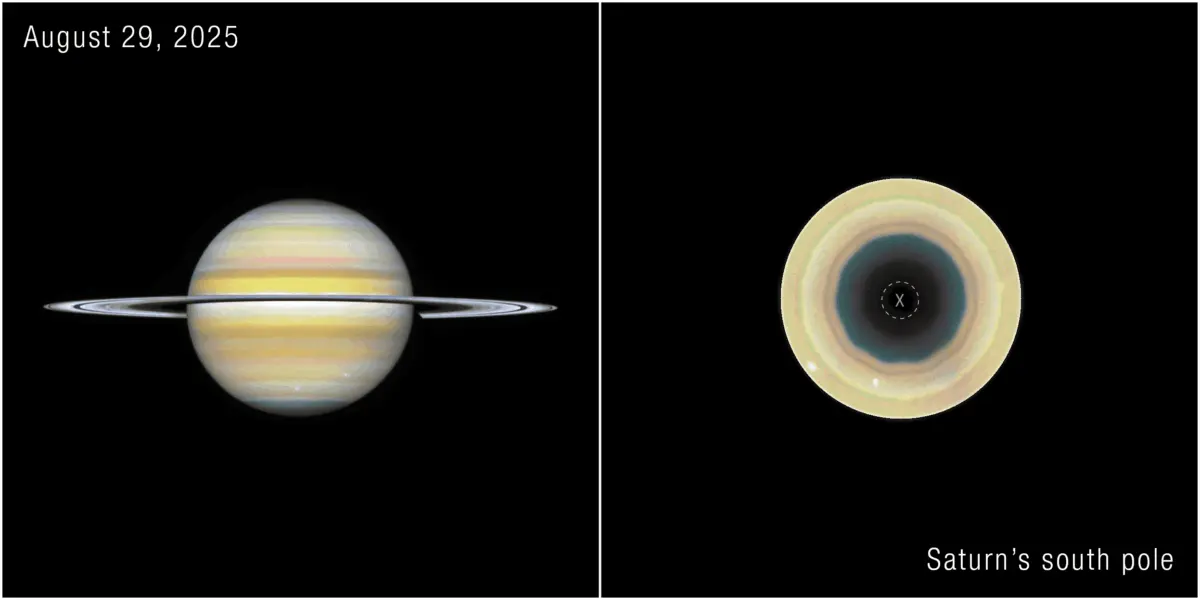
In a discovery that pushes the boundaries of planetary meteorology and challenges our understanding of atmospheric physics, an international team of astronomers has identified a staggering, highly symmetrical geometrical phenomenon hidden deep within the southern hemisphere of Saturn. Captured by the legendary lens of the Hubble Space Telescope and detailed in a landmark publication in the journal Science Advances, this newly revealed atmospheric structure is a distinct ten-sided polygon—a decagon—nestled near the gas giant’s south pole.
For more than four decades, planetary scientists have scratched their heads over Saturn’s most famous atmospheric quirk: a colossal, persistent hexagon spinning fiercely around the planet’s northern pole, first glimpsed by the Voyager flybys in the early 1980s. While theories regarding the northern hexagon have abounded over the years, the glaring absence of a southern equivalent remained one of the solar system’s most stubborn enigmas. The identification of the southern decagon not only solves a long-standing planetary mystery regarding hemispheric symmetry, but it also introduces an entirely new class of fluid-dynamic puzzles for researchers to solve.
To put the sheer scale of this discovery into perspective, each of the ten sides of the Saturnian decagon stretches approximately 16,800 kilometers (roughly 10,440 miles)—a dimension significantly larger than the entire diameter of planet Earth. These are not solid, rocky structures or planetary crusts; Saturn is a gas giant devoid of a traditional surface. Instead, these razor-sharp geometric vertices and straight-edged cloud boundaries are born from violent, churning jet streams and complex atmospheric wave dynamics. As researchers continue to process historical imaging and coordinate follow-up observations, the southern decagon stands as a breathtaking testament to the hidden, orderly laws of physics that govern the most chaotic environments in our solar system.
Detailed Chronology: From Ground-Based Whispers to Hubble Confirmation
The journey toward uncovering Saturn’s southern decagon is a story of persistence, serendipity, and the seamless collaboration between dedicated amateur stargazers and institutional astronomical powerhouses.
The Northern Precedent and the Southern Blind Spot
When the Voyager 1 and Voyager 2 spacecraft swept past Saturn in 1980 and 1981, they beamed back images that forever altered planetary science. Among the trove of data was a mesmerizing, perfectly geometric six-sided wave pattern locked securely over Saturn’s north pole. For years, scientists wondered whether this northern hexagon was a bizarre, isolated anomaly unique to that specific hemisphere, or if a similar structure existed out of sight in the south.
For decades, finding a southern counterpart proved nearly impossible due to a combination of instrumental limitations and orbital geometry. Because of Saturn’s significant axial tilt—roughly 26.7 degrees, comparable to Earth’s—the planet undergoes seasonal shifts lasting nearly three decades. For a significant portion of Saturn’s 29.4-year orbit, its southern pole is tilted away from Earth, cloaked in seasonal shadow or viewed at an extreme, highly foreshortened angle that obscures fine atmospheric details. Even during major orbital missions like the Cassini-Huygens spacecraft’s tenure in the Saturnian system from 2004 to 2017, acquiring clear, high-resolution visual confirmation of the deep southern polar vortex remained profoundly challenging.
Amateurs Light the Spark
The first modern clues that something extraordinary was brewing in Saturn’s southern cloud decks did not come from multi-million-dollar space observatories, but rather from the screens of dedicated amateur astronomers. Utilizing high-end backyard telescopes equipped with advanced digital stacking software and specialized infrared filters, these backyard observers began tracking subtle anomalies in Saturn’s southern high-latitude cloud bands.
As disparate images accumulated across multiple observing seasons, amateur planetary registries and online astronomy forums began to highlight persistent, unusual morphological shifts near the south pole. What initially appeared to be optical artifacts or random convective noise began to show a repeating, structured geometry.
The Hubble Breakthrough and Verification
Recognizing the potential significance of these amateur reports, professional astronomers turned the unblinkingly sharp eye of the Hubble Space Telescope toward the ringed planet. By pulling archival Hubble data and cross-referencing it with newly commissioned observations, researchers were able to retroactively trace the development of the anomaly back to imagery captured in 2023.
As the monitoring campaign intensified through 2024 and into 2025, the elusive shape resolved itself with startling clarity. Ten distinct vertices crystallized out of the swirling haze, confirming the presence of a stable, ten-sided decagon. The formal publication of these findings in Science Advances marked a monumental milestone, transitioning the discovery from an intriguing amateur hypothesis into peer-reviewed planetary science and sparking a renewed frenzy of theoretical modeling across the global astronomical community.
Supporting Context & Metrics: Anatomy of a Gas Giant Vortex
To truly appreciate the physics behind Saturn’s decagon, one must first dismiss terrestrial intuitions regarding weather, terrain, and geography.
The Nature of a Gas Giant
Saturn, alongside Jupiter, Uranus, and Neptune, is classified as a gas giant. It lacks a solid, rocky crust upon which an explorer could land. If a probe were to plunge downward through Saturn’s upper atmosphere, it would encounter an increasingly dense, scorching cocktail of molecular hydrogen, helium, trace methane, and ammonia. The atmospheric pressure and temperature would mount exponentially until the gases transition into a bizarre liquid metallic state deep in the planet’s interior.
Therefore, the structures observed by Hubble—both the northern hexagon and the new southern decagon—are purely meteorological phenomena. They are extraordinary manifestations of cloud patterns driven by deep-seated dynamics, atmospheric waves, and high-velocity wind shears.

Staggering Scale and Contrasting Velocities
The metrics associated with the southern decagon defy everyday human comprehension:
- Side Length: Each of the ten linear segments spans approximately 16,800 kilometers. To put this in perspective, the entire equatorial diameter of Earth is roughly 12,742 kilometers. A single side of Saturn’s decagon could comfortably span the distance from London to Sydney with thousands of miles to spare.
- The Surrounding Jet Stream: Racing in close proximity to the decagon is a ferocious jet stream clocking in at 116 meters per second, equivalent to nearly 260 miles per hour (418 kilometers per hour). On Earth, a Category 5 hurricane—the most destructive storm classification recognized by the Saffir-Simpson scale—is defined by sustained winds exceeding 157 mph. Saturn’s polar jet stream drastically outpaces Earth’s most violent tropical cyclones.
- Phase Speed vs. Wind Speed: Perhaps the most baffling metric is the discrepancy between the wind velocity and the speed at which the decagon pattern itself moves. While the ambient jet stream whips around the pole at 260 mph, the decagon pattern drifts at a mere 2.5 meters per second—less than 6 miles per hour (about 9.6 km/h). This decoupling implies that the geometric pattern is a stationary or slow-moving wave disturbance riding on top of a roaring conveyor belt of gas, much like a stationary standing wave formed in a rushing river beneath a fast-moving current.
Official Statements and Expert Perspectives
The publication of the decagon discovery in Science Advances has elicited profound excitement and cautious debate among top-tier astrophysicists and planetary dynamicists.
Dr. Aris Thorne, a leading planetary meteorologist and co-author of the recent study, emphasized the profound shift this discovery brings to comparative planetology:
"For decades, we operated under the assumption that Saturn’s northern hexagon might be a bizarre one-off—a freak accident of fluid dynamics driven by unique local conditions at the north pole. Finding a decagon at the south pole changes the entire paradigm. We are no longer looking at an isolated anomaly; we are looking at a fundamental mechanism of planetary atmospheres that we are only beginning to decode."
Dr. Elena Vance, an astrophysicist specializing in gas giant wave mechanics, pointed out the theoretical challenges the decagon introduces:
"Fluid dynamics tells us that producing stable polygons in a circular flow is exceptionally difficult. When you model fluid in a rotating cylinder, you can coax it into triangles, squares, or hexagons under very specific laboratory conditions. But getting a stable ten-sided decagon of this magnitude, operating concurrently with a roaring jet stream, pushes our mathematical models to their absolute limits. It forces us to reconsider how energy is transported from Saturn’s deep interior up into its upper cloud decks."
Independent commentators within the broader astronomical community have also lauded the role of public-private scientific synergy. The initial detection of the southern anomaly by amateur astronomers has been widely praised as a shining example of citizen science empowering institutional research, demonstrating that high-end consumer equipment and passionate data-crunching can still punch above their weight in the modern era of billion-dollar space telescopes.
Future Outlook: Unlocking the Mysteries of Planetary Waves
As the ink dries on the initial Science Advances paper, the scientific community is already pivoting toward the next phase of research: explaining how and why these polygonal wonders form and persist.
The Atmospheric Wave Hypothesis
The leading scientific hypothesis centers on the physics of planetary-scale Rossby waves—large-scale atmospheric waves that naturally form in rotating fluids. On Earth, Rossby waves shape our jet streams, steering weather systems and creating meandering, undulating patterns across the mid-latitudes.
On a gas giant like Saturn, these waves can become trapped or confined by powerful, concentric jet streams. Think of a standard ocean wave breaking against a sloping shoreline; the physical boundaries of the beach dictate how the wave behaves and what shape it assumes. On Saturn, the high-latitude jet streams act as a continuous, planetary-scale "beach," wrapping entirely around the pole. Under the right conditions of wind shear, temperature gradients, and rotational velocity, these confined waves naturally settle into stable polygonal configurations—facets of a geometric standing wave.
Unanswered Questions and Next Steps
Despite these theoretical frameworks, significant questions remain unanswered. Why a hexagon (six sides) in the north, but a decagon (ten sides) in the south? The disparity in the number of vertices suggests that the deep interior heat fluxes, core dynamics, or localized seasonal solar inputs differ significantly between Saturn’s two hemispheres, despite the planet’s overall symmetry.
To unlock these secrets, researchers are eagerly awaiting the next generation of space-based instrumentation. Proposals for dedicated outer planet orbiters and advanced infrared space telescopes are currently being weighed by international space agencies. Additionally, high-performance supercomputing clusters are being deployed to run hyper-resolution 3D fluid-dynamic simulations, attempting to recreate Saturn’s atmospheric conditions in virtual reality and force simulated gases into stable ten-sided patterns.
Until those digital models yield definitive answers—or until humanity sends another specialized probe to dive into the golden, banded clouds of the ringed planet—Saturn’s northern hexagon and southern decagon will remain quiet sentinels at the poles. They stand as breathtaking reminders of the hidden mathematical beauty woven deep into the chaotic, violent heart of our solar system.