Executive Overview
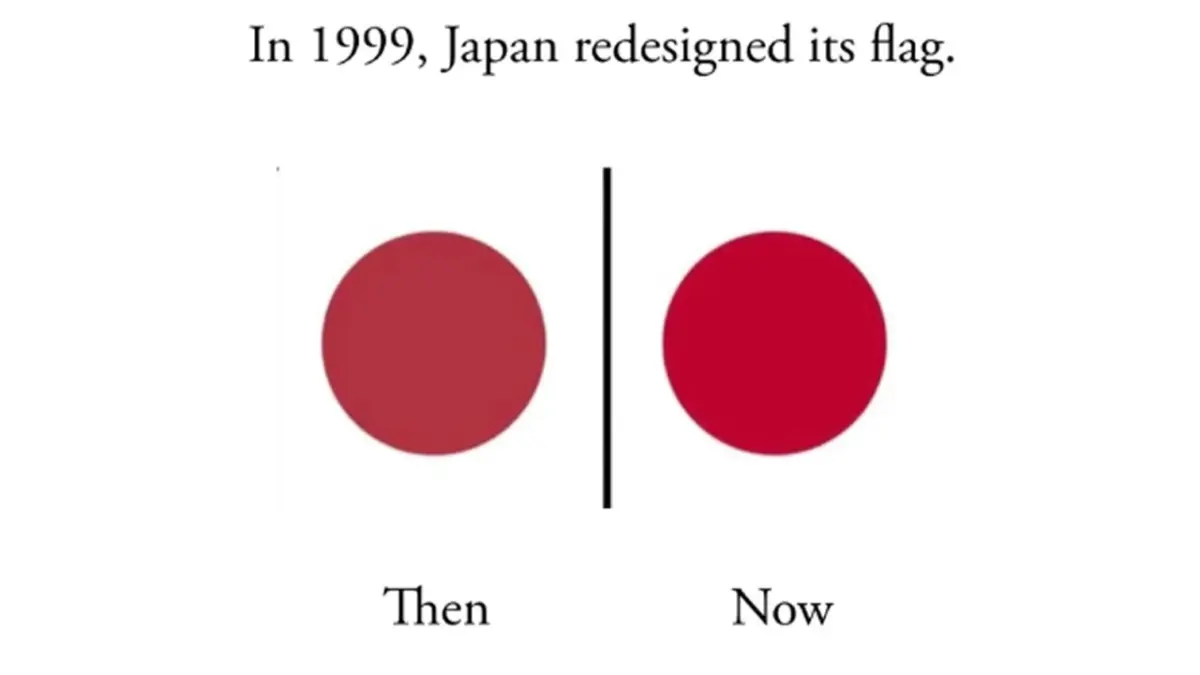
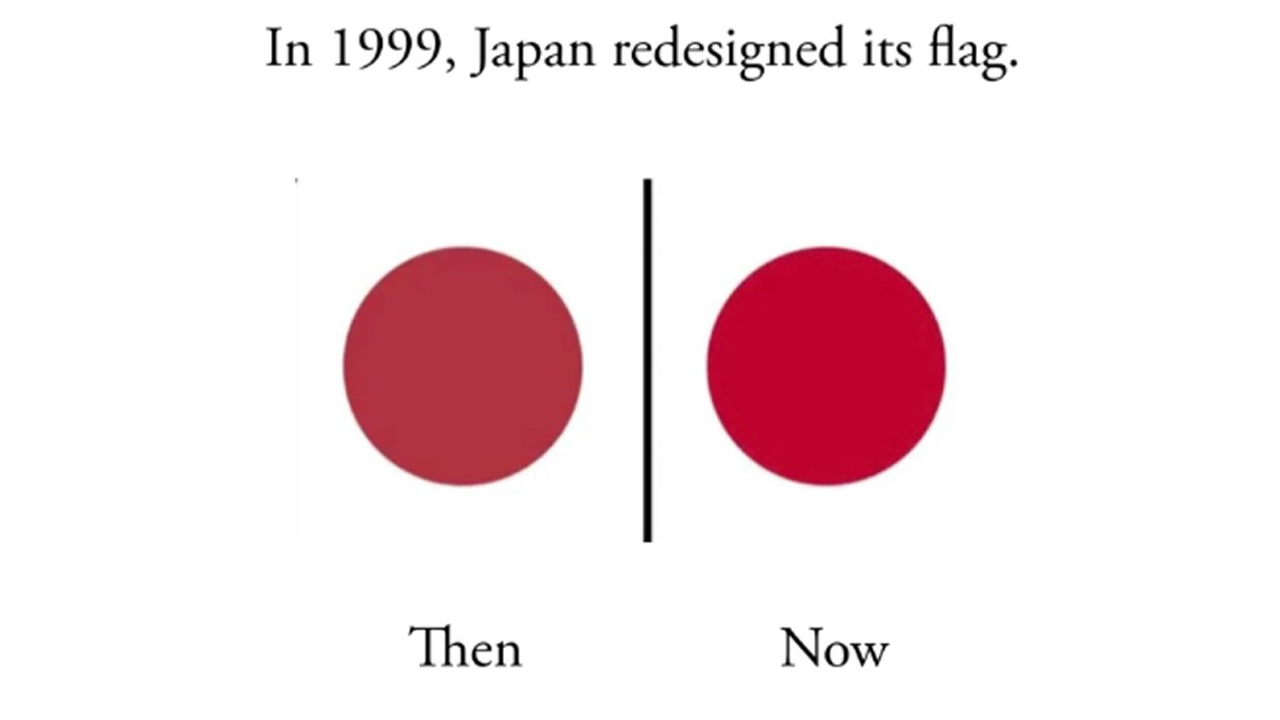
In the sprawling ecosystem of internet humor, few visual formats capture the essence of microscopic, negligible change quite like the “In 1999, Japan Redesigned Its Flag” meme. Functioning as a potent comparative reaction image, this format juxtaposes Japan’s historic national flag—the Nisshōki or Hinomaru (Circle of the Sun)—from its 1870 iteration with the modern version officially codified in 1999. To the untrained eye, the two designs are visually identical, save for a subtle shift from a muted crimson to a vibrant, brilliant red and a minor adjustment in the disc’s precise geometric centering.
Since emerging in the late 2010s, this macro has transformed into a ubiquitous satirical tool across platforms like Reddit, Imgur, and X (formerly Twitter). Netizens deploy the format to lampoon corporate "rebrandings," superficial personal transformations, and redundant updates pushed by major technology companies. Far from merely poking fun at a piece of vexillological trivia, the meme serves as a sophisticated psychological and cultural commentary on corporate tokenism, bureaucratic redundancy, and the absurdity of marketing hyperbole. This report provides an exhaustive investigation into the origins, technical context, digital spread, and cultural resonance of one of the internet’s most enduring comparative humor templates.
Detailed Chronology: From Vexillological Legislation to Digital Satire
To understand why the 1999 Japanese flag redesign became a prime target for internet mockery, one must first explore the historical reality behind the legislation.
1870–1999: The Genesis of the Hinomaru
Japan’s iconic red circle on a white field has deep historical roots, traditionally associated with the samurai and imperial lineage. However, it was formally codified as a national symbol during the Meiji Restoration. In 1870, the Daijō-kan (Prime Minister’s Office) issued Proclamation No. 57, establishing the flag for merchant vessels. The design featured a 7:10 aspect ratio with the red sun disc offset slightly toward the hoist (the side attached to the flagstaff) by one percent of the flag’s length. While widely recognized as the national flag thereafter, it lacked formal statutory backing as the absolute national flag and anthem for decades following World War II.
1999: The Law Regarding the National Flag and Anthem
The turning point occurred on August 13, 1999, when the Japanese Diet passed the Law Regarding the National Flag and National Anthem (Kokki Kokka-hō). Prompted by shifting societal norms and a desire to legally cement national symbols following post-war disputes, the legislation standardized the design specifications.
Under the 1999 law, the proportions of the flag were formally altered to a strict 2:3 ratio. Crucially, the red sun disc—which previously leaned toward the left—was shifted precisely to the geometric center. Furthermore, the official shade of red was transitioned from a darker, more subdued crimson to a brighter, more vivid hue. To the government, these changes represented modernization, legal clarity, and institutional precision. To internet users decades later, however, the monumental bureaucratic effort required to shift a dot by a fraction of a millimeter and brighten the paint by a few shades became the ultimate punchline.
2018–Present: The Rise of the Meme
The conceptual leap from vexillological trivia to viral meme occurred in early 2018. On February 6, 2018, Imgur user Steezyskreezy published the earliest known iteration of the format. Pairing the side-by-side flag comparison with the caption, "When I tell my girl I’ll change for her," the post laid the structural foundation for the meme.
Though modest in its initial reach, the template acted as a cultural catalyst. By the turn of the decade, the format had broken containment, migrating to Reddit communities such as r/2meirl4meirl, r/memes, and niche hobby spaces like r/formuladank. Users began pairing the image with text macros mocking personal stagnation, corporate laziness, and trivial updates disguised as major innovations.
Supporting Context & Metrics: Analyzing Viral Adoption
The virality of the "In 1999, Japan Redesigned Its Flag" meme is underpinned by predictable waves of search interest and high-engagement social media amplification. Quantitative metrics from content aggregators illustrate how the format evolved from a niche joke into a mainstream reaction macro.
Engagement Metrics Across Platforms
- r/memes (March 2020): A post by Redditor Groovyaardvark paired the flag comparison with the "No Need to Thank Me" reaction image, attributing the minute change to an overly proud flag designer. The post accumulated over 41,000 upvotes.
- r/memes (September 2020): Redditor Sh3dinja utilized the format alongside the "It Ain’t Much, But It’s Honest Work" macro, generating over 55,000 upvotes—cementing the meme’s status as a top-tier Reddit template.
- Niche Communities (2022–2024): The format successfully breached specialized subcultures. In February 2022, r/formuladank users applied the template to mock the Haas F1 Team’s nearly identical car liveries across consecutive seasons. Similarly, in October 2024, a user on r/memes juxtaposed the flag against a press release from Google Design announcing a "refreshed" YouTube color palette featuring a "softer shade of red."
Comparative Analysis of Derivative Formats
The template belongs to a broader lineage of internet humor dedicated to mocking imperceptible changes. Psychologically, it functions similarly to the Greg Heffley Yearbook Photo comparison or the "Corporate Needs You to Find the Differences" (The Office) template. However, the Japanese flag meme holds a unique satirical edge: unlike fictional characters or corporate stock photos, it represents a real-world, highly official government action, heightening the absurdity of the comparison.
Official Statements and Institutional Perspectives
While the meme operates entirely within the realm of digital satire, the real-world actors involved—from government bodies to corporate design teams—provide an unintentional backdrop of solemn seriousness that amplifies the comedy.
The Bureaucratic Viewpoint
During the 1999 parliamentary debates surrounding the Law Regarding the National Flag and National Anthem, Japanese lawmakers and cultural preservationists emphasized the necessity of legal codification. Proponents argued that defining precise dimensions and color coordinates was essential for official state functions, international diplomacy, and educational continuity. From the perspective of the Japanese government, the adjustments were never marketed as a radical aesthetic reinvention, but rather as a technical standardization.
The Internet’s Counter-Narrative
Conversely, the internet community strips away the bureaucratic nuance, treating the legislation as a masterclass in over-engineering. Internet commentators frequently weaponize the meme to satirize:
- Corporate Rebranding: Organizations that spend millions of dollars on design agencies only to alter their logo’s font weight by a single point or adjust a hex code by two digits.
- Personal Accountability: Individuals promising sweeping life changes while retaining their exact behavioral patterns.
- Software Updates: Tech giants pushing massive updates that change nothing except the placement of a menu icon or the saturation of a loading screen.
By juxtaposing solemn national legislation with mundane human behavior, the meme creates a comedic dissonance that resonates deeply with modern digital audiences.
Future Outlook: The Longevity of Minimalist Satire
As internet humor increasingly favors surrealism, meta-commentary, and highly adaptable template structures, the "In 1999, Japan Redesigned Its Flag" meme is positioned for sustained longevity.
Unlike fast-burning TikTok trends tied to transient audio clips or fleeting pop-culture moments, structural comparison formats possess infinite modularity. As long as corporations continue to announce superficial rebrandings, politicians promise negligible policy shifts, and individuals vow to "turn over a new leaf" without altering their habits, this historical footnote-turned-meme will remain a vital tool in the digital satirist’s arsenal.
Ultimately, the meme transcends its origins as a joke about vexillology. It has evolved into a cultural shorthand for skepticism toward empty promises of change—proving that sometimes, no matter how much time passes, the more things change, the more they stay the exact same shade of red.