Published: February 7, 2018
Author: Rachel Leah (Adapted and Expanded)
Executive Overview
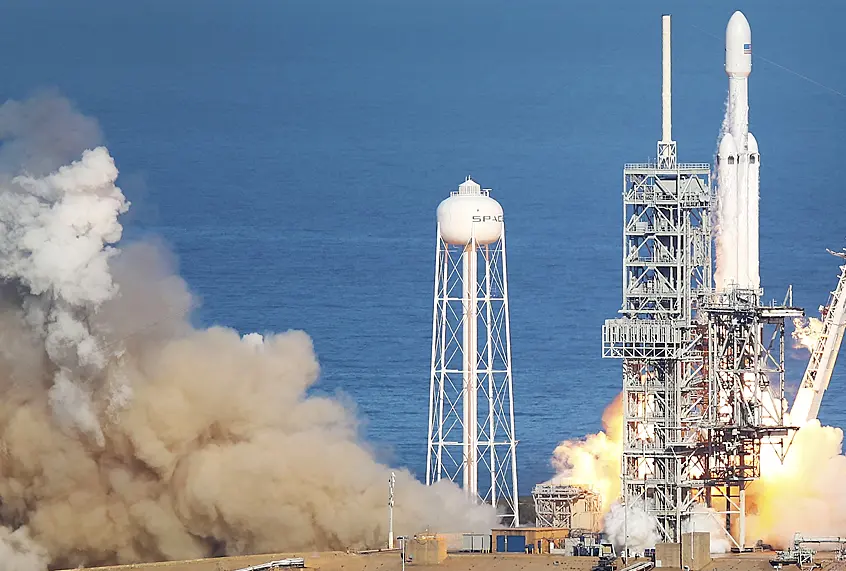
On February 6, 2018, private aerospace manufacturer SpaceX achieved a monumental engineering triumph by successfully launching its Falcon Heavy rocket from historic Launch Pad 39A at the Kennedy Space Center in Florida. Beyond the sheer power of the launch—which successfully propelled Elon Musk’s personal cherry-red Tesla Roadster into an elliptical heliocentric orbit—the event provided unprecedented, crystal-clear high-definition visual documentation of our planet from space.
As the rocket pierced through the stratosphere, live-streamed footage beamed back breathtaking views of the Earth’s unmistakable curvature set against the infinite black vacuum of space. Simultaneously, in a unprecedented display of reusable rocket technology, two of the Falcon Heavy’s three primary booster stages executed synchronized, propulsive retro-burns to touch down safely back on terra firma at Cape Canaveral.
Yet, even as the global scientific community and millions of digital spectators celebrated a new era of commercial space exploration, the striking footage instantly triggered a different kind of cultural phenomenon online. Across social media platforms like Twitter, amused and bewildered internet users posed a tongue-in-cheek question: Could this finally be the definitive proof that shuts down the flat-Earth community once and for all?
This article explores the details of the Falcon Heavy mission, the technical parameters of the launch, the cultural reactions across digital networks, and the psychological mechanisms that ensure fringe pseudoscientific beliefs like the flat-Earth theory will almost certainly survive even the most conclusive empirical evidence.
Detailed Chronology: A Day That Reshaped Commercial Spaceflight
The Buildup to Launch Pad 39A
For years leading up to February 2018, the aerospace industry watched with bated breath as SpaceX promised the debut of the Falcon Heavy—a heavy-lift launch vehicle designed to combine three Falcon 9 first-stage cores into a single, titanic powerhouse generating more than 5 million pounds of thrust at liftoff. Delays, technical hurdles, and shifting deadlines had plagued the development timeline, leading skeptics to question whether the rocket would ever fly.
On the morning of February 6, those doubts were systematically dismantled. Situated at Kennedy Space Center’s historic Launch Pad 39A—the same staging ground that once launched Apollo missions to the Moon and the Space Shuttle fleet into low-Earth orbit—the Falcon Heavy stood as a physical testament to the evolution of private-sector aerospace engineering.
Liftoff and the Ascent
At precisely 3:45 PM EST, the engines ignited. The sheer magnitude of 27 Merlin engines firing in unison sent low-frequency acoustic shockwaves rolling across the Florida coastline. Millions of viewers tuned in via SpaceX’s official webcasts and global broadcast streams to watch the vehicle slice upward through the troposphere.
As the rocket accelerated past Max-Q (the point of maximum aerodynamic pressure) and staged successfully, the mission profile entered its most visually iconic phase. Encased within the payload fairing was Elon Musk’s personal Tesla Roadster, outfitted with a mannequin space-suited driver affectionately dubbed "Starman." Upon reaching orbit, the fairing peeled away, exposing the vehicle to the unfiltered sunlight of space.
The Historic Double Booster Landing
While the core booster was lost during its attempted ocean landing due to a lack of igniter fluid, the two side boosters—having separated earlier in the sequence—flipped orientation, re-ignited their engines, and executed a synchronized, pinpoint landing at Landing Zones 1 and 2 at Cape Canaveral Air Force Station. The twin sonic booms echoing across Florida served as a dual exclamation point to a flawless flight profile, demonstrating that multi-core heavy-lift rocket components could be successfully recovered and reused.
Supporting Context & Metrics: The Science of Earth’s Curvature and the Falcon Heavy Specs
To understand why the live footage caused such a stir regarding global geography, it helps to examine the raw engineering metrics of the Falcon Heavy mission alongside the scientific consensus regarding planetary geometry.
Falcon Heavy Specifications
- Height: 70 meters (230 feet)
- Maximum Thrust at Liftoff: 5.13 million pounds (approx. 22.8 Meganewtons)
- Payload Capacity to Low Earth Orbit (LEO): 63,800 kilograms (140,660 lbs)
- Payload Capacity to Mars: 16,800 kilograms (37,000 lbs)
- First-Stage Engines: 27 Merlin 1D engines configured across three booster cores.
Observing the Curve
At cruising altitudes typical of commercial airliners (roughly 35,000 feet), the human eye perceives only a marginal, easily disputable horizon curvature due to atmospheric haze and limited perspective. However, as the Falcon Heavy accelerated past the upper boundaries of the stratosphere and into the thermosphere—ultimately placing the Tesla Roadster into an orbit ranging from Earth-crossing to the asteroid belt—the vantage point shifted dramatically.
High-definition cameras mounted on the vehicle captured a sweeping, undeniable 180-degree panoramic perspective of an oblate spheroid globe. The blue oceans, swirling cloud patterns, and thin atmospheric halo contrasted sharply against the pitch-black backdrop of the cosmos, providing visual confirmation that has been continuously documented by astronauts, weather satellites, and deep-space probes for over half a century.
Official Statements and Digital Reactions
As soon as the telemetry feeds and video streams were broadcast to the public, social media erupted. SpaceX founder Elon Musk tweeted a video from SpaceX Launch Control with the wry caption: "Apparently, there is a car in orbit around Earth."
View from SpaceX Launch Control. Apparently, there is a car in orbit around Earth. pic.twitter.com/QljN2VnL1O
— Elon Musk (@elonmusk) February 6, 2018
The online community quickly seized on the visual irony of sending an automobile into space to showcase humanity’s technical prowess while simultaneously confronting the internet’s most stubborn subculture.
Selected Social Media Reactions
- Sebastian Bell (@sepsis13): "Suck it Flat Earthers. #Starman"
- Skyler (@thatguysky13): "Look you can see the curvature of the Earth, I bet the flat Earthers are pissssed"
- State of Mind (@StateofMindNZ): "Tough day at the office for flat eathers…"
- Dave Days (@davedays): "Flat earth conspiracy officially debunked… with style @SpaceX #FlatEarth"
- Darin (@darink): "Look at that flat earth" (employing heavy sarcasm alongside snapshot links of the globe).
The overwhelming sentiment among mainstream internet users was one of triumphant finality—a collective belief that cinematic, high-definition, unedited live footage of an object orbiting the globe would finally force proponents of pseudoscientific geography to abandon their claims.
The Psychology of Pseudoscience: Why Flat-Earthers Won’t Budge
Despite the optimism of mainstream internet commentators, sociologists, psychologists, and science communicators immediately recognized a sobering reality: The video would do nothing to change the minds of actual flat-Earth believers.
The Core Tenets of Flat-Earth Belief
Adherents to the flat-Earth model operate under a rigid, insular belief system that directly rejects centuries of established physics, astronomy, and mathematics. They maintain that:
- The Disk Model: The Earth is not a sphere, but a flat disk centered around the North Pole, bounded by an impenetrable wall of Antarctic ice.
- The Illusion of Gravity: Downward force is allegedly caused either by the flat disk accelerating upward through space at a constant rate of $9.8 , textm/s^2$ via dark energy, or by density and buoyancy alone.
- The Grand Conspiracy: Every photograph, video stream, and piece of telemetry data provided by NASA, ESA, SpaceX, and independent space agencies worldwide is dismissed as an elaborate hoax orchestrated by a shadowy international cabal of governments and scientists.
Confirmation Bias and Conspiracy Insulation
According to psychological research into belief perseverance and conspiracy theories, individuals who subscribe to fringe ideologies do not evaluate evidence objectively. Instead, they apply a double standard of proof:
- Concordant Evidence: Any information supporting their worldview is accepted without scrutiny, no matter how flimsy or anecdotal.
- Discordant Evidence: Any information contradicting their worldview—such as high-altitude rocket launches, satellite telemetry, or circumnavigational data—is immediately reinterpreted as CGI (Computer-Generated Imagery), government propaganda, or corporate deception.
Therefore, when presented with crisp, high-definition footage of Earth’s curvature from the Falcon Heavy stream, flat-Earth truthers simply pivoted to claiming the camera lenses were distorted with "fisheye" effects designed to manufacture a false curve, or that the entire broadcast was pre-rendered in a studio.
Future Outlook: The Intersection of Commercial Spaceflight and Information Literacy
The February 2018 Falcon Heavy launch inaugurated a new chapter in human history, proving that heavy-lift rocketry can be commercially viable and rapidly reusable. Over the subsequent years, SpaceX’s Starship development program and the expansion of private space tourism have continued to democratize access to the upper atmosphere and beyond.
Yet, the persistence of flat-Earth advocacy in the face of such monumental achievements highlights a broader, ongoing challenge for modern society: the widening gap between technological advancement and public information literacy.
As high-definition cameras, private space missions, and orbital imagery become increasingly ubiquitous, the debate is no longer about whether we have enough evidence to prove the shape of our world. We have had that evidence for millennia, reinforced by modern satellite networks and deep-space exploration. Rather, the phenomenon of modern conspiracy theories serves as a reminder that human belief systems are profoundly resilient against external facts when identity, community, and distrust of institutional authority are deeply intertwined.
As humanity looks outward toward Mars and deeper into the solar system, the cherry-red Tesla Roadster—still orbiting silently somewhere in the vast expanse of the cosmos—remains both a symbol of our highest engineering aspirations and a silent monument to the enduring quirkiness of human skepticism.