Executive Overview
For enterprise leaders and e-commerce operators, the hype surrounding artificial intelligence customer experience (AI CX) agents has reached a fever pitch. Software vendors routinely promise near-total automation, seamless customer handoffs, and instant resolution of consumer woes. But exactly how many customer support and related issues can AI agents really, truly resolve today when placed in the unforgiving crucible of live, high-volume retail operations?
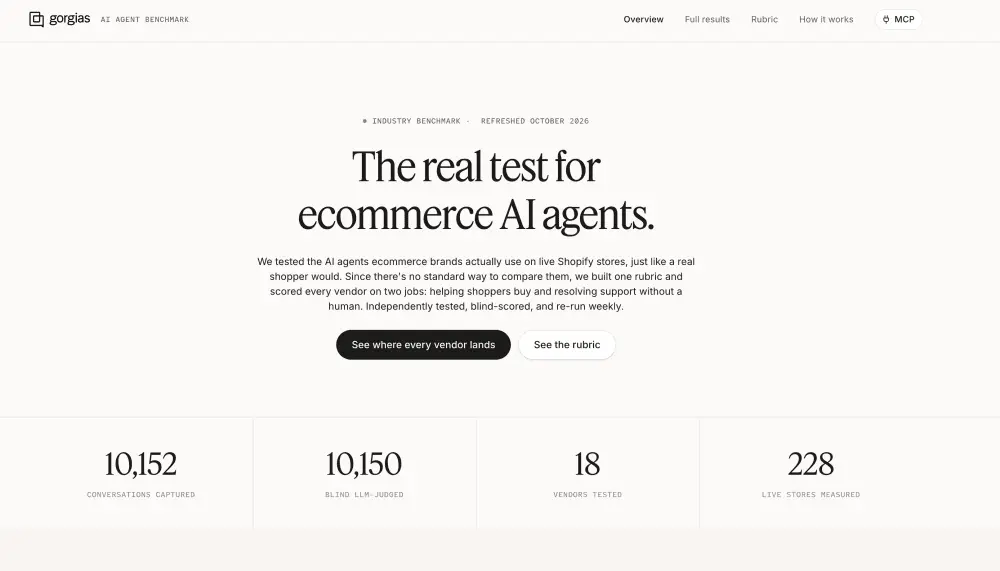
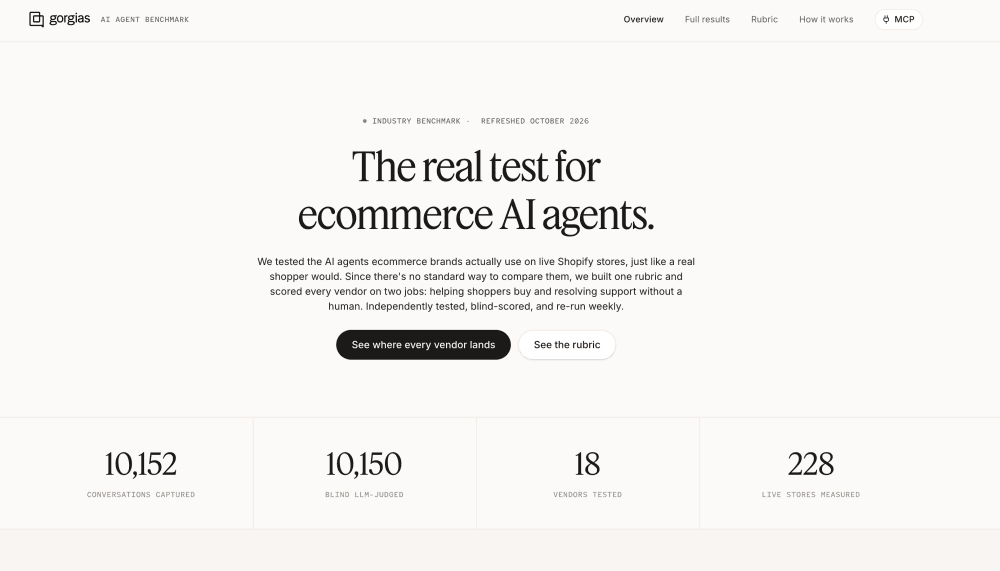
A groundbreaking, transparent evaluation published by Gorgias—a $100M ARR e-commerce customer support leader backed by the SaaStr Fund—seeks to answer this exact question. Stripping away the sterile environments of vendor sandboxes, synthetic catalogs, and carefully curated product demos, the newly released public benchmark puts 13 distinct AI vendors to the ultimate test across 212 live, mid-market e-commerce stores carrying real inventory.
The findings offer a sobering corrective to industry marketing. The absolute best-performing AI agents fully resolve roughly 70% of customer conversations without human intervention. However, the typical vendor on the market resolves fewer than half. Perhaps most surprisingly for legacy platform strategies, the proprietary AI tools bundled directly into major helpdesk and marketing platforms—such as Zendesk, Intercom, and Klaviyo—rank among the weakest options evaluated, failing to cross the 42% resolution threshold.
This deep dive examines the methodology, metrics, and sobering realities unearthed by the benchmark, offering a comprehensive blueprint for e-commerce executives looking to separate marketing fiction from operational fact.
Detailed Chronology: The Evolution of E-Commerce AI Evals
To understand the significance of this benchmark, one must trace the recent history of how AI customer service agents have been marketed, deployed, and ultimately audited.
Phase One: The Sandbox Era
When generative AI models first infiltrated the customer service sector, vendors evaluated their software using controlled, internal sandboxes. These testing grounds featured idealized product catalogs, predictable customer inquiries, and zero real-world friction. Success metrics were defined loosely, often counting any conversation where a customer did not immediately scream for a human as a "deflection" or a "soft resolution." During this period, bold claims of 90% to 95% automation rates became commonplace in pitch decks across Silicon Valley.
Phase Two: The Implementation Gap
As mid-market and enterprise e-commerce brands rushed to deploy these tools, a stark reality gap emerged. Retailers quickly discovered that sandbox performance rarely translated to the chaotic ecosystem of live web stores. Dynamic inventory levels, complex shipping exceptions, multi-item returns, and strict authentication protocols frequently caused AI agents to hallucinate, lock up in clarification loops, or abruptly dump frustrated shoppers onto human agents.
Phase Three: The Rise of Objective, Blind Auditing
Recognizing the market’s desperate need for objective, ground-truth data, Gorgias engineered a radically transparent testing protocol. Rather than relying on self-reported vendor metrics, the benchmark subjects all 13 participating vendors to identical, real-world customer messages across live storefronts.
Under this rigorous framework, a neutral, blind judge evaluates each response against 26 binary checks. Crucially, factual claims—such as specific product pricing, return windows, policy details, and SKU availability—are verified programmatically against the live store database. There is no room for subjective interpretation; an agent is either factually correct and helpful, or it fails.
Supporting Context & Metrics: Breaking Down the Benchmark Data
The data compiled in the report shatters several long-held assumptions about AI readiness, automation rates, and response quality.
Automation Rates: The Top Tier vs. The Median
When looking strictly at automation rate—defined as the share of engaged conversations the AI resolved entirely on its own with zero human involvement over a four-week evaluation window—the stratification is stark:
- The Elite Top Five: Average an impressive 70% automation rate, with top performers ranging between 64% and 75%.
- The Median Vendor: Resolves just 48% of conversations.
- Weighted Industry Average: Sits at 46% when adjusted for conversation volume.
Platforms that brands already pay for out of habit—Zendesk, Intercom, and Klaviyo—underperformed significantly. None of these established ecosystem players managed to resolve more than 42% of live customer queries in the benchmark. For retailers relying on bundled features for convenience, the data suggests they are deploying some of the weakest AI engines on the market.
Balancing Automation with Quality
A high automation rate can easily lead an organization down the wrong path if the quality of the interactions is subpar. To account for this, the benchmark pairs each vendor’s automation rate with a blind quality score ranging from 0 to 100.
The vendor landscape splits into three distinct operational profiles:
- Strong on Both Metrics: Vendors like Yuma, Decagon, and Gorgias strike a rare balance, clearing both 64% automation and 65 in quality score.
- High Automation, Weak Answers: Some platforms close a high volume of tickets, but their accuracy suffers. For instance, Ada resolves a high volume of conversations but scores 27 points lower on answer quality than top-tier rivals.
- Strong Answers, Low Automation: Sierra ties Yuma for the highest quality score on the board, yet manages to resolve fewer than half of its incoming conversations.
The practical business case for weighting quality heavily is straightforward: a ticket incorrectly marked as "resolved" because the agent provided the wrong return window inevitably generates a secondary contact. That second ticket frequently costs more in customer lifetime value and support labor than the initial inquiry. A vendor scoring poorly on quality is essentially manufacturing its own future ticket volume.
The Problem of Regressing Performance
Perhaps the most alarming metric uncovered in the report is temporal: 9 out of 10 vendors actually lost automation ground over the preceding four-week testing period.
Quality metrics followed a similarly downward trajectory, with nine out of ten vendors seeing their scores drop (e.g., Ada dropping 17 points, Zendesk down 15, and Sierra down 14). While the benchmark does not definitively isolate the root cause, contributing factors likely include underlying foundation model updates, store configuration drift, or tightening benchmark questions.
Regardless of the cause, the operational takeaway for buyers is clear: the high-water mark achieved during a vendor’s software pilot is rarely the baseline performance you will experience a month into production. Continuous auditing and scheduled re-testing are mandatory operational overhead for any enterprise deploying AI support.
Official Statements and Methodological Definitions
Much of the friction between vendor marketing claims and independent evaluations comes down to how terms are defined.
Defining "Resolved"
In typical software analytics dashboards, vendors often employ loose definitions. For instance, an interaction might be counted as automated if the AI provides an answer and 72 hours pass without a human agent stepping in. Under this logic, a frustrated customer who simply gave up, abandoned the cart, and never returned is logged as a successful "resolution."
The Gorgias benchmark applies a drastically stricter, zero-tolerance standard: A conversation is only counted as automated if the AI handled it with absolute zero human touch. This means:
- No handover to a human agent.
- No deflection out of the channel (e.g., telling the customer to "email us," fill out a contact form, or "call us").
- If an agent pushes a customer out of the channel, the conversation is marked as unresolved.
Because the auditor never explicitly asks for a human, every single handoff represents an active decision by the AI agent itself. This distinction carries massive financial implications. Because many AI agents—including the Gorgias AI Agent—charge on a per-resolved-conversation unit economic model (e.g., $0.90 per resolved ticket), enterprises must demand precise, contractually binding definitions of billable resolutions before signing vendor agreements.
Topic-Specific Performance Disparities
Support quality also varies wildly depending on the nature of the inquiry. Averaged across the field, the benchmark revealed a staggering 28-point drop between the easiest support categories and the hardest:
- Policy Questions (Highest Resolution): Questions answered directly from static policy pages score highest. The AI simply acts as a retrieval engine.
- System Lookup & Judgment Calls (Lowest Resolution): Questions requiring live database integrations, dynamic lookups, or nuanced judgment score near the bottom.
Crucially, order tracking—typically the single largest ticket category for any e-commerce brand—sits near the bottom of the effectiveness list. Across the board, only about one-third of post-sale tracking conversations reach a successful, autonomous finish. Brands whose ticket volume is dominated by "Where is my order?" (WISMO) queries will find that benchmark averages heavily overstate the automation they will actually experience.
Bottlenecks: Auth Walls and Clarification Loops
The investigation revealed that catastrophic AI hallucinations (making up completely false facts) were relatively rare. Instead, the most common failure modes were structural and behavioral:
- Aggressive authentication walls.
- Endless, repetitive demands for order numbers.
- Clarification loops where the agent gets stuck asking the same question.
- Premature escalation to human staff.
Interestingly, the benchmark noted that the identical underlying AI vendor could score exceptionally well on one store while failing miserably on another. This variance pointed less to inherent model limitations and more to onboarding quality control, store configuration, and prompt engineering. Nearly a third of the active "AI chat" widgets evaluated produced no meaningful conversation at all due to poor implementation.
Future Outlook: Strategic Recommendations for E-Commerce Leaders
As the AI agent market matures, e-commerce brands must adopt a sophisticated, highly skeptical procurement and management strategy. Industry experts and enterprise deployment teams recommend the following actions:
- Build Conservative Financial Models: Base your business case on a realistic 65% to 70% resolution rate—and only when partnering with a top-five vendor. If you rely on the native AI bundled into legacy platforms like Zendesk, Intercom, or Klaviyo, budget for a modest 20% to 42% automation ceiling.
- Evaluate on Automation and Quality Simultaneously: Never select a vendor based on automation volume alone. Demand side-by-side metrics covering both throughput and factual accuracy on standardized test sets.
- Audit Your Unique Ticket Mix: Map your historical customer support tickets against the benchmark’s topic breakdown. If your business is heavily weighted toward complex post-purchase logistics rather than simple FAQ lookups, discount the vendor’s headline metrics accordingly.
- Execute Cold Testing: Do not rely on vendor-supplied reference lists. Take 30 real customer tickets from the previous month, open fresh incognito browser sessions on the vendor’s live reference stores, and test their capabilities firsthand using public grading rubrics.
- Institute Monthly Re-Testing: Because foundation models drift and platform performance degrades over time (as observed in 9 out of 10 tested vendors), treat AI agent maintenance as an ongoing operational cadence rather than a "set-and-forget" deployment.
Final Verdict
The latest benchmark data proves that AI customer service agents are no longer mere science experiments; top-tier systems are fully capable of handling nearly three-quarters of incoming support volume autonomously. However, they are far from the frictionless, 100% replacement tools promised by aggressive marketing departments. By embracing rigorous auditing, prioritizing factual quality over raw deflection metrics, and maintaining realistic expectations, e-commerce brands can successfully harness AI to drive efficiency without sacrificing the customer experience.