Executive Overview
In the high-stakes theater of B2B software and artificial intelligence marketing, a perplexing phenomenon continually unfolds across major industry gatherings like the SaaStr AI Annual and regional European summits. Two companies—offering brutally competitive, functionally identical products at virtually the same price point—can secure adjacent booths on the exhibition floor, invest equivalent capital into sponsorships, and target the exact same pool of 10,000+ C-level executives, founders, and VPs.
Yet, as the conference doors close and the dust settles, the divergence in outcomes is staggering. Company A walks away overwhelmed by a backlog of high-intent leads, subsequently closing upwards of $700,000 to $1,000,000 in new revenue over the ensuing 90 days. Company B, meanwhile, leaves the venue convinced that live events are a dead-end medium, staring at a pipeline yielding virtually zero measurable return.
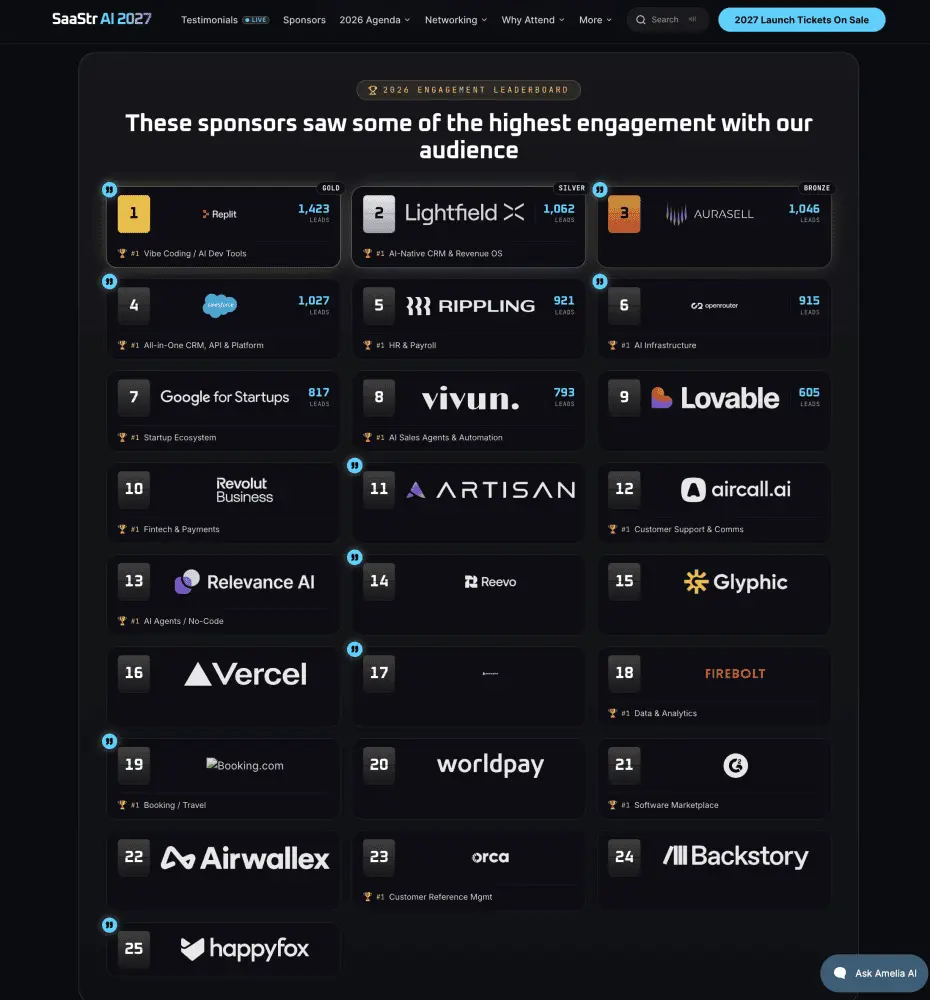
How is this massive disparity possible? According to insights gathered over a decade of operating the SaaStr ecosystem and observing hundreds of enterprise software sponsors—including heavyweights like Google Cloud, Replit, Stripe, and Fin—the answer has little to do with the venue, the audience demographics, or even the underlying software code.
Instead, the catalyst for this marketing divide rests squarely on the shoulders of leadership: specifically, the core competencies, operational instincts, and execution strategies of the Chief Marketing Officer (CMO) or VP of Marketing. Field marketing, trade shows, executive dinners, and experiential activations are undeniably "magical"—but only when deployed by leadership teams that genuinely know how to wield them. This comprehensive report investigates the anatomy of B2B event ROI, the multi-faceted trap of modern marketing generalism, and how executive alignment determines whether your marketing spend drives millions in revenue or vanishes into thin air.
Detailed Chronology: The Evolution of B2B Event ROI and Marketing Specialization
To understand how modern B2B marketing teams arrive at such starkly contrasting outcomes, one must examine how the expectations placed upon marketing leadership have evolved over the past decade.
Phase 1: The Era of the Universal Marketer (Early 2010s)
In the earlier days of cloud computing and the Software-as-a-Service (SaaS) boom, venture-backed startups typically hired a single "VP of Marketing" early in their trajectory. At the time, the expectation was monolithic: this individual was supposed to build the brand, write the copy, manage public relations, set up paid acquisition funnels, oversee SEO, design the website, negotiate sponsorships, and run the company booth at trade shows.
Because tech stacks were less fragmented and customer acquisition costs (CAC) were relatively forgiving, generalist marketers could muddle through various channels without catastrophic failure. However, as the SaaS market saturated and competition intensified exponentially—culminating in today’s hyper-crowded AI landscape—the breadth of channels expanded far beyond the capacity of any single human being to master.
Phase 2: The Proliferation of Specialized Channels (Late 2010s–2020)
As digital advertising grew more expensive and privacy regulations tightened, marketing fragmented into highly technical sub-disciplines. Companies began searching for unicorns who could handle product-led growth (PLG), enterprise account-based marketing (ABM), complex content operations, demand generation, and community building all at once.
Concurrently, physical trade shows and industry conferences experienced a renaissance. Rather than serving as passive billboard spaces, events transformed into high-touch, immersive relationship-building hubs. Sponsors realized that simply paying for logo placement and setting up a pop-up banner yielded dismal results. Success required active pre-show outreach, executive networking orchestration, private dinners, and razor-sharp booth-side qualification. This is when the performance gap between sophisticated field marketers and passive attendees began to widen dramatically.
Phase 3: The Modern AI & B2B Boom (Present Day)
Today, events like the SaaStr AI Annual bring together tens of thousands of elite tech buyers. The noise floor is deafening. In this environment, passive execution is a financial liability. Industry observations consistently reveal a stark polarization among sponsors:
- The High-Performers: Companies with specialized, execution-oriented field and demand-generation leaders treat an event not as a marketing vacation, but as a compressed, high-velocity sales pipeline generator. They orchestrate meetings weeks in advance, dominate social channels around the conference, and ruthlessly capture contact data on-site.
- The Underperformers: Companies whose leadership lacks field marketing expertise treat the booth like an unattended retail counter, waiting for foot traffic to magically convert into qualified enterprise deals.
Supporting Context & Metrics: Decoding the CMO Skillset
The friction between marketing investment and actual revenue generation often boils down to a fundamental misalignment between corporate expectations and executive superpowers. No CMO or VP of Marketing is equally brilliant across all functional domains. Yet, corporate boards and CEOs routinely hand their marketing leaders a job description that spans five to six distinct disciplines, implicitly expecting mastery in every single one.
The Five Pillars of Marketing Responsibility
- Brand & Communications: Crafting the narrative, managing PR, defining visual identity, and building long-term category awareness.
- Field Marketing & Events: Designing immersive physical and digital experiences, trade show presences, executive roundtables, and hospitality dinners.
- Demand Generation & Performance Marketing: Running paid media, outbound campaigns, email sequences, and optimizing bottom-of-funnel conversion rates.
- Content & SEO: Building organic discovery engines, thought leadership programs, whitepapers, podcasts, and educational ecosystems.
- Product Marketing: Positioning releases, enabling the sales team with battle cards, and translating complex technical features into clear value propositions.
The Specialization Dilemma
A brilliant Brand CMO can elevate a company’s market prestige, secure tier-one press, and make an early-stage startup look like an established category leader. However, if that same brand-focused executive is suddenly thrust into running an aggressive, pipeline-driven trade show strategy with aggressive SQL quotas, the results are frequently underwhelming.
Conversely, a hardened Demand Gen or Field Marketing leader will squeeze every drop of ROI out of an event sponsorship, turning handshakes into booked demos within 48 hours—yet they might occasionally struggle to refine the company’s high-level brand messaging or tone of voice.

+-----------------------------------------------------------------------+
|                       THE CMO CAPABILITY SPECTRUM                     |
+---------------------------+-------------------------------------------+
| Primary Competency        | Typical Event / Pipeline Outcome          |
+---------------------------+-------------------------------------------+
| Field & Demand Gen        | Exceptional ROI, high volume of qualified |
| (e.g., Replit, Stripe)    | meetings, rapid post-event revenue close. |
+---------------------------+-------------------------------------------+
| Brand & Content-Focused   | Strong top-of-funnel awareness, polished  |
| (Generalist Approach)     | presence, but lower immediate conversion. |
+---------------------------+-------------------------------------------+
As industry data and observational case studies demonstrate, the companies that walk away from events like SaaStr with $700k+ in fresh pipeline are those whose leadership DNA matches the channel being deployed. If your VP of Marketing’s super-power is content SEO, forcing them to lead a heavy field-marketing roadshow without specialized support is a recipe for mediocracy.
Official Statements & Industry Perspectives
The operational reality of modern tech marketing has prompted candid reflections from industry leaders and ecosystem builders who witness these dynamics firsthand.
Jason Lemkin, founder of SaaStr, addressed the core paradox of event marketing through direct field observations:
"Field marketing like events do work. They are magical. But only if you are great at them. At SaaStr itself, I saw one competitor close $700k in revenue the week after our European event. And a very similar competitor close… $0."
Expanding on the underlying strategic takeaway for executive teams, Lemkin emphasizes that accountability must be anchored in reality rather than wishful thinking:
"The learning is to focus your marketing efforts primarily on what your CMO / VP of Marketing is good at. If you expect him or her to primarily focus on something they are less experienced at, then the best case is that you get mediocre results. They can own the department—hold them accountable for everything, of course, because they are your VP. But the areas they aren’t naturally skilled at shouldn’t be your #1 KPI for them."
Enterprise sponsors who have mastered this balance echo these sentiments. High-growth organizations that extract maximum value from large-scale gatherings do not leave execution to chance. They pair their operational strengths with the specific environment of the venue, ensuring that whether the activation is an intimate 20-person executive dinner or a massive exhibition presence, internal expertise drives every touchpoint.
Future Outlook: The Next Era of B2B Marketing Alignment
Looking toward the remainder of the decade, the tolerance for "spray-and-pray" marketing budgets is shrinking rapidly across the technology sector. As venture capital demands clearer paths to profitability and capital efficiency, CEOs and founders can no longer afford the luxury of mismatched marketing leadership.
1. Shift Toward Hyper-Targeted Specialization
Rather than searching for the mythical "unicorn CMO" who can execute masterfully across brand, performance, product, and field marketing, forward-thinking organizations are structuring their teams around distinct operational strengths. If a company’s primary go-to-market motion relies on high-touch enterprise sales and field events, leadership is hiring specialized field marketing directors who report into a broader marketing umbrella, rather than forcing a content-first CMO to learn trade show logistics on the fly.
2. Redefining Accountability and KPIs
Boards and executive teams are learning to align performance metrics directly with executive pedigree. When a new VP of Marketing is onboarded, their core Key Performance Indicators (KPIs) will mirror their proven historical successes. A demand-generation specialist will be measured heavily on pipeline velocity and CAC payback periods, while a brand visionary will be evaluated on share of voice, category creation milestones, and organic market positioning.
3. The Enduring Power of Experiential Context
Despite the relentless digitization of the B2B buyer’s journey, physical and hybrid events are not losing their potency—they are becoming more polarized. The middle tier of mediocre, generic conference presence is dying out. In its place, elite brands will continue to invest heavily in immersive field marketing, leveraging major hubs like SaaStr AI Annual not merely as passive sponsorship slots, but as highly orchestrated engines for revenue acceleration.
Ultimately, the lesson for executive leadership is clear: marketing success is not a random lottery ticket distributed on the exhibition floor. It is the direct byproduct of matching channel strategy with authentic executive capability. Know what your marketing leader does best, build your primary growth engine around those superpowers, and watch the magical ROI of disciplined marketing execution materialize.