Executive Overview
For decades, the milestone of $100 million in Annual Recurring Revenue (ARR) served as the ultimate threshold of survival and validation for B2B software companies. A decade ago, reaching this zenith meant a company was essentially "un-killable." A robust brand placed you on every enterprise shortlist, a mature multi-year feature roadmap made it nearly impossible for new market entrants to catch up, and predictable renewals from a loyal installed base easily self-funded the development of next-generation products. Competitors might out-raise you in venture capital, but they could never out-ship years of established engineering momentum.
Today, that defensive moat has dried up. In the current enterprise software landscape, the true line of scale has shifted dramatically upward to $1 billion in ARR.
Venture capitalists and market observers recognize this shifting tectonic plate across their portfolios. Companies sitting comfortably at $100 million, $200 million, or even higher in ARR have largely stalled. Net Revenue Retention (NRR) struggles to crack the 100% barrier, and net-new logo acquisition has plummeted close to zero.
Crossing the $1-billion threshold provides the critical mass required to weather the seismic disruptions of the Age of AI. At that scale, a corporation retains the free cash flow necessary to fundamentally rebuild its product architecture around autonomous AI agents, the deeply entrenched enterprise relationships required to sell those reimagined versions, and a sturdy balance sheet capable of acquiring agile AI startups that move faster than internal roadmaps allow. Below $1 billion, companies often possess none of these lifeboats.
Median public SaaS revenue growth has slid from 14.0% in late 2025 to 11.8% mid-year 2026, with Wall Street consensus
pointing toward a further deceleration below 10%. As the public markets heavily penalize stagnant growth while heavily rewarding hyper-growth, sub-$1 billion B2B firms face a grueling existential trial: adapt to the AI era on a shoestring budget or face inevitable consolidation.
Detailed Chronology: The Decline of Mid-Market B2B Growth
To understand how precarious the sub-$1 billion tier has become, one must examine the trajectory of public SaaS metrics over recent quarters.
- Late 2025: Median public SaaS revenue growth hovered at a modest 14.0%. Even then, industry leaders noted underlying sluggishness in net-new customer acquisition as corporate buyers began diverting discretionary IT budgets toward generative AI experimentation.
- Early to Mid-2026: Growth figures continued their downward slope, touching 11.8% by Q2 2026. Analyst consensus projections indicate an even steeper drop, threatening to push median growth into single digits throughout 2027.
- The Rule of 40 Collapse: Out of 46 tracked public B2B companies with reported metrics, a mere seven clear the legendary "Rule of 40" threshold (where growth rate plus profit margin equals or exceeds 40%). The median public B2B score currently languishes at a meager 26%.
- The Valuation Chasm: The public markets pay aggressively for growth and practically nothing else. Companies forecast to grow faster than 22% trade at a lofty multiple of 19.4x revenue. Those growing between 15% and 22% command a 6.8x multiple, while firms growing under 15% plummet to a multiple of just 3.4x. This structural divide creates a stunning 5.7x valuation gap between the market’s fastest and slowest performers.
Against this backdrop, the SEG SaaS Index—tracking 106 public B2B companies—reports a median revenue of $1.2 billion. The median public B2B firm barely clears the newly established survival line, leaving an entire cohort of legacy mid-market players exposed.
Supporting Context & Metrics: Inside the Sub-$1B Public Cohort
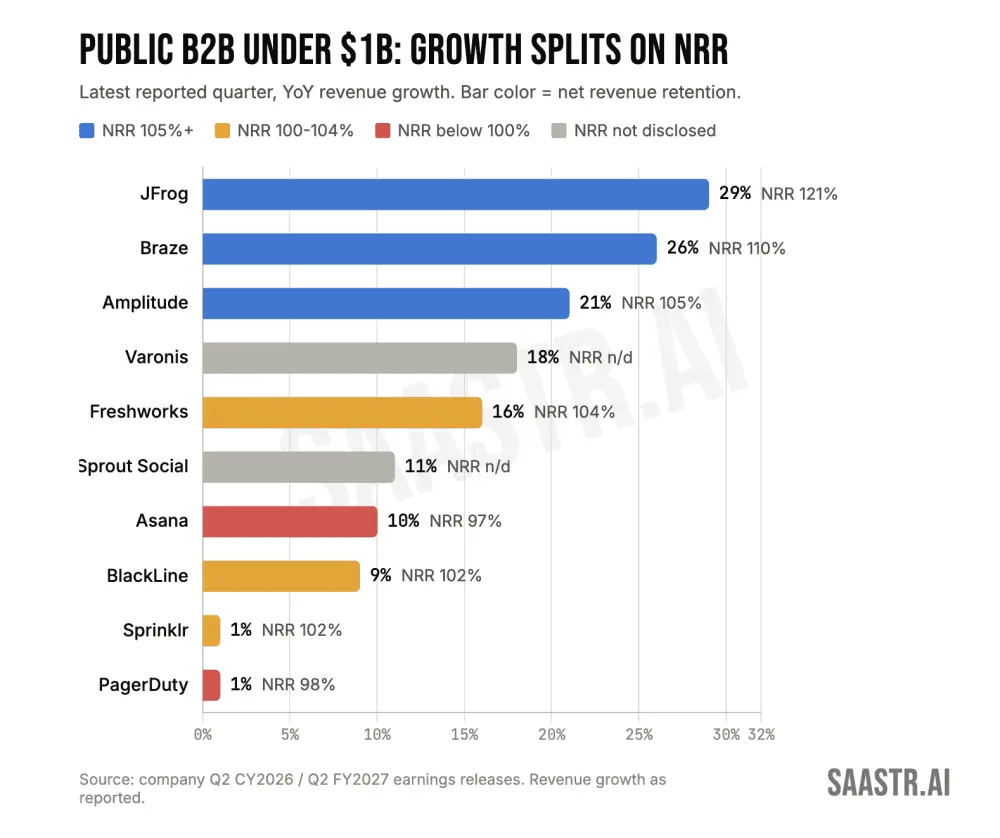
An analysis of ten established public B2B companies with annual revenues under $1 billion reveals a stark operational reality. By 2014 standards, every single one of these firms—selling mission-critical products used daily by enterprises worldwide—would be considered unassailable category leaders. In 2026, half of them are growing at 11% or less.
The Profit-Without-Growth Paradox
Consider the plight of PagerDuty and Sprinklr. Both generate substantial cash and boast loyal customer bases, yet both have hit a brick wall regarding top-line expansion:
- PagerDuty: Reported revenue of $124.4M (a meager 1% year-over-year increase), even as ARR crossed the $500M mark for the first time. However, net-new ARR added during the quarter crawled to just $6 million, and full-year revenue guidance sits essentially flat. Net retention limps along at 98%. Yet, PagerDuty remains profitable, generating $33 million in free cash flow and marking its fifth consecutive quarter of GAAP profitability.
- Sprinklr: Posted revenue growth of 1% to $213.7M, with subscription revenue up 3% to $194.8M. Full-year guidance implies flat total growth at the midpoint. Despite this stagnation, Sprinklr generated $79 million in free cash flow in the first half of its fiscal year alone.
The AI Headwind on Seat-Based Models
Asana grew top-line revenue by 10% with an overall NRR of 97%, but leadership warned that product-led growth (PLG) headwinds are here to stay. LLM-driven shifts in search engines and paid media are eroding the top-of-funnel web traffic that historically fed its self-serve customer acquisition engine. Generative AI tools are simultaneously competing directly with Asana’s core project management functionality and cannibalizing the organic discovery pipeline.

Furthermore, business model architecture dictates survival. Traditional software pricing relies heavily on per-seat licenses. As AI agents take over routine administrative, coding, and workflow tasks, enterprises need fewer human seats. Companies pricing strictly on seats find their addressable market shrinking.
Conversely, consumption-based pricing models are thriving on AI volume.
- JFrog: Revenue surged 29% to $163.8M, supercharged by a 53% leap in cloud growth. Customers generating over $1M in ARR jumped from 61 to 97.
- GitLab: Posted a 42% year-over-year net ARR growth rate—its second-highest quarterly acceleration in four years.
As JFrog’s leadership pointed out, AI-driven software development dramatically multiplies the volume of code binaries, packages, and machine learning models that corporations must store, secure, and distribute. Every autonomous agent writing code creates downstream operational artifacts that JFrog monetizes.
Official Statements and Market Reactions
Market reactions to earnings reports across the sub-$1 billion tier highlight a brutal intolerance for single-digit expansion.
When Braze reported a solid quarter featuring 26% revenue growth and record free cash flow, its stock initially fell 11% due to lighter remaining performance obligation (RPO) growth and investor anxiety over delayed AI monetization timelines.
Yet, Braze’s strong fundamentals and sub-$1 billion scale made it an ideal acquisition target. Just six weeks later, enterprise software titan Salesforce agreed to acquire Braze for roughly $5.66 billion in enterprise value—paying $47.50 per share in cash, a staggering 58% premium over its prior closing price. This represented approximately 6.2x Braze’s 2026 revenue guidance. Salesforce financed the deal directly from its balance sheet while preserving its $25 billion stock buyback program, marking its second major acquisition of the year following the $3.6 billion buyout of Fin.
Braze’s journey encapsulates the new ecosystem rules: strong sub-scale companies with clean cash flows and solid growth metrics get acquired at a premium by giants sitting comfortably above the $1 billion mark.
Other sub-scale firms have not been as fortunate. Asana shares dropped 12.7% following cautious forward guidance. Sprinklr, despite pulling in nearly $868 million in annual revenue, trades at a depressed market capitalization of $1.54 billion—valuing a profitable enterprise with over $1 billion in RPO at less than 2x revenue. Below the $1-billion line, historical brand prestige and established category leadership no longer protect stock prices; only immediate growth acceleration and transparent AI monetization metrics do.
Future Outlook: The Scale Divide and Strategic Imperatives
The contrast between sub-$1 billion operators and multi-billion-dollar conglomerates like Samsara, ServiceNow, and HubSpot illustrates the widening chasm in modern enterprise software.
- Samsara comfortably surpassed $2.1 billion in ARR, sustaining a 30% year-over-year growth rate for three consecutive quarters, fueled by million-dollar accounts growing at over 50% annually.
- ServiceNow expanded subscription revenue by 24.5% to $3.88 billion in Q2, with its proprietary AI offerings alone crossing $1 billion in annual contract value (ACV).
- HubSpot, though experiencing minor deceleration with Q3 guidance pointing to 14% growth and NRR dipping to 102%, retains overwhelming financial fortitude. Generating roughly $750 million in projected free cash flow for 2026, HubSpot easily funds its own product pivot toward AI agents while maintaining double-digit top-line growth.
For companies trapped under the $1 billion ceiling, strategic options are rapidly narrowing. Smaller players are forced to stitch together AI capabilities through piecemeal, bolt-on acquisitions—such as Asana integrating StackAI or Amplitude absorbing Statsig for inorganic ARR lifts. However, these tactical moves pale in comparison to ServiceNow absorbing Armis outright or Salesforce deploying multi-billion-dollar cash reserves to absorb high-performing mid-market innovators.
Four Critical Imperatives for B2B Founders Below $1 Billion
- Shift From Seat to Consumption Models: If your software pricing model assumes a human is sitting in front of a screen clicking buttons, AI automation will eventually shrink your revenue base. Align monetization directly with compute, storage, data volume, or completed agentic tasks.
- Deliver Indispensable Net Revenue Retention: Market data proves that every public company growing above 20% maintains an NRR of 105% or higher. If your NRR dips below 100%, your installed base is actively eroding, forcing an unsustainable reliance on expensive new-logo acquisition in a hostile budget environment.
- Secure the Balance Sheet: Cash generation is no longer just a metric of financial health; it is your primary R&D engine. Without robust operating cash flow, pivoting product architecture around autonomous AI agents becomes mathematically impossible.
- Evaluate M&A Realities Early: As Salesforce, ServiceNow, and other giants aggressively consolidate the mid-market, sub-$1 billion founders must objectively evaluate whether independent scale is achievable or if positioning the company for a lucrative cash acquisition is the optimal fiduciary path for shareholders.
In 2014, reaching $100 million ARR was a lifetime achievement that guaranteed market safety. In the 2026 AI-driven economy, $1 billion is the new baseline for survival. Until mid-market B2B firms successfully re-architect their business models around consumption, agentic workflows, and unyielding retention, the pressure from the top of the market will only intensify.