Executive Overview
The landscape of personal computing hardware is on the cusp of a profound visual transformation. According to a landmark market intelligence report published by Counterpoint Research, the global notebook display market is undergoing a seismic structural shift, moving aggressively away from traditional liquid crystal displays (LCDs) and early-generation alternatives toward advanced display technologies. At the vanguard of this revolution is organic light-emitting diode (OLED) technology, which is poised to experience an unprecedented surge in adoption.
The driving force behind this market realignment is none other than Apple Inc., alongside a broader industry push toward premium artificial intelligence (AI) personal computers. Counterpoint Research projects that advanced notebook display shipments will expand by 11% year-over-year in 2026, defying a broader notebook display market that is anticipated to contract by 3%. More remarkably, shipments of OLED notebook panels alone are projected to skyrocket by a staggering 50% in 2026, signaling a major turning point for component manufacturers, tech giants, and everyday consumers alike.
As Apple prepares to introduce its long-awaited, next-generation MacBook Pro models—rumored to feature groundbreaking updates including touchscreens, a significantly lighter chassis, and a transition to state-of-the-art tandem OLED panels—the ripple effects will be felt across the entire consumer electronics supply chain. This comprehensive report explores the catalysts behind the 2026 OLED boom, analyzes the technological advancements making it possible, details the competitive battleground between OLED and MiniLED, and examines the long-term trajectory of the premium laptop market through 2030.
Detailed Chronology: The Road to Apple’s OLED MacBook Pro
The journey toward bringing OLED technology to the Mac lineup has been one of the most highly anticipated and protracted developments in modern consumer technology history. For years, Apple has systematically evaluated and refined display technologies across its product ecosystem, serving as a bellwether for the wider tech industry.
The Apple Ecosystem Precedent
Apple’s cautious yet deliberate deployment of OLED technology began years ago with the Apple Watch, transitioned successfully to the iPhone lineup starting with the iPhone X in 2017, and finally made its way to larger form factors with the introduction of the M4 iPad Pro. The iPad Pro’s adoption of tandem OLED proved that the technology could scale to larger tablet sizes while delivering exceptional contrast, deep blacks, and impressive peak brightness without the traditional drawbacks of early-generation OLED screens, such as rapid degradation and burn-in.
Industry insiders and supply chain analysts have tracked rumors of an OLED MacBook Pro for nearly half a decade. Early projections suggested a transition might occur as early as 2024 or 2025; however, manufacturing complexities, cost constraints, and the rigorous performance standards demanded by pro-tier laptop users pushed the timeline back.
The 2026 Inflection Point
The timeline crystallized when reports surfaced pointing to late 2026 as the definitive window for Apple’s hardware overhaul. Industry rumblings indicated an anticipated product announcement slated for late October 2026, setting the stage for a dramatic redesign of the company’s flagship professional portable line.
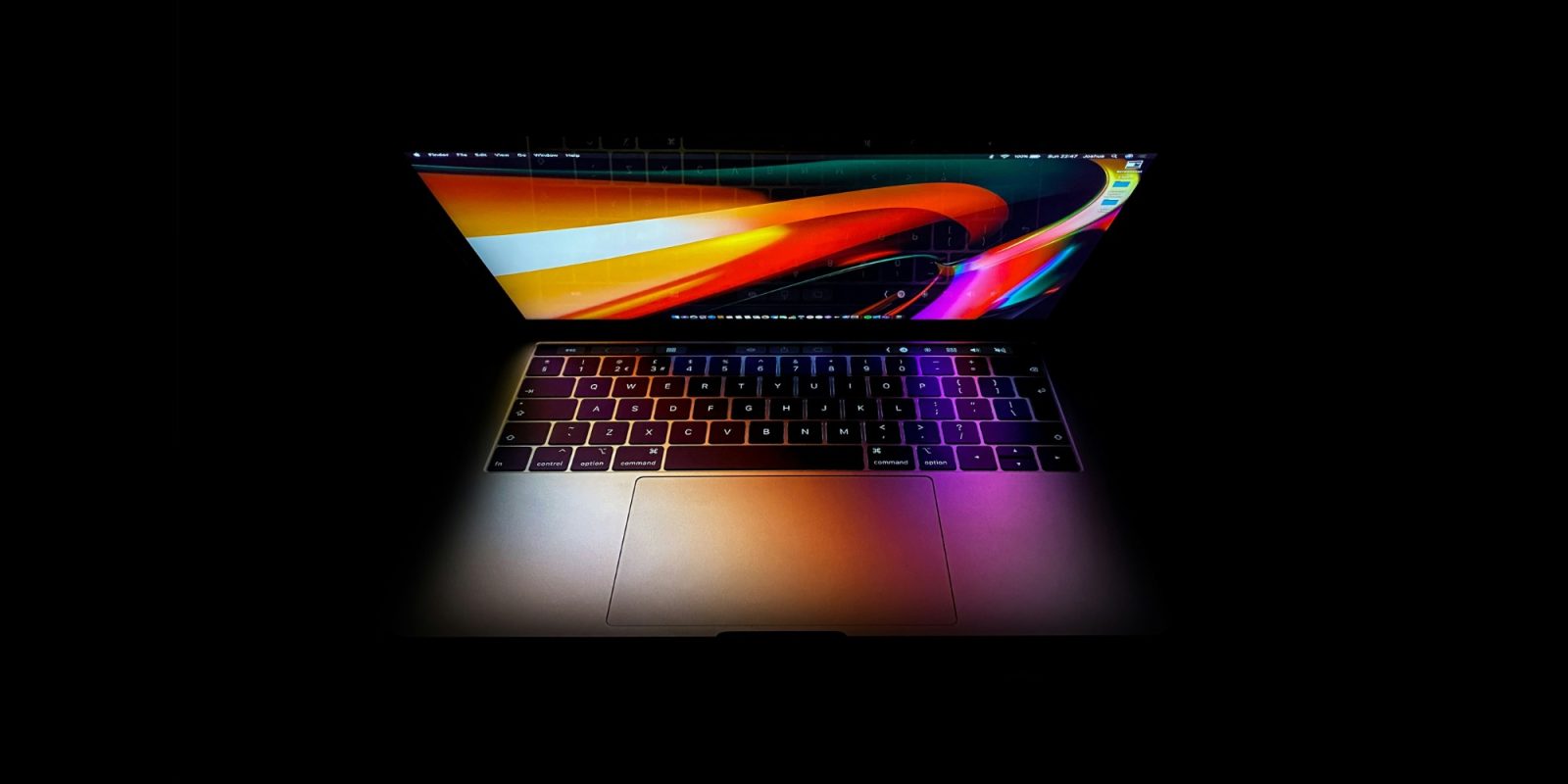
According to supply chain intelligence, the upcoming 14-inch and 16-inch MacBook Pro models will not merely swap out their current Liquid Retina XDR MiniLED displays for OLED panels; they are expected to represent a holistic reimagining of the MacBook Pro form factor. Whispers from manufacturing hubs suggest a significantly thinner and lighter chassis design, paired with the re-introduction of a touchscreen interface—a feature long resisted by the late Steve Jobs but increasingly demanded by a generation of users accustomed to seamless, multi-modal computing popularized by iPads and Windows competitors.
By choosing late 2026 for this launch, Apple is perfectly aligning its hardware cadence with broader market maturation. The timing coincides with the peak of enterprise and consumer demand for high-end AI PCs capable of running heavy local machine learning models—devices that inherently require premium display real-time rendering capabilities and energy-efficient power management systems.
Supporting Context & Metrics: Decoding the Counterpoint Research Data
To truly understand the magnitude of the 2026 display shift, one must examine the hard data compiled by Counterpoint Research. The numbers tell a story of an industry bifurcating sharply into a commoditized entry-to-mid tier and a fiercely competitive, high-value premium tier.
Market Growth Disconnect
While the overall notebook display market faces a modest 3% year-over-year decline in total shipment volume—driven by market saturation and lengthening consumer upgrade cycles—the advanced display segment is bucking the trend entirely. Counterpoint projects an 11% expansion for advanced notebook displays in 2026. This stark contrast highlights a clear consumer and enterprise preference: buyers are purchasing fewer laptops overall, but when they do invest, they are demanding superior, premium-grade visual experiences.
The OLED vs. MiniLED Supremacy Battle
For the past few years, high-end laptops have been locked in a architectural tug-of-war between MiniLED and OLED technologies. While MiniLED offered impressive peak brightness and localized dimming zones—making it a favorite for Apple’s initial transition away from standard IPS LCDs in the 2021 MacBook Pro lineup—it ultimately struggled to match the pixel-level precision and pure black levels of emissive OLED technology.
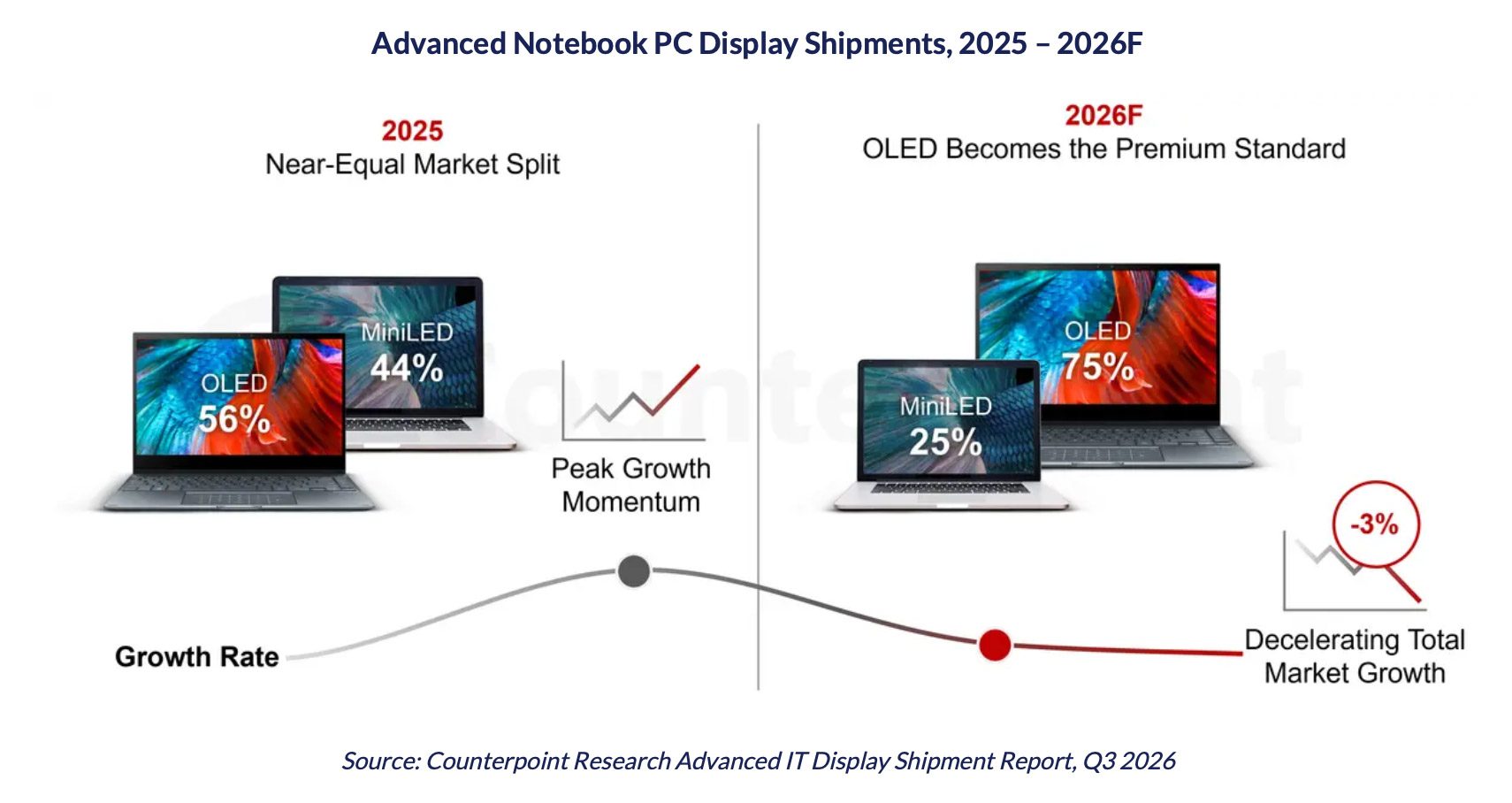
Counterpoint’s metrics illustrate a definitive turning point in this rivalry:
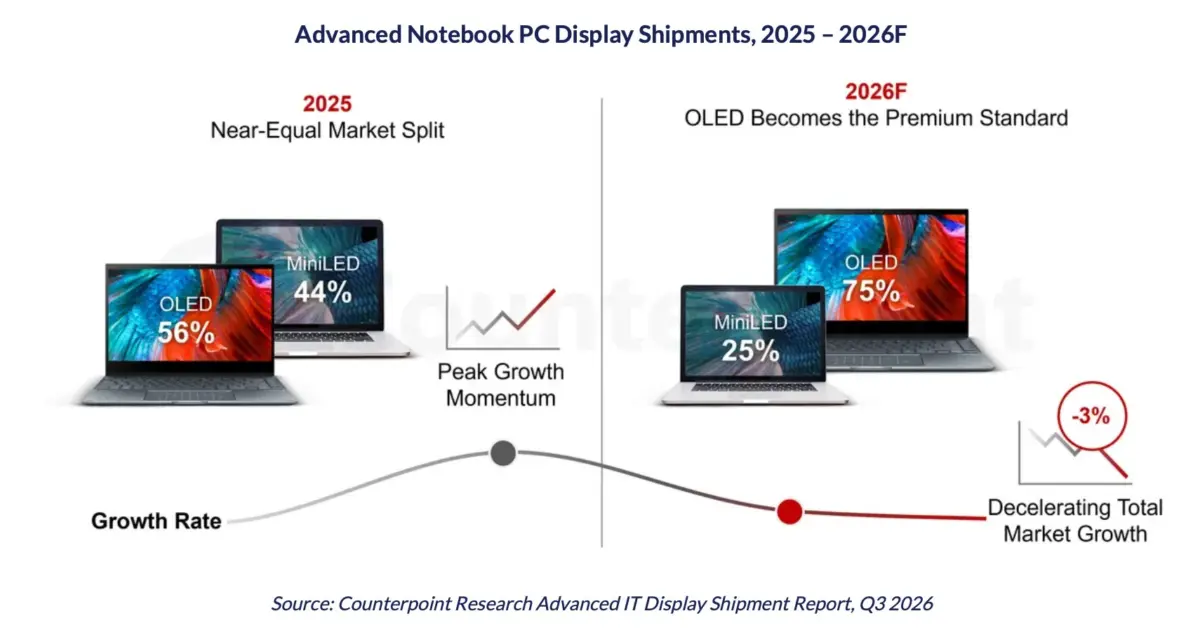
- 2025 Market Share: OLED held a commanding 56% share of the advanced notebook display market, while MiniLED captured the remaining 44%.
- 2026 Projections: OLED is forecast to surge to an overwhelming 75% market share, leaving MiniLED to plummet to just 25%.
This dramatic market share capture is a direct result of manufacturing breakthroughs and economies of scale. As panel manufacturers in South Korea and East Asia ramp up production lines dedicated to laptop-sized OLED substrates, unit costs are falling, making the technology economically viable for a broader range of professional and enthusiast notebooks.
Long-Term Growth Trajectory (2024–2030)
The momentum observed in 2026 is merely the catalyst for a decade-long expansion. Counterpoint Research outlines a robust long-term outlook for the sector:
- Compound Annual Growth Rate (CAGR) for Shipments: OLED notebook panel shipments are expected to grow at a staggering CAGR of 26% between 2024 and 2030.
- Revenue Growth: Owing to the higher average selling prices (ASPs) associated with advanced tandem architectures and larger screen sizes, panel revenue is forecast to surge at an even faster clip of 35% per year over the same six-year window.
Official Statements and Technological Insights
The technological leap enabling this market explosion cannot be overstated. Traditional single-layer OLED displays have long faced criticism regarding their longevity, susceptibility to burn-in when displaying static user interface elements for extended periods, and limitations in sustained full-screen brightness.
To overcome these hurdles, display engineers turned to tandem OLED architecture—a breakthrough innovation that is central to Apple’s hardware strategy.
The Mechanics of Tandem OLED
As detailed by industry research and validated by Apple’s implementation in the M4 iPad Pro, tandem OLED stacks two distinct emission layers vertically on top of one another.

- Doubled Efficiency: By dividing the workload between two separate light-emitting stacks, each individual layer can operate at a lower electrical current to achieve the same perceived brightness as a single layer pushed to its limits.
- Extended Lifespan: Lower current density directly translates to significantly reduced thermal stress and pixel degradation, mitigating long-term burn-in risks and dramatically extending the operational lifespan of the display.
- Superior Peak Brightness: When driven to its full capacity, a tandem architecture yields significantly higher full-screen and HDR peak brightness levels, satisfying the rigorous demands of professional video editors, photographers, and creative directors who work in color-critical environments.
Industry Commentary
In its comprehensive market insights brief, Counterpoint Research explicitly underscored the dual catalysts of this technological revolution:
"OLED notebook display shipments are forecast to rise 50% in 2026 and another 24% in 2027. Apple’s anticipated adoption of OLED in next-generation MacBook Pro models, alongside continued demand for premium AI PCs, is expected to drive this growth."
Furthermore, market analysts emphasize that the rise of AI PCs is not purely computational. Modern artificial intelligence workloads—ranging from real-time generative image rendering and local large language model (LLM) interfaces to advanced data visualization tools—require high-density, highly responsive displays that can render complex graphical user interfaces with zero motion blur and infinite contrast. OLED panels provide the ideal canvas for these next-generation software experiences.
Future Outlook: What the OLED Transition Means for the Industry
As the consumer electronics industry marches toward late 2026 and beyond, the implications of Apple’s impending OLED transition will reverberate across every level of the supply chain, impacting competitors, component suppliers, and end-users.
1. Supply Chain Realignment
Display manufacturing juggernauts—including Samsung Display, LG Display, and BOE—are rapidly reallocating capital expenditure budgets away from legacy LCD lines and standard single-layer OLED facilities in favor of high-capacity tandem OLED production lines. The sheer scale of Apple’s procurement power ensures that supply chains will be heavily stressed, potentially leading to supply constraints for rival PC manufacturers attempting to source identical premium panels. Consequently, Windows OEMs (such as Dell, HP, Lenovo, and ASUS) will be forced to accelerate their own premium notebook roadmaps to avoid falling behind the visual benchmark set by the upcoming MacBook Pro.
2. The Standardization of High-End Features
Features that were once considered exotic or niche—such as touch-enabled professional laptops, ultra-thin chassis designs, and 120Hz variable refresh rate OLED screens—will rapidly transition from luxury add-ons to baseline expectations for any device commanding a "pro-tier" price tag. As manufacturing yields improve and production volumes scale over the 2024–2030 forecast period, the cost premium associated with OLED will gradually compress, eventually trickling down to mid-range consumer laptops.

3. Software Adaptation and Burn-In Mitigation
With millions of users adopting OLED-equipped laptops, software ecosystems will also need to evolve. Operating systems like macOS will incorporate increasingly sophisticated pixel-shifting algorithms, dynamic UI dimming, and automated dark-mode optimizations to safeguard displays against static element degradation. Developers of professional productivity software (such as Adobe Creative Cloud, Final Cut Pro, and Xcode) will update their interface designs to minimize high-contrast, static toolbar burn-in risks, ensuring that hardware longevity matches consumer expectations.
Conclusion
The 50% surge in OLED notebook display shipments projected for 2026 is more than a routine statistical milestone; it represents a definitive generational shift in how humans interact with portable computing devices. Propelled by Apple’s strategic pivot toward tandem OLED technology in its redesigned MacBook Pro lineup and accelerated by the insatiable hardware demands of the AI PC era, the display industry has crossed a permanent Rubicon.
As the October 2026 announcement window approaches, the message to the market is unmistakably clear: the era of the liquid crystal display in high-end computing is drawing to a close, and a brighter, deeper, and vastly more vibrant OLED future has officially arrived.