Executive Overview
The pervasive rise of generative artificial intelligence has ignited an existential debate across the technology sector, casting a long shadow over the future of software engineering. From ambitious seed-stage startups to massive multinational enterprises sinking billions of dollars annually into research and infrastructure, the defining question of the modern corporate landscape remains: Will AI ultimately replace software engineering jobs?
At first glance, the economic logic driving corporate adoption appears deceptively straightforward. Industry leaders look at early performance metrics showing developers completing complex coding tasks in a fraction of their historical time, and they draw a swift conclusion. If an individual software engineer can suddenly accomplish the output previously demanded of three or four team members, corporate leadership naturally assumes that headcount can be trimmed to realize unprecedented operational efficiency.
Yet, a deeper, more nuanced investigation reveals a profound paradox that many industry analysts, financial forecasters, and corporate executives are currently underestimating. As software developers increasingly outsource their cognitive friction to Large Language Models (LLMs), a subtle yet dangerous erosion of independent problem-solving skills takes root.
Rather than ushering in an era of ultra-lean, low-cost engineering departments, this heavy dependency on artificial intelligence may inadvertently trap organizations in a paradoxical financial loop. Companies could soon discover that while their developers are typing faster, they are thinking less—forcing enterprises to maintain their existing engineering headcount while simultaneously absorbing massive, recurring overhead costs for AI platforms, infrastructure, and specialized tooling.
This in-depth investigative report explores the shifting dynamics of software development in the age of generative AI, dissecting the hidden costs of cognitive outsourcing, evaluating the real-world impact on developer capability, and posing a radical new question that goes far beyond simple job replacement.
Detailed Chronology: From Manual Architecture to Algorithmic Autonomy
To understand where the software engineering profession is heading, we must first examine where it has been. The trajectory of enterprise technology over the past several decades provides crucial context for the current disruption.
The Era Before AI: The Architecture of Friction
For decades, building enterprise software was a deliberately deliberate, intellectually demanding exercise. Imagine a Fortune 500 technology conglomerate allocating billions of dollars annually to maintain a massive workforce comprising thousands of software engineers.
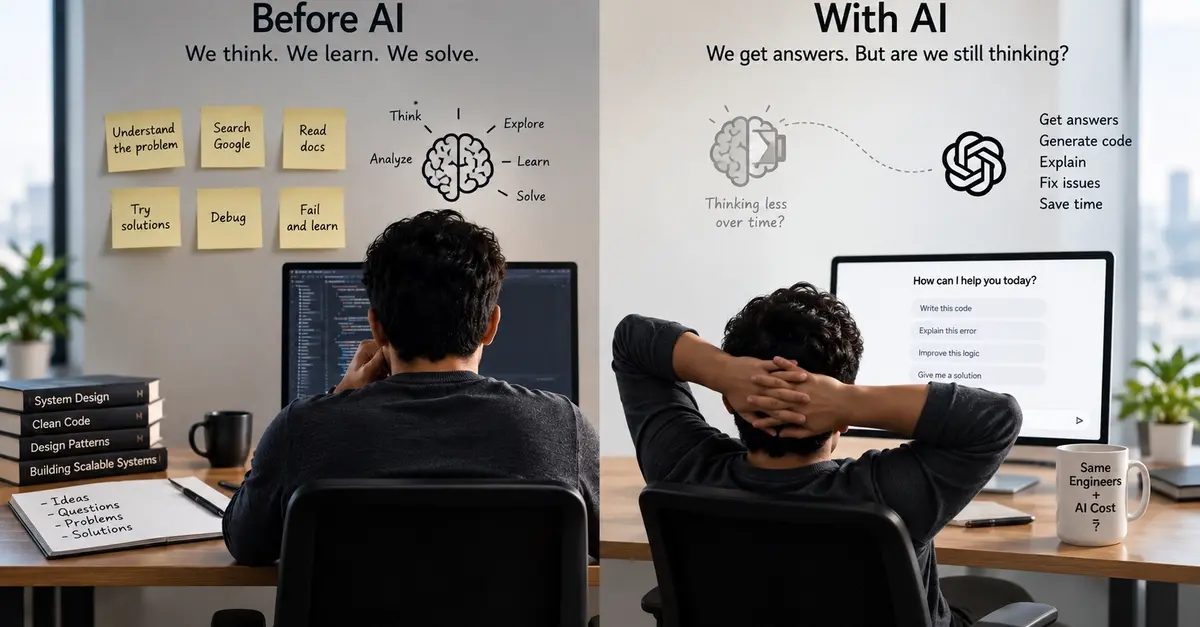
Before the advent of advanced generative AI models, a software engineer’s day was characterized by deep, manual investigation. A typical development cycle involved:
- Spent hours analyzing abstract business logic and mapping system architectures.
- Conducting exhaustive searches across developer forums like Stack Overflow, reading sprawling, poorly maintained API documentation, and cross-referencing legacy codebases.
- Engaging in lengthy whiteboard debates with cross-functional peers to debate design patterns, memory management, and scaling bottlenecks.
- Stepping through code line by line in debuggers to isolate obscure syntax errors, race conditions, or memory leaks.
While these processes often tested patience and introduced friction into product delivery, they served a vital hidden purpose: they forced developers to think critically. Every bug tracked down and every piece of documentation deciphered forged a deeper mental model of computer science fundamentals. The friction was not merely an administrative tax; it was the crucible in which strong problem-solving capabilities were formed.
The Acceleration: AI Drops the Processing Window to Minutes
The paradigm shifted abruptly with the mainstream deployment of generative artificial intelligence coding assistants. Tasks that historically consumed hours—such as writing boilerplate code, drafting unit tests, translating syntax between programming languages, and generating regex patterns—can now be executed in a matter of seconds or minutes.
For corporate bean-counters and Chief Technology Officers, this represents a golden age of engineering velocity. Velocity metrics, deployment frequencies, and pull-request volumes have skyrocketed across organizations that have integrated AI copilots into their integrated development environments (IDEs).
Naturally, this leap in output triggers a predictable C-suite calculation: if every individual engineer is suddenly operating at three to five times their historical throughput, why should the enterprise continue to fund sprawling engineering departments? The instinctual executive response is to trim the workforce, capturing the productivity gains as immediate bottom-line savings. However, this line of reasoning assumes that human productivity in software engineering is a static metric that exists independently of human cognition.
Supporting Context & Metrics: The Cost of Cognitive Atrophy
As companies race to optimize their engineering pipelines, a critical psychological and operational shift is occurring beneath the surface. The greatest risk of artificial intelligence adoption is not that machines will suddenly become sentient and write flawless software; it is that human engineers will gradually stop exercising the cognitive muscles required to understand what the machine is writing.
What Happens When We Stop Thinking?
Cognitive dependency is a well-documented phenomenon in human-computer interaction, but its implications for high-stakes software engineering are unprecedented.
In the pre-AI era, when a developer encountered an unfamiliar programming challenge, their immediate reaction was internal search and synthesis. They had to construct a mental model of the problem space, formulate hypotheses, test them, and fail until they found a workable solution.
Today, the path of least resistance has fundamentally shifted. When faced with a complex architectural roadblock or a cryptic error message, the modern developer’s reflexive reaction is increasingly: "Ask AI."
While this yields immediate gratification and keeps the Jira ticket moving, it fundamentally alters the feedback loop of learning. When an AI instantly provides a fully formed, elegant solution to a complex problem, the human developer bypasses the struggle—and with it, the deep comprehension of why the solution works.
If this trend compounds over years, industry insiders warn of a looming crisis: a generation of developers who are exceptionally skilled at prompting AI models, yet increasingly incapable of debugging complex systems, diagnosing obscure performance bottlenecks, or designing resilient architectures when the AI outputs subtly flawed or insecure code. AI makes developers faster in the short term, but an over-reliance on automated generation risks creating a profound fragility in long-term technical capability.
The Financial Boomerang: Why Companies May End Up Paying More
This behavioral shift directly undermines the corporate financial thesis of AI adoption. Consider the long-term projection for a technology company that deploys artificial intelligence expecting to downsize its engineering workforce:
- Phase One (Implementation): The enterprise deploys AI coding assistants to thousands of engineers. Productivity surges, and leadership begins trimming headcount, anticipating reduced payroll expenditures.
- Phase Two (Cognitive Atrophy): Over several years, the remaining engineers grow heavily dependent on AI tools. Because their independent problem-solving skills have degraded, they rely on AI not just for acceleration, but for foundational comprehension.
- Phase Three (The Productivity Plateau): Because the human workforce is now constrained by a diminished capacity for deep, independent architectural thinking, the overall output of the engineering department plateaus. To deliver the same aggregate volume of complex, enterprise-grade software that the original, larger workforce once produced, the company discovers it actually needs more human oversight, code review, and manual intervention to catch AI hallucinations and security vulnerabilities.
- Phase Four (The Double-Billing Trap): The enterprise realizes it still requires a robust engineering headcount to maintain systems, vet code, and guide product direction—except now, those engineers are saddled with an additional, permanent overhead cost: licensing fees for enterprise AI platforms, specialized cloud infrastructure, token consumption, and continuous security tooling.
Rather than watching engineering expenditures plummet, companies could find themselves trapped in a financial vice: paying legacy-level salaries to human workforces while simultaneously funding multi-million-dollar artificial intelligence utility bills. The anticipated cost savings evaporate, replaced by a permanent, highly complex financial overhead.
Official Statements & Industry Perspectives
The debate surrounding the intersection of artificial intelligence and software engineering has drawn sharp commentary from prominent technology leaders, researchers, and enterprise architects.
Dr. Elena Vance, a senior researcher in human-computer interaction at the global tech institute, highlights the psychological dangers of over-automation:
"We are witnessing a dangerous conflation between speed and capability. Generative AI tools are exceptional force multipliers for experts who already possess deep domain knowledge. However, when junior or mid-level developers use these tools as a substitute for foundational learning, they are essentially borrowing against their own cognitive future. You cannot outsource your foundational thinking to a statistical model without eventually paying the interest in technical debt and system fragility."
Meanwhile, enterprise CTOs offer a more pragmatic, yet equally cautious, assessment of the economic realities. Speaking anonymously at a recent industry summit on software economics, a chief technology officer of a major financial services firm noted:
"The board room wanted a headcount reduction plan the moment we rolled out our internal AI coding assistant. But our engineering leads pushed back hard. They pointed out that while AI can write seventy percent of our boilerplate code, it also generates subtle security vulnerabilities and concurrency bugs that require senior-level human oversight to catch. If we cut our senior engineering staff, we wouldn’t save money—we would simply invite catastrophic system failures. We aren’t firing engineers; we’re just paying for both the engineers and the software that writes their code."
Prominent open-source maintainers and software architects have similarly sounded the alarm regarding the quality and maintainability of AI-generated codebases, pointing out that an increase in raw code volume does not equate to an increase in software value.
Future Outlook: Navigating the New Engineering Paradigm
As the software engineering landscape continues its rapid evolution, the path forward requires a deliberate recalibration of how organizations view artificial intelligence. The future will not belong to companies that blindly replace human intellect with machine output, nor will it favor organizations that reject technological progress in favor of outdated manual workflows.
Redefining the Role of the Software Engineer
The profession of software engineering is shifting away from syntax memorization and manual code entry toward a discipline centered on:
- System Architecture & Design: Evaluating how disparate services interact, scaling systems under load, and designing resilient, fault-tolerant infrastructure.
- Critical Evaluation & Security Auditing: Serving as rigorous editors and validators of machine-generated code, ensuring adherence to strict compliance, privacy, and security standards.
- Problem Formulation: The art of breaking down complex, ambiguous business requirements into precise, logical components that can be effectively solved—whether by human ingenuity or algorithmic assistance.
Strategic Recommendations for Enterprise Leaders
To avoid the financial and operational traps of the AI productivity paradox, technology executives must adopt a balanced, forward-thinking strategy:
- Invest in Human Capability, Not Just Tooling: Treat AI as a training wheels system designed to elevate developer efficiency, not as a replacement for deep technical education and mentorship.
- Monitor Cognitive Dependency: Encourage engineering teams to step away from automated assistants periodically to maintain core problem-solving competencies and algorithmic fluency.
- Account for Total Cost of Ownership: Look beyond immediate developer velocity metrics when budgeting for AI adoption. Factor in the long-term costs of code maintenance, security auditing, platform licensing, and infrastructure scaling.
Conclusion
The question of whether artificial intelligence will take software engineering jobs is deceptively simple, masking a far more complex economic and psychological reality.
AI is undeniably one of the most powerful productivity amplifiers ever placed in the hands of creators. Used correctly, it liberates developers from tedious administrative tasks, accelerates prototyping, and unlocks new frontiers of digital innovation. However, treating it as a substitute for human intellect is a perilous gamble that could leave enterprises paying more for software than ever before.
The ultimate challenge facing the technology industry is not technological, but philosophical. As we stand at this historic crossroads, the ultimate question is no longer just: Will AI make engineers so productive that companies need fewer of them?
The real question we must answer is: Will we become so dependent on AI that companies eventually find themselves forced to pay for both the engineers and the machines—while the engineers lose the very capacity to function without them?
Time will ultimately provide the answer. But for every software engineer and enterprise leader navigating this transition, the guiding principle must remain absolute: Use artificial intelligence to amplify your thinking, never to replace it.