Executive Overview
ELLSWORTH, Kansas — For decades, the political geography of Ellsworth—a town of 3,000 residents nestled in the heart of Kansas—has remained as fixed and unyielding as the surrounding prairie. In a county where Donald Trump has routinely secured victories by 50-point margins since 2016, lifelong Republicans like David Rankin saw little practical reason to display partisan yard signs. Politics here was a settled matter, a background hum of conservative certainty.
Recently, however, Rankin and his wife Dina broke with a lifetime of political habit. Driven by a deep-seated frustration with the status quo in Washington, they walked out to their front lawn and hammered in a bright campaign sign bearing the name of the Rev. Adam Hamilton. A prominent Methodist megachurch pastor, Hamilton is running for the United States Senate. He is also a Democrat.
Across Kansas, a state that has not sent a Democrat to the U.S. Senate in 94 years, the political landscape is undergoing a historic and unexpected upheaval. Incumbent Republican Senator Roger Marshall finds himself locked in a precarious fight for survival, battered by declining approval ratings, a series of damaging personal controversies, and an increasingly unpopular national Republican platform tied to healthcare cuts, fuel costs, volatile beef prices, and sweeping tariffs.

As national parties pour last-minute cash into the state, turning Kansas into an unexpected toss-up, Hamilton’s campaign has emerged as a fascinating national case study. Unlike conventional secular Democrats who frequently cede the language of faith to the religious right, Hamilton is running an openly spiritual campaign. By anchoring his progressive policy positions in Gospel teachings and the fundamental tenets of the Christian Bible, he is attempting to answer a high-stakes question for the Democratic Party: Can a moderate, openly religious candidate offer a viable roadmap for reclaiming Christianity and winning back disillusioned voters of faith in the American heartland?
Detailed Chronology: On the Trail in the Heart of Kansas
To understand the scope of Hamilton’s unconventional run, one must follow the campaign trail across the vast expanses of the Sunflower State.
The Road Through the Heartland
Over a grueling four-day stretch, the campaign traversed nearly 900 miles of Kansas highways, moving from bookstores in Salina to historic theaters in Hutchinson, and onward to rural outposts like Garden City and Hanston. At every stop, the atmosphere felt less like a traditional partisan rally and more like an exercise in political and communal healing.

On a Thursday evening inside a packed downtown theater in Hutchinson, Hamilton addressed several hundred voters—many wearing "Republicans for Hamilton" pins. He diagnosed the dysfunction in Washington using an unexpected metaphor, comparing members of the U.S. Senate to Dorothy’s companions in The Wizard of Oz: politicians who had lost their minds, their hearts, and their courage.
Hamilton recounted an encounter with a constituent who made a simple, haunting request: she asked him to be someone who could help her stop hating her neighbors who wore red MAGA caps. The line drew a mixture of quiet sighs of recognition and knowing laughter from the room.
A Journey Shaped by Crisis and Theology
Hamilton’s path to this political moment is deeply rooted in his personal history. Raised nominally Catholic, he drifted toward atheism during his youth following his parents’ divorce and the tragic suicide of his grandmother. A late-night encounter with a Pentecostal missionary eventually brought him to a local church, where he met his wife, LaVon.

Feeling a calling to ministry, he enrolled at Oral Roberts University. However, the unexpected deaths of his closest friends plunged him into a profound spiritual crisis. When local pastors offered hollow platitudes rather than answers to his grief, Hamilton turned to the theology of John Wesley and the Methodist movement, finding intellectual rigor combined with social responsibility.
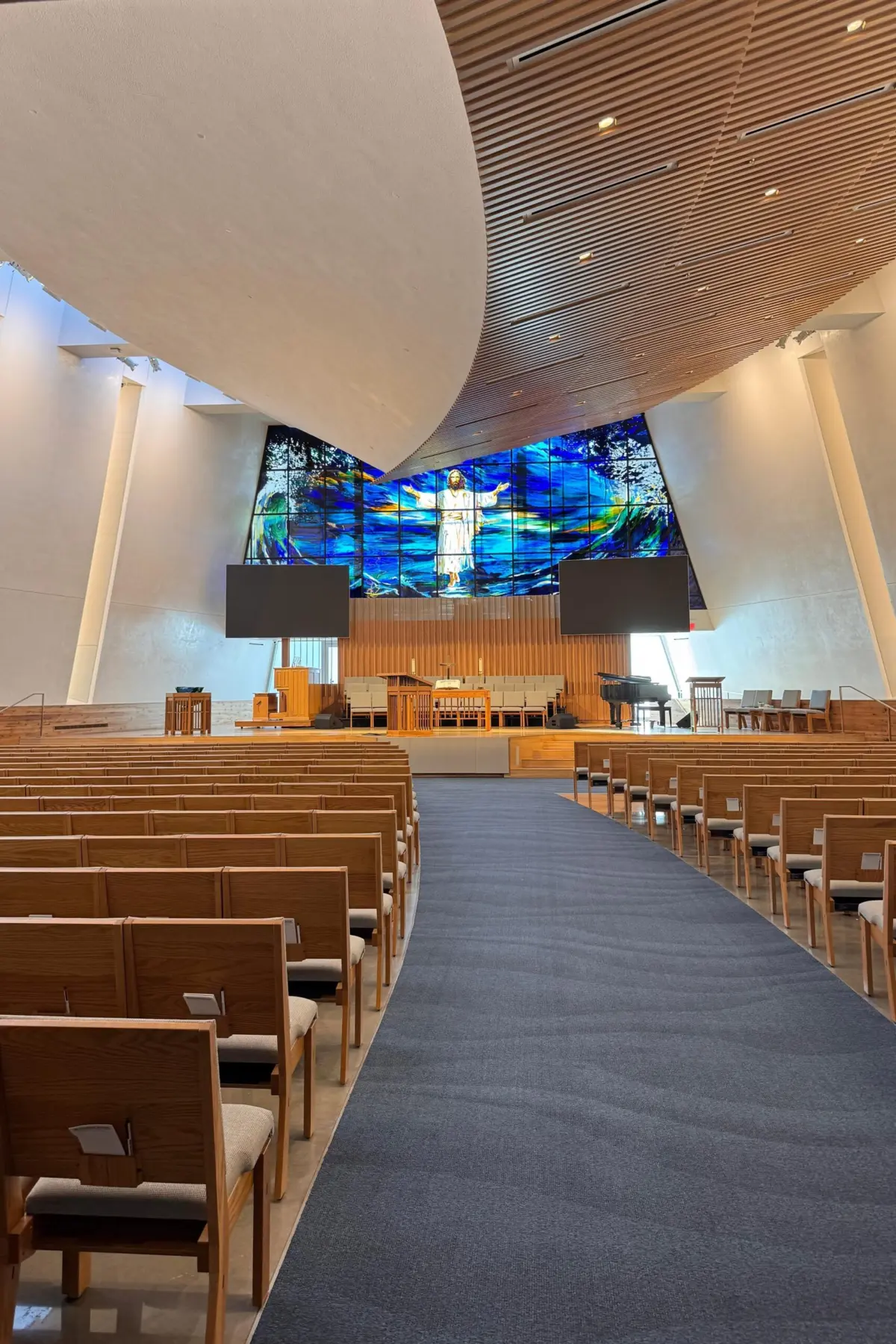
At just 25 years old, he founded the Church of the Resurrection, tasked by bishops with starting a church "for thinking people." What began in the chapel of a funeral home in the 1990s grew into the largest Methodist congregation in the United States, spanning nine locations across two states and serving roughly 24,000 members from its striking, spaceship-like complex in Leawood, a Kansas City suburb.
Lindsborg and the Politics of Nuance
The intersection of faith, music, and politics was vividly on display inside a historic Swedish chapel in Lindsborg. Standing before a packed room of constituents at a local Lutheran college, Hamilton broke into song, leading the audience in an 800-year-old hymn based on the prayer of St. Francis of Assisi.

When opened to questions, Hamilton leaned directly into complex, emotionally charged issues rather than retreating to safe partisan talking points. Pressed by a constituent on reproductive rights, Hamilton articulated a deeply personal viewpoint. Describing himself as "pro-life with a heavy heart," he shared the story of his own mother: pregnant at 17, she faced intense pressure from her father to seek an abortion abroad, an option she ultimately rejected at great personal cost.
Yet, translating that personal moral tension into public policy, Hamilton maintained that in the wake of Kansas voters overwhelmingly protecting abortion access at the ballot box, a U.S. senator must ensure safe and legal access to healthcare.
"There are things that are clearly black and white, but there’s a lot where there’s room," Hamilton told reporters after the event. "People on the extremes on either end… don’t want me telling the story about my mom. But in the broad center, folks on the left say, ‘You know what? That’s real.’ And on the right, people say, ‘I appreciate the fact that you understand the moral tension.’"

Supporting Context & Metrics: The Shifting Religious Electorate
Hamilton’s overperformance highlights a structural shift in American politics that has been decades in the making.
The Realignment of Faith and Politics
From the 1960s through the 1980s, the Democratic Party could reliably count on robust support from white evangelical Protestants and mainline Christians. By the 1990s, however, a profound realignment took hold: as the GOP successfully consolidated evangelical voters, Democrats increasingly became the party of secular, college-educated, and religiously unaffiliated Americans.
This polarization left Democrats largely abandoning religious outreach in rural and red states, effectively writing off large swaths of the electorate where white evangelical and mainline Protestant voters hold significant sway.

Data and Demographics
According to religious researchers and political scientists, while winning over white evangelical conservatives remains a steep climb for Democrats, substantial untapped potential exists among mainline Protestants and white Catholics—demographics with deep roots in heartland states like Kansas, Iowa, Nebraska, and Wisconsin.
Furthermore, data from institutions like the Pew Research Center indicates that the religiously unaffiliated ("nones") are not monolithically anti-religious; atheists make up less than one in five of this group. Many unaffiliated voters remain open to spiritual concepts, suggesting that an authentic, values-driven message does not alienate secular voters in the way party strategists often fear.
Official Statements and Campaign Controversies
As the race has tightened, the national spotlight has intensified, drawing sharp attacks from Republican leadership and unleashing a fierce debate over character, faith, and institutional conduct.

The National GOP Counter-Offensive
In September, Vice President JD Vance—a Catholic convert with a background in evangelical and Pentecostal traditions—launched a blistering critique of Hamilton during a rally in the Kansas City suburbs. Vance dismissed Hamilton’s platform as "left-wing radicalism dressed in the skin suit of our religion," labeling him a figure who would "insult your faith and spit on your religion to accrue donations to himself."
President Donald Trump echoed these sentiments at a subsequent rally in Wichita, branding Hamilton a "Radical Left LUNATIC" and asserting that he does not represent evangelical Christians. The Marshall campaign further attacked Hamilton’s leadership of his megachurch, questioning his handling of historic denominational splits and invoking decades-old allegations against a former volunteer at a church camp.
The Defense of the Pastor
The attacks drew an immediate and forceful rebuke from the religious community. More than 100 Methodist clergy signed an open letter defending Hamilton’s ministry.

"When you attack Adam’s pastoral ministry, his home congregation, and our denomination as a whole, you sow seeds of division and dissent," the clergy wrote. "You tear at the fabric that is the body of Christ."
The Unraveling of the Incumbent
While debates over theology raged, the race shifted dramatically due to a series of devastating disclosures regarding Senator Roger Marshall’s personal and professional conduct.
An extensive New York Times investigation revealed that Marshall, a former OB-GYN, had filed lawsuits against more than 700 former patients—including new mothers—over unpaid medical bills, charging up to 18 percent interest and resulting in dozens of arrests tied to missed court dates. Additional reports surfaced concerning Marshall’s primary residence in Florida, unpaid campaign debts, and questions surrounding the use of public funds.

These revelations severely damaged Marshall’s standing on the issue of personal character, propelling Hamilton to the top tier of favorable ratings in CNN polling averages across competitive Senate battlegrounds.
Future Outlook: Lessons for a Post-Trump America
Whether Adam Hamilton ultimately secures victory on election night or falls short in his historic bid, his campaign has injected a provocative new vocabulary into American politics.
For the Democratic Party nationally, the Kansas experiment offers both an enticing roadmap and a sobering reality check. Replicating Hamilton’s success requires a rare combination of personal authority, deep institutional backing, and decades of community leadership—qualities that political analysts note are difficult to manufacture overnight.

Nevertheless, the race demonstrates that voters in rural heartland communities are deeply responsive to candidates who reject hyper-partisan extremism in favor of moral integrity, civic grace, and a values-driven approach to governance. As David Rankin looked out at the campaign sign planted firmly in his Kansas lawn, the prevailing sentiment was clear: voters are searching for leaders who prioritize human dignity over partisan division, proving that even in the most predictable political terrain, the ground can shift beneath our feet.