Executive Overview
For over a decade, BeamNG.drive has occupied a fascinating, paradoxical space in the video game ecosystem. Within specific online enclaves—particularly among car-culture enthusiasts, simulation purists, and automotive content creators—it is viewed as nothing short of a technological marvel. Yet, to the broader gaming public, it has largely remained an obscure PC curiosity.
Initially launched via Steam’s Early Access program eleven years ago, the title has steadfastly resisted a traditional "1.0" commercial release, choosing instead to iterate continuously under the stewardship of its developer, BeamNG. Despite this unorthodox development cycle, the title has carved out a formidable market presence. Today, it stands proudly as the second-biggest driving game on Steam, outperforming heavy-hitting commercial heavyweights like Forza Horizon 6 while sitting just behind SCS Software’s juggernaut, Euro Truck Simulator 2.
Now, the simulation sandbox has broken out of its PC enclosure. Following the recent PlayStation 5 release—a launch made even more significant given the delayed port of rival exclusives—console players can finally experience the game’s legendary computational engine. However, the transition to Sony’s current-generation hardware brings to light a compelling paradox: while BeamNG.drive sets an uncompromising gold standard for vehicle physics, soft-body damage modeling, and mechanical fidelity, its identity as a video game remains an unrefined, sprawling sandbox.
This article explores the journey of BeamNG.drive from an 11-year early-access PC darling to its console debut on the PS5, evaluating its engineering triumphs, its structural design flaws, and what its arrival means for the future of racing and driving simulations.
Detailed Chronology: From Academic Experiment to Console Frontier
To understand the magnitude of BeamNG.drive’s arrival on the PlayStation 5, one must trace its roots back to its conceptual beginnings. The engine powering the game did not start as a traditional video game project; rather, it evolved from advanced academic and industrial research into real-time soft-body physics.
The Genesis and Early Access Years (2013–2015)
Long before its Steam debut, the core technology—known initially as Rigs of Rods legacy concepts—attracted attention for its unique approach to physics. Traditional racing games utilized rigid-body models where vehicles were treated as solid shells with pre-determined damage textures or scripted deformation zones. BeamNG’s founders abandoned this shortcut entirely, building a system where every chassis, suspension arm, and engine block was treated as an interconnected mesh of nodes and beams.
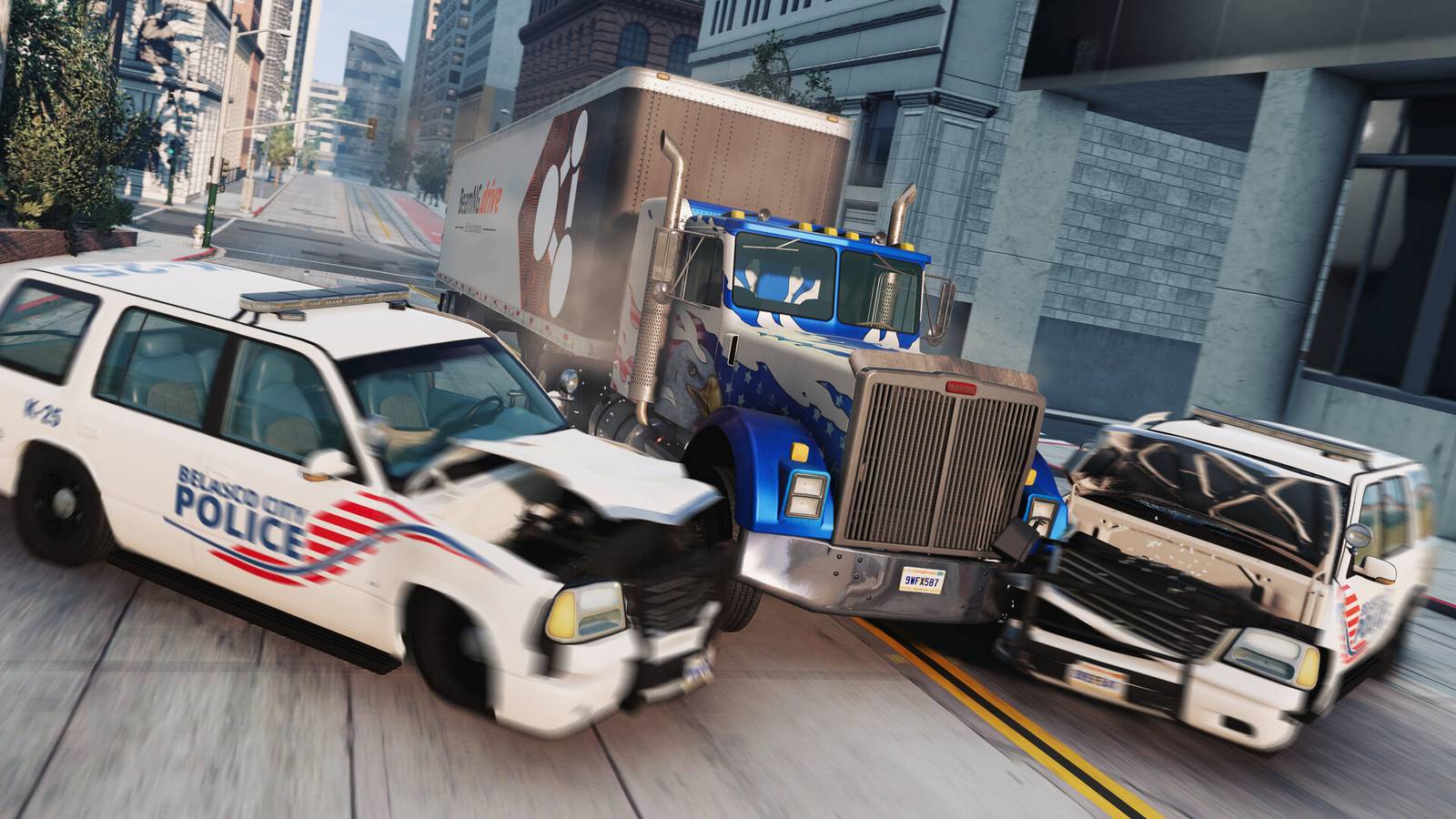
When BeamNG.drive quietly entered Steam Early Access in 2013, it was less of a structured game and more of a physics playground. Players were given open-ended environments to spawn fictional vehicles, roll them down cliffs, and marvel at the shockingly accurate way metal crumpled, chassis twisted, and axles sheared.
The Long, Unfinished Middle Era (2016–2025)
Over the next decade, the small development team steadily expanded the scope of the project. Rather than rushing toward a definitive release version, BeamNG adopted a live-service approach decades ahead of its time, releasing incremental updates that introduced new maps (such as the sprawling terrains of Italy, Utah, and the American East/West coasts), expanded vehicle rosters, and implemented rudimentary gameplay modes.
During this period, the game cultivated a passionate community. It became a viral sensation on YouTube and TikTok, where creators leveraged its unfettered destruction mechanics to stage elaborate stunt videos, cinematic crashes, and vehicular stress tests. Slowly but surely, the concurrent player counts climbed, eventually propelling the game to the upper echelons of Steam’s driving category charts.
The Console Leap: PlayStation 5 Debut (Late 2026)
The announcement and subsequent release of BeamNG.drive on the PlayStation 5 in late 2026 marks a watershed moment for the franchise. The timing could not have been more strategic. With major competitors like Forza Horizon 6 facing high-profile delays on Sony’s platform, the PS5 consumer base has been hungry for top-tier automotive experiences.
Furthermore, running BeamNG.drive has traditionally required a powerful, CPU-heavy PC rig due to the massive computational overhead demanded by its soft-body calculations. Bringing the game to the PS5 offers a streamlined, accessible entry point for console owners to experience high-fidelity physics without needing to invest in expensive hardware upgrades.
Supporting Context & Metrics: By the Numbers
To contextualize the scale of BeamNG.drive’s success and the technical weight of its simulation engine, one must examine the metrics that define its ecosystem.
- Steam Market Standing: As of late 2026, BeamNG.drive comfortably holds the position of the #2 driving game on Steam by active player metrics and 24-hour peak engagement. It routinely outpaces massive commercial releases, sitting behind only Euro Truck Simulator 2 while besting titles backed by multi-million-dollar publishers.
- Development Lifespan: With 11 years in Early Access, the title represents one of the longest-running continuous development cycles in modern gaming history, rivaling projects like Star Citizen or Minecraft in its evolution.
- Vehicle Ecosystem: Unlike traditional racing games that rely heavily on heavily-licensed, real-world manufacturer fleets (such as Ford, Ferrari, or Porsche), BeamNG.drive features an entirely fictional roster of vehicles. This design choice frees the developers from restrictive licensing agreements that often forbid showing vehicles being torn to pieces.
- Computational Load: The game’s proprietary physics engine simulates hundreds of individual nodes and beams per vehicle simultaneously. In scenarios involving multiple cars—such as multi-vehicle pileups or AI-driven traffic—the CPU demands scale exponentially, making optimization for the PS5 a monumental engineering achievement.
Official Statements and Critical Reception
The transition from a PC-centric sandbox to a curated console experience has sparked robust discourse among critics and players alike. Early reviews of the PlayStation 5 version highlight the stark contrast between the brilliance of the game’s underlying physics and the limitations of its overarching game design.
The Triumphs of Soft-Body Physics
Reviewers and automotive enthusiasts have universally praised the sheer accuracy of the driving dynamics and crash physics on the PS5. Unlike arcade racers where vehicles feel glued to the asphalt, BeamNG.drive communicates weight transfer, tire deformation, and suspension load with startling fidelity.

Industry analysts note that the game’s handling model, while initially jarring to players accustomed to arcade-style racers, reveals its true brilliance in specialized disciplines. Commenting on the game’s execution, early critics noted:
"If you smash your car into a tree at speed in BeamNG.drive, it won’t go anymore—because the suspension’s broken, or a wheel is missing, or the engine’s been cleaved right off the chassis… The realism of BeamNG.drive’s damage system is truly astonishing and entertaining in its own right."
The Design Dilemma: A Masterpiece Without a Master Plan
Despite universal acclaim for the physics engine, critics have pointed out that BeamNG remains, at its core, a collection of disparate engineering achievements searching for a cohesive game.
While the developers have introduced onboarding tutorials, quick-start menus, and a nascent Career Mode—where players must purchase cars, earn currency, and pay for insurance-covered repairs—the overall user experience retains a distinctly unrefined edge. The interface can feel cumbersome, and navigating the vast array of game modes (ranging from rock crawling and bus driving to police chases and hypermilling challenges) often requires the player to invent their own fun rather than following a structured narrative or progression curve.
As one industry observer aptly summarized:
"BeamNG is a team of gifted engineers that has built something extraordinary. As game designers, though, they are a work in progress—just like the game itself, which feels as though it may never reach 1.0."
Future Outlook: Where Does BeamNG.drive Go From Here?
As BeamNG.drive establishes its footprint on the PlayStation 5, the project faces a pivotal crossroads. The console release proves that the grueling computational demands of soft-body physics can be successfully harnessed on fixed hardware, opening up the franchise to millions of new players who prefer couch gaming over desktop setups.

However, the long-term viability of the franchise on consoles will depend heavily on how the developers address structural game design.
1. Maturation of the Career Mode
For BeamNG.drive to retain casual console players who are accustomed to the tight progression loops of Gran Turismo or Forza, the Career Mode must evolve. Transforming the current loop—buying, crashing, repairing, and repeating—into a deep, engaging campaign with meaningful progression will be crucial.
2. UI and Accessibility Overhauls
The PC heritage of the game is deeply embedded in its complex, occasionally sprawling menu systems. Streamlining the user interface for controller inputs and making the vast array of user-generated content and sandbox tools easily digestible for console users will dictate whether the game transitions from a niche cult hit to a mainstream staple.
3. Setting a New Industry Benchmark
Regardless of its structural growing pains, BeamNG.drive has already achieved something historic. By proving that ultra-realistic, physics-driven vehicle damage is not only possible in real-time but deeply compelling, it has raised the bar for what players will expect from future racing titles. Whether mainstream developers choose to adopt similar soft-body technologies or BeamNG continues to hold a monopoly on automotive chaos, the landscape of driving games has been permanently altered.
In the end, BeamNG.drive on the PS5 is an exhilarating, messy, and utterly unique proposition. It may lack the manicured polish of traditional studio releases, but for those willing to look past its rough edges, it offers a window into the absolute cutting edge of digital simulation.