Executive Overview
In modern software engineering, developers have grown accustomed to a certain baseline of feedback from their toolchains. When a compiler fails, it throws a stack trace. When an HTTP endpoint rejects a payload, it returns a status code. When an integration breaks, logs usually bleed terminal red.
Yet, as artificial intelligence architectures shift from simple chat wrappers to autonomous "agentic" systems—orchestrating local models, complex command-line interfaces (CLIs), and policy enforcement layers—a more insidious class of software defect has emerged: the silent failure.
This phenomenon took center stage during the recent v0.1.0 field tests for agentpolicy, an open-source, local-first, Cedar-based policy decision point designed to govern AI agent actions. Released recently to PyPI by the agentic-suite collective, agentpolicy intercepts every agent action, rendering granular decisions—allow, deny, ask, rate-limit, or redact—backed by shipped rule packs.
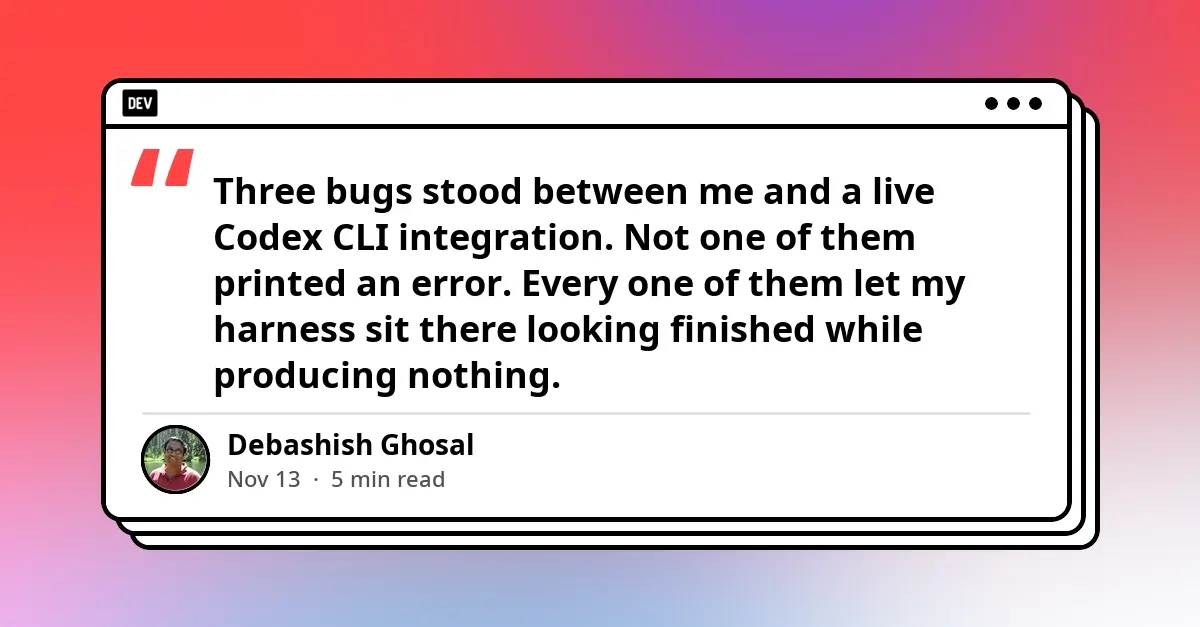
However, before the policy engine could even be tested against a live Codex CLI integration, its author encountered a wall of absolute quiet. Three distinct bugs stood between the harness and execution. Not one of them printed an error. Every single one allowed the test harness to sit idle, looking deceptively finished, while producing total nothingness.
This investigative report examines the anatomy of those silent failures, the fragility of modern vendor abstractions, and the broader implications for engineering teams building autonomous AI agent architectures.
Detailed Chronology: Anatomy of Three Silent Traps
The integration effort sought to couple Codex CLI (version 0.135.0) with a local model server (oMLX), bypassing external API keys in favor of a closed-loop, box-local testing environment. What followed was a diagnostic masterclass in systems engineering troubleshooting, broken down into three cascading traps.
Trap One: The Vanishing API Assumption
The initial integration attempt relied on a well-worn path: configuring the Codex CLI to point toward the local model server using standard chat completions—the bedrock endpoint of the OpenAI-compatible server ecosystem (wire_api = "chat").
Instead of gracefully negotiating or throwing a descriptive error, Codex flatly refused to start. The initialization check returned a rigid rejection: wire_api = "chat" is no longer supported. The CLI had quietly dropped support for chat completions altogether. In its place, the software now exclusively demanded the OpenAI Responses API.
[FATAL] wire_api = "chat" is no longer supportedThe conventional wisdom in such scenarios is to immediately dive into documentation or pore over changelogs. But the deeper lesson learned was empirical: assumptions about transport layers are ticking time bombs.
Fortunately, the local server, oMLX, natively supported /v1/responses via an unadvertised route. This was discovered not through documentation, but through a rudimentary curl probe. A single HTTP request returned a valid resp_* payload accompanied by an HTTP 200 status code. With zero translation layers required, the transport hurdle was cleared—proving that vendor APIs drift unpredictably, and yesterday’s working configuration is today’s silent startup rejection.
Trap Two: The Infinite Stdin Hang
With the transport protocol identified, the next phase involved running codex exec headlessly from an automated test script. Upon execution, the terminal printed a single, innocuous line:
Reading additional input from stdin...…and then it froze.
No error code was thrown. No timeout mechanism tripped. The process did not exit. Instead, the test harness—which was actively monitoring the parent process and its output stream—registered the process as "busy." A quick check of the system’s process list showed the application running merrily along, consuming negligible CPU cycles while producing zero output or logs. It was the epitome of a patient bug: an unattended process blocked on a read operation, waiting forever while a CI/CD pipeline patiently displays a spinning wheel.
The culprit lay in the interactive heritage of many CLI tools. codex exec naturally expects to consume standard input. When invoked headlessly within a test harness, it inherits whatever file descriptor the parent process left connected—which is never an active, closing TTY.
The fix proved deceptively simple—a two-character shell modifier: </dev/null. By explicitly closing standard input on every headless invocation, the hanging read was aborted before it could begin. The broader engineering rule extracted here is absolute: Any headless CLI that consumes stdin will eventually hang your harness quietly if left unconstrained.
Trap Three: The 404s That Blamed the Server
Having conquered transport negotiation and stdin blocking, the integration faced its final subterranean hurdle: uniform, instantaneous HTTP 404 errors on every single model call.
Naturally, troubleshooting initially focused on the server side. Engineers spent hours auditing routing tables, middleware configurations, and endpoint mappings on the local oMLX instance, operating under the assumption that a 404 error is an indictment of the server.
The diagnosis, however, exposed a classic client-side configuration mismatch. Codex automatically appends /responses to whatever base_url is supplied in its configuration file. The proxy URL had been set to http://127.0.0.1:PORT, causing Codex to issue requests to /responses. Meanwhile, the local server was properly configured to serve endpoints at /v1/responses.
Configured: http://127.0.0.1:PORT        -> Requested: /responses (404 Not Found)
Corrected:  http://127.0.0.1:PORT/v1     -> Requested: /v1/responses (200 OK)
The fix required a simple off-by-one path correction: updating the configuration to base_url = "http://127.0.0.1:PORT/v1". The server had been completely healthy the entire time; the client was simply knocking on the wrong door. Path configurations are critical test surfaces; a uniform 404 across all requests is rarely a sign of a broken server—it is almost always an indication that the client is looking in the wrong neighborhood.
Supporting Context & Metrics: The Philosophy of Harness Testing
Beyond debugging syntax and configurations, the field test forced a critical design decision regarding policy enforcement scoping.
Different AI agent frameworks expose vastly different governance surfaces. For instance, tools like Claude Code incorporate a pausable, per-call human approval hook, allowing developers to wire policy engines directly into an interactive authorization loop. Codex, when executed headlessly, operates differently; its primary governance mechanisms are its built-in sandbox modes (--sandbox read-only), configuration files, and discrete command executions.
An inferior engineering approach might have attempted to force artificial parity—writing a fake, simulated approval flow to make Codex conform to a preconceived testing shape. The agentpolicy team rejected this path, choosing instead to test what the surface actually guaranteed:
- Allow Decisions: Verified via real command execution, such as a genuine
catutility execution producing verifiable terminal output. - Deny Decisions: Verified by issuing destructive commands. The target directory remained completely intact—verified by the continued presence of a canary
keep.txtfile—prompting the agent to autonomously replan its execution path. - Parity Audits: Mirroring decisions through an in-process engine before execution, tracked via an immutable audit trail logging exact matches for
allow,escalate, anddenyoutcomes.
To manage and debug these interactions without external dependencies, a lightweight stdlib logging proxy (t1_proxy.py) was positioned between the Codex CLI and the local model server. Across the final test run, the proxy successfully captured, sanitized, and logged four request/response pairs—all returning healthy 2xx HTTP codes.
Future Outlook: Governing the Autonomous Enterprise
As AI agents transition from experimental chat interfaces to autonomous enterprise workers capable of executing shell commands, modifying codebases, and interacting with cloud infrastructure, the need for robust, local-first policy enforcement points becomes paramount.
The lessons learned from the agentpolicy v0.1.0 field test highlight several critical trajectories for the future of agentic security:
- Zero-Trust Tooling: Developers can no longer blindly trust that CLI integrations will fail loudly. As software stacks become more modular, observability tooling must expand to catch silent stalls, unresponsive stdin descriptors, and silent configuration drift.
- Standardized Agent Governance: Projects like
agentpolicyand its underlying Cedar-based decision framework point toward a future where agent actions are governed independently of the underlying LLM provider, enforcing strict boundaries regardless of whether an agent is running Claude, Codex, or an open-source weights model. - Resilient Harness Design: Automated testing frameworks for AI agents must mature beyond simple functional assertions. They must explicitly test failure modes, sandbox integrity, and policy enforcement boundaries under adversarial or misconfigured conditions.
The silent failure epidemic proves that in the world of autonomous agents, silence is rarely golden—it is simply a bug waiting to be diagnosed.