Executive Overview
The web development landscape is undergoing a silent yet seismic architectural shift. As browser vendors race to implement robust native APIs and declarative solutions for long-standing layout and interface challenges, the boundaries of what Cascading Style Sheets (CSS) and modern HTML can achieve are expanding exponentially. This edition of our recurring industry deep dive—What’s Important (#18)—curates and analyzes the most profound developments, technical proofs-of-concept, and emerging specifications produced by the front-end engineering community over the past fortnight.
From sophisticated UX micro-interactions like delayed-then-instant tooltips to cutting-edge web platform capabilities like the <geolocation> HTML element and the Custom Highlight API, front-end developers are discarding bulky JavaScript libraries in favor of high-performance, native solutions. Furthermore, layout mastery is leaping forward with the introduction of CSS Grid variable extraction, flex-wrap balancing, and revolutionary syntactic proposals such as the class prefix selector and the @supports named-feature() function.
This report provides an exhaustive, authoritative breakdown of these technological advancements, analyzing their performance implications, browser compatibility horizons, and immediate practical applications for professional web architects.
Detailed Chronology: Technical Breakdowns of the Fortnight’s Top Releases
1. The Ergonomics of Interaction: Delayed-Then-Instant Tooltips
User experience (UX) design often lives or dies in the milliseconds of delay between user intent and interface response. Standard hover states can trigger tooltips prematurely, creating a noisy, visually cluttered user interface. Conversely, a sluggish interface feels unresponsive.
To solve this, developer Abhishek Jakhar published a comprehensive architectural guide detailing why tooltips should feature an initial delay followed by instant subsequent triggers. The fundamental rationale is twofold:
- Accidental Triggers: A slight delay prevents tooltips from flashing on the screen when a user’s cursor merely sweeps across the viewport.
- Streamlined Navigation: Once a user is actively engaging with a tooltip-enabled element, moving to subsequent targets should yield instant feedback, eliminating friction.
Jakhar provided a robust vanilla CSS and JavaScript implementation of this pattern. However, front-end luminary Chris Coyier responded with a remarkably forward-thinking paradigm shift utilizing interest invokers. This modern approach relies on two nascent native CSS properties:
interest-delay-startinterest-delay-end
While currently restricted to Google Chrome under experimental flags or bleeding-edge channels, interest invokers signal a future where native declarative states manage UI interest without brittle JavaScript event listeners. Through progressive enhancement, developers can safely build these features today while ensuring resilient fallbacks for legacy browsers.
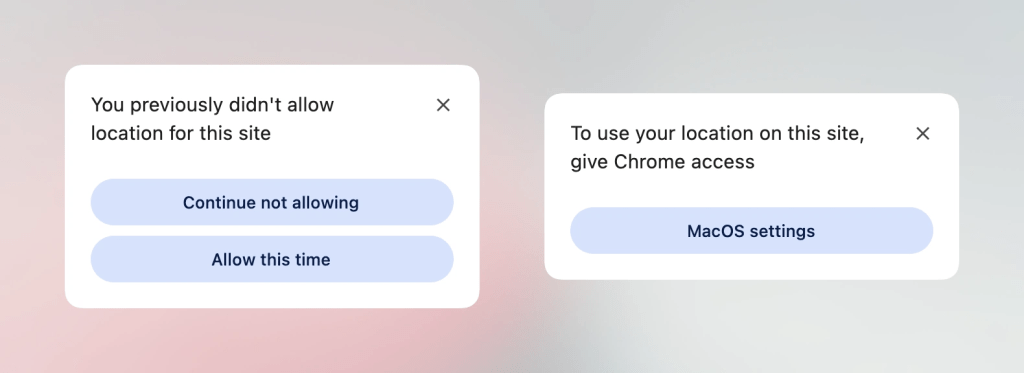
2. The <geolocation> HTML Element and the Future of Device Context
For decades, handling geolocation in web applications meant wading through the asynchronous complexities of the JavaScript Geolocation API. Developers had to orchestrate handshakes across GPS hardware, Wi-Fi triangulation nodes, and cellular towers, all while managing rigid, hard-to-reset browser permission states.
The introduction of the native <geolocation> HTML element aims to abstract much of this underlying complexity, though it introduces its own set of design system challenges—most notably, strict styling restrictions imposed by user agents for security and privacy reasons. Because support is currently isolated to Chrome, developers face an integration hurdle. Fortunately, architectural workarounds allow teams to use <geolocation> as a progressive enhancement layer sitting gracefully atop the legacy JavaScript Geolocation API. This hybrid strategy ensures that modern browsers leverage the declarative tag while older clients seamlessly degrade to programmatic requests.
3. MicroLighter: High-Performance Syntax Highlighting via the Custom Highlight API
Syntax highlighters have traditionally relied on heavy DOM manipulation, injecting hundreds of nested <span> elements into code blocks to colorize tokens. This approach degrades rendering performance on large files and inflates memory usage.
Dave Rupert introduced MicroLighter, a featherweight syntax highlighter built exclusively on top of the native Custom Highlight API (leveraging the ::highlight() pseudo-element). By separating the DOM tree structure from the styling layer, MicroLighter applies syntax colors via CSS without mutating the underlying text nodes. This architectural leap guarantees faster paint times, zero layout thrashing, and cleaner markup. The front-end community—with commentary from Geoff Graham and Dave Rupert himself—has widely celebrated this as a textbook example of how modern CSS pseudo-elements can replace complex JavaScript DOM parsers.
4. Bridging Layout and Variables: Extracting CSS Grid Data into Custom Properties
CSS Grid is arguably the most powerful layout engine ever built into the web platform, yet bridging its calculated metrics back into CSS custom properties (variables) has historically been a persistent developer pain point.
Temani Afif published a groundbreaking technique demonstrating how to extract CSS grid structural information—such as total rows, total columns, and individual cell X/Y coordinates—directly into CSS variables.
While this technique currently requires uniform column widths, it unlocks unprecedented styling capabilities. Afif demonstrated this by engineering a hover proximity detection system written entirely in modern CSS. By mapping grid coordinates to custom properties, elements can dynamically calculate their distance from the cursor and alter their styling in real-time, completely bypassing JavaScript mouse-tracking loops.
5. The Great Dark Mode Debate: Two-State vs. Tri-State
User preference management for color schemes continues to spark intense architectural debates across the design community. The core architectural question remains: Should dark mode implementations be two-state (Light/Dark) or tri-state (Light/Dark/System Auto)?
- Lea Verou advocates for a streamlined two-state approach, arguing that users ultimately prefer a definitive toggle once they override system defaults.
- Bramus Van Damme makes a passionate counter-case for tri-state architecture, emphasizing that respecting the operating system’s dynamic context while allowing manual overrides is critical for accessibility.
- Meanwhile, Vale.Rocks proposed a pragmatic middle ground: the auto-until-overridden two-state approach, which defaults to system settings but respects explicit user choice once toggled.
6. Syntactic Sugar: The Class Prefix Selector
Selector performance and readability are perennial concerns for large-scale web applications. Bramus introduced a proposal for the class prefix selector, a native syntax designed to target multiple classes sharing a common namespace without resorting to clumsy attribute selectors.
Instead of writing verbose and performance-heavy attribute queries like:
[class^="something-"]  /* ... */
[class*=" something-"]  /* ... */
The proposed class prefix selector enables a clean, highly optimized native syntax:
.something-*
  /* Targets all classes beginning with the specified prefix */
Though lacking current browser support, the simplicity, clean DX (Developer Experience), and performance advantages of this proposal suggest it will likely fast-track through the CSS Working Group.
7. Feature Detecting the Undetectable: @supports named-feature()
Querying browser capabilities has traditionally been limited to standard CSS properties and values via @supports (property: value). However, modern browsers implement complex layout engines where specific rendering behaviors (such as how transform matrices interact with CSS anchor positioning) remain entirely opaque to standard feature queries.
Bramus unveiled the @supports named-feature() function, currently supported in Chrome. This function empowers developers to query hyper-specific browser behaviors and rendering engine capabilities that were previously impossible to detect. This expands the scope of @supports from a simple property checker into a granular capability-auditing tool.
8. Balancing Flexbox Layouts: flex-wrap: balance
Following in the footsteps of the revolutionary text-wrap: balance property—which transformed responsive typography by evenly distributing text lines—Chrome has introduced flex-wrap: balance.
Ahmad Shadeed published an in-depth analysis of this new layout primitive. When applied to multi-row flex containers, flex-wrap: balance prevents awkward "orphaned" items on the final row by programmatically distributing flex items evenly across all available lines. This eliminates centuries of hacky media queries and rigid width calculations designed to make flexbox wraps look visually balanced.
Supporting Context & Metrics: The Paradigm Shift Toward Native Web Primitives
To fully appreciate the velocity of these updates, one must examine the broader metrics governing modern front-end engineering. Over the past twenty-four months, browser engine parity (driven by the interoperability efforts of the Interop project) has compressed the time between spec proposal and cross-browser stability.
| Feature / API | Primary Driver / Author | Current Engine Support | Performance Impact |
|---|---|---|---|
Interest Invokers (interest-delay-*) |
Chris Coyier / Abhishek Jakhar | Chrome (Experimental) | Reduces JS event listener overhead for hover states. |
<geolocation> Element |
Piccalilli / Standard Web | Chrome | Eliminates boilerplate JS wrappers for location prompts. |
MicroLighter (::highlight) |
Dave Rupert / Geoff Graham | Universal (Modern Browsers) | Dramatically reduces DOM node count; zero layout thrashing. |
| CSS Grid Variable Extraction | Temani Afif | Universal (Modern CSS Engines) | Enables pure CSS proximity calculations without JS loops. |
Class Prefix Selector (.something-*) |
Bramus Van Damme | Proposed (In Discussion) | Replaces expensive attribute selectors with native parsing. |
@supports named-feature() |
Bramus Van Damme | Chrome | Granular feature detection for complex layout behaviors. |
flex-wrap: balance |
Ahmad Shadeed | Chrome | Automatic visual equilibrium for multi-row flex items. |
The overarching metric uniting these developments is the systematic elimination of JavaScript-dependent polyfills and UI utility libraries. By pushing layout balancing, syntax highlighting, tooltip delays, and grid introspection directly into the browser’s native rendering pipeline, web applications are achieving unprecedented levels of execution speed and memory efficiency.
Official Statements & Community Perspectives
The discourse surrounding these releases underscores a maturing philosophy among web standards architects.
Geoff Graham, reflecting on the arrival of MicroLighter and the Custom Highlight API, noted:
"We are witnessing the death of the heavy syntax-highlighting DOM tree. By leveraging
::highlight(), we are treating text as text again rather than wrapping every single token in an administrative<span>tag. It’s cleaner, faster, and respects the semantic integrity of the document."
Bramus Van Damme, commenting on his series of exploratory proposals including the class prefix selector and named-feature(), emphasized the need for developer ergonomics in large codebases:
"As design systems scale to tens of thousands of components, our selectors and feature-detection queries must evolve. We can no longer rely on brittle attribute matching or blind assumptions about how rendering engines handle complex anchor positioning. We need native, expressive syntax that speaks directly to the browser’s internal capabilities."
Future Outlook: Preparing for the Next Era of CSS
As the industry transitions into the autumn release cycle of browser engines, the roadmap for web developers is unmistakably clear. The era of writing custom JavaScript to emulate native layout and interaction behaviors is drawing to a close.
Front-end teams must adopt a forward-looking mindset centered around progressive enhancement:
- Embrace Native Primitives: Adopt CSS Grid variable extraction and
flex-wrap: balanceimmediately to streamline responsive layouts without extraneous layout code. - Audit UI Performance: Replace legacy JavaScript-heavy syntax highlighters and tooltip libraries with
::highlight()-based tools and interest invokers. - Monitor Spec Proposals: Keep a close eye on the CSS Working Group regarding the class prefix selector and expanded
@supportsfunctions, as these will fundamentally alter how design systems are structured.
The web platform has never been more powerful, expressive, or performant. By harnessing these tools today, developers are laying the foundation for a faster, more resilient internet tomorrow.