Executive Overview
The adaptation of landmark interactive media into prestige television represents one of the most fraught endeavors in modern entertainment. When Prime Video announced its ambitious plans to bring Santa Monica Studio’s critical darling, God of War, to the small screen, the weight of expectation rested heavily on the creative team and, most crucially, the actor tasked with stepping into the imposing boots of the Ghost of Sparta.
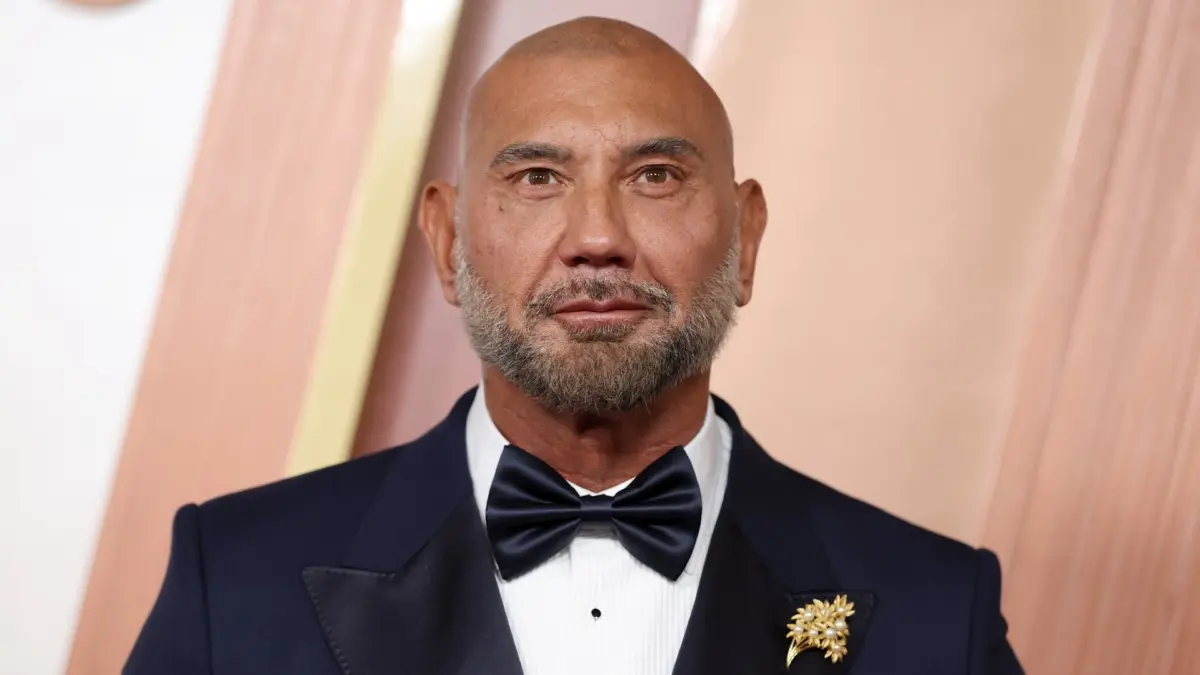
That immense physical and dramatic burden now rests firmly on the shoulders of Dave Bautista. In a recent social media update that has sent shockwaves through both the gaming and cinematic communities, the former WWE superstar and acclaimed character actor revealed that he has successfully packed on 20 pounds of pure muscle in preparation for his role as Kratos. Tipping the scales at a formidable 250 pounds, Bautista’s latest physical renaissance addresses the initial skepticism of purists head-on.
This transformation marks a dramatic pivot for an actor who, in recent years, deliberately shed his towering professional wrestling physique to pursue nuanced, character-driven cinematic roles. Bautista’s willingness to rebuild his colossal frame underscores his profound commitment to honoring the Norse-era iteration of Kratos—a weathered, world-weary deity whose imposing physical silhouette is as vital to his narrative identity as his complex emotional arc.
With Prime Video having already given a two-season greenlight to the series—which will adapt the beloved 2018 PlayStation masterpiece—Bautista’s physical milestone signals that production is marching forward with unrelenting intensity. This comprehensive report examines the timeline of Bautista’s casting, the rigorous training regimen behind his 20-pound muscle gain, the historical context of his physique changes, and what fans can ultimately expect from Prime Video’s monumental video game adaptation.
Detailed Chronology: From Casting Turmoil to Physical Metamorphosis
To fully appreciate the significance of Dave Bautista’s recent physique update, one must examine the turbulent sequence of events that brought the actor to the role of Kratos. The path to Prime Video’s God of War series has been marked by unforeseen hurdles, high-stakes recasting, and a compressed timeline that demanded absolute dedication from its leading man.
The Unfortunate Exit of Ryan Hurst
The foundational phase of Prime Video’s production suffered a major blow when original casting plans had to be entirely dismantled. Initially, actor Ryan Hurst—renowned for his commanding presence in Sons of Anarchy and his motion-capture performance as Thor in God of War Ragnarök—was slated to embody the iconic Spartan. However, production realities intervened during principal photography on early stunt sequences.
While filming an intense physical action beat, Hurst suffered a severe bicep tear. The injury required immediate medical intervention and an extended rehabilitation timeline that rendered him unable to complete the grueling physical demands of the series. Recognizing that the production schedule could not accommodate the necessary recovery period without incurring catastrophic delays, the creative team and studio executives made the difficult decision to part ways with Hurst, leaving a massive void at the heart of the series.
Bautista Steps Into the Breach
In August, Amazon MGM Studios announced the official recasting: Dave Bautista would step in to assume the mantle of Kratos. The announcement instantly galvanized the internet. Bautista, whose career trajectory has successfully transitioned from the squared circle of the WWE to critical darlings like Blade Runner 2049, Dune, and Knock at the Cabin, possessed the dramatic gravitas required to portray a god grappling with his violent past and his responsibilities as a father.
Yet, timing presented an immediate obstacle. With cameras rolling and the production momentum already established, Bautista was brought onto the project with a vanishingly small window to prepare his physical vessel for the colossal demands of the Ghost of Sparta.
The Three-Week Benchmark
By early September, just weeks after the ink on his contract had dried, Bautista offered fans a glimpse behind the curtain. Taking to Instagram, the actor shared a video showcasing an already noticeably improved and thickening physique. At that juncture, Bautista revealed a crucial detail regarding his schedule: he had been undergoing intensive weight training for a mere three weeks, leaving him with a tight two-month window to "get where he needs to be" physically before core action sequences and dramatic confrontations were captured on camera.
Crossing the 250-Pound Threshold
That two-month developmental window has now drawn to a close. In a recent update shared via his Instagram story, Bautista provided concrete numbers to mark the end of this grueling phase of physical conditioning. Featuring a prominent "250" digital sticker alongside the text "Gained 20 lbs for GOW," and sporting a branded God of War t-shirt, the actor confirmed he has successfully packed on 20 pounds of dense, functional muscle. The update was swiftly amplified across digital platforms, most notably by industry tracker DiscussingFilm, cementing the narrative that Bautista’s dedication to the role is absolute.
Supporting Context & Metrics: Rebuilding the Spartan Frame
The achievement of gaining 20 pounds of muscle in roughly two months is an extraordinary physiological feat, particularly for an actor in his mid-fifties. However, understanding why this transformation was necessary requires a deep dive into Bautista’s unique physical history, body composition changes, and the exacting aesthetic standards demanded by the God of War intellectual property.
The WWE Era vs. The Cinematic Shift
During his illustrious tenure as a professional wrestler with the WWE, Dave Bautista—performing under the moniker Batista—maintained an imposing, hyper-muscular average weight hovering around 290 pounds. During this period, his body was optimized for the visual spectacle and explosive power required of sports entertainment, fueled by heavy caloric intake and massive amounts of mass.

However, upon successfully transitioning into mainstream Hollywood cinema, Bautista made a conscious, strategic decision to downsize. In interviews following his breakout role as Drax the Destroyer in Marvel Studios’ Guardians of the Galaxy, the actor openly discussed shedding massive amounts of weight. By dropping down significantly from his wrestling peak, Bautista aimed to:
- Open up a wider variety of diverse, non-action-heavy acting roles.
- Alleviate the joint strain and physical discomfort associated with carrying nearly 300 pounds of mass.
- Improve his on-camera mobility and comfort during long shooting days.
While this deliberate slimming down allowed him to showcase his range in films like Glass Onion: A Knives Out Mystery and M. Night Shyamalan’s Knock at the Cabin, it inadvertently created a hurdle when the God of War casting was announced.
Overcoming Fan Skepticism
When Bautista was confirmed as the replacement for Ryan Hurst, a vocal faction of the gaming community expressed immediate skepticism. Having associated Bautista with his leaner, post-WWE cinematic build, some purists questioned whether the actor still possessed the sheer, mythic bulk required to convincingly portray Kratos—a character defined by marble-hewn shoulders, colossal traps, and a silhouette that commands absolute terror on the battlefield.
Critics argued that Kratos required a larger-than-life physical presence that a leaner, dramatic actor might struggle to project. Bautista’s recent 20-pound muscle acquisition—pushing his operational weight to a lean, functional 250 pounds—serves as an emphatic rebuttal to those doubts. Far from resting on his laurels as a decorated dramatic performer, Bautista undertook a punishing hypertrophy regimen to recapture the imposing physical geometry of a literal god of war.
Official Statements and Industry Reception
The reveal of Bautista’s 250-pound frame has elicited widespread commentary from industry insiders, fitness experts, and entertainment journalists alike. While full promotional rollouts and official character first-looks from Prime Video remain tightly under wraps, the digital footprint left by the actor’s social media disclosures has provided a clear window into the production’s internal ethos.
Industry observers have noted that Bautista’s willingness to radically alter his body composition for a television role highlights a rare level of commitment in modern streaming productions, where actors often rely on clever costuming, muscle padding, or digital alterations to achieve superhuman physiques. By choosing the hard road of natural hypertrophy and heavy compound lifting, Bautista ensures that every flex, strain, and battle-rage sequence captured by Prime Video’s cameras is grounded in authentic, physical reality.
Furthermore, the smooth transition following Ryan Hurst’s departure has been praised by studio insiders as a masterclass in crisis management. Rather than letting the production stall or attempting to cast an unknown substitute, Amazon MGM Studios secured a global star who not only possesses the acting chops to carry a prestige fantasy epic but is also willing to undergo a grueling physical transformation on short notice to satisfy the exacting visual demands of millions of passionate gamers.
Future Outlook: What to Expect from Prime Video’s God of War
As Dave Bautista solidifies his physical preparation at a formidable 250 pounds, anticipation for Prime Video’s God of War series reaches a fever pitch. With physical production fully underway under the guidance of showrunner Rafe Judkins and executive producers Mark Fergus and Hawk Ostby, the project is shaping up to be one of the most ambitious fantasy adaptations in television history.
Adapting the Norse Saga
Rather than revisiting the Greek mythology era of the original 2005–2010 PlayStation trilogy—which charted Kratos’s bloody vengeance against the Olympian pantheon—the Prime Video series will directly adapt the critically acclaimed 2018 soft reboot developed by Santa Monica Studio.
This era presents a profoundly different version of the character: an older, bearded Kratos living in self-imposed exile in the realm of Norse mythology. Having laid aside the Blades of Chaos (though eventually forced to reclaim them), this iteration of Kratos is striving to suppress his raging inner monster, hide his divine nature from his new family, and teach his young son, Atreus, how to survive in a harsh, unforgiving realm governed by unfamiliar gods and monsters.
Key Narrative Beats and Cast Dynamics
The series will trace the deeply emotional and perilous narrative arc of Kratos and Atreus as they embark on a sacred quest to scatter the ashes of Faye—Kratos’s late wife and Atreus’s mother—at the highest peak across all nine realms.
- Kratos: Portrayed by Dave Bautista, bringing an imposing 250-pound physical presence, profound emotional depth, and the paternal conflict inherent in guiding a son while fearing the passing down of his own destructive legacy.
- Atreus: Played by young actor Callum Vinson, capturing the inquisitive, vulnerable, yet increasingly capable nature of the demigod boy as he navigates his heritage.
Production Scale and Long-Term Vision
Demonstrating immense confidence in the creative vision and the commercial viability of the intellectual property, Prime Video bypassed the traditional pilot phase, giving the series a formal two-season order right out of the gate. This guarantees that the narrative breathing room required to flesh out the complex lore of Midgard, the Aesir, and the Vanir will be fully realized without feeling rushed.
As Bautista puts the finishing touches on his physical preparation and dives headfirst into the brutal choreography, wire-work, and dramatic heavy lifting of the series, fans can rest assured that the Ghost of Sparta is in fiercely capable hands. The transformation from a streamlined cinematic actor back into a mythic, 250-pound powerhouse proves that Dave Bautista isn’t just playing Kratos—he is willing to suffer the gods’ own labors to bring him to life.