By Saf Malik
Head of Content & Insights
04 November 2026
Executive Overview
The global financial markets experienced a sharp volatility spike following the outcome of the US midterm elections, sending immediate shockwaves through Asia’s technology supply chains. Japanese industrial heavyweights and AI infrastructure suppliers—most notably fiber-optic cable pioneers Fujikura and Furukawa Electric—suffered steep losses during Wednesday morning trade in Tokyo.
The sell-off was triggered by growing investor anxiety over a newly empowered Democratic Congress. Market participants rapidly began pricing in the likelihood of stricter regulatory oversight, tighter environmental and zoning restrictions on data center expansions, and a potential deceleration in aggressive domestic artificial intelligence (AI) spending by US hyperscalers.
While Japanese equities managed a partial afternoon recovery mirroring a stabilization in US index futures, the morning plunge underscored a fragile truth: Asia’s most lucrative technology hardware manufacturing ecosystems remain inextricably bound to shifting political winds in Washington. With grassroots anti-data center sentiment gaining momentum across dozens of American communities and regulatory bottlenecks multiplying domestically, the events of this week have forced institutional investors to re-evaluate the risk profiles of the foundational "picks and shovels" powering the global AI boom.
Detailed Chronology of the Sell-Off
Morning Trade Panic in Tokyo
The trading session on Wednesday opened under heavy selling pressure across Tokyo’s premier stock exchanges. As institutional algorithms digested the final congressional tallies from the United States, equity markets targeted companies that had previously enjoyed meteoric rises as direct beneficiaries of the generative AI infrastructure supercycle.
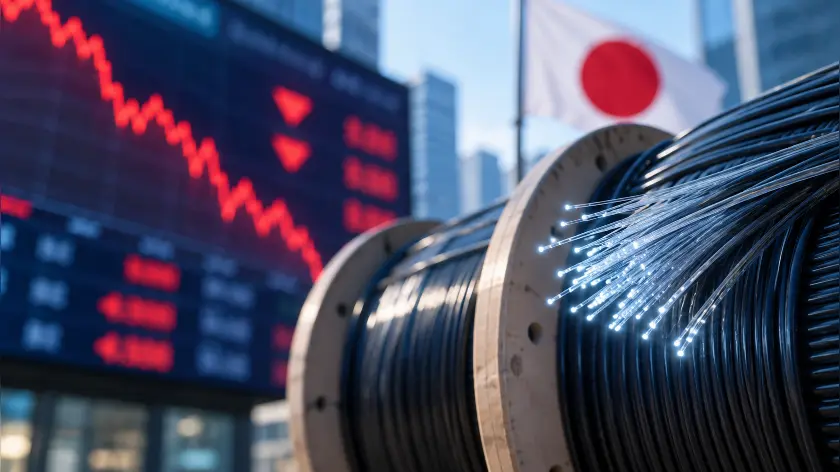
Fibre-optic cable manufacturers bore the brunt of the initial wave. Fujikura shares plummeted by as much as 8.2%, while rival Furukawa Electric suffered a steeper 9.0% drop in morning trade. The sell-off quickly broadened into a comprehensive retreat across Tokyo’s AI-adjacent hardware sector.
According to data from Bloomberg, the benchmark Nikkei 225 tumbled up to 4.8% intraday. Memory manufacturer Kioxia and precision electronic component maker Taiyo Yuden both absorbed devastating blows, plunging more than 13% at their daily lows. Major semiconductor equipment suppliers and tech conglomerates were not spared: chip-testing gear maker Advantest dropped 6.4%, Tokyo Electron slid 5%, and tech investment giant SoftBank Group saw its shares retreat by approximately 7%, as reported by Reuters.
The Afternoon Rebound and US Market Parallels
Despite the severe morning turbulence, the Japanese market exhibited remarkable resilience in the latter half of the trading day. Bargain hunters stepped in as panic selling subsided, allowing the Nikkei 225 to claw back a significant portion of its intraday losses. The index ultimately closed down a modest 1.42%, settling at 62,188.63.
A parallel dynamic played out across the Pacific. US markets followed a similar roller-coaster trajectory. Nasdaq 100 futures initially erased up to 2.4% of their value during Asian trading hours before staging a recovery. Market sentiment in the US stabilized following political reassurances, including statements from former President Donald Trump indicating a willingness to accept election results, which helped calm broader institutional nerves, as noted by Bloomberg.
Supporting Context & Metrics: Why Fibre and Hardware Are Exposed
To understand why traditional manufacturing firms in Japan reacted so violently to a US political shift, one must examine the mechanics of the modern AI buildout.
The "Picks and Shovels" of the AI Gold Rush
During the initial phases of the generative AI boom, hardware suppliers that provided physical connectivity and foundational components were hailed as the ultimate "picks and shovels" winners. Fibre-optic cable, in particular, is the critical nervous system of hyperscale data centers, facilitating the ultra-low-latency data transmission required to train massive large language models (LLMs).
The rewards for these suppliers had been astronomical. By late November 2024, Fujikura had crowned itself the single best-performing stock on the entire Nikkei 225 index, boasting a year-to-date share price surge exceeding 400%, according to historical reports by Fortune.
However, this hyper-exposure to a single secular trend cuts both ways. When US data center construction faces political, legal, or regulatory headwinds, the shockwaves travel instantaneously back down the supply chain to Asian manufacturing hubs.

Grassroots Resistance and Political Headwinds in the US
The market’s sudden anxiety was not born of speculation alone; it coincided with tangible domestic friction across the United States regarding the physical footprint of AI infrastructure.
On election Tuesday, voters in at least 33 local US communities successfully passed or backed ballot measures restricting the construction of new data centers. Furthermore, exit polling data released by NBC News revealed that 56% of voters considered the rapid, power-hungry expansion of AI and data center facilities to be a crucial or major factor influencing their vote for Congress.
State-level resistance is also compounding the issue. In Texas—long a preferred haven for data center developers seeking lax regulations and cheap land—voters elected a governor who has pledged to enact a strict moratorium on certain grid-intensive industrial projects. This follows closely on the heels of earlier grid policy freezes that forced developers to slam the brakes on planned builds, as previously tracked by Capacity.
Masahiro Yamaguchi, head of investment research at SMBC Trust Bank, noted to Bloomberg that global markets had swiftly pivoted to price in these emerging headwinds. The assumption that US hyperscalers could expand indefinitely without municipal or federal pushback has officially been shattered.
Official Statements and Industry Perspectives
Market analysts and financial experts have been quick to dissect the structural implications of Wednesday’s market correction, emphasizing that regulatory scrutiny is no longer a hypothetical risk for digital infrastructure investors.
Takamasa Ikeda, senior portfolio manager at GCI Asset Management, pointed directly to the shifting composition of the US legislature as a catalyst for investor caution.
"Winning seats in key states fuelled caution for stricter regulations on AI infrastructure investment," Ikeda explained, highlighting how a Democratic-controlled Congress is historically more inclined to impose rigorous environmental reviews, labor standards, and energy consumption caps on large-scale technological developments.
The sentiment is echoed across institutional desks in Tokyo and Singapore. Analysts point out that as AI data centers increasingly strain local power grids and consume vast quantities of water, energy regulators and central governments are stepping in to reclaim control over urban and regional planning.
Consequently, the narrative surrounding AI infrastructure has evolved. What was once viewed purely as an unstoppable growth story is now being analyzed through the lens of regulatory risk, municipal pushback, and grid capacity constraints—factors that directly threaten the order books of overseas suppliers like Fujikura and Furukawa.
Future Outlook: The Road to ITW Asia in Singapore
The timing of this market correction could not be more poignant for the global telecommunications and digital infrastructure sectors. Wednesday’s sell-off casts an intense spotlight on the upcoming debates scheduled for ITW Asia, running from 1 to 3 December at the Shangri-La Singapore.
Operating under the core theme “Building Networks for AI Demand,” the conference—alongside concurrent events like Datacloud Asia 2026—will serve as a crucial crucible for industry leaders trying to navigate this new geopolitical and regulatory landscape. Several key panel discussions directly address the precise risks that investors priced in during this week’s market fluctuations.
Key Questions Facing Asian Connectivity
The overarching question for Asian connectivity providers is whether US political risk must now become a permanent line item in corporate financial models.
- Hyperscaler Reliance vs. Domestic Policy: Much of the unprecedented demand driving Asia’s AI infrastructure suppliers originates directly from US hyperscalers (such as Microsoft, Google, Amazon, and Meta). If these tech giants face protracted delays, zoning bans, or power moratoriums on their home turf, their capital expenditure cycles will inevitably shift, directly impacting export volumes from Tokyo to Seoul.
- The Shift to Power Regulators: As reported extensively by Capacity, the authority to approve or deny digital infrastructure projects is rapidly shifting away from municipal zoning boards and into the hands of national energy regulators and central governments. How Asian suppliers adapt to these fragmented global approval processes will dictate their long-term valuations.
- Local Resistance Go Global: With communities in the US, Europe, and parts of Asia increasingly pushing back against the environmental impact of data centers, developers are being forced to innovate—exploring alternative energy sources, liquid cooling efficiencies, and off-grid power generation.
As executives, investors, and policymakers gather in Singapore this December, the events of early November will serve as an unignorable backdrop. The gold-rush era of uninhibited AI infrastructure spending has matured into a complex, highly regulated chess match. For Japan’s cable makers and the broader tech supply chain, navigating the next phase of the AI boom will require as much political agility as it does engineering excellence.
Event Details
- Event: ITW Asia and Datacloud Asia 2026
- Dates: 1 – 3 December 2026
- Location: Shangri-La Singapore
- Focus Areas: AI connectivity investment, power constraints, subsea capacity, and regulatory navigation.