Executive Overview
The landscape of enterprise artificial intelligence experienced a significant realignment as Amazon Web Services (AWS) announced the public preview of Amazon Bedrock Managed Agents powered by OpenAI. This strategic integration marries OpenAI’s powerful Agents API with AWS’s robust, enterprise-grade cloud architecture, built on a custom-engineered version specifically tailored for the AWS ecosystem. For enterprise architects, Chief Information Security Officers (CISOs), and cloud developers, this development represents a critical bridge, allowing organizations to harness top-tier OpenAI models directly within their native AWS infrastructure while leveraging existing identity access management, security guardrails, and governance policies.
Simultaneously, AWS has rolled out a comprehensive update to its broader service portfolio, including the expansion of frontier model choices on Amazon Bedrock, critical lifecycle shifts for legacy features, and community-driven initiatives heading into the final quarter of the year. This report provides an exhaustive, authoritative breakdown of these announcements, detailing their architectural implications, operational workflows, and strategic significance for the global cloud community.
Detailed Chronology: Unpacking the Bedrock Managed Agents Integration
The Genesis of AWS-Native OpenAI Agents
The announcement, spearheaded by AWS leadership, addresses a long-standing enterprise dilemma: how to utilize cutting-edge generative AI models from OpenAI without fragmenting security postures or introducing shadow IT architectures. Historically, deploying advanced agentic workflows required custom API wrappers, external data-routing pipelines, and fragmented permission schemas.
The public preview of Amazon Bedrock Managed Agents fundamentally alters this dynamic. By utilizing a customized version of OpenAI’s Agents API deeply integrated into the AWS-native control plane, developers can now orchestrate complex, multi-step autonomous tasks entirely within the confines of their secure cloud perimeters.
Architectural Execution Environments
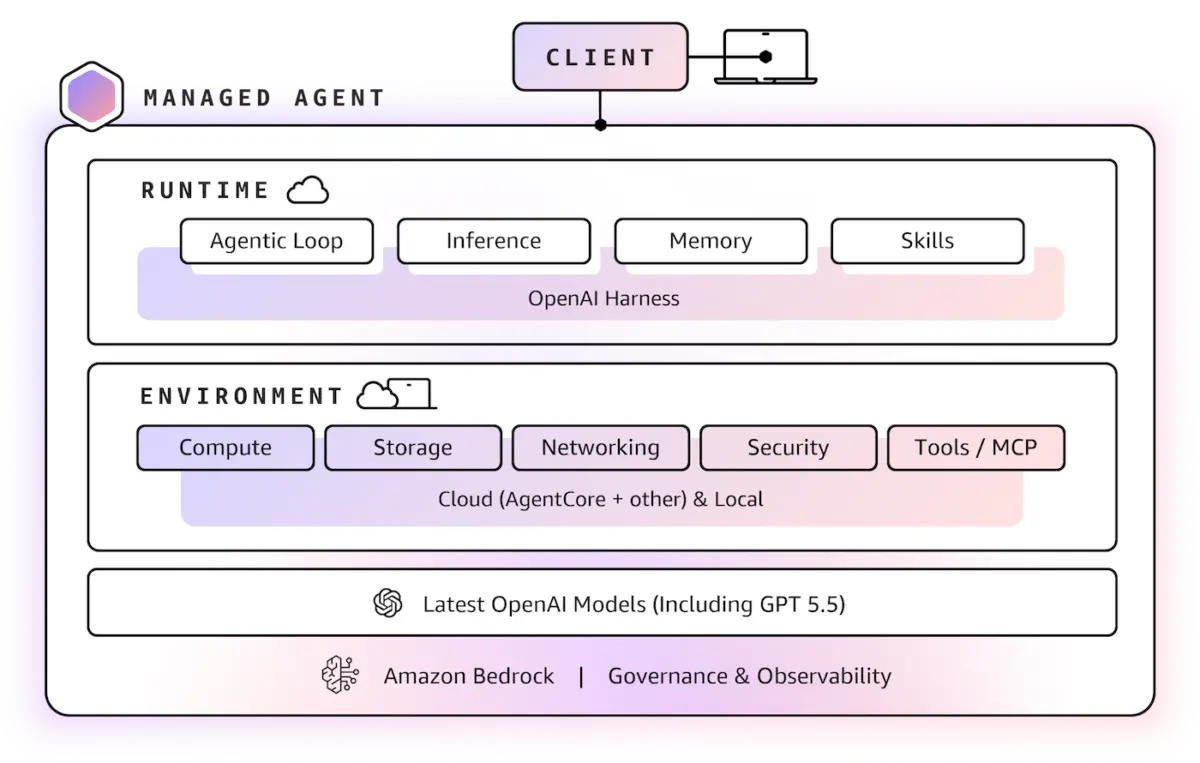
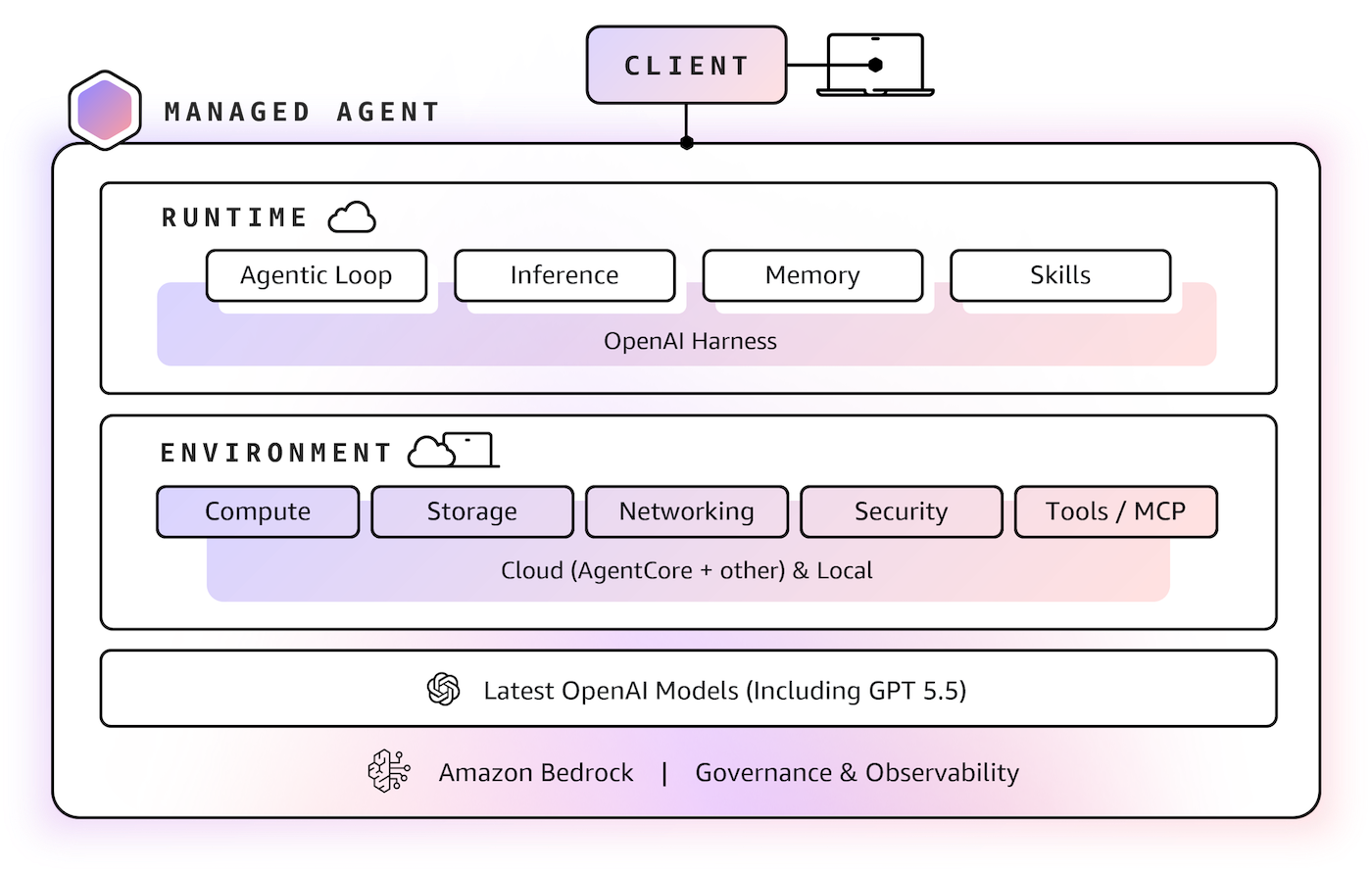
A cornerstone of this release is the flexibility afforded to development teams regarding execution environments. AWS has engineered two distinct deployment paths to cater to varied organizational maturity levels and security requirements:
- Self-Hosted Compute: For development teams desiring granular control over their runtime environments, AWS allows agents to run on existing local development machines, customized containers, or self-managed compute instances. This is ideal for early-stage prototyping, debugging, and offline development pipelines.
- Amazon Bedrock AgentCore Runtime: For production workloads demanding high availability, elasticity, and zero-management overhead, AWS introduces the Bedrock AgentCore Runtime. This fully managed execution environment handles scaling, session management, and configurable data storage directly inside the customer’s designated AWS account, ensuring that sensitive intermediate states and agent memory never leave the secure corporate boundary.
Governance, Identity, and Permissions
In enterprise deployments, data leakage and unauthorized API execution remain paramount concerns. Amazon Bedrock Managed Agents inherit AWS’s foundational security matrix. Agents operate under strict AWS Identity and Access Management (IAM) roles, enabling fine-grained least-privilege access to corporate databases, S3 buckets, and internal microservices. Furthermore, logging and monitoring are natively integrated with AWS CloudTrail and Amazon CloudWatch, offering complete auditability over every agent-driven transaction and API call.
Supporting Context & Metrics: Model Expansion and Product Lifecycle Realignment
Expanding Frontier Horizons on Amazon Bedrock
Beyond the OpenAI integration, AWS continues to execute its multi-model strategy. Enterprise customers are increasingly demanding choice rather than vendor lock-in. To address this, AWS is continuously updating Amazon Bedrock with new frontier models. This agility allows organizations to benchmark different model weights against specific workloads—whether optimizing for mathematical reasoning, low-latency code generation, or nuanced multilingual comprehension—without altering their underlying orchestration layer.
Product Lifecycle Adjustments and Operational Guidance
Cloud evolution inevitably necessitates the deprecation of older features to make way for modern, high-performance architectures. AWS updated its Product Lifecycle Changes framework, issuing clear guidelines for services transitioning through maintenance, sunset, and end-of-support phases.

To prevent operational disruptions, AWS maintains a structured lifecycle methodology:
- Maintenance Phase: Services entering this tier become inaccessible to new customers, while existing users are provided with comprehensive migration paths and alternative architectural recommendations.
- Sunset and End-of-Support: Services reaching these final milestones require immediate migration action by engineering teams. AWS has emphasized its commitment to providing documentation, transition toolkits, and dedicated support channels to guide enterprises through these mandatory upgrades smoothly.
Official Statements and Industry Implications
Bridging the Ecosystem Divide
Industry analysts have noted that the integration of OpenAI technology into the AWS-native Bedrock framework signals a pragmatic evolution in the cloud computing wars. Rather than forcing enterprises into a single, monolithic ecosystem, hyperscalers are increasingly recognizing the need for interoperability.
"Enterprise customers do not want to choose between the best foundation models in the market and the most secure, scalable cloud infrastructure," noted cloud industry observers following the announcement. "By bringing OpenAI’s agent capabilities directly into Bedrock with native IAM and governance controls, AWS is removing the friction that has traditionally slowed down generative AI adoption in highly regulated sectors."
The Developer Experience
For the builder community, the announcement simplifies the deployment lifecycle. Developers no longer need to build complex custom middleware to translate OpenAI function-calling schemas into AWS Lambda invocations or ECS tasks. The Bedrock Managed Agents framework handles state management, tool invocation, and error handling natively, allowing engineers to focus on business logic rather than integration plumbing.
Future Outlook: Preparing for re:Invent and Beyond
As the technology sector looks toward major year-end gatherings—including the upcoming AWS re:Invent conference and global AWS Community Days—the release of Bedrock Managed Agents sets a definitive tone for the future of cloud-based autonomous systems.
What Builders Should Do Next
- Review Architecture Blueprints: Engineering teams should review the official Amazon Bedrock documentation regarding the OpenAI Agents API integration to map out how existing serverless and containerized workloads can incorporate these new agents.
- Assess IAM Policies: Security administrators must audit current IAM roles and permissions to ensure that least-privilege principles are established well in advance of deploying managed agents into staging or production environments.
- Engage with the Community: Builders are encouraged to connect via the AWS Builder Center to share early implementation strategies, access peer reviews, and participate in upcoming developer-focused virtual and in-person sessions.
The convergence of OpenAI’s advanced reasoning capabilities with AWS’s enterprise infrastructure marks a watershed moment for generative AI deployment. As organizations transition from basic chat interfaces to complex, autonomous agentic workflows, platforms like Amazon Bedrock Managed Agents will serve as the foundational bedrock of the next generation of cloud applications. Check back next Monday for the next comprehensive Weekly Roundup from the AWS ecosystem.