"Scientists representing the world’s foremost research centers took part in the examination of the evidence. The facts that will be presented are true. This may be the most startling film you’ll ever see."
— Peter Graves, The Mysterious Monsters (1975)
Executive Overview
The 1970s was an era defined by institutional distrust. In the shadow of the Vietnam War and the Watergate scandal, the glossy, optimistic veneer of post-war America fractured. As the public grew deeply skeptical of the government, the judicial system, the military, and local law enforcement, a cultural shift took root. Citizens began to question long-held perceptions of reality itself, turning their gaze toward the occult, extraterrestrial life, and cryptozoology.
Into this fertile vacuum stepped Sunn Classic Pictures. Based in Utah, this independent production house recognized a massive, unserved appetite for the unexplained. Long before the era of viral TikTok mysteries, niche subreddits, or Wikipedia rabbit holes, Sunn Classic capitalized on this collective cultural curiosity. They manufactured a cinematic empire out of partially-dramatized "documentaries" that tantalized audiences with the boundaries of human knowledge.
Releasing low-budget, high-concept features about Bigfoot, the Bermuda Triangle, near-death experiences, and biblical archaeology, Sunn Classic bypassed traditional Hollywood distribution and pioneered a ruthless, highly lucrative marketing strategy. Their films did not merely entertain; they captured the zeitgeist of a paranoid generation, transforming fringe pseudoscience into a mainstream box-office phenomenon.
Detailed Chronology: The Rise of the Pseudoscience Cinema Machine
The Accidental Beginning (1971–1972)
The genesis of Sunn Classic Pictures traces back to an unexpected phone call in 1971. James L. Conway, then a senior studying mass communications at the University of Denver, answered a ring from Charles E. Sellier Jr., an entrepreneur running an industrial film and commercial production company in Denver.
"Chuck was looking for cheap labor to edit his industrial films," Conway recalls. "I said, ‘I’m your guy.’ While I finished college, I worked for Chuck, and after about three months, I said to him, ‘You know, I can direct these shows better than the people you’re hiring.’ Total chutzpah. He gave me a shot, I did really well, and that began our relationship."
After collaborating on a western comedy titled The Brothers O’Toole, Sellier partnered with Sunn Classic Pictures. Originally operating as a distribution outfit in Utah, Sunn was a newly founded subsidiary of the Schick razor company. Having achieved moderate success with outdoor hunting pictures like The Life and Times of Grizzly Adams, the company shifted its focus toward pseudoscience documentaries.
The Chariots of the Gods Phenomenon (1973)
Sunn’s pivot truly began when they acquired, re-edited, and English-dubbed Chariots of the Gods, a 1970 German documentary based on Erich von Däniken’s pseudoscientific text proposing that ancient celestial beings engineered early human civilization. Released in 1973, the film grossed over $25 million—a staggering sum for the era—and surprisingly earned an Academy Award nomination for Best Documentary Feature.
Noted film scholar Dr. Gary D. Rhodes, author of the book Weirdumentary, points to Chariots of the Gods as the urtext of the 1970s strange-documentary movement.
"The fact that it was nominated for an Academy Award suggests how many more people were taking these ideas seriously," Rhodes explains. "I hesitate to think a documentary on that subject now would get an Academy Award nomination. From the late ’60s we see a rise in interest in everything from occultism and psychic phenomena, new age philosophies, magic, astrology, paganism, life after death, anti-materialism, holistic medicine, reincarnation… there’s a desire to find alternate ways of examining our experiences that is unique to that era, including academia."
The Monster Mash and Biblical Archaeology (1975–1976)
Having unlocked a winning formula, Sunn Classic unleashed a wave of sensational features. In 1975, they released The Mysterious Monsters, hosted by Mission: Impossible star Peter Graves, which served as a cinematic sampler platter of cryptids.
"For me as a little kid, I certainly loved Mysterious Monsters the most of any of them because it was the era of fascination with Bigfoot, widespread belief that there might be such a creature," Rhodes notes. "There was equal interest in the Loch Ness monster and the Yeti. There were documentary films individually about all of those monsters, but here it was like the Universal monster rally films where you were getting all of them at once."
The film synthesized older television segments, including CBS’s Monsters! Mystery or Myth, which helped cement the legendary status of the Roger Patterson and Robert Gimlin Bigfoot footage.
Because Sunn Classic was run by members of The Church of Jesus Christ of Latter-day Saints, Rhodes notes that the company consciously "wanted to tap into films where everybody from a little kid to the grandparents could go and not feel out of place or offended." Sellier dubbed this demographic "the lost audience"—viewers alienated equally by sanitized Disney children’s fare and the blood-and-nudity-soaked gritty realism of New Hollywood masterpieces like Taxi Driver and The Exorcist.
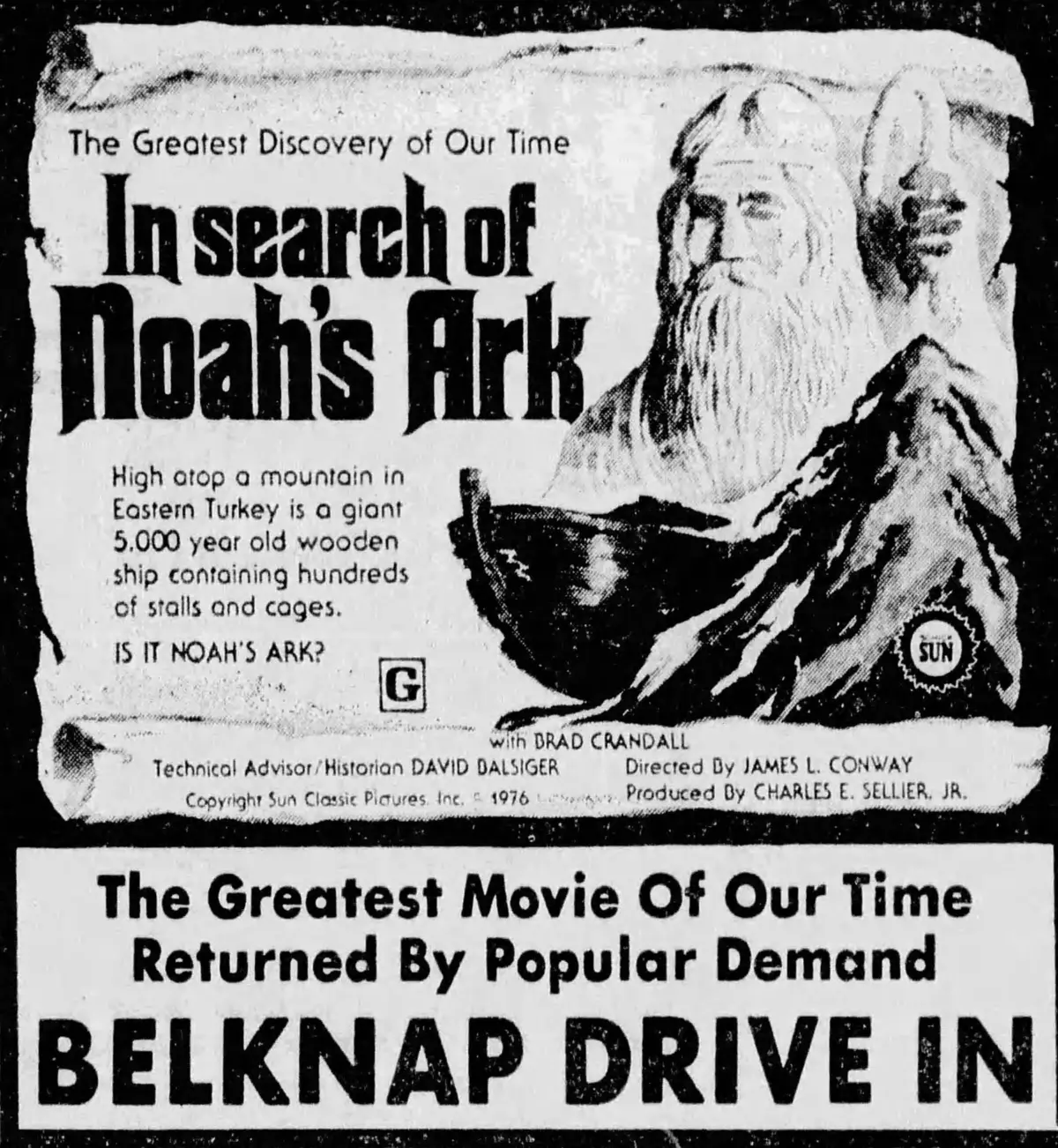
Sunn’s slate soon expanded to validate Christian faith through pseudoscientific inquiry. Their most lucrative venture in this vein was In Search of Noah’s Ark (1976), co-written and directed by Conway and based on a book by Sellier and David W. Balsiger. Positing that the physical remains of the Ark rested atop Turkey’s Mount Ararat, the film featured dramatic reenactments and presented a blurry photograph as definitive, smoking-gun evidence.
Narrated with gravitas by Brad Crandall, the film declared:
"The answer came in late September of 1974 when an expedition from the Holy Ground Mission in Frankston, Texas, scaled Mount Ararat… When studied under photographic enlargement, the outline of the ship is not only clear but planking can actually be seen—the planking of Noah’s Ark."
Supporting Context & Metrics: The Mechanics of "Four-Walling"
Sunn Classic’s financial success relied as much on business innovation as it did on sensational subject matter. The studio spent tens of thousands of dollars on market research—polling shoppers at malls—to determine which fringe topics held the highest public interest. They even analyzed meteorological data to route their theatrical rollouts around severe winter snowstorms.
Once a film was finalized, Sunn bypassed traditional Hollywood distribution frameworks entirely, utilizing a distribution model known as "four-walling."
As Conway explains:
"We’d say, ‘We’re going to pay you $25 cash for Friday night, $25 cash for Saturday night. We control the box office. Everything that comes in is ours.’ Because it was four-walled, we did very heavy television commercials. We would only have, let’s say, 300 prints of the movie. It would go into a city like Chicago, play two nights at this one theater, three nights at a different theater, four nights at another theater, and the commercials would list all the different movie theaters it was going to be on each night. They were enormously successful. On In Search of Noah’s Ark I think our budget was $600,000 and it grossed $55 million. It was the 9th highest grossing movie of 1976."
Rhodes praises the audacity of the strategy: "Four-walling was a brilliant strategy. Sunn Classic were, in some respects, using old tricks of the trade not unlike the roadshow cinema of the early 20th century. In other respects, they were way ahead of their time."
Official Statements and Insider Perspectives
The cultural footprint of Sunn Classic eventually bled into television, sparking industry competition. Producer Alan Landsburg adopted Sunn’s successful formula for the small screen, launching the iconic docuseries In Search of… hosted by Leonard Nimoy, which ran from 1976 to 1982.
"He came after us with the In Search of… television series, basically ripped off our In Search of Historic Jesus and In Search of Noah’s Ark," Conway asserts. "He made it a TV series that was very successful, but that came after we had done our stuff."
Despite accusations of sensationalism and shaky scholarship, the filmmakers understood that absolute factual accuracy was secondary to emotional resonance.
"Belief was not essential," Conway reflects on projects like Beyond and Back (1978), which explored near-death experiences. "Some I believed in more than others. As I was interviewing all these different people, I became more of a believer in it. Some of the other things we did, the more people I talked to the less I might have actually believed it, but you still present it."
Sunn’s internal quality control was achieved through pioneering audience testing methodologies. "We were one of the first people to do a lot of audience testing," Conway notes. "We would make a film, and then we would screen it and people would have dials. If they liked something they would go right, didn’t like it, go left. We would actually adjust the editing based on if something just completely sucked."
Future Outlook: The Enduring Legacy of Pseudoscience Entertainment
Eventually, the novelty of occultism and conspiratorial phenomena wore off as Hollywood mainstreamed these themes into major fictional blockbusters like Close Encounters of the Third Kind, Carrie, and The Amityville Horror. As pseudoscience became woven into everyday popular culture, theatrical audiences lost interest in paying admission for faux-documentary investigations. Sunn Classic eventually transitioned into fictional feature films like Hangar 18 before being absorbed by Taft Entertainment, later winding up under Aaron Spelling and Paramount.
Nevertheless, the DNA of the 1970s "weirdumentary" persists. Modern networks like The History Channel and Discovery continue to feed audiences a steady diet of programming dedicated to UAPs, skinwalkers, and lost civilizations. Podcasts, digital blogs, and streaming services endlessly recycle the exact same lore pioneered by Sunn Classic half a century ago. Even when foundational evidence—such as the Patterson-Gimlin Bigfoot recording or Erich von Däniken’s ancient astronaut theories—is thoroughly debunked, public fascination remains unbroken.
"Certainly as kids these subjects resonated because you are more naive," Rhodes concludes. "There’s always one more piece of possible evidence to be tantalizing. ‘Even if one thing was faked, that doesn’t mean it’s all fake. What about these others?’ There is a kind of whataboutism… From a historical film perspective, these movies are fun. There’s a nostalgia factor. James Conway, Charles Sellier, Alan Landsburg… they’re heroes to me. They made incredibly fun movies, even if I disbelieve the subjects. They’re wonderful."