Executive Overview
In the relentless pursuit of understanding the universe’s most elusive and energetic phenomena, astronomers have achieved a major milestone. Utilizing the unprecedented capabilities of the James Webb Space Telescope (JWST), a global team of researchers has successfully identified the host galaxy of the most distant Fast Radio Burst (FRB) ever detected. First identified in 2024 by the MeerKAT ground-based radio telescope array, this ancient burst of cosmic energy has provided scientists with a rare window into the early universe—and vital clues regarding how these mysterious emissions are born.
Fast radio bursts are intensely bright, millisecond-long flashes of radio waves originating from deep space. Despite lasting only a fraction of a second, a single FRB can release an incomprehensible amount of energy—equivalent to the total energy output of our Sun over three days. Since their accidental discovery in 2007, FRBs have baffled astrophysicists. Their fleeting nature and extreme distances make them notoriously difficult to trace to their sources.
However, by leveraging the near-infrared vision of the James Webb Space Telescope, researchers peered back in time to pinpoint the exact galactic cradle of the 2024 signal. The findings, published in the prestigious journal Science, not only shatter previous distance records for localized FRBs but also challenge prevailing theories about their astronomical origins. By pointing toward a catastrophic stellar explosion rather than a binary stellar merger, this discovery marks a critical turning point in our understanding of high-energy astrophysics.
Detailed Chronology: From the MeerKAT Detection to Webb’s Breakthrough
The journey to unraveling this cosmic mystery began with a state-of-the-art radio telescope array and culminated in an unprecedented infrared observation millions of light-years away.
The 2024 Breakthrough at MeerKAT
The story of this record-breaking discovery began in 2024, when the MeerKAT radio telescope array—situated in the Karoo region of South Africa—intercepted an anomalous signal from deep space. MeerKAT, known for its high sensitivity and wide field of view, detected a classic Fast Radio Burst. Preliminary data analysis quickly revealed that this was no ordinary local signal; the dispersion measure (how much the radio waves are delayed by the matter they pass through on their way to Earth) indicated that the signal had traveled across an immense cosmic expanse.
Astronomers realized they were looking at the farthest fast radio burst detected to date. While radio telescopes like MeerKAT are exceptionally skilled at capturing the transient radio pulses, they typically lack the angular resolution required to pinpoint the precise host galaxy from which the signal originated. To bridge this gap, astronomers needed a telescope capable of deep optical and infrared imaging.
Deploying the James Webb Space Telescope
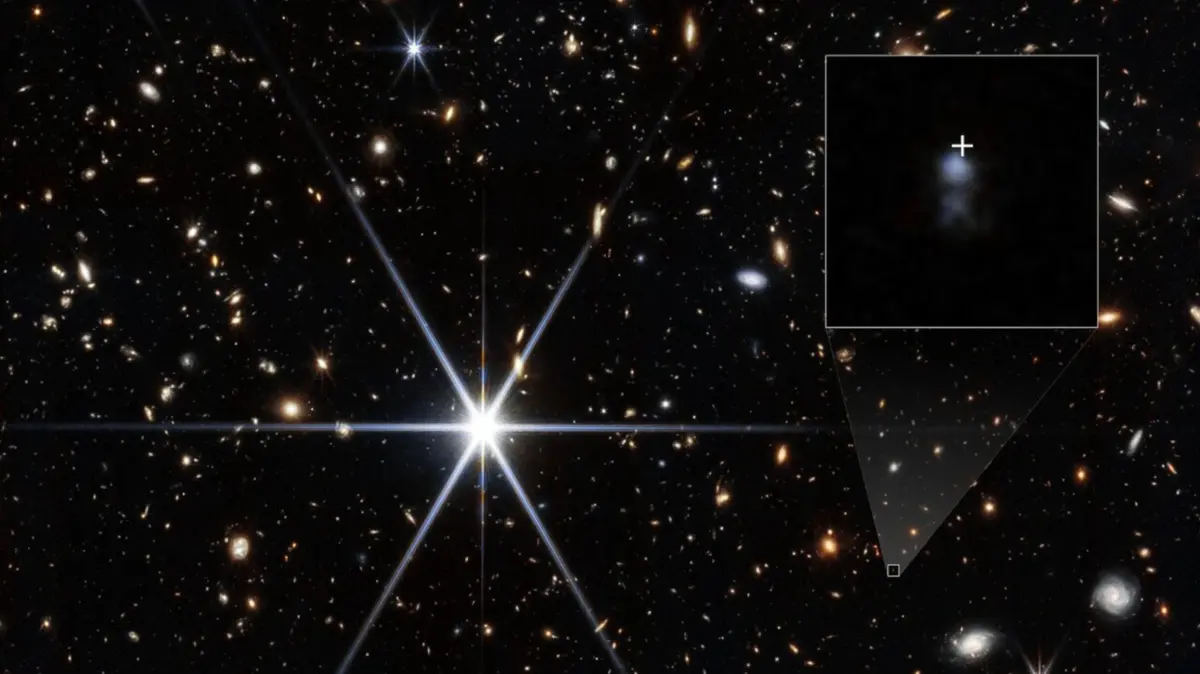
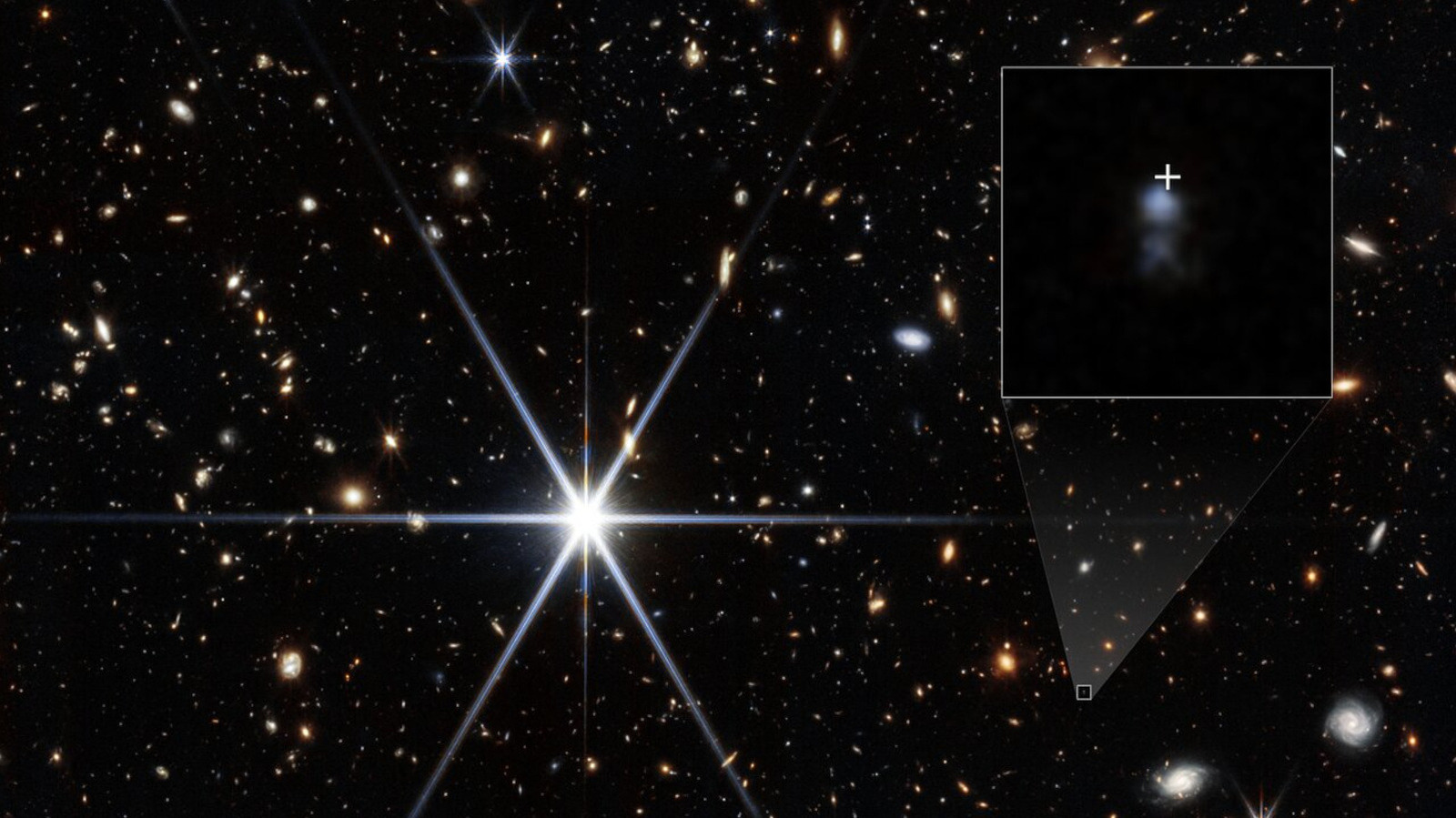
Enter the James Webb Space Telescope. Tasked with the challenge of finding the needle in a cosmic haystack, researchers directed JWST’s powerful near-infrared instruments toward the coordinates estimated by radio triangulation.
Using its Near-Infrared Camera (NIRCam), Webb stared deep into the targeted patch of the sky. The telescope successfully identified a faint, distant galaxy situated precisely along the line of sight from which the radio burst had emanated. By analyzing the light spectrum of this newly discovered galaxy, researchers were able to measure its redshift—the degree to which the expansion of the universe has stretched the galaxy’s light toward the red end of the spectrum.
The calculations revealed a staggering reality: the fast radio burst had occurred approximately 3 billion years after the Big Bang, during an era when the universe was in its cosmic infancy. This places the event billions of years further back in cosmic history than any previously localized FRB, offering an unprecedented look at how high-energy phenomena operated in the early cosmos.
Supporting Context & Metrics: Decoding the Cosmic Anomaly
To fully grasp the significance of this discovery, it is essential to examine the unique characteristics of both the fast radio burst and its surprising home galaxy, as well as the theoretical framework governing FRB origins.
A Miniature Galaxy in the Early Universe
One of the most shocking revelations from the JWST data was the physical nature of the host galaxy itself. Based on theoretical models of galaxy evolution, astronomers expected a galaxy from that era—when star formation across the universe was at its absolute peak—to be massive, turbulent, and expansive.
Instead, the galaxy that produced the 2024 FRB proved to be roughly 1,000 times smaller than expected. It is a compact, dwarf-like stellar system that punched far above its weight class in terms of energy production. This stark contrast challenges modern models of galaxy formation and suggests that the mechanisms capable of generating FRBs can thrive in environments previously thought too small or inhospitable.
The Physics of Fast Radio Bursts
To understand why this discovery is shaking up the astrophysics community, one must examine the two primary competing theories regarding how FRBs are generated:
- The Binary Neutron Star Merger Theory: This hypothesis suggests that FRBs are born when two neutron stars—the incredibly dense, collapsed cores of massive supergiant stars—spiral inward and collide. However, stellar evolution dictates that it takes billions of years for a binary system of massive stars to evolve, age, and ultimately merge. Consequently, if FRBs were exclusively the result of mergers, they should only be found in older, more mature galaxies with a long history of stellar evolution.
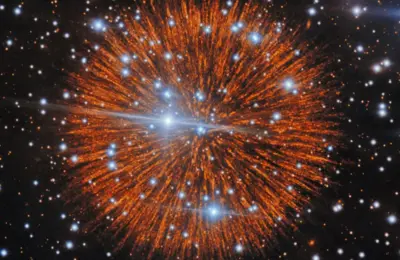
- The Magnetar Supernova Theory: The alternative theory proposes that FRBs are spawned when massive, short-lived stars reach the end of their lives, exploding in a catastrophic supernova. This explosion leaves behind a magnetar—a rare and exotic type of neutron star possessing an intensely powerful magnetic field trillions of times stronger than Earth’s. Because massive stars burn through their fuel quickly and die young, magnetars can form rapidly, meaning this mechanism is entirely compatible with young, distant, and smaller galaxies.
Metrics of the Discovery
- Time of Occurrence: ~3 billion years after the Big Bang.
- Host Galaxy Size: Approximately 1,000 times smaller than the massive star-forming galaxies typically associated with previously localized FRBs.
- Energy Output: A single millisecond flash releases energy comparable to what our Sun emits over three days.
- Instrument Lineage: Discovered by the ground-based MeerKAT radio array and localized via the space-borne James Webb Space Telescope.
Official Statements and Expert Analysis
The implications of the JWST observations have reverberated throughout the international scientific community, prompting leading researchers to reevaluate longstanding assumptions about stellar lifecycles and cosmic transients.
Dr. Manisha Caleb of the University of Sydney in Australia served as the lead author of the groundbreaking study published in the journal Science. Commenting on the weight of the new data, Dr. Caleb stated:
"Our work suggests that it’s very unlikely that this [fast radio burst] was produced by a merger."
This assertion directly targets the binary neutron star merger hypothesis. Because the host galaxy existed during the peak era of star formation and is remarkably compact and young, the timeline simply does not support the multi-billion-year aging process required for a neutron star merger.
Instead, Dr. Caleb and her co-authors point toward a stellar explosion as the most plausible culprit. By providing robust observational evidence that an FRB can originate from a compact, early-universe dwarf galaxy, the study strongly reinforces the theory that certain types of energetic star explosions—specifically those giving rise to magnetars—are capable of generating these intense radio pulses.
Other astrophysicists collaborating on the research have emphasized the sheer power of combining ground-based radio astronomy with space-based infrared imaging. While radio telescopes provide the ears to hear the universe’s whispers across vast distances, instruments like the James Webb Space Telescope provide the eyes necessary to locate the exact neighborhoods where these cosmic fireworks take place.
Future Outlook: The Next Frontier in Radio Astronomy
The successful localization of the farthest fast radio burst to date marks not an endpoint, but a brilliant new beginning for time-domain astronomy. As researchers digest the data returned by the James Webb Space Telescope, the scientific community is already looking toward the horizon to plan the next phase of discovery.
Expanding the FRB Census
To date, astronomers have only been able to precisely localize a small fraction of the thousands of fast radio bursts detected by ground-based arrays. Many FRBs are one-off events that flash once and never repeat, making them notoriously difficult to track down without ultra-precise interferometry.
With JWST demonstrating its capability to identify host galaxies deep in the cosmic dawn, astronomers now have a proven methodology for studying the environments of ancient FRBs. Future observation campaigns will likely target additional high-redshift bursts to determine whether the dwarf galaxy discovered in this study is an outlier or part of a broader trend among early-universe transients.
The Upcoming Square Kilometre Array (SKA)
The hunt for fast radio bursts is also set to receive a massive technological upgrade on the ground. The upcoming Square Kilometre Array (SKA), currently under construction in South Africa and Australia, will boast unprecedented sensitivity and survey speed. The SKA is expected to discover tens of thousands of new FRBs every year, many of them from the farthest reaches of the observable universe.
When paired with the deep-imaging capabilities of next-generation space telescopes—including future upgrades to JWST and upcoming observatories like the Nancy Grace Roman Space Telescope—astronomers will be able to construct a comprehensive evolutionary timeline of fast radio bursts.
Unraveling Fundamental Physics
Beyond understanding the stellar engines that power them, fast radio bursts serve as invaluable probes of the cosmos. As radio waves travel billions of years across the universe to reach our detectors, they interact with the gas and plasma residing in the intergalactic medium. By analyzing how these signals are dispersed and distorted along their journey, scientists can map the "missing matter" of the universe—the diffuse gas threads connecting galaxies that are otherwise nearly impossible to detect.
As we stand on the precipice of a new era in astrophysics, the discovery of this ancient fast radio burst’s galactic home reminds us of how much remains hidden in the dark expanses of space. Thanks to the synergy between radio arrays like MeerKAT and the unprecedented infrared vision of the James Webb Space Telescope, humanity is steadily shining a light into the deepest corners of the cosmos, transforming ephemeral flickers into profound insights about the origin of the universe itself.