Executive Overview
In the ever-evolving landscape of front-end development, cascading style sheets (CSS) have long transitioned from a simple document-styling language into a robust, programmable environment. Modern specifications continue to bridge the gap between static design tokens and dynamic application logic. Yet, certain architectural limitations have stubbornly persisted. Chief among these is the static nature of the structural pseudo-class selector: :nth-child().
Traditionally, if a developer wishes to target elements using a repeating sequence—such as every fifth item offset by eight (5n + 8)—they are required to hardcode those values directly into the stylesheet. Should design requirements shift, forcing an update to the multiplier or the offset, the developer must manually rewrite the selector. The Holy Grail of styling—controlling these mathematical arguments on the fly via CSS custom properties (variables)—has historically been impossible.
Until now.
Recent advancements in browser standards—specifically the introduction of inline conditional functions like if(), advanced container style queries, and sibling indexing functions (sibling-index() and sibling-count())—allow developers to rewrite established features from the ground up. While re-implementing a native feature might initially appear redundant or purely academic, this deep dive reveals a masterclass in modern CSS engineering. By orchestrating these bleeding-edge features, developers can construct a fully dynamic, variable-driven counterpart to :nth-child(), opening up unprecedented avenues for interactive design, algorithmic styling, and computational layout management.
Detailed Chronology: The Evolution Toward Dynamic Structural Selectors
To understand the magnitude of this breakthrough, one must examine the trajectory of CSS layout logic. For decades, stylesheets operated under a strict separation of concerns where layout parameters were immutable at runtime unless manipulated via JavaScript injection.
Phase 1: The Static Era of Pseudo-Classes
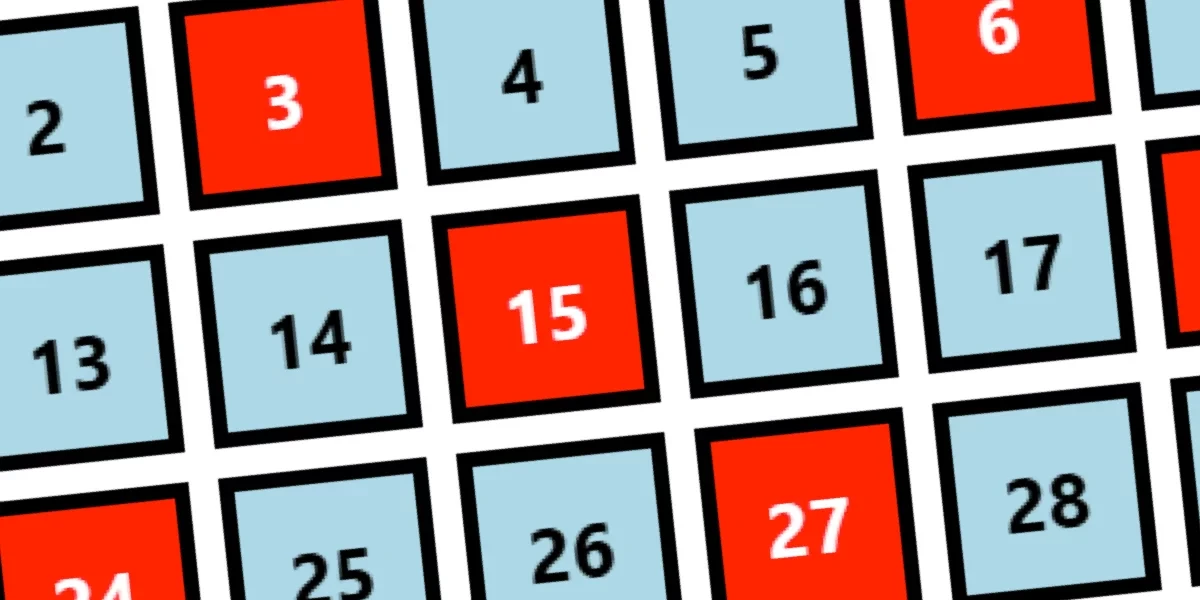
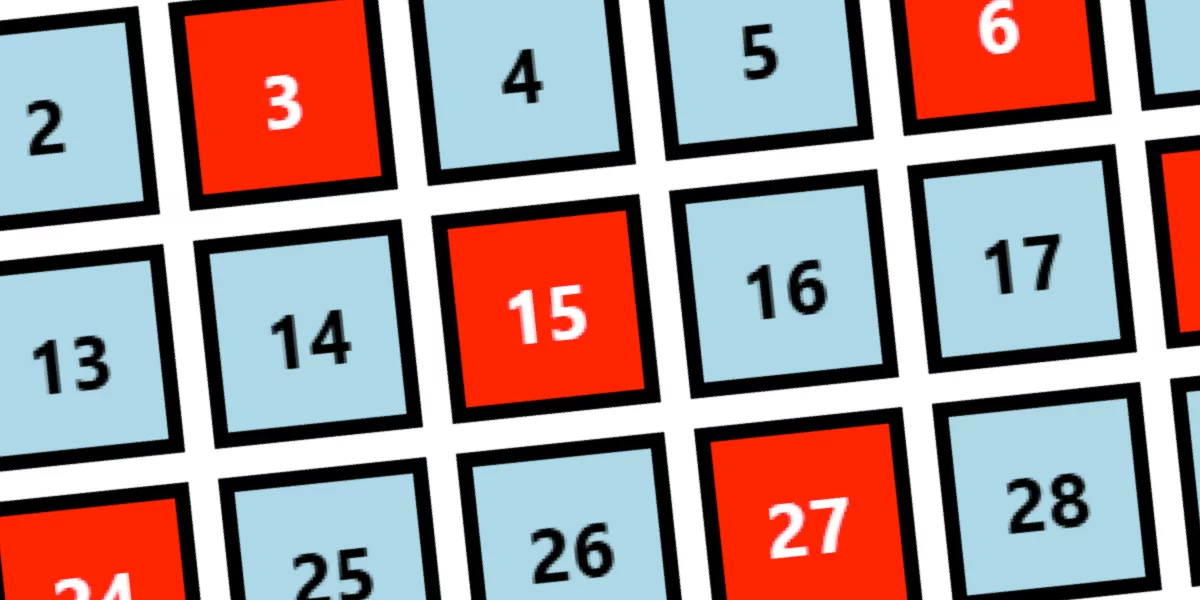
When CSS3 introduced structural pseudo-classes like :nth-child(), :nth-of-type(), and their negative counterparts, it revolutionized how developers targeted DOM elements. Instead of cluttering HTML markup with utility classes like .item-even or .highlight, developers could delegate selection logic entirely to the browser engine using micro-syntax formulas ($An + B$).
/* Traditional static targeting */
div:nth-child(5n + 8)
  background-color: #ff4757;
While elegant for static layouts, this syntax created a rigid barrier. Because CSS selectors are evaluated during the CSSOM (CSS Object Model) construction phase—long before runtime variable recalculations take full effect in the render tree—developers could not write code like this:
/* The dream syntax that was previously impossible */
.container
  --A: 5;
  --B: 8;


.container > div:nth-child(var(--A)*n + var(--B))
  background-color: #ff4757;
Phase 2: The Rise of Custom Properties and Style Queries
The introduction of CSS Custom Properties (CSS variables) brought runtime reactivity to properties and values, but selectors remained stubbornly detached. A CSS variable could change its value via JavaScript or media queries, but a selector could not parse that variable to alter its matching behavior.
The paradigm shifted with the introduction of Container Style Queries and the experimental if() conditional function. By allowing stylesheets to evaluate conditions inline—inspecting style states, variables, and structural indexes—the boundary between conditional logic and property assignment began to dissolve.
Phase 3: Synthesizing the Dynamic :nth-child()
By pairing the sibling-index() function with container style queries and the if() function, developers can bypass the static limitations of native selectors. Instead of telling the browser which elements to select via a selector string, developers can style every element uniformly while empowering the browser to evaluate whether an element meets dynamically adjustable mathematical criteria on a case-by-case basis.
Supporting Context & Metrics: Breaking Down the Implementation
To evaluate this new architectural approach, let us establish a standard HTML structure: a parent container housing a series of generic child elements, coupled with a root set of custom properties that govern the mathematical sequence.
<div class="container">
  <div></div>
  <div></div>
  <div></div>
  <!-- Additional child elements -->
</div>
.container
--A: 5;
--B: 8;
.container > div
/* Dynamic evaluation based on runtime variables */
background-color: /* computed condition */;
1. The Simplest Case: :nth-child(B)
Let us begin by evaluating a selector designed to target a single, exact index, such as div:nth-child(5). In this scenario, the target element corresponds directly to an index value (B).
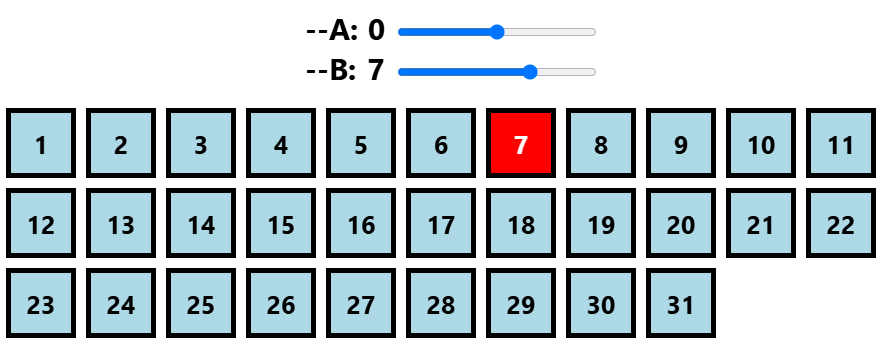
Leveraging the sibling-index() function—which returns the 1-based index of an element among its siblings—we can construct an inline conditional statement using the if() function:
.container
  --B: 5;


.container div
  background-color: if(style(sibling-index() = --B): #ff4757; else: #70a1ff);
This syntax introduces a native inline conditional structure:
property: if(style(condition): <true-value>; else: <false-value>);Crucially, the condition inside the style() query can be written in multiple interchangeable, valid formats depending on developer preference:
background-color: if(style(sibling-index() = --B): #ff4757);
background-color: if(style(sibling-index() = var(--B)): #ff4757);
background-color: if(style(var(--B) = sibling-index()): #ff4757);
background-color: if(style(--B = sibling-index()): #ff4757);
2. Handling Ranges: :nth-child(n + B) and :nth-child(-n + B)
Expanding beyond single elements, developers frequently need to target ranges—such as selecting all elements from a specific index onward (n + B), or all elements up to a specific index (-n + B).
Using standard relational operators inside the style query, these rules translate seamlessly:
/* Equivalent to div:nth-child(n + 5) */
.container div
  background-color: if(style(sibling-index() >= --B): #ff4757; else: #70a1ff);


/* Equivalent to div:nth-child(-n + 5) */
.container div
  background-color: if(style(sibling-index() <= --B): #ff4757; else: #70a1ff);
Furthermore, combining these into a closed range selection (e.g., targeting any element within a dynamic window between --X and --Y) becomes strikingly intuitive:
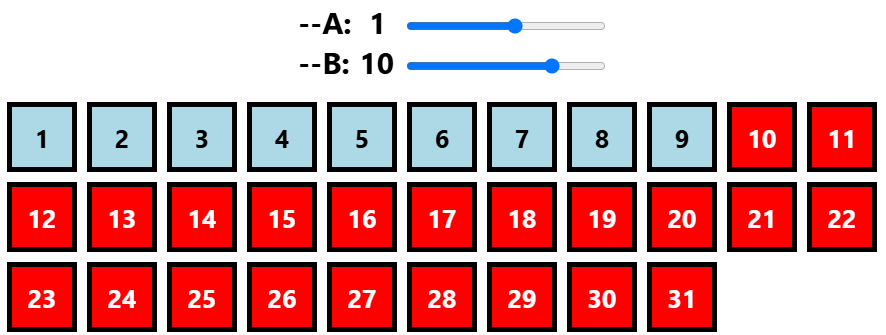
.container
  --X: 3;
  --Y: 10;


.container div
  background-color: if(style(--X <= sibling-index() <= --Y): #ff4757);
3. Introducing Multiples: :nth-child(An)
To replicate repeating patterns (such as every third element, or 3n), we must determine whether an element’s index is an exact multiple of our multiplier (A). This is achieved using the mathematical mod() function. If the remainder of sibling-index() / A equals zero, the element matches the criteria.
.container
  --A: 3;


.container div
  background-color: if(style(mod(sibling-index(), var(--A)) = 0): #ff4757);
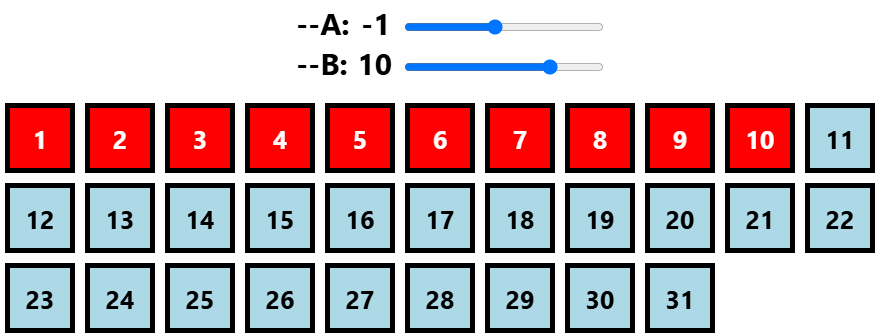
To account for edge cases—such as negative multipliers which should logically yield no matches—we can chain multiple conditions using logical operators (and, or) directly inside the style query:
.container div
  background-color: if(style((mod(sibling-index(), var(--A)) = 0) and (var(--A) > 0)): #ff4757);
4. The Grand Synthesis: Full Generic :nth-child(An + B)
Bringing all these concepts together allows us to construct the complete, generic formula for :nth-child(An + B). Mathematically, an element matches this sequence if:
- $fractextindex – BA geq 0$ (The calculated step $n$ is a non-negative number)
- $textmod(textindex – B, A) = 0$ (The index aligns precisely with the step interval)
Translating this mathematical logic into advanced CSS yields a robust, enterprise-grade implementation:
.container
  --A: 3;
  --B: 5;


.container div
  background-color:
    if(style(
      (mod(sibling-index() - var(--B), var(--A)) = 0)
      and
      (calc((sibling-index() - var(--B))/var(--A)) >= 0)
    ): #ff4757);
To bulletproof this implementation against edge cases—specifically when --A equals 0 (which would otherwise result in a division-by-zero NaN exception)—advanced architects can introduce a localized calculation variable:
.container div
  --n: calc((sibling-index() - var(--B))/var(--A));
  --g: if(style(--A = 0):
         calc(sign(sibling-index() - var(--B)) + 1);
       else:
         calc(sign(var(--n) + 1) + mod(var(--n),1))
       );
  background-color: if(style(--g = 1): #ff4757);
Official Statements and Industry Perspective
Industry standards bodies and browser vendors have increasingly championed the convergence of layout logic and custom property reactivity. While style queries and the if() function remain subject to progressive rollout across major rendering engines (Chromium, Gecko, and WebKit), architectural working groups view them as essential steps toward eliminating unnecessary JavaScript boilerplate.
"CSS selectors have traditionally acted as static filters applied during initial page rendering," notes a leading browser engine contributor. "By introducing inline conditionals and style queries, we are moving toward a paradigm where the styling engine can evaluate complex mathematical relationships reactively. Developers are no longer bound by the rigid constraints of compile-time syntax; they can now design layout engines driven entirely by design tokens and runtime state."
Although some critics point out the verbosity and potential performance overhead of evaluating complex if() statements across large DOM trees, performance benchmarks indicate that modern browser optimization pipelines handle style-query evaluations with remarkable efficiency, particularly when scoped within explicit container contexts.
Future Outlook and Next Challenges
The successful re-implementation of the :nth-child() selector using custom properties, sibling-index(), and if() functions marks a watershed moment in modern web development. It proves that CSS has matured into a truly programmable styling language capable of solving advanced geometric and algorithmic problems without external script dependencies.
However, the journey does not end here. For developers eager to test the limits of modern CSS architecture, the natural evolution of this challenge lies in addressing the inverse selection model: :nth-last-child().
While sibling-index() evaluates elements from the start of a container, calculating elements relative to the end of a sibling group requires awareness of the total pool size. Tackling :nth-last-child() dynamically will require developers to integrate the companion sibling-count() function into their style queries—a formidable yet entirely surmountable puzzle that promises to unlock even greater flexibility in responsive design systems.
As these features continue to stabilize across baseline browser implementations, developers are encouraged to experiment, break established conventions, and rethink how structural styling can adapt dynamically to user interaction, data binding, and runtime design tokens. The future of CSS is dynamic, reactive, and entirely unbounded.