Executive Overview
As humanity stands on the precipice of a new era in space exploration, the instruments we design grow ever more audacious. Nestled deep within the hardware architecture of NASA’s upcoming Nancy Grace Roman Space Telescope is an experimental apparatus so revolutionary it threatens to redefine humanity’s place in the universe. Measuring small enough to fit comfortably in the palm of a human hand, a pair of active, deformable mirrors are poised to undertake a technological trial run that could fundamentally alter how we study the cosmos.
While the primary mission of the Roman Space Telescope is designed to inform nearly every conceivable subfield of modern astrophysics—from mapping the distribution of dark energy to cataloging billions of cosmic objects—its secondary payload is what has the exoplanet community holding its collective breath. Tucked within the observatory’s core is an advanced, high-contrast instrument known as a stellar coronagraph.
This specialized tool is engineered to achieve a milestone that has eluded astronomers since the dawn of the space age: directly capturing starlight reflected off the surface of an extrasolar planet. It is an extraordinary technological leap, functioning as a vital proving ground. NASA hopes this mission will pave the way for a future flagship space observatory capable of delivering a crystal-clear, direct photograph of an Earth-like planet orbiting a sun-like star.
Currently, capturing an image of an exoplanet residing in the habitable zone of its parent star sits far beyond the bleeding edge of modern engineering. The contrast ratio between a sun-like star and a terrestrial planet is comparable to trying to spot a firefly sitting directly beside a blinding military floodlight—while viewing the scene from clear across the country. To bridge this technological gulf, NASA is taking these foundational innovations for a critical test flight on the Roman Space Telescope.
Detailed Chronology: From Concept to Launch Window
The path toward direct exoplanet imaging has been decades in the making, marked by steady iterations in telescope optics, coronagraph design, and wavefront sensing.
- The Precursor Era (Hubble and James Webb): Earlier space-based observatories, including the Hubble Space Telescope and the James Webb Space Telescope (JWST), have utilized rudimentary coronagraphs to block out central starlight. However, these systems relied on blunt, brute-force engineering—such as solid metal masks placed in the optical path—which are insufficient for detecting faint, cool worlds illuminated solely by reflected starlight.
- Ground-Based Innovations: Meanwhile, ground-based giants like the Very Large Telescope (VLT) in Chile and the twin Keck Observatory in Hawaii pioneered the use of adaptive optics. These systems were designed to counteract the blurring effects of Earth’s shifting, turbulent atmosphere by rapidly flexing mirrors in real-time.
- The Roman Integration Phase: Recognizing that space telescopes face optical distortions caused by thermal shifts, internal mechanical vibrations, and minute structural changes, NASA engineers decided to adapt ground-based adaptive optics for the vacuum of space. The Roman coronagraph underwent years of rigorous laboratory stress-testing, thermal vacuum cycling, and optical alignment to ensure it could survive the punishing vibrations of launch and the harsh thermal environment of space.
- The Present Launch Window: Today, as the launch window for the Nancy Grace Roman Space Telescope rapidly approaches, integration is complete. The mission stands ready to push the boundaries of observational astronomy, marking the first time active deformable mirrors will be deployed in space.
Supporting Context & Metrics: The Engineering Marvel of Roman’s Coronagraph
To understand why the Roman Space Telescope’s coronagraph represents such a massive evolutionary leap, one must examine the staggering physics and precision engineering required to make it functional.
The Physics of Starlight Suppression
Space telescopes have historically omitted adaptive optics because they operate above Earth’s atmosphere, free from the turbulent thermal layers that muddy starlight for ground-based observatories. However, looking for old, cool exoplanets that emit virtually no infrared or visible light of their own—relying entirely on the pale reflection of their host stars—presents an entirely distinct optical challenge.
Any stray photon that slips past the coronagraph’s precision-engineered masks can scatter across the detector, entirely washing out the faint signature of an orbiting world. As Margaret Turnbull, an exoplanet scientist at the SETI Institute and lead of the Roman coronagraph science team, notes: "Any little bit of starlight that gets in the wrong place could just destroy a whole portion of the image."
Palm-Sized Mirrors and Actuator Mechanics
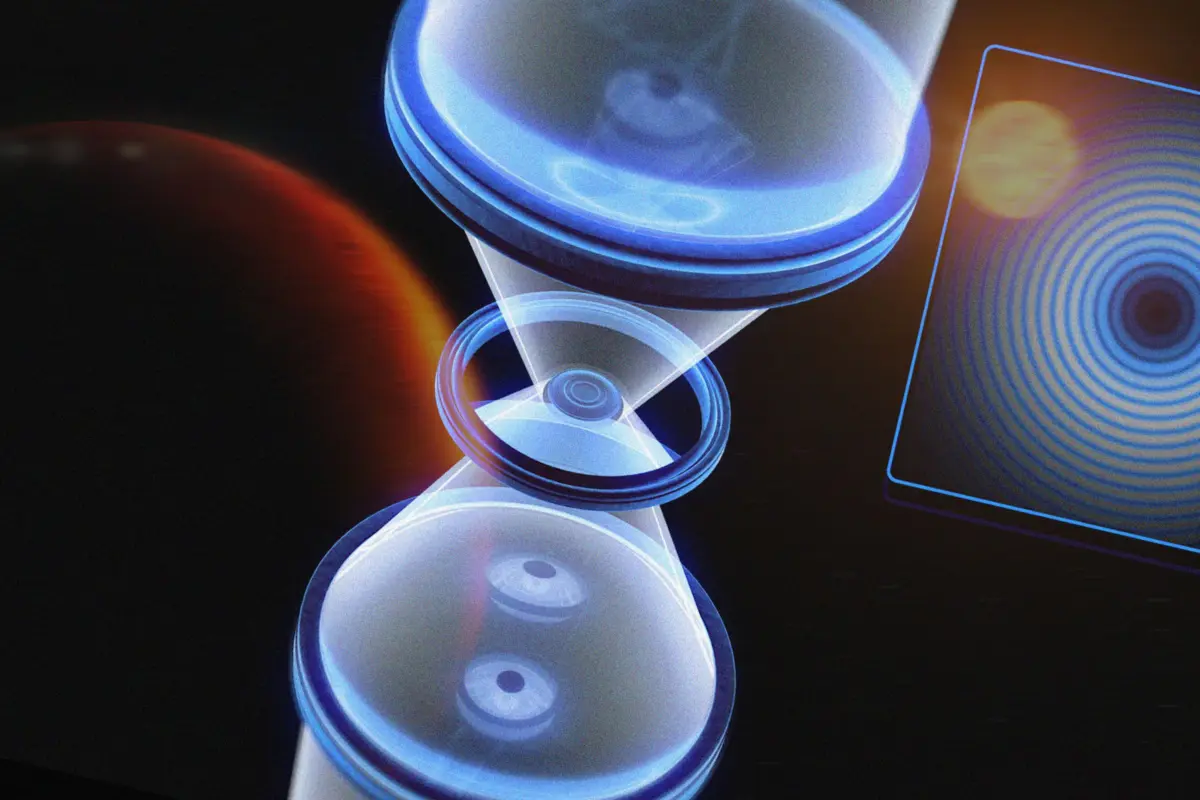
At the heart of the Roman coronagraph’s success are two palm-sized mirrors. Each mirror is meticulously rigged with approximately 2,300 tiny, piezoelectric actuators.
When a minute jolt of electricity is applied to these actuators, they expand or contract with sub-nanometer precision. This causes the mirror surfaces to infinitesimally reshape themselves thousands of times per second, actively reversing optical interference and correcting wavefront errors before they can corrupt the image. This marks NASA’s inaugural flight of active deformable mirrors in space.
Advanced Coronagraph Masks vs. Brute-Force Blockers
Beyond the deformable mirrors, the system relies on supersensitive detectors capable of amplifying the electrical signal generated by individual photons—an absolute necessity given the extreme scarcity of light bouncing off distant exoplanets.
At the structural heart of the coronagraph are its star shades: a series of exquisitely detailed, mathematically optimized masks. Bruce Macintosh, an astronomer leading the University of California Observatories and a member of the Roman coronagraph science team, highlights the stark contrast between past and present designs:
"The Hubble ones are just completely brute force, just literally a little piece of metal that gets in the way of the star."
By contrast, Roman’s masks utilize complex wave-interference patterns designed to manipulate light at a quantum level, canceling out diffraction spikes and carving out a dark "contrast hole" where faint planets can finally become visible.
Official Statements and Mission Objectives
During the operational phase of the Roman coronagraph, mission engineers and astrophysicists will compile massive quantities of telemetry and test data. This data will be used to rigorously evaluate how the hardware performs in the actual space environment, providing vital lessons for future missions.
To validate the instrument, scientists will first target a handful of previously cataloged exoplanets. If the coronagraph successfully isolates and images these known worlds, it will serve as an immediate empirical validation of the hardware.
"If we go through the whole thing and we don’t see them, then we know something is wrong with the coronagraph, because those planets are there," explains Margaret Turnbull.
Furthermore, the instrument will target stellar systems surrounded by complex circumstellar disks of dust and debris. By analyzing gaps and asymmetries carved into these dust clouds, scientists can infer the presence of unseen planets that are too small or distant to detect via traditional radial velocity or transit methods. This will grant researchers an unprecedented perspective on how our own solar system’s level of debris and architecture compares to planetary systems across the Milky Way.
Julie McEnery, an astrophysicist at NASA’s Goddard Space Flight Center in Maryland and senior project scientist for Roman, emphasizes the philosophical approach driving the mission:
"Obviously, the best way of demonstrating that something works is to do something interesting scientifically."
Future Outlook: Toward Earth 2.0 and Beyond
The technological validation achieved by the Nancy Grace Roman Space Telescope will serve as an indispensable stepping stone for the decades to come.
The Habitable Worlds Observatory and Beyond
Every technical hurdle cleared and metric recorded by Roman’s coronagraph will directly inform the design of future flagships. Chief among these is NASA’s proposed Habitable Worlds Observatory (HWO), a conceptual space telescope slated for launch in the 2040s. HWO will require a coronagraph up to 100 times more effective than Roman’s to directly image Earth-sized worlds in the habitable zones of sun-like stars and characterize their atmospheres for potential biosignatures.
Commercial and Private Sector Synergies
The appetite for direct imaging technology is not restricted to government agencies. A coronagraph system armed with adaptive optics and featuring a sensitivity comparable to Roman’s is scheduled to fly on the planned Lazuli Space Observatory, an ambitious private venture announced by research institutions backed by former Google CEO Eric Schmidt.
Beyond Exoplanets: Unlocking Deep Space Marvels
While hunting for alien worlds is undeniably the most culturally captivating application of this technology, coronagraphs equipped with adaptive optics hold immense promise for other areas of astrophysics. In the future, these advanced optical systems could allow astronomers to resolve tight binary star systems, study stellar nurseries hidden behind intense glare, or examine exotic objects lurking dangerously close to hyper-luminous quasars.
The Nancy Grace Roman Space Telescope represents a vital, foundational stride into this uncharted optical frontier. By testing the limits of starlight suppression in the cold void of space, Roman is not merely taking a technical risk; it is constructing the optical bridge that will eventually lead humanity to its first true glimpse of an Earth twin.