Executive Overview
In a milestone event for planetary science and public space exploration, NASA has officially released approximately 800 gigabytes of raw, high-resolution scientific data captured during the historic Artemis II mission. This unprecedented digital archive marks the first time in over half a century that humanity has obtained firsthand planetary science data gathered directly by human crews beyond Earth orbit. The last comparable benchmark in deep space data collection dates back to the Apollo program, leaving a generation of scientists eager to dive into fresh metrics from the lunar environment.
The newly published repository contains a staggering 11,000 full-resolution images, hours of high-definition video footage, 8.5 hours of spoken crew observations, handwritten personal notes from the astronauts, official transcripts, and specialized imagery harvested from the onboard cameras of the Orion spacecraft. While the raw near-terabyte of data is primarily engineered for the rigorous demands of researchers, planetary geologists, heliophysicists, and aerospace engineers, NASA has also curated accessible, media-rich gateways for space enthusiasts and the general public.
Alongside this expansive digital database, the space agency has published three foundational documents outlining the preliminary findings of the mission: the Artemis II Preliminary Lunar Science Report, the Artemis II Lunar Science Operations Report, and the Artemis II Lunar Science Data User Guide. Together, these assets provide a comprehensive blueprint of Earth’s nearest celestial neighbor as observed by the first crewed spacecraft to loop around the Moon in five decades.
Initial evaluations of this trovesome data are already bearing fruit, yielding breakthrough insights into lunar meteoroid impact frequencies and localized terrain dynamics. As global space agencies look toward establishing a permanent sustainable presence at the lunar South Pole, the treasures unlocked by Artemis II offer vital operational intelligence that will shape the future of human habitation on the Moon.
Detailed Chronology: From Launch Pad to the Far Side and Back
To fully appreciate the gravity of the Artemis II data release, one must trace the trajectory of the mission itself. Unlike the Apollo missions of the late 1960s and 1970s, which ultimately targeted touchdown on the lunar regolith, Artemis II served as a rigorous, high-stakes shakedown cruise for the Orion spacecraft and its integrated life support systems with a human crew on board.
The journey began with meticulous pre-launch integrations at NASA’s Kennedy Space Center, culminating in a flawless liftoff powered by the Space Launch System (SLS) rocket. Once safely in Earth orbit, the crew executed a series of critical check-outs, testing manual piloting capabilities, proximity operations, and the life-support architecture of the Orion capsule far from the immediate safety net of low-Earth orbit.
Following these Earth-orbit checkouts, the mission transitioned into its trans-lunar injection phase, propelling the spacecraft toward the far side of the Moon. As Orion swept around the lunar farside, the crew was cut off from direct radio communication with Earth for harrowing periods—a modern reenactment of the radio blackouts experienced during Apollo. During this transit, the astronauts utilized their specialized training to execute targeted visual surveys, document thermal profiles across varying lighting conditions, and record verbal observations of the lunar surface passing beneath them.
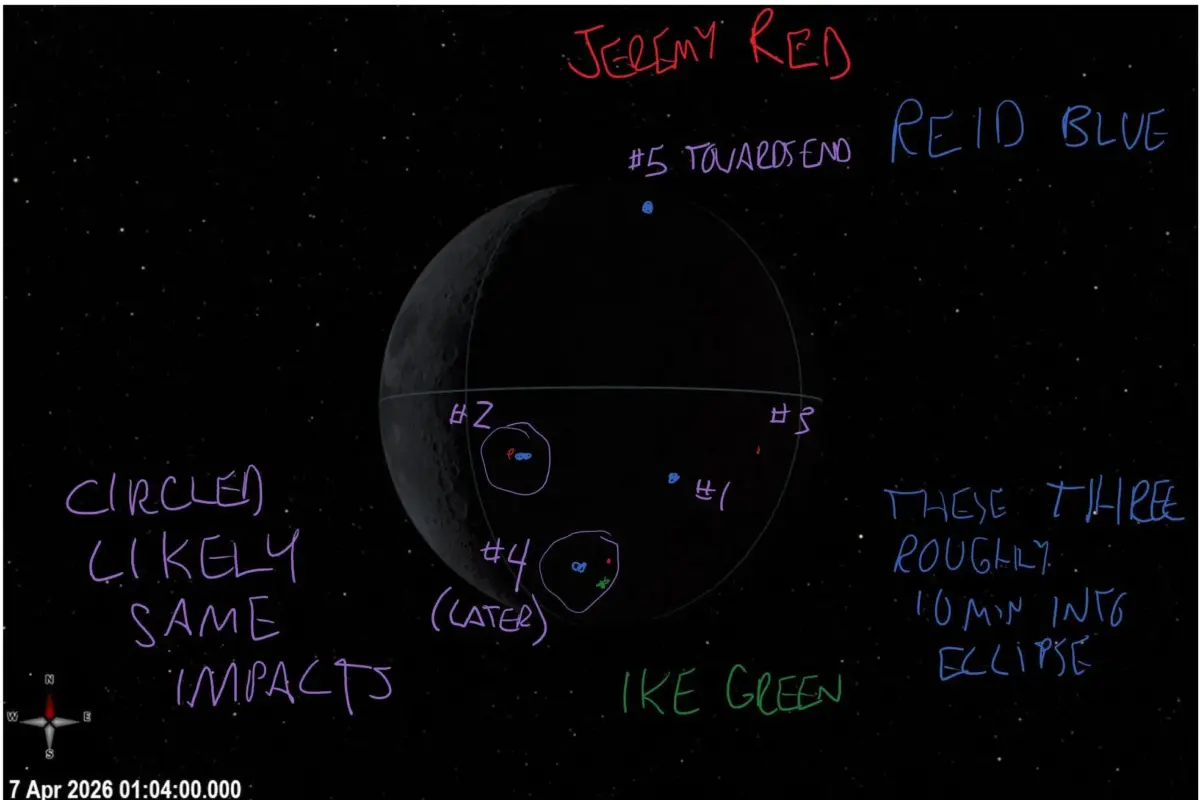
A particularly dramatic chapter of the mission unfolded during a 54-minute lunar eclipse observed directly by the Orion crew. As the Moon plunged the spacecraft into shadow, the cameras and sensors aboard Orion captured phenomena that would otherwise remain invisible from terrestrial observatories. Most notably, this eclipse window provided the precise atmospheric and visual contrast needed to record high-frequency meteoroid impacts striking the lunar surface in real time.
Upon completing its historic loop, Orion fired its engines to execute a trans-Earth injection, hurtling back toward home at speeds exceeding 24,000 miles per hour. The mission concluded with a blistering atmospheric reentry and a precision parachute-assisted splashdown in the Pacific Ocean. The recovery of the capsule not only secured the physical hardware of the spacecraft but also protected the digital flight recorders and internal storage drives that held the 800 gigabytes of raw science data now made available to the global scientific community.
Supporting Context & Metrics: Unpacking the 800-Gigabyte Archive
The sheer scale of the Artemis II data release requires a careful breakdown of its components to understand how different disciplines within the scientific community will leverage the information. Spanning nearly a terabyte, the archive is meticulously organized to support a wide array of specialized research fields, ranging from heliophysics to structural engineering.
Breakdown of the Digital Repository
- Visual Media: The archive includes 11,000 full-resolution photographs and high-definition video files. These encompass exterior views of the lunar terrain, internal operations of the Orion cabin, and specialized tracking shots of orbital mechanics.
- Audio and Transcripts: Researchers and enthusiasts can access 8.5 hours of continuous spoken observations recorded by the astronauts, accompanied by time-synced official mission transcripts.
- Annotated Imagery: A distinct subsection features lunar photographs directly annotated by the crew, highlighting geological anomalies, albedo shifts, and areas of high scientific interest.
- Spacecraft Telemetry & Engineering Logs: Comprehensive telemetry data detailing thermal shifts, structural stresses, radiation exposure levels, and propulsion performance during the lunar flyby.
Cross-Disciplinary Applications
- Planetary Geologists: Will utilize the high-resolution imagery and terminator-line documentation to study regolith maturation, micro-crater distributions, and geological stratigraphy without the atmospheric interference plaguing Earth-based telescopes.
- Flight Engineers & Systems Architects: Can analyze structural thermal loads and environmental control performance data to optimize the design of future habitats and crewed rovers.
- Heliophysicists & Meteoroid Impact Specialists: Will draw upon observations recorded during the lunar eclipse to model impact dynamics, velocity distributions, and the frequency of small-body collisions in cislunar space.
- Telecommunications & Remote Sensing Experts: Benefit from propagation logs and signal clarity metrics gathered during deep-space relay tests between Orion and NASA’s Deep Space Network.
Access to this trove has been centralized through NASA’s Planetary Data System (PDS), specifically via the Geosciences Node hosted at Washington University in St. Louis. Furthermore, NASA has established a dedicated public science portal where non-technical users can explore curated photo galleries, listen to audio snippets, and download the primary reports without navigating complex directory structures.
Official Statements and Initial Discoveries
The release of the Artemis II data archive has been accompanied by formal commentary from NASA leadership, mission scientists, and principal investigators who emphasize the transformative nature of human-in-the-loop space exploration.
"Robotic missions have given us breathtaking maps and invaluable foundational data, but there is no substitute for the human eye, intuition, and contextual observation," noted a senior NASA science mission director during the initial data rollout. "By returning humans to the vicinity of the Moon, we have unlocked a layer of qualitative and quantitative resolution that machines alone simply cannot replicate."
Initial peer-level analyses of the newly available datasets have already validated this sentiment. The most prominent early discovery to emerge from the raw archives is the confirmed detection of five distinct meteoroid impacts on the lunar surface. These microscopic to centimeter-scale impacts were caught on camera during the crew’s observation of the 54-minute lunar eclipse.
Because the Moon lacks a substantial atmosphere to burn up incoming debris, it is constantly battered by micrometeoroids and space dust. Accurately quantifying the flux rate of these small projectiles has historically been challenging for ground-based telescopes due to glare and atmospheric distortion. By recording multiple impacts in real-time from orbit, the Artemis II data has allowed scientists to refine empirical models of impact hazard risks. This is not merely an academic exercise; calculating the frequency and kinetic energy of these strikes is a critical engineering requirement for designing shielding systems for future lunar bases, surface vehicles, and EVA suits destined for the lunar South Pole.
In addition to impact dynamics, the preliminary reports highlight significant findings regarding lunar albedo and surface texture. The crew’s photographs taken near the terminator—the shifting boundary line between lunar day and night—reveal minute variations in topography and soil compaction under low-angle sunlight. Because NASA’s upcoming Artemis III and subsequent landings are slated for the permanently shadowed regions and elevated ridges of the lunar South Pole, understanding how low solar illumination affects visual depth perception, navigation, and terrain recognition is paramount. The Artemis II dataset provides the exact visual baselines required to train upcoming crews for these challenging lighting environments.
Future Outlook: Paving the Way for Artemis III and Beyond
The publication of the Artemis II archive is not an isolated milestone; rather, it functions as a critical stepping stone in NASA’s broader strategic roadmap for sustained human exploration of the solar system. The insights gleaned from these 800 gigabytes of data will directly inform the operational parameters of Artemis III, which aims to return human boots to the lunar surface for the first time in over fifty years.
As independent researchers, academic institutions, and commercial aerospace partners begin processing the terabyte of data, several key forward-looking initiatives are already taking shape:
- Refining South Polar Landing Strategies: Flight planners are integrating terminator-line lighting data into autonomous navigation simulations to ensure landers can safely touch down despite long shadows and obscured crater rims.
- Advanced Habitat Hardening: Engineers are utilizing meteoroid impact frequencies captured during the lunar eclipse to develop multi-layered regolith-shielding concepts for surface habitats, protecting astronauts from high-velocity ejecta.
- Global Collaboration and Open Science: In alignment with NASA’s open-science mandates, the public accessibility of the PDS repository ensures that researchers from emerging spacefaring nations can contribute to lunar analysis, democratizing space science on a global scale.
- Deep-Space Communications Evolution: Telemetry assessments from Orion are guiding the upgrade of communication protocols needed to maintain high-bandwidth data transfers as human missions push deeper into cislunar space and eventually toward Mars.
Ultimately, the Artemis II data drop transforms a historic mission of exploration into a perpetual engine of scientific discovery. By placing these raw resources into the hands of the global community, NASA has ensured that the echoes of humanity’s return to the Moon will resonate through laboratories, classrooms, and engineering bays across the world for decades to come, laying an unbreakable foundation for our permanent expansion into the cosmos.