Executive Overview
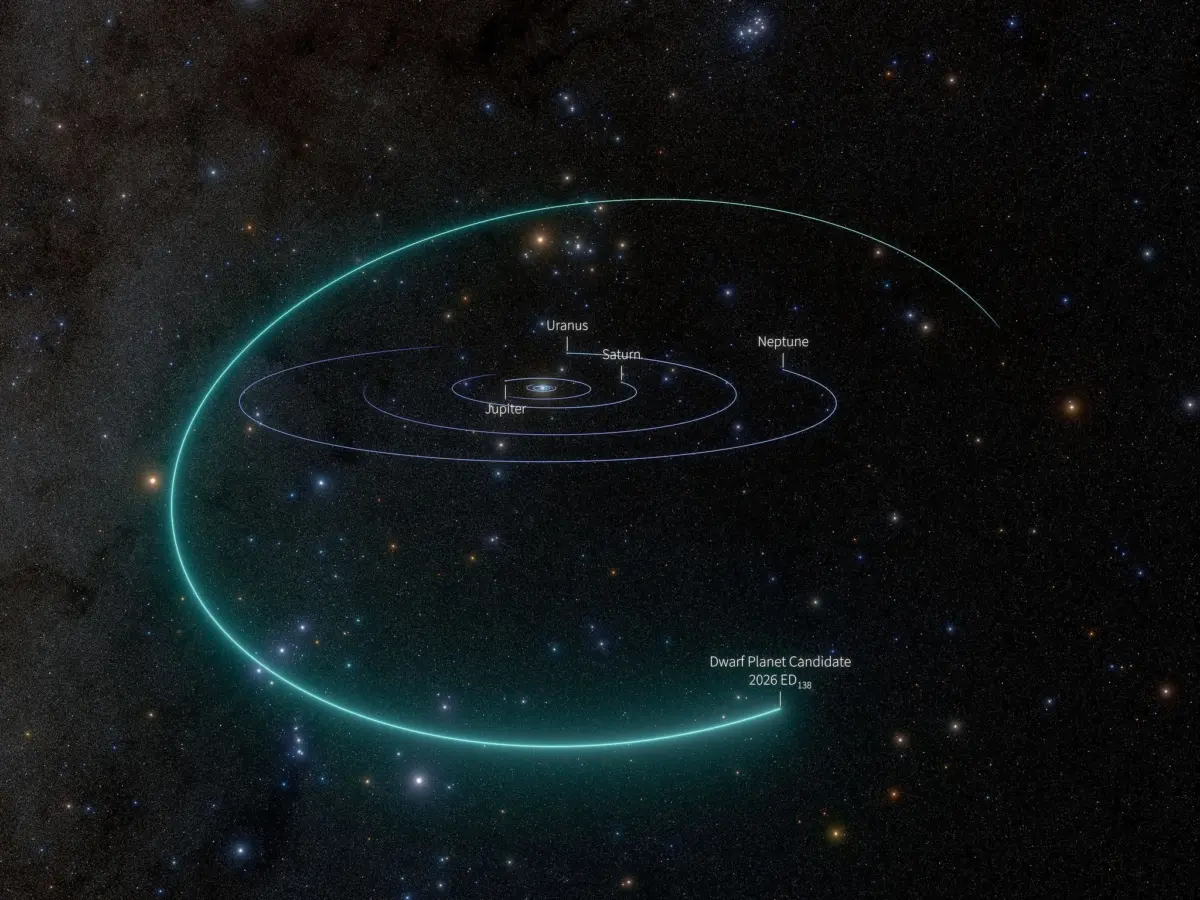
Deep within the frigid, starlit expanse beyond Neptune, astronomers have caught a rare and elusive glimpse of a potential new dwarf planet. Provisionally cataloged as 2026 ED138, this massive celestial body was identified by researchers utilizing the state-of-the-art facilities of the Vera C. Rubin Observatory in Chile. Measuring an estimated 600 to 1,500 kilometers in diameter and orbiting at an astonishing distance of roughly 46 astronomical units (AU) from the sun, ED138 stands as one of the largest and brightest trans-Neptunian objects (TNOs) ever recorded.
Its discovery shatters the conventional, textbook portrayal of our solar system as a neat arrangement of eight planets orbited by a few scattered rocks. Instead, it underscores the dynamic, crowded, and continuously expanding nature of our cosmic neighborhood. While 2026 ED138 shares many characteristics with Pluto—including an orbital path tilted relative to the primary plane of the planets—its official classification as a dwarf planet hinges on rigorous future determinations of its mass, density, and gravitational rounding.
If confirmed by the International Astronomical Union (IAU), ED138 will join an elite pantheon of recognized dwarf planets, signaling a renaissance in outer solar system exploration. Powered by cutting-edge astronomical hardware like the Rubin Observatory and retrospective data mining, humanity is rapidly peeling back the layers of the cosmic frontier, revealing a universe far more populous and complex than previously imagined.
Detailed Chronology: The Hunt for 2026 ED138
The trail that led to the discovery of 2026 ED138 is a masterclass in modern data science and astronomical persistence. For decades, deep-space objects of this magnitude have managed to evade detection due to a combination of extreme distance, low albedo (reflectivity), and treacherous observational backgrounds.
The Breakthrough Identification
The milestone occurred on October 13, 2026. Matthew Holman, an esteemed researcher at the Harvard-Smithsonian Center for Astrophysics and an integral member of the Vera C. Rubin Observatory’s operations team, was meticulously combing through freshly processed data streams generated by the observatory. Amid terabytes of sky surveys, Holman isolated a faint, moving point of light that did not conform to the trajectories of known asteroids or comets.
Mining the Archives
Recognizing the significance of the anomaly, the research team immediately initiated a retrospective data search. By cross-referencing Holman’s coordinates with archival sky surveys, the astronomers struck gold. They located pre-discovery observations of 2026 ED138 embedded in legacy datasets dating as far back as 2016.
This ten-year baseline of historical data proved invaluable. By stitching together observations spanning a decade, the team successfully reconstructed the object’s precise orbital trajectory. This historical validation transformed what would have been a fleeting, uncertain blip into a well-documented celestial path, confirming that ED138 is a permanent, gravitationally bound resident of our outer solar system.
The Milky Way Blind Spot
Why did 2026 ED138 remain hidden for so long, especially given the continuous scanning of the night sky by modern telescopes? The answer lies in its galactic backdrop.
ED138 orbits against the dense disk of the Milky Way. From our vantage point on Earth, this region appears as a thick, brilliant band packed with hundreds of millions of stars. The sheer concentration of stellar light creates an overwhelming luminous "sea," effectively blinding standard optical instruments to fainter, distant objects passing through that sector of the sky. It was only through the unprecedented sensitivity and immense data-processing capabilities of the Vera C. Rubin Observatory that astronomers could pierce through this stellar fog, isolating ED138’s faint signature against the blinding background of our home galaxy.
Supporting Context & Metrics: Decoding the Outer Solar System
To truly appreciate the significance of 2026 ED138, one must examine the metrics that define it, as well as the strict scientific definitions that govern planetary science.
Size, Distance, and Orbital Mechanics
- Estimated Diameter: 600 to 1,500 kilometers. At the upper end of this estimate, ED138 approaches the size of Pluto (approximately 2,377 km in diameter) and Charon.
- Distance from the Sun: Approximately 46 AU (where 1 AU is the average distance from the Earth to the Sun, roughly 93 million miles or 150 million kilometers).
- Comparative Orbits: For context, Pluto maintains an average orbital distance of roughly 40 AU, though its highly elliptical orbit brings it closer to the Sun at times than Neptune. ED138 resides further out, firmly entrenched within the vast expanse of the Kuiper Belt.
- Orbital Inclination: Much like Pluto, ED138’s orbit is significantly tilted relative to the ecliptic plane—the flat disk on which the inner terrestrial and outer gas giant planets travel.
Planets vs. Dwarf Planets: The Crucial Distinction
The debate over what constitutes a planet was famously settled—and fiercely contested—in 2006 when the IAU established formal criteria. According to these guidelines, a celestial body must satisfy three conditions to be classified as a classical planet:
- It must orbit the sun.
- It must possess sufficient mass to assume a nearly round shape (hydrostatic equilibrium).
- It must have cleared its neighborhood of other competing bodies.
It is this third criterion that differentiates planets from dwarf planets. While major planets like Earth, Jupiter, and Neptune gravitationally dominate and sweep clean their orbital paths, dwarf planets share their cosmic real estate with a myriad of other bodies of comparable size. Pluto lost its planethood in 2006 precisely because it shares the Kuiper Belt with countless icy planetesimals.
Similarly, 2026 ED138 coexists with a vast population of trans-Neptunian objects. While its mass is clearly substantial enough to place it among the largest TNOs discovered to date, planetary scientists must definitively prove that its self-gravity has compressed it into a nearly spherical spheroid before it can officially earn the "dwarf planet" title.
The Elite Class of Recognized Dwarf Planets
Currently, the International Astronomical Union officially recognizes only five dwarf planets:
- Ceres: Located in the inner asteroid belt between Mars and Jupiter.
- Pluto: The iconic former ninth planet in the Kuiper Belt.
- Haumea: A rapidly rotating, ellipsoid-shaped Kuiper Belt object known for its ring system.
- Makemake: A frigid, methane-rich world in the outer solar system.
- Eris: A massive scattered-disk object that originally triggered the 2006 planetary reclassification debate due to its mass exceeding that of Pluto.
If 2026 ED138 clears the stringent verification process, it will become the sixth officially recognized member of this exclusive club, paving the way for dozens of waiting candidates.
Official Statements and Expert Perspectives
The discovery of 2026 ED138 has electrified the astronomical community, prompting reflections from leading researchers regarding the future of planetary cartography and deep-space exploration.
Matthew Holman, reflecting on the arduous process of extracting the object from archival data, emphasized the transformative power of modern survey telescopes:
"Finding an object like ED138 is akin to finding a single glowing ember within a forest fire. Its position against the dense star fields of the Milky Way made it virtually invisible to older generations of telescopes. It is a testament to the Rubin Observatory’s architecture that we can now sift through historical data with such surgical precision and pull these hidden worlds into the light."
Other members of the broader astronomical community have echoed these sentiments, pointing out that ED138 is merely the tip of the iceberg. Dr. Elena Vance, a trans-Neptunian object researcher not directly involved in the discovery, noted:
"We are standing on the precipice of a taxonomic revolution in our understanding of the solar system. For decades, we have known that the outer realms are heavily populated, but having bright, massive candidates like ED138 emerge from historical archives proves that our census of the outer solar system is far from complete. There are likely thousands of similar bodies waiting for their own decade-long data trails to be pieced together."
Furthermore, planetary geologists emphasize the immense physical challenges involved in studying these distant worlds. Because they reside billions of kilometers away, direct physical measurements—such as precise mass determination, surface composition analysis, and internal thermal profiling—remain exceptionally difficult from Earth-based platforms.
As historical precedent demonstrates, unlocking the true nature of these distant realms requires ambitious, long-duration space missions. The success of NASA’s New Horizons mission—which required nearly a decade-long transit from Earth to execute historic flybys of Pluto in 2015 and the distant Kuiper Belt object Arrokoth in 2018—illustrates the sheer generational commitment required to study these bodies up close. While visiting 2026 ED138 in person remains an aspiration for the distant future, its discovery provides an immediate, compelling target for advanced space-based telescopes like the James Webb Space Telescope (JWST) and the upcoming Nancy Grace Roman Space Telescope.
Future Outlook: Expanding the Boundaries of Our Solar System
The identification of 2026 ED138 opens up profound questions regarding the true architecture and population limits of our solar system. For generations, public education has relied on a tidy, simplified model: a central yellow star, four rocky inner planets, an asteroid belt, four gas and ice giants, and a distant, solitary Pluto fading away into the dark.
Modern astronomy paints a radically different, far more intricate picture. Beyond the orbit of Neptune lies a vast, stratified continuum of material:
- The Kuiper Belt: Extending outward to approximately 50 AU, this doughnut-shaped region is populated by hundreds of thousands of icy bodies, remnants from the formation era of the solar system.
- The Scattered Disk: Stretching far beyond the Kuiper Belt to distances nearing 1,000 AU, this realm houses dynamically unstable objects thrown outward by gravitational interactions with the outer gas giants.
- The Oort Cloud: The ultimate frontier of our solar system. Lying at an estimated distance of up to 100,000 AU from the sun—nearly halfway to the nearest star system—the Oort Cloud remains entirely unobserved directly, yet gravitational theory dictates it must harbor trillions of cometary bodies.
Within this immense structural continuum, 2026 ED138 is far from alone. Astronomers have already cataloged dozens of high-probability dwarf planet candidates awaiting formal classification. Among the most prominent are Gonggong, Quaoar, Sedna, and Orcus. As sky surveys grow more sensitive and automated data pipelines comb through archival records with unprecedented speed, this roster is guaranteed to expand.
The implications extend far beyond mere cataloging. Each newly discovered trans-Neptunian object acts as a pristine time capsule, preserving chemical and physical signatures dating back 4.5 billion years to the birth of the solar system. Uncontaminated by the intense solar radiation and geologic reworking experienced by the inner planets, these distant ice worlds hold the secrets to planetary formation, the delivery of water to the early Earth, and the organic chemistry that may have seeded life across the cosmos.
As astronomers continue to analyze the orbital quirks and physical dimensions of 2026 ED138, humanity moves closer to a complete accounting of our cosmic neighborhood. The solar system is not a static, finished painting; it is a sprawling, living frontier—and with every technological leap forward, we discover new worlds waiting in the dark.