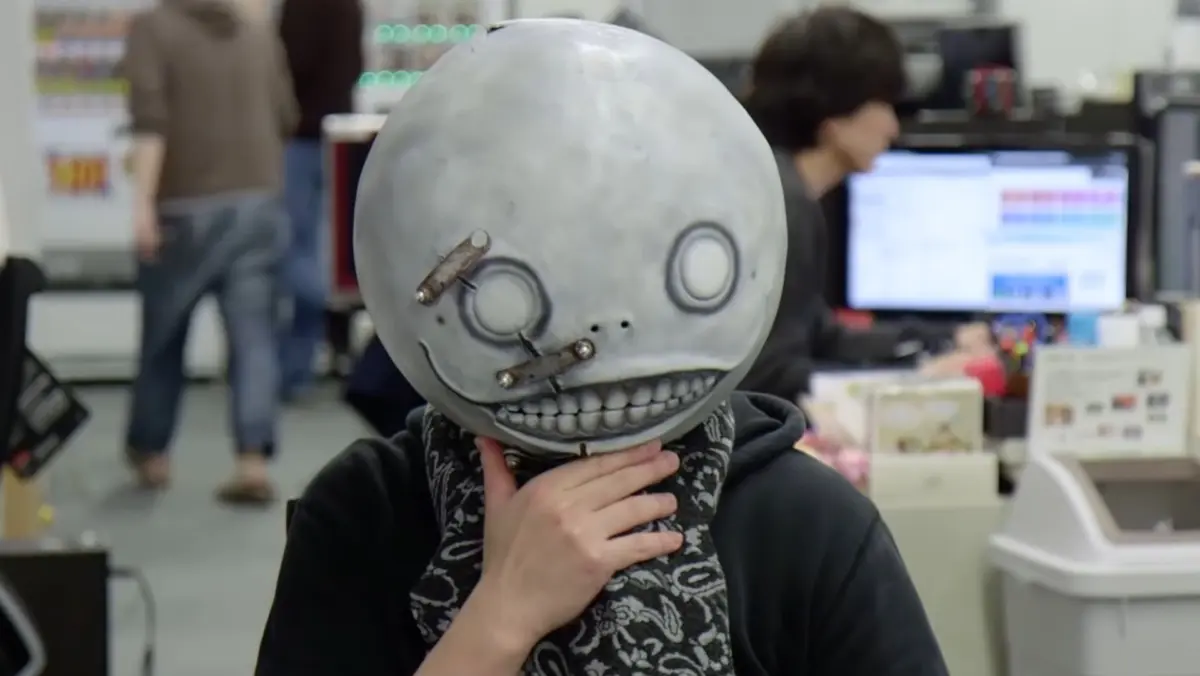
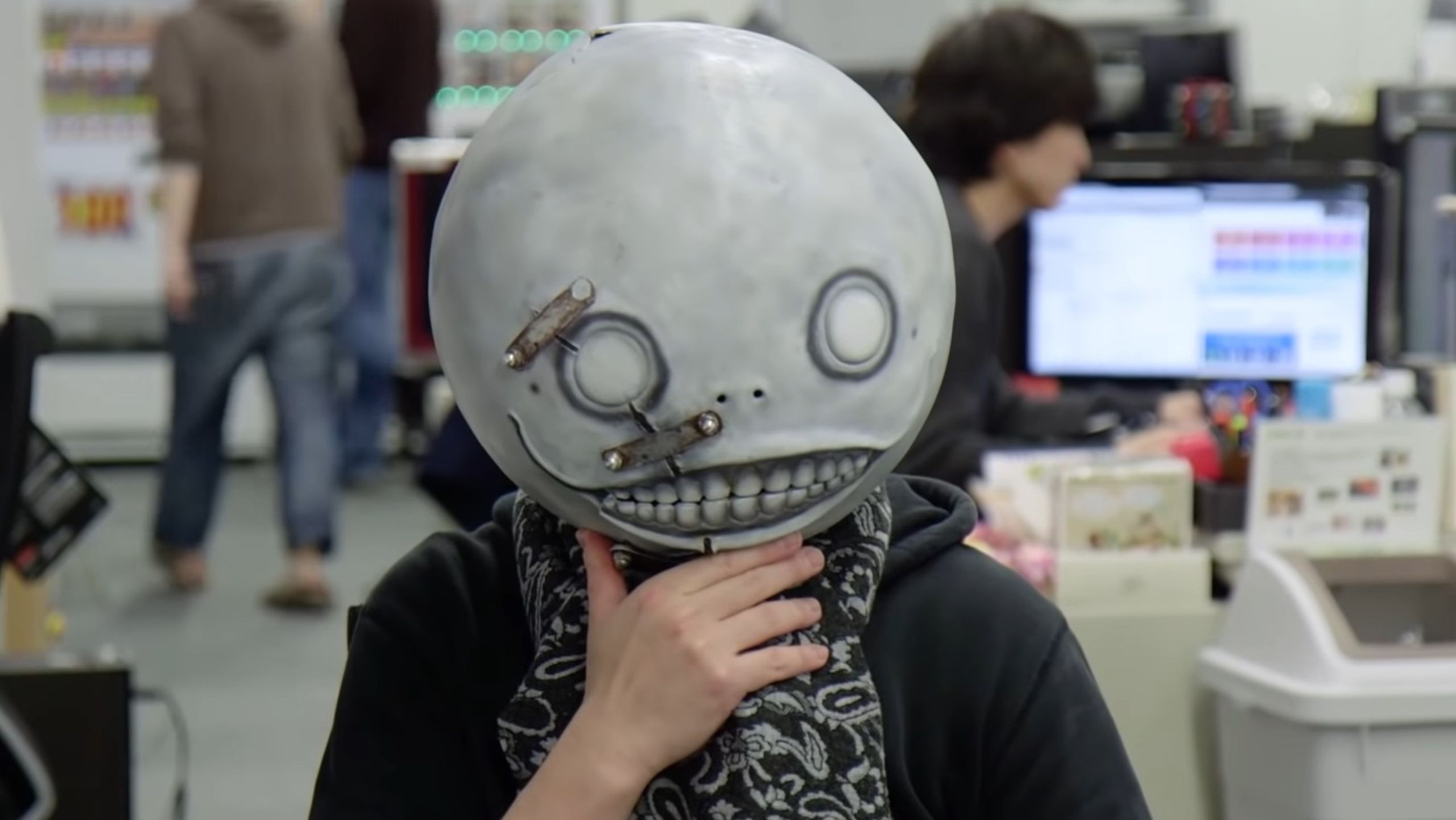
The video game industry is built upon the relentless pursuit of innovation, commercial viability, and technological marvels. Yet, few figures within this multi-billion-dollar apparatus occupy as eccentric, philosophical, and uncompromising a niche as Yoko Taro. Famed globally for his signature, unsettling Emil mask—derived directly from the grim lore of his acclaimed gameography—Taro has cultivated a reputation as an auteur who views the medium through a lens entirely his own.
Recently, speaking at an event at the Tokyo French Institute, the mastermind behind Drakengard and the NieR series made a series of characteristically candid and startling declarations. According to reports from Denfaminicogamer and IGN, Taro revealed that he has already achieved his ultimate creative ambitions. In a theoretical world, he would have retired long ago.
Instead, the eccentric director continues to craft video games for two surprisingly pragmatic reasons: financial compensation and a personal crusade to ward off cognitive decline. Beneath his trademark self-deprecation and dark humor, Taro’s commentary offers a profound look into the psyche of an aging veteran navigating an industry undergoing radical transformation—from shifting generational standards to the looming shadow of artificial intelligence.
Detailed Chronology: From Drakengard to Post-Career Realities
To understand Yoko Taro’s current perspective on retirement and game development, it is necessary to examine the unorthodox trajectory of his career. Unlike many directors who spend decades climbing the corporate ladder before finally steering a project to completion, Taro found a rare alignment of circumstances early on.
1. The Genesis of an Auteur (Drakengard)
When Taro was given the opportunity to direct his debut title, Drakengard (released as Drag-On Dragoon in Japan) for the PlayStation 2 in 2003, he did not treat it merely as a commercial assignment. He approached it as a blank canvas to explore his darkest psychological fascinations. Looking back at that pivotal moment during his Tokyo French Institute appearance, Taro noted:
"With Drakengard, the first game I was given the opportunity to direct, I was actually able to do almost everything the way I wanted. As a game otaku, I think the dream is to release something you’ve always wanted to create into the world. Having achieved that dream, I view everything after that as the remainder of my life."
This realization reframes his entire subsequent portfolio. Titles like NieR: Replicant, NieR: Automata, and Drakengard 3 were not stepping stones toward a grander professional plateau; rather, they existed in a creative space born after he had already accomplished his primary artistic dreams.
2. The Post-Dream Era and Commercial Survival
Having checked his ultimate artistic objective off his bucket list on his very first attempt, Taro spent the next two decades navigating troubled development cycles, publisher shifts, and cult-classic status. While NieR: Automata (2017) achieved massive mainstream and commercial success—shifting millions of copies worldwide and rescuing the franchise from relative obscurity—Taro’s core motivation has rarely been corporate expansion or the accumulation of industry accolades.
Instead, as he confessed during his recent panel, continuing to work serves a very grounded earthly purpose: earning a living and keeping his mind sharp. Characteristically leaning into deadpan humor, Taro remarked that his ongoing participation in game development is an effective hedge against cognitive degradation:
"This is good for preventing dementia."
While industry analysts and fans alike are quick to parse these comments through the lens of Taro’s famously facetious public persona, the underlying sentiment highlights a stark reality. For veteran creators who have spent decades immersed in the intense, high-stress environment of software engineering and design, stopping entirely can be as psychologically perilous as continuing.
Supporting Context & Metrics: The Philosophy of "Filling in the Gaps"
Yoko Taro’s approach to game design has always defied conventional market research. While major publishers rely on focus groups, trend forecasting, and high-fidelity graphical benchmarks, Taro views his role within the industry through an ecological framework of creative gaps and ecological niches.
Filling the Gaps left by Giants
During his discussion, Taro elaborated on how he surveys the landscape of existing video games and deliberately carves out a path for his own idiosyncratic style. Rather than attempting to compete directly with masterpieces of perfection, he seeks out the neglected corners of the medium:
"I’ve always worked in the games industry with the mindset of ‘filling in the gaps.’ I really like games like Ico and Ikaruga, but when I played them they were so perfect that I thought, ‘I don’t need to make games in these genres.’ That’s not jealousy, it’s the feeling of, ‘This gap has already been filled, so I need to fill a different one.’ I think the reason that my games are crude games full of terrible things is because the pioneers have already seized all the beautiful aspects."
This self-effacing analysis underscores why games like NieR often feature deliberately unorthodox mechanics, jarring tonal shifts, looping narrative structures, and abrasive philosophical themes. By abandoning the pursuit of pristine polish—a domain dominated by corporate monoliths—Taro intentionally carves out territory for emotional resonance, existential melancholy, and narrative experimentation.
The Looming Shadow of Artificial Intelligence
Taro’s reflections extend beyond his own creative lifecycle to encompass the broader future of the gaming landscape. As a veteran who has witnessed decades of technological iteration, he voiced a distinct anxiety regarding the rapid advancement of generative artificial intelligence and the incoming wave of younger, AI-assisted creators.
He expressed a hope that he can successfully dodge the "flames" of this new era of hyper-competition before his career naturally concludes. This commentary reflects a growing industry-wide unease: seasoned developers who rely on human idiosyncrasies, flaws, and distinct points of view now face an environment where automated systems threaten to homogenize creative output. Taro’s embrace of "crude" and "terrible" things stands in direct opposition to the hyper-sanitized, algorithmically optimized content that modern AI tools threaten to proliferate.
Official Statements & Industry Reaction
The gaming community and media landscape responded to Taro’s remarks with a mixture of amusement, deep empathy, and philosophical introspection. Known for trolling interviewers and wearing his Emil helmet during serious financial earnings calls, Taro’s public appearances are always scrutinized for the line between performance art and genuine vulnerability.
The Persona vs. The Person: Media outlets like IGN and Denfaminicogamer noted the inherent duality of Taro’s statements. While his assertion that he works solely to "prevent dementia" carries the hallmark comedic timing of a veteran internet-era provocateur, the accompanying reflections on creative burnout and post-ambition career management ring entirely true.
Fan Response: Across social media platforms and gaming forums, fans rallied around the sentiment. Many pointed out that Taro’s "crude" games have provided emotional depths that AAA perfection frequently fails to deliver. The acknowledgment that a celebrated director views his later work as "the remainder of my life" added a poignant layer of human vulnerability to an industry often obsessed with relentless, infinite growth.
Future Outlook: What Lies Ahead for Yoko Taro?
As the games industry hurtles toward the next console generation, the question of Yoko Taro’s long-term future remains characteristically opaque.
Continued Collaboration: Square Enix and other partners continue to maintain a strong relationship with Taro. Whether through multimedia projects, mobile extensions of the NieR universe, or entirely new intellectual properties, his unique brand of storytelling retains significant commercial and cultural value.
Creative Independence: Because Taro views his career post-Drakengard as bonus time, he operates with a rare level of creative freedom. Unburdened by the pressure of chasing his initial dream—having already realized it—he is uniquely positioned to take radical risks that corporate-mandated directors cannot afford.
The Retirement Horizon: While his fear of cognitive stagnation currently keeps him chained to his desk, the day may eventually come when the Emil mask is permanently hung up. Until then, the gaming industry can rest assured that Yoko Taro will continue filling the gaps, antagonizing conventional design standards, and reminding players why imperfect art often speaks to the human condition far more effectively than manufactured perfection.