Executive Overview
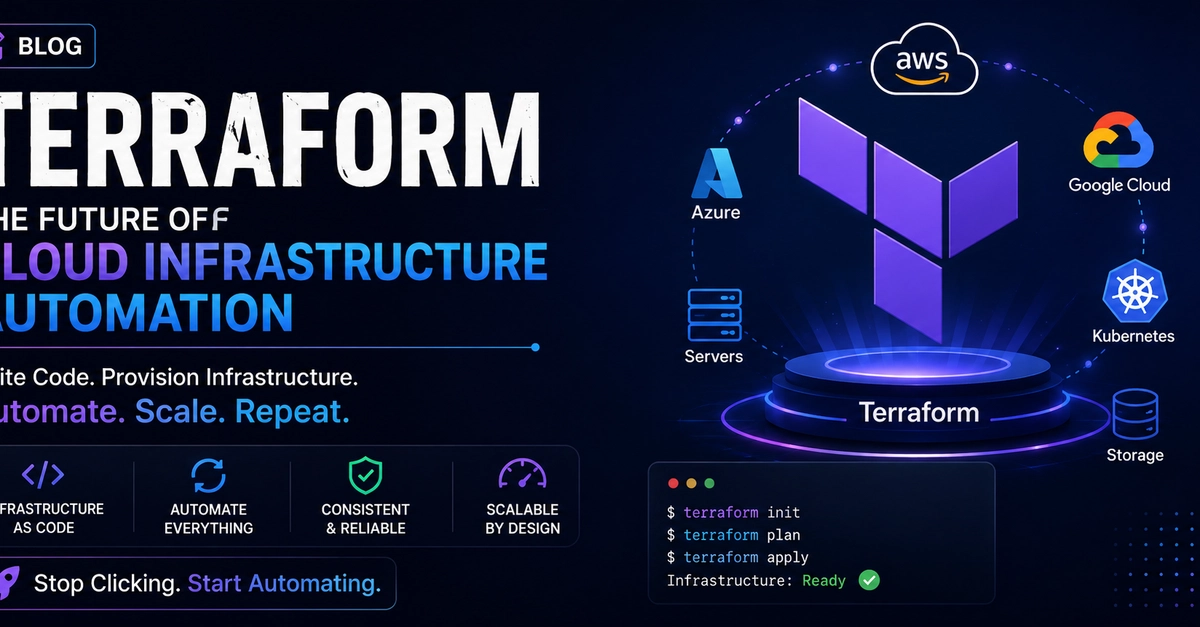
"Stop clicking. Start automating."
For decades, the expansion of enterprise technology was bound to the physical limitations of hardware. Servers required physical rack space, manual cabling, and hours of painstaking manual configuration. When cloud computing arrived, it promised a liberation from the physical datacenter. Yet, in its early days, the paradigm merely shifted from physical racks to virtual dashboards.
Imagine spinning up dozens of virtual servers, complex database clusters, load balancers, and intricate networking topologies manually through a cloud provider’s web console every single time an environment needed to be replicated. At scale, this manual clicking is slow, notoriously error-prone, and practically impossible to manage sustainably.
Enter Terraform, an open-source Infrastructure as Code (IaC) tool created by HashiCorp that has fundamentally transformed how cloud infrastructure is conceptualized, built, and scaled. Today, Terraform stands as a cornerstone of modern Cloud and DevOps engineering. Whether an organization is deploying workloads on Amazon Web Services (AWS), Microsoft Azure, Google Cloud Platform (GCP), or orchestrating containers via Kubernetes, Terraform empowers engineers to build, manage, and scale their cloud environments with unprecedented efficiency, consistency, and safety.
This comprehensive report examines the evolution of Terraform, the core principles of Infrastructure as Code, its critical role in modern DevOps workflows, and why mastering it has become a non-negotiable requirement for the next generation of cloud architects.
Detailed Chronology: From Manual Dashboards to Code-Driven Environments
To truly appreciate the disruption caused by Terraform, one must understand the chronological evolution of infrastructure management over the last twenty years.
Era 1: The On-Premises Physical Datacenter (Pre-2006)
In the traditional era of computing, infrastructure was synonymous with hardware. Deploying a new application required purchasing physical servers, waiting weeks for delivery, racking them in a datacenter, configuring operating systems manually, and physically wiring switches and routers. Scaling up meant repeating this expensive and time-consuming physical labor.
Era 2: The Cloud Dawn and the GUI Click-Ops Era (2006–2012)
With the launch of AWS EC2 in 2006, cloud computing introduced elasticity. Suddenly, servers could be created in minutes instead of weeks. However, the initial interface for managing these resources was the Graphical User Interface (GUI)—the cloud console. Engineers would log into web dashboards, click through menus, select instance types, configure security groups, and manually attach storage volumes.
While faster than physical hardware, this "Click-Ops" approach introduced a massive operational blind spot. There was no historical record of why a specific setting was changed, environments drifted apart (meaning development, staging, and production environments were rarely identical), and destroying or recreating complex architectures required remembering dozens of manual steps.
Era 3: The Birth of Configuration Management (2009–2014)
As systems grew, tools like Puppet, Chef, and Ansible emerged to automate software installation and configuration management inside servers. While these tools solved the problem of configuring individual machines, they struggled to provision the underlying cloud infrastructure—the virtual networks, subnets, and routing tables—required to support those machines.
Era 4: The Infrastructure as Code Revolution & Terraform (2014–Present)
Recognizing the gap between software configuration and raw infrastructure provisioning, HashiCorp released Terraform in 2014. Terraform introduced a declarative approach to cloud infrastructure. Instead of writing procedural scripts telling the cloud how to build something step-by-step, engineers could write configuration files declaring what the final infrastructure should look like.
Over the past decade, Terraform has matured into a multi-cloud standard. It has survived industry shifts, enterprise licensing debates, and the rise of containerization, cementing its place as the definitive tool for managing cloud-agnostic and cloud-native infrastructure alike.
Supporting Context & Metrics: Why Terraform Dominates the DevOps Ecosystem
The adoption of Terraform is not merely a developer preference; it is an organizational necessity driven by the complexities of multi-cloud strategies and rapid software delivery cycles.
The Multi-Cloud Reality
Modern enterprises rarely lock themselves into a single cloud provider. According to industry surveys, over 80% of enterprises maintain a multi-cloud strategy, distributing workloads across AWS, Azure, GCP, and specialized local providers.
Learning a separate proprietary tool for every cloud platform (such as AWS CloudFormation or Azure Resource Manager) creates immense cognitive overhead and siloed engineering teams. Terraform solves this via its rich ecosystem of providers. An engineer can learn a single declarative language—HashiCorp Configuration Language (HCL)—and use it to orchestrate resources across hundreds of distinct cloud and SaaS providers, from Kubernetes clusters to Datadog monitors and GitHub repositories.
Key Metrics of IaC Adoption
- Deployment Speed: Organizations utilizing Terraform report a reduction in environment provisioning time from days or weeks down to minutes.
- Error Reduction: Automated, code-driven deployments eliminate human configuration errors—which industry studies estimate account for over 70% of cloud outages.
- Auditability: Storing infrastructure code in Git repositories provides an immutable history of every change, who made it, and when, satisfying rigorous compliance and security standards like SOC 2 and HIPAA.
Official Principles and Core Mechanics of Terraform
At its core, Terraform relies on a few fundamental design patterns that separate it from traditional scripting or manual provisioning.
1. Infrastructure as Code (IaC) Philosophy
The foundational philosophy of IaC can be summarized by a single maxim in the DevOps community:
"If it’s not in code, it doesn’t exist."
By treating infrastructure as code, teams gain the ability to apply software engineering best practices—such as code reviews, automated testing, and continuous integration—directly to servers, databases, and firewalls.
2. Declarative vs. Imperative Automation
Traditional automation scripts are imperative: they provide a step-by-step recipe of commands to execute. If a step fails halfway through, the system can end up in an unpredictable, half-configured state.
Terraform is declarative. The engineer writes down the desired end-state of the infrastructure. Terraform’s engine calculates the current state of the cloud environment (via a state file) and automatically determines the exact delta required to bridge the gap between reality and the configuration files.
3. Safe Infrastructure Changes via the Execution Plan
One of Terraform’s most powerful safety features is its separation of the planning phase from the execution phase. Before making any modifications to a live production environment, engineers run the terraform plan command.
This generates a detailed execution blueprint showing precisely what resources will be:
- Created (marked with a green
+) - Modified (marked with a yellow
~indicating attribute updates) - Destroyed (marked with a red
-)
This transparency prevents catastrophic mistakes, such as accidentally terminating a primary production database or exposing an internal storage bucket to the public internet.
Essential Terraform Workflow and Commands
Professionals follow a standardized lifecycle when managing infrastructure with Terraform. Understanding these core commands is essential for anyone operating in a cloud environment:
terraform init        # Initializes the working directory and downloads required providers
terraform validate    # Checks the syntax and internal consistency of configuration files
terraform fmt         # Automatically formats configuration files to a canonical standard
terraform plan        # Generates an execution preview of changes against the live cloud
terraform apply       # Executes the planned changes to provision or update infrastructure
terraform destroy     # Safely tears down all managed infrastructure when no longer needed
terraform output      # Extracts specific data (like IP addresses or database endpoints) from state
terraform state list  # Inspects the resources currently tracked in the state file
terraform import      # Brings existing, manually-created cloud resources under Terraform management
terraform workspace   # Manages multiple isolated instances of the same configuration (e.g., dev, staging, prod)
The Standard Professional Workflow
- Write & Format: Engineers write or update HCL configuration files and format them using
terraform fmt. - Validate: Syntax and configuration parameters are validated locally using
terraform validate. - Plan: An execution plan is generated via
terraform planand reviewed by peers during a pull request review. - Apply: Once approved, the configuration is applied via
terraform apply(often automated through CI/CD pipelines). - Review: Outputs and state files are updated to reflect the new reality of the cloud environment.
Real-World Use Cases and DevOps Integration
Terraform is versatile, fitting into numerous architectural patterns across modern software engineering:
- Ephemeral Environments: Automatically spinning up temporary, full-stack replica environments for pull requests or staging tests, and tearing them down automatically once testing concludes.
- Disaster Recovery (DR): Maintaining secondary cloud regions in a dormant state via code, ready to be spun up instantly in the event of a primary region outage.
- Standardized Landing Zones: Large enterprises use Terraform modules to enforce security baselines, IAM roles, and networking structures across dozens of distinct business unit accounts.
- CI/CD Integration: Integrating Terraform into pipelines (such as GitHub Actions, GitLab CI, or Jenkins) to achieve fully automated, zero-touch infrastructure updates.
Common Beginner Pitfalls and Best Practices
As developers transition from manual cloud consoles to Terraform, several common anti-patterns emerge:
- Hardcoding Secrets: Storing database passwords, API keys, or access tokens directly inside configuration files. Best Practice: Utilize environment variables, secret managers (like AWS Secrets Manager or HashiCorp Vault), and variable files excluded from version control.
- Ignoring the State File: Modifying infrastructure manually in the cloud console while forgetting to update Terraform files, leading to "state drift." Best Practice: Treat Terraform as the single source of truth; never make manual out-of-band changes.
- Monolithic Configurations: Writing all infrastructure code in a single massive file. Best Practice: Break configurations down into modular, reusable blocks categorized by function or environment.
Future Outlook: The Evolution of Infrastructure Automation
As cloud computing continues to evolve toward serverless architectures, edge computing, and AI-driven operations, the role of Infrastructure as Code remains paramount. While abstractions like Platform-as-a-Service (PaaS) and Kubernetes have shifted developer focus higher up the stack, the underlying resources still require definition, scaling, and secure management.
Furthermore, the rise of AI-assisted coding tools has begun intersecting with IaC, enabling engineers to generate complex Terraform modules through natural language prompts. However, the underlying principles—state management, security compliance, modular design, and safety planning—remain distinctly human responsibilities.
For students, developers, and platform engineers looking to future-proof their careers, mastering Terraform is no longer an optional resume builder; it is a fundamental literacy of the modern cloud era. Automation is not simply the future of infrastructure—it is the undeniable present.