Executive Overview
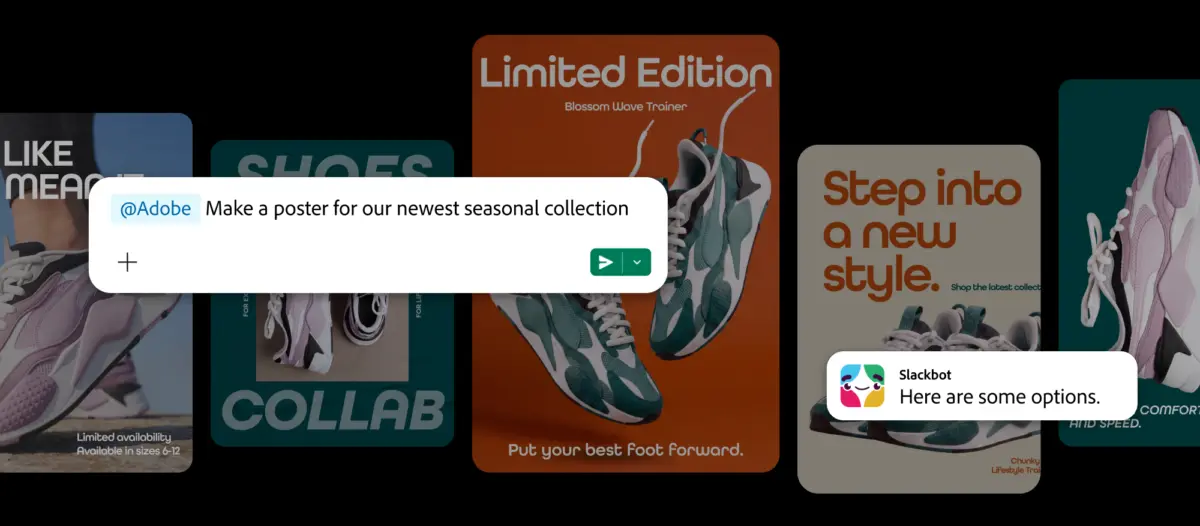
In a significant move toward the consolidation of enterprise workflows, Adobe has announced a deep, agentic AI integration with Slack. This partnership allows users to access Adobe’s flagship creative and productivity applications—including Firefly, Adobe Express, Photoshop, Premiere, Acrobat, InDesign, Illustrator, Stock, and Lightroom—directly within Slack’s native AI chatbot, Slackbot. Alongside this conversational integration, Adobe is launching the "Adobe for Slack MCP" app, making more than 70 of its specialized tools programmatically accessible within the Slack ecosystem.
This integration represents a fundamental paradigm shift in how enterprise teams interact with specialized software. Rather than requiring users to constantly context-switch between design environments, document editors, and communication hubs, the partnership brings professional-grade creative and document tools directly into the conversational canvas where daily collaboration occurs. At launch, these capabilities will be available exclusively to Slack Business+ and Enterprise+ tier customers, highlighting a clear focus on high-value corporate environments where workflow friction directly impacts operational efficiency.
The strategic rationale behind this alliance is clear: as generative AI matures, the traditional boundaries of application user interfaces are eroding. Knowledge workers increasingly expect to execute complex, multi-step tasks using natural language from a single centralized interface. By embedding its industry-standard tools within Slack, Adobe is positioning itself to capture user intent at the point of origin, defending its market leadership against emerging digital design and productivity competitors.
Detailed Chronology & Integration Mechanics
   [ Slack User Thread / Canvas ]
                 │
                 ▼ (Conversational Context & Assets)
         [ Slackbot / LLM ]
                 │
                 ▼ (Invokes via MCP)
    [ Adobe for Slack MCP App ]
                 │
   ┌─────────────┼─────────────┐
   ▼             ▼             ▼
[Firefly]   [Photoshop]   [Acrobat]  (70+ Adobe Tools)
   │             │             │
   └─────────────┼─────────────┘
                 ▼
     [ Finished Asset in Chat ]
The Evolution of Adobe’s Conversational Strategy
The integration with Slack is not an isolated experiment, but rather the next phase of Adobe’s broader omni-channel AI distribution strategy. It follows a similar integration launched for OpenAI’s ChatGPT and precedes a planned rollout for Google’s Gemini ecosystem. This phased expansion demonstrates Adobe’s commitment to transforming its software suite from static desktop applications into a headless, API-driven creative engine capable of operating across any major conversational AI platform.
Under the Hood: The Model Context Protocol (MCP)
The technical backbone of this new integration is the "Adobe for Slack MCP" app. Built on the Model Context Protocol (MCP)—an open standard designed to connect large language models (LLMs) securely to external data sources and API-driven tools—this framework allows Slack’s underlying AI models to dynamically discover, understand, and invoke over 70 distinct Adobe tools.
When a user interacts with Slackbot, the interaction follows a structured execution path:
- Intent Parsing: The user describes a desired business outcome in plain English (e.g., "Take the marketing copy from our shared Slack Canvas, generate a high-res promotional banner using our brand guidelines, and export the final copy package as a secure PDF.")
- Contextual Harvesting: Slackbot analyzes the active conversation, thread history, and linked Slack Canvas files to gather the necessary text, brand parameters, and structural layout requirements.
- Dynamic Tool Orchestration: Through the MCP app, the AI identifies and chains together the precise Adobe microservices needed for the job. It might call Adobe Firefly to generate the background imagery, Photoshop APIs to apply specific layer adjustments, and Adobe Acrobat to compile the final PDF.
- Asset Retrieval and Editing: The system can securely query the organization’s Creative Cloud asset library, bringing existing brand collateral, vector logos, and templates directly into the active chat interface for real-time modification.
By automating these handoffs, the integration eliminates the tedious manual steps of downloading, converting, re-uploading, and verifying files across disconnected software environments.
Supporting Context & Market Dynamics
The Cost of the "Toggle Tax"
The integration of Adobe’s tools directly into Slack addresses one of the most persistent drains on modern enterprise productivity: context switching. Often referred to by organizational psychologists as the "toggle tax," the cognitive friction of constantly switching between communication tools, design suites, and document managers degrades focus and wastes valuable time.
| Metric / Workflow Dimension | Traditional Disconnected Workflow | Integrated Agentic Workflow |
|---|---|---|
| Average App Switches per Hour | 10 to 30 times | Near zero (centralized in Slack) |
| Time to Retrieve & Edit Assets | 15–20 minutes (manual search, download, edit, upload) | < 2 minutes (natural language retrieval & edit) |
| Workflow Friction | High (siloed files, manual version control issues) | Low (direct integration with Creative Cloud libraries) |
| Primary Interface | Multi-window desktop environments | Single conversational canvas |
Industry research indicates that employees waste up to four hours per week simply reorienting themselves after switching between disparate software applications. By consolidating these capabilities within Slack, enterprise teams can achieve a continuous workflow state, accelerating project delivery timelines and reducing operational overhead.
The Battle for the Enterprise Canvas
The enterprise productivity landscape is currently defined by an intense race to control the "primary interface" of the modern worker. While Adobe remains the undisputed giant of professional creative software, agile competitors like Canva and Figma have made rapid inroads into corporate environments by prioritizing browser-first, highly collaborative design workspaces.
Both Canva and Figma have aggressively launched their own integrations with advanced chatbots like ChatGPT and Claude. Concurrently, AI labs like Anthropic are releasing deeper integrations directly into Slack, recognizing that the vast majority of actionable corporate knowledge and decision-making resides within conversational history.
       [ COLLABORATION HUBS ]
       (Slack, Teams, ChatGPT)
                 ▲
                 │ (Deep Integrations / MCP)
                 ▼
     [ CREATIVE & PRODUCTIVITY LIBRARIES ]
       (Adobe, Canva, Figma, Microsoft)
In this competitive environment, Adobe’s primary advantage lies in its sheer breadth. While competitors excel in specific niches—such as simple templates or vector-based UI design—Adobe is unique in its ability to offer high-end creative engines (Photoshop, Illustrator, Premiere) alongside enterprise-grade document management systems (Acrobat). Delivering both modalities through a single conversational AI interface gives Adobe a distinct competitive edge in securing enterprise-wide software deployments.
Official Statements & Strategic Analysis
The strategic focus of this integration is highlighted by comments from Adobe’s leadership. Speaking on the launch, Deepti Pradeep, Senior Director for Agentic AI at Adobe, shared insights from user testing:
"In focus groups, people talked about the value they get from this experience very clearly: saving time, getting to the outcome they want faster without having to micromanage every step, being able to access Adobe wherever they’re already working. That’s been interesting for us because it’s pushed us to think less about individual edits and more about the larger outcome someone is trying to get to."
Pradeep’s emphasis on "outcomes over individual edits" highlights a major shift in product design. For decades, software companies focused on building highly detailed user interfaces with thousands of manual controls. In the era of agentic AI, the product is increasingly judged on its ability to understand user intent and autonomously orchestrate those controls behind the scenes to deliver a finished product.
Pradeep also addressed the competitive landscape, acknowledging that while users have more software choices than ever, Adobe’s unique position lies in its deep, multi-modal portfolio:
"Consumers having choices between tools is a good thing, but Adobe has the advantage of providing both creative and productive tools across different modalities."
This multi-modal capability is a key differentiator. A marketing team, for instance, does not just need to generate an image; they must also review legal copy, generate localized variants, compile PDFs, and distribute secure files. By unifying these diverse workflows under a single Slackbot interface, Adobe positions itself as the end-to-end operational engine for the modern digital enterprise.
Future Outlook
The Rise of Headless Enterprise Software
The integration of Adobe’s creative suite into Slack is a clear sign of the trend toward "headless" enterprise applications. In this model, the traditional graphical user interface (GUI) of an application becomes optional. Instead, the application’s core capabilities are exposed as APIs that can be orchestrated by AI agents operating within chat programs, email clients, or virtual whiteboards.
As these agentic ecosystems mature, we can expect several key developments:
- Hyper-Personalized Workflows: AI agents will automatically learn an organization’s specific brand guidelines, compliance rules, and design preferences, generating custom assets without requiring detailed prompts.
- Autonomous Version Control: AI systems will automatically update linked assets across all shared channels, canvases, and document libraries when changes are made in a Slack thread, ensuring team-wide consistency.
- Cross-Platform Agent Collaboration: Future iterations of the Model Context Protocol may allow Adobe’s AI agents to collaborate autonomously with external CRM, ERP, and project management tools, automatically initiating marketing campaigns and updating budgets based on simple conversational approvals.
Addressing Security, Compliance, and Intellectual Property
As enterprise workflows migrate to conversational interfaces, maintaining data security and compliance becomes critical. Large corporations operating on Slack Business+ and Enterprise+ tiers require strict assurances regarding data residency, intellectual property protection, and access controls.
Adobe has designed its generative AI offerings, particularly the Firefly engine, to be commercially safe and trained on licensed or public-domain content to mitigate copyright risks. However, bringing these tools into Slack introduces new compliance questions:
- How will enterprise administrators control which users can invoke premium creative tools or access sensitive brand assets?
- How will data privacy be maintained when confidential document contents are processed by Slack’s underlying AI models to generate summaries or visual assets?
Resolving these challenges will require close collaboration between Adobe, Salesforce (Slack’s parent company), and enterprise IT departments. The success of this conversational shift will depend on building robust security, auditability, and governance frameworks directly into these agentic workflows.
Conclusion
The partnership between Adobe and Slack marks an important step in the evolution of enterprise software. By turning Slackbot into an active collaborator capable of orchestrating 70+ professional tools, Adobe is meeting workers where they already are. As conversational platforms continue to establish themselves as the operating system of the modern workplace, the companies that successfully embed their capabilities within these natural-language environments will define the future of productivity.