Executive Overview
The convergence of decentralized finance (DeFi) and traditional capital markets has long promised a borderless, unified financial system. Yet, bridging the gap between native digital assets and tokenized real-world assets (RWAs)—such as gold and equities—remains one of the most formidable engineering hurdles in modern financial technology.
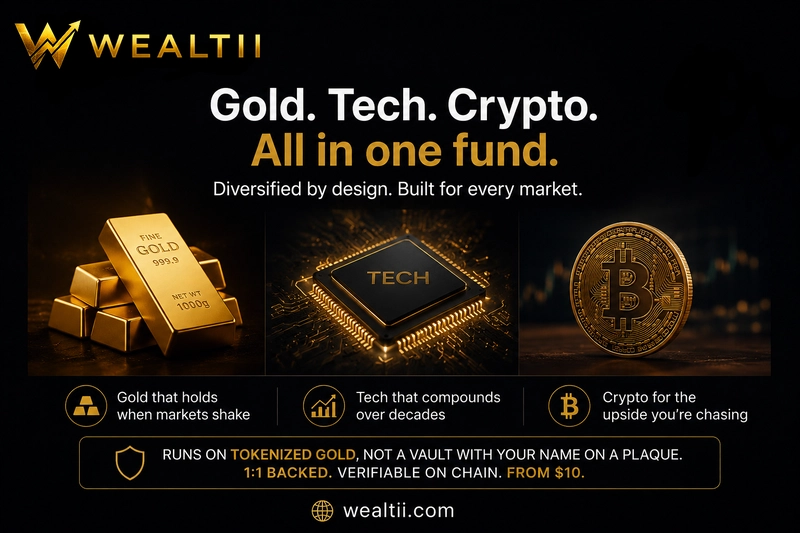
When an everyday user deposits a modest sum—say, ten dollars—into a multi-asset index fund like Wealtii, they expect an instantaneous, frictionless transition from fiat or stablecoin currency into a diversified portfolio spanning cryptocurrencies, tokenized precious metals, and tokenized tech equities. Behind this seemingly simple user interface, however, lies a complex orchestration of disparate technical rails, multi-source price oracles, liquidity management algorithms, and decentralized custody frameworks.
Unlike traditional index funds that operate within standardized, centralized infrastructure (clearinghouses, custodians, and legacy exchanges speaking a unified technical language), a hybrid digital asset fund must cross infrastructural divides. Crypto assets trade on decentralized exchanges (DEXs) and high-speed layer-1 blockchains; tokenized gold operates via specific issuer tokens; and tokenized equities rely on entirely separate infrastructural pipelines originally built for isolated regulatory environments.
This investigative technical report examines the architecture powering Wealtii. Drawing from architectural disclosures, engineering challenges, and operational realities, we dissect the mechanics of pricing, execution, custody, automated rebalancing, and on-chain verification. We also explore the unique vulnerabilities of building complex financial infrastructure as an independent developer, highlighting the trade-offs required to maintain radical transparency in an industry frequently plagued by opacity.
Detailed Chronology: The Lifecycle of a Micro-Deposit
To understand the engineering complexity of Wealtii, one must trace the exact chronological pathway of a single transaction—from the moment a user initiates a deposit to the final settlement of diversified assets inside a public vault.
[ User Deposit ($10) ]
       │
       ▼
[ Step 1: Real-Time Oracle Aggregation ] ──> (Handles multi-feed price latency & divergence)
       │
       ▼
[ Step 2: Batch Execution & Routing ]    ──> (Minimizes slippage & gas overhead for micro-deposits)
       │
       ▼
[ Step 3: Gnosis Safe Vault Custody ]    ──> (Settles directly into public, verifiable on-chain multi-sig)
Phase 1: Pricing, Oracles, and Conversion Logic
The first and most critical technical challenge occurs before a single satoshi or stablecoin is converted: establishing a unified, tamper-resistant price snapshot across vastly different asset classes.
A crypto price feed, driven by high-frequency automated market makers (AMMs) and order books, behaves entirely differently than a tokenized gold price feed, which is tethered to physical commodity pricing mechanisms. Similarly, tokenized equity feeds are anchored to traditional stock market trading hours, creating latency and liquidity disparities when traditional markets close.
- The Synchronization Problem: The system must query live market data from multiple sources simultaneously. If the pricing engine experiences lag or oracle manipulation on a single feed, the entire asset allocation ratio becomes skewed. This risks either overpaying for a specific asset class or misrepresenting the fund’s actual net asset value (NAV).
- Mitigating Slippage on Micro-Deposits: Executing a ten-dollar deposit across three distinct asset classes presents severe economic friction. If each asset is purchased individually via direct market orders, gas fees and DEX slippage would rapidly consume a disproportionate percentage of the user’s capital. To solve this, the engineering architecture relies on deposit batching. Rather than executing fragmented trades instantly, the system aggregates incoming micro-deposits, calculating optimal execution routes in bulk to preserve capital efficiency.
- Volatility and Slippage Thresholds: Market prices fluctuate dynamically between the exact microsecond a user clicks "Deposit" and the moment smart contracts execute the transaction on-chain. Systems operating in volatile crypto environments must establish strict slippage boundaries. If market movement breaches a predefined threshold during execution, the transaction must either be automatically aborted or flagged, balancing user protection against the frustration of unnecessary transaction failures.
Phase 2: Custody and Settlement Infrastructure
Once assets are successfully acquired via optimized routing, they must be securely housed without falling into the trap of opaque, centralized ledger entries.
Wealtii utilizes a public, on-chain Gnosis Safe multi-signature vault architecture. This ensures a seamless handoff from the execution layer to the custody layer. The tokens purchased during the conversion phase are immediately deposited into a verifiable, public wallet address rather than an internal database. This structural design guarantees that the assets backing the user’s investment are cryptographically provable and immune to internal balance sheet manipulation.
Phase 3: The Reality of Automated Rebalancing
In a fully mature, institutional-grade index fund, portfolio rebalancing is an automated, continuous process. As market values shift, the fund periodically sells overweighted assets and accumulates underweighted ones to maintain its targeted asset allocation.
However, cross-asset rebalancing across crypto, tokenized commodities, and tokenized equities introduces extraordinary algorithmic and computational complexity.

- Current State vs. Roadmap: True, fully automated, continuous multi-asset rebalancing is not yet fully live and battle-tested within the current iteration of the platform. Founders emphasizing transparency note that while the initial point-of-investment allocation is fully functional, ongoing, programmatic cross-market rebalancing remains an active work-in-progress. Acknowledging this technical gap prevents the dangerous divergence between marketing hype and engineering reality that frequently undermines user trust in early-stage Web3 protocols.
Supporting Context & Metrics: The Verification Problem
A common misconception in the Web3 ecosystem is that "on-chain and verifiable" is an entirely solved problem the moment assets land in a public smart contract wallet. In practice, transparency is only as good as its legibility.
The Legibility Gap
Consider the average user navigating a blockchain block explorer (such as Etherscan or Arbiscan). They are confronted with a raw alphanumeric wallet address containing a heterogeneous list of contract addresses and hexadecimal token balances. To a non-technical participant, this raw data is functionally useless. It does not inherently prove that the assets held in the wallet match the fund’s marketing claims or structural mandate.
┌────────────────────────────────────────────────────────┐
│               RAW BLOCKCHAIN DATA                      │
│  0x4F92...B12A: 0.045 ETH, 3.2 PAXG, 1.15 xTSLA         │
└──────────────────────────┬─────────────────────────────┘
                           │
                           ▼ (The Verification Translation Layer)
┌────────────────────────────────────────────────────────┐
│            USER-FACITING DASHBOARD                     │
│  Crypto: 33.3% | Tokenized Gold: 33.3% | Equities: 33.3% │
│  [Cross-Checkable Directly Against Public Vault]       │
└────────────────────────────────────────────────────────┘
To bridge this gap, engineering teams must build an intermediate verification translation layer. This layer acts as a cryptographic bridge, translating complex on-chain token balances into an intuitive, human-readable dashboard that ordinary users can independently audit against the fund’s stated composition.
- Custody vs. Execution vs. Verification:
- Custody answers the question: Who controls the funds? (Answer: Multi-sig smart contracts).
- Execution answers the question: How are deposits converted efficiently? (Answer: Batch routing and oracle pricing).
- Verification Legibility answers the question: Can a non-engineer independently confirm the system’s claims without trusting the developer’s word?
Without the third pillar, even a flawlessly secured custody model fails to achieve true decentralization, as users are ultimately forced to trust a proprietary interface to interpret the blockchain for them.
Official Statements & Architectural Philosophy
Building financial infrastructure as an independent developer or small team exposes unique systemic vulnerabilities. Large fintech enterprises deploy dedicated engineering departments to isolate failure modes across risk management, compliance, execution routing, and front-end design. Solo builders, by contrast, must internalize the entire surface area of potential system failures.
The Solo-Builder’s Risk Matrix
When interviewed regarding the structural hurdles of scaling multi-asset Web3 platforms, independent systems architects routinely highlight three primary failure vectors:
- Oracle Degradation During High Volatility: Price feeds inevitably lag or experience intermittent downtime precisely during macroeconomic stress events—the exact moments when pricing accuracy is paramount.
- Live Market Variance: DEX liquidity pools and AMM routing pathways that perform flawlessly in isolated testnet environments can behave unpredictably under heavy mainnet congestion or sudden market shocks.
- Third-Party Issuer Dependencies: Relying on external tokenized asset issuers introduces systemic counterparty risk. If an issuer’s backend infrastructure experiences downtime or regulatory friction, the indexing platform must possess architectural workarounds to prevent cascading failures.
"If a price feed lags or an execution route fails during a volatility spike, I don’t have a multi-layered corporate hierarchy to absorb the blow—every failure mode is something I have to catch, understand, and handle myself," notes the core architecture documentation. "That is precisely why I default to public, on-chain, checkable custody. If something breaks in the allocation layer, I want it to be visible and verifiable on-chain rather than quietly hidden behind a sanitized dashboard number."
Future Outlook: The Horizon of Multi-Asset Tokenization
The trajectory of decentralized index funds points toward increasingly sophisticated, programmatic financial instruments. As tokenized real-world assets gain regulatory clarity and deeper secondary liquidity, the infrastructural gap between traditional finance (TradFi) and decentralized finance (DeFi) will continue to narrow.
Key Milestones for Next-Generation Infrastructure:
- Standardized Cross-Chain Liquidity Protocols: The eventual emergence of universal messaging standards and cross-chain liquidity layers will eliminate the friction of moving value between distinct layer-1 networks and tokenized RWA issuers.
- Zero-Knowledge (ZK) Proofs for Verification: Future iterations of verification layers will likely utilize Zero-Knowledge proofs to mathematically guarantee that fund holdings match stated index weights in real-time, removing even the need to trust an API dashboard.
- Fully Autonomous Rebalancing Engines: As gas optimization techniques improve and decentralized automation networks (such as Chainlink Automation or Gelato) mature, continuous, programmatic multi-asset rebalancing will become economically viable even for micro-deposits.
Conclusion
The evolution of platforms attempting to unify crypto, commodities, and equities into a single user-friendly product serves as a case study in modern financial engineering. While the vision of frictionless, diversified micro-investing is compelling, the technical reality requires navigating complex webs of oracle synchronization, batch execution, and verifiable custody.
For developers, investors, and industry observers, the ongoing iteration of these systems provides a transparent window into the future of capital formation—one where complex financial engineering is rendered invisible to the end user, yet remains entirely open to cryptographic verification.