Executive Overview
On September 9, 2026, the competitive landscape of the on-demand grocery and retail delivery sector underwent a major shift. Shipt, the same-day delivery subsidiary of Target Corporation, officially announced the launch of "Ask Shipt," an advanced generative AI-powered shopping assistant. Designed to transition the traditional, manual e-commerce search-and-filter experience into a conversational, intuitive interface, the tool allows users to compile complex, customized, and ready-to-buy shopping carts using natural language prompts and image uploads.
The rollout of "Ask Shipt" is not an isolated product launch, but rather a strategic escalation in what industry analysts are calling the "AI Cart Race." Strikingly, Shipt’s announcement coincided directly with Instacart’s morning launch of its own proprietary AI grocery assistant, "Clementine." This double-header of major product debuts underscores an industry-wide realization: in an era of tightening consumer wallets and intense platform competition, the future of digital retail belongs to platforms that can eliminate friction, anticipate household needs, and convert inspiration into instant commerce.
As gig-economy giants like Uber Eats and DoorDash deploy similar conversational systems, Shipt’s new tool represents a critical defensive and offensive play for Target. By integrating multimodal AI search capability directly into its ecosystem, Shipt aims to lock in customer loyalty, increase average order value (AOV), and establish a highly personalized retail environment that blurs the line between meal planning and direct-to-door fulfillment.
Detailed Chronology: The 2026 Convergence of Delivery AI
The debut of "Ask Shipt" on September 9, 2026, is the latest chapter in a highly active year for artificial intelligence integrations across the on-demand delivery sector. Over the course of 2026, the industry’s focus pivoted sharply from back-end logistical optimization to consumer-facing, generative AI experiences.
2026 AI Delivery Integration Timeline:

[Feb 11] Uber Eats launches AI grocery cart assistant
   │
[Jun 11] DoorDash debuts multimodal AI chatbot with photo ordering
   │
[Sep 09] Instacart launches "Clementine" AI assistant (Morning)
   │
[Sep 09] Shipt launches "Ask Shipt" conversational assistant (Midday)
February 11, 2026: Uber Eats Fires the First Salvo
The year’s consumer-facing AI transformation began in earnest when Uber Eats introduced an AI-powered assistant specifically engineered to streamline the tedious process of grocery cart creation. Recognizing that users found building a full weekly grocery list on a mobile screen cumbersome, Uber integrated a conversational agent designed to suggest entire recipes and automatically populate carts based on broad dietary preferences and past ordering history.
June 11, 2026: DoorDash Integrates Multimodal Capabilities
Four months later, DoorDash escalated the technology curve by launching a highly interactive AI chatbot. Crucially, DoorDash’s update introduced multimodal inputs, enabling users to order not just through text-based commands but also by uploading photos. This allowed consumers to photograph a physical menu, a pantry item, or a handwritten list, which the AI parsed to automatically identify and compile matching items from nearby merchants.
September 9, 2026: The Clash of the Titans
The AI cart race reached a fever pitch on the morning of September 9, 2026.
- Morning: Instacart, the market leader in independent grocery delivery, went live with "Clementine," an AI assistant designed to act as a highly specialized digital sous-chef and personal shopper. Clementine focused heavily on conversational meal prep, dietary restrictions, and intelligent item substitutions.
- Midday: Shipt counter-punched with the official release of "Ask Shipt." Available immediately across both the iOS/Android apps and Shipt.com, the tool went live with a robust feature set combining natural language processing, photo-to-cart recognition, and budget-optimized meal planning.
This rapid sequence of product rollouts highlights how quickly conversational search has transitioned from a novel, experimental feature to an essential, baseline utility in the gig-economy ecosystem.
Technical Deep Dive: How "Ask Shipt" Reengineers the Shopping Experience
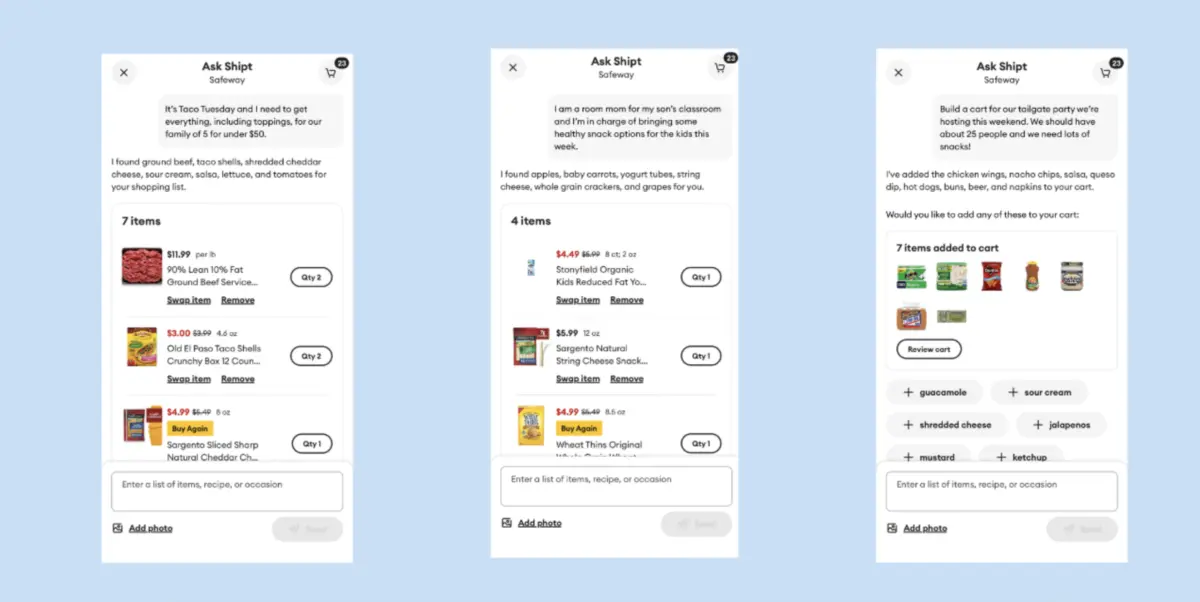
"Ask Shipt" utilizes a combination of proprietary retail algorithms and large language models (LLMs) to bridge the gap between abstract human intent and concrete retail inventory (SKUs). Instead of forcing consumers to execute multiple separate searches for items like "buns," "ground beef," "charcoal," and "plates," the tool processes holistic, situational prompts.
User Prompt: "Create a tailgate cart for 25 people with brunch items."
      │
      ▼
[Ask Shipt AI Engine]
   ├── Natural Language Processing: Identifies context, guest count, & theme
   ├── SKU Mapping & Local Inventory Check: Verifies stock at local Target/partner stores
   └── Budget & Portioning Algorithm: Calculates quantities (e.g., scale for 25 people)
      │
      ▼
Outcome: A fully populated, ready-to-buy cart delivered to the user's screen.
1. Complex, Context-Aware Cart Assembly
The engine excels at translating vague, multi-variable requests into actionable lists. Shipt highlights queries such as, "Create a cart for my Saturday tailgate for 25 people and include some brunch items," or "Build a cart for easy school lunches and after-school snacks."
To execute this, the AI must not only understand what constitutes a "tailgate" or a "school lunch" but must also calculate volume. The system estimates the volume of food required to feed 25 people, automatically adjusting the quantities of orange juice, pastries, and grilling supplies before presenting the completed cart to the user for final approval.
2. Multimodal Photo-to-Cart Conversion
Following the multimodal trend validated by DoorDash earlier in the year, "Ask Shipt" features advanced computer vision capabilities. Users can take a photo of a meal they are eating at a restaurant, upload a screenshot of a recipe from social media platforms like Instagram or TikTok, or photograph a dish in a cookbook. The AI identifies the core ingredients of the dish, cross-references them with the real-time inventory of the user’s selected local store, and populates the cart with the exact items needed to recreate the meal at home.
3. Algorithmic Budget Optimization
Addressing macroeconomic pressures and heightened consumer price sensitivity, Shipt integrated a budget-conscious planning feature. Users can input constraints such as, "Build a weeknight meal for a family of five under $35."
The AI then performs a real-time calculation, balancing recipe requirements with local product pricing, active promotions, and private-label alternatives (such as Target’s Good & Gather or Market Pantry brands) to deliver a complete meal solution that remains strictly under the user’s financial ceiling.
Supporting Context & Market Metrics: The Business Case for Conversational AI
For Target and Shipt, the deployment of "Ask Shipt" is a highly strategic move designed to protect market share and drive digital revenue growth.

The Fight for Customer Retention and AOV
The same-day delivery market is notoriously low-margin and highly vulnerable to customer churn. According to industry data, the average cart abandonment rate in online grocery shopping hovers near 60% to 70%, often due to the frustration of manually searching for dozens of individual items.
By streamlining this process into a single conversational prompt, Shipt aims to significantly boost conversion rates. Furthermore, conversational AI naturally lends itself to smart upselling. When a user asks for a "tailgate cart," the AI can suggest high-margin non-grocery items—such as coolers, folding chairs, and wet wipes—directly from Target’s general merchandise inventory, effectively increasing Average Order Value (AOV).
| Platform | AI Assistant Name | Key Launch Date | Primary Unique Feature |
|---|---|---|---|
| Shipt | Ask Shipt | September 9, 2026 | Budget-optimization constraints & Target ecosystem integration |
| Instacart | Clementine | September 9, 2026 | Deep culinary integration & smart dietary substitutions |
| DoorDash | DashAI (unbranded chatbot) | June 11, 2026 | Photo upload & physical menu parsing |
| Uber Eats | Uber Eats Assistant | February 11, 2026 | Automated weekly cart creation & recipe-based recommendations |
Synergies with Target’s Broader Digital Strategy
The launch of "Ask Shipt" directly aligns with a broader, coordinated push by its parent company, Target. Earlier in September 2026, Target.com introduced an array of upgraded AI utilities across its primary e-commerce portal, including:
- AI-Powered Photo Search: Allowing users to find apparel and home decor by uploading images.
- Generative Review Summaries: Synthesizing thousands of customer reviews into concise, digestible bullet points highlighting product pros and cons.
- Hyper-Personalized Recommendation Engines: Tailoring the storefront based on real-time browsing behavior and historical purchase patterns.
By ensuring that Shipt’s platform operates on a similarly advanced technological footing, Target is creating a unified, AI-driven digital ecosystem. Whether a customer shops for bi-weekly delivery via Target.com or requires immediate, same-day fulfillment via Shipt, the underlying AI infrastructure provides a consistent, high-utility experience.
Official Statements and Strategic Intent
In its official launch announcement, Shipt emphasized that the primary goal of "Ask Shipt" is to redefine the convenience of modern shopping by aligning digital tools with the natural, conversational ways humans think about their daily needs.
A spokesperson for Shipt highlighted the user-centric design of the tool:
"We know that our customers don’t think about their shopping lists in terms of isolated search terms; they think in terms of real-life scenarios—feeding their families on a budget, planning a weekend gathering, or trying to recreate a delicious meal they saw online. ‘Ask Shipt’ is built to understand those real-life contexts. By turning simple, conversational prompts and photos into ready-to-buy carts, we are removing the cognitive load of shopping and delivering a truly intuitive, personalized experience."
This positioning reflects a broader corporate shift away from transactional utility and toward conversational relationship-building. By positioning "Ask Shipt" as a helpful household companion rather than a sterile search engine, the company hopes to foster deeper brand affinity and secure a larger share of the consumer’s weekly spend.
Future Outlook: The Autonomous Future of Digital Retail
The simultaneous emergence of "Ask Shipt" and Instacart’s "Clementine" on September 9, 2026, signals that the grocery delivery landscape has entered a new phase. Looking ahead, several key trends and challenges are poised to shape the next iteration of conversational retail.
1. The Challenge of "Hallucinations" and Inventory Realities
While the promise of generative AI is immense, the real-world execution remains highly complex. AI models are prone to "hallucinations"—potentially recommending products that do not exist, misinterpreting dietary restrictions (such as suggesting a gluten-containing product to a celiac user), or miscalculating budget constraints. Furthermore, because grocery store inventories fluctuate rapidly throughout the day, these AI models must be deeply integrated with real-time local inventory systems to prevent the disappointment of out-of-stock items upon checkout.
2. Transitioning from Reactive to Proactive Commerce
The current generation of AI assistants, including "Ask Shipt," are primarily reactive: they respond to prompts initiated by the user. The next logical step in this technological evolution is proactive, predictive commerce.
Industry analysts predict that by late 2027 or 2028, these assistants will analyze household consumption patterns, smart-appliance data (such as connected refrigerators), and calendar events to autonomously suggest cart additions. For instance, the AI might proactively prompt a user: "I noticed your local high school has a home game this Friday, and you are running low on snacks. Shall I build a game-day cart for your family under $20?"
3. The Battle for Platform Loyalty
As the underlying AI capabilities of Shipt, Instacart, DoorDash, and Uber Eats reach parity, the battleground will shift from what the AI can do to how well it knows the individual user. The platform that can most accurately remember a family’s unique preferences, brand loyalties, allergy profiles, and budgetary boundaries will ultimately win the long-term loyalty of the consumer.
With "Ask Shipt," Target and its delivery arm have established a formidable foothold in this high-stakes arena. By transforming the tedious task of digital grocery shopping into an effortless, conversational dialogue, Shipt is not merely delivering groceries—it is redefining the fundamental dynamics of modern retail.