Executive Overview
In the contemporary landscape of digital entertainment and high-performance computing, storage has quietly transitioned from a routine hardware component into a critical bottleneck. As modern game titles regularly surpass the 100-gigabyte threshold, and operating systems demand ever-faster data retrieval pipelines, consumers find themselves locked in a continuous battle against capacity constraints.
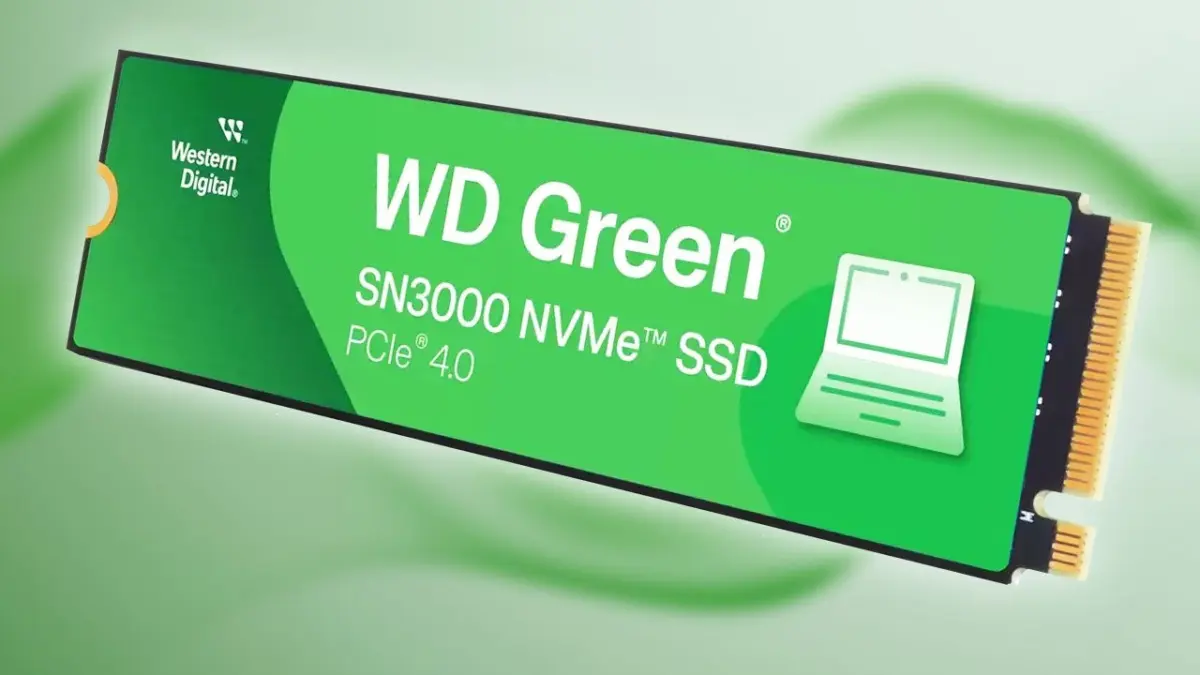
Addressing this universal pain point, Newegg—via its official storefront on the global marketplace platform AliExpress—has introduced a compelling discount on a recognizable name-brand component. The WD Green SN3000 1TB PCIe 4.0 M.2 NVMe Solid State Drive is currently being retailed at an aggressive price point of $129.48, complete with free shipping. This pricing represents one of the lowest entry barriers for a reputable, branded PCIe Gen 4 storage solution seen in the consumer market throughout the year. For comparison, the identical hardware piece commands a higher price tag of $160 on Amazon, translating to a notable savings opportunity for budget-conscious system builders and console owners alike.
However, purchasing budget-tier hardware always invites a degree of technical scrutiny. The WD Green SN3000 occupies a specific niche: it is designed to deliver reliable, robust performance without the premium costs associated with flagship enterprise or enthusiast-grade drives. Most notably, its integration profile includes a caveat regarding its utility within Sony’s PlayStation 5 ecosystem. While officially compatible with the console, it operates slightly below Sony’s stringent speed benchmarks, and it lacks an integrated heatsink—a mandatory thermal accessory for extended console deployment.
This comprehensive report examines the technical specifications of the WD Green SN3000, evaluates its performance metrics within both PC and console environments, analyzes the broader economics of storage scarcity, and provides actionable guidance for consumers looking to maximize their hardware investments.
Detailed Chronology: The Evolution of Storage Pricing and the SN3000 Rollout
The trajectory of NAND flash memory pricing over the past several years has been characterized by dramatic volatility. Global manufacturing shifts, fluctuating demand for enterprise data centers, and the post-pandemic stabilization of consumer electronics spending have created a constantly moving target for hardware consumers.
The Shift Toward PCIe 4.0 Accessibility
When PCIe 4.0 architecture first saturated the market, drives capable of maximizing its throughput were reserved for early adopters and high-end professionals willing to pay an elite tax. Over time, manufacturing processes matured. The introduction of QLC (Quad-Level Cell) 3D NAND memory allowed semiconductor manufacturers to pack more data bits per memory cell, drastically lowering production costs per gigabyte.
The launch and subsequent retail positioning of the WD Green SN3000 line represent this maturation phase. Positioned as an accessible upgrade path, the drive bridges the gap between legacy SATA SSDs—which max out around 550 MB/s—and the blistering, high-cost PCIe 4.0 flagships that push 7,000 MB/s and beyond.
The Promotional Window
The current promotional campaign orchestrated by Newegg via AliExpress highlights a modern retail strategy: leveraging global e-commerce infrastructure to push high-volume hardware units directly to consumers. By deploying targeted promotional incentives—specifically the $15 off coupon code "15USAFF"—retailers can artificially depress the price floor below standard domestic fulfillment overheads.
Analyzing the temporal alignment of this deal reveals an aggressive push heading into the autumn hardware season. With major gaming releases traditionally clustering in the final quarter of the calendar year, consumer demand for reliable storage solutions spikes predictably. By securing a 1TB drive at the $129.48 threshold, budget-minded consumers are insulated against potential localized supply chain crunches and seasonal price inflation.
Supporting Context & Technical Metrics: Under the Hood of the WD Green SN3000
To fully understand the value proposition of the WD Green SN3000 1TB M.2 SSD, one must examine its engineering architecture, speed ratings, and operational compromises.
+-----------------------------------------------------------------+
|              WD Green SN3000 1TB Technical Profile              |
+--------------------------+--------------------------------------+
| Form Factor              | M.2 2280                             |
| Interface                | PCIe Gen 4.0 x4 NVMe                 |
| Memory Architecture      | SanDisk QLC 3D NAND                  |
| DRAM Cache               | DRAM-less                            |
| Sequential Read Speed    | Up to 5,000 MB/s                     |
| Sequential Write Speed   | Up to 4,200 MB/s                     |
| Target Applications      | PC Boot Drives, PS5 Storage Expansion|
+--------------------------+--------------------------------------+
Architectural Breakdown: DRAM-less and QLC NAND
The WD Green SN3000 achieves its aggressive price point through two primary design choices:

- DRAM-less Architecture: Unlike high-end NVMe drives that feature a dedicated onboard DRAM cache to manage mapping tables and accelerate data access, the SN3000 relies on Host Memory Buffer (HMB) technology. HMB allows the drive to utilize a tiny fraction of the host system’s main system memory (RAM) to cache its mapping tables. For standard gaming, office work, and general operating system tasks, the performance delta introduced by the lack of dedicated DRAM is virtually imperceptible.
- QLC 3D NAND Technology: Developed by SanDisk, the Quad-Level Cell memory architecture stores four bits of data per cell. This increases storage density significantly compared to TLC (Triple-Level Cell) or SLC alternatives, directly lowering the cost per gigabyte of manufacturing. While sustained write operations over massive file transfers can experience a drop-off in speed once the high-speed SLC cache is exhausted, typical consumer workloads rarely push the drive into this sustained saturation zone.
Performance Benchmarks
In terms of raw throughput, the drive is rated for:
- Sequential Read Speeds: Up to 5,000 MB/s
- Sequential Write Speeds: Up to 4,200 MB/s
For a budget-tier PCIe 4.0 drive, these figures represent a comfortable sweet spot. They vastly outstrip any legacy SATA or PCIe 3.0 drive, ensuring snappy boot times, rapid application launches, and seamless asset streaming in modern video games.
Official Statements and Compatibility Analysis: The PlayStation 5 Caveat
One of the most frequent applications for M.2 NVMe drives in the modern era is the expansion of internal storage within the Sony PlayStation 5. However, hardware compatibility requires careful adherence to manufacturer guidelines.
Sony’s Official Specifications vs. Reality
Sony Interactive Entertainment outlines strict requirements for any third-party M.2 NVMe SSD installed in the PS5 expansion slot:
- Interface: PCIe Gen4 x4 M.2 NVMe SSD
- Recommended Read Speed: 5,500 MB/s or faster
- Capacity: 250GB to 8TB
- Form Factor: 2230, 2242, 2260, 2280, 22110 (2280 is standard)
- Heatsink: Required (Thermal dissipation structure)
With a maximum sequential read speed of up to 5,000 MB/s, the WD Green SN3000 falls slightly below Sony’s recommended minimum threshold of 5,500 MB/s.
What Does This Mean for the End User?
From a practical standpoint, the drive is fully functional and compatible with the PlayStation 5. During system installation, the PS5 runs a quick speed test on the inserted drive. While drives below 5,500 MB/s may prompt a routine warning message regarding performance, the console permits their use without restriction.
In real-world gaming scenarios, the 500 MB/s shortfall relative to Sony’s recommendation translates to negligible differences. Game load times, level transitions, and asset streaming managed by Sony’s custom I/O complex remain exceptionally fast. The only scenario where an observant user might notice a minor variance is during heavy background tasks, such as copying massive game installation files from an external backup or downloading multi-gigabyte patches simultaneously. For the vast majority of players, the minor speed variance is a negligible compromise in exchange for a significantly lower price point.
The Thermal Management Imperative
A crucial element often overlooked by casual upgraders is thermal management. Sony’s PlayStation 5 hardware architecture demands an efficient cooling solution for any internal expansion drive. High-speed NVMe drives generate substantial thermal output during intensive read and write cycles. Without adequate cooling, thermal throttling occurs—a protective mechanism where the drive automatically reduces its operating speed to prevent overheating and potential hardware degradation.
The WD Green SN3000 does not include an integrated heatsink out of the box. Consequently, installation in a PS5 requires the user to procure a compatible third-party M.2 heatsink. Fortunately, standard aluminum heatsinks designed explicitly for the PS5 expansion slot are widely available on marketplaces like Amazon for approximately $6. These accessories are exceptionally simple to install, typically utilizing pre-applied thermal pads and secure mechanical clips or adhesive backing to sandwich the drive safely. Ignoring this step risks compromised drive longevity and system-level thermal warnings.
The Economics of Storage Scarcity: Why Upgrading is Essential
To appreciate the urgency behind securing affordable storage options, one must examine the baseline storage realities of current-generation gaming consoles and personal computers.
The Myth of the "1TB" Console
When Sony launched the standard PlayStation 5, it boasted a custom 1TB ultra-high-speed SSD. However, raw hardware capacity does not equate to usable space. Once the system reserves storage allocation for the proprietary operating system, system software partitions, and vital firmware utilities, the actual usable storage space collapses to 667GB.

In an era where major AAA software titles routinely demand between 100GB and 150GB of local storage (often ballooning further with mandatory day-one patches, high-resolution texture packs, and post-launch expansions), the stock 667GB fills up rapidly. A gamer maintaining an active library of just five or six contemporary titles will find their internal drive completely saturated.
Even for users who upgrade to a 2TB configuration, industry analysts note that digital-first gaming libraries, service subscriptions (such as PlayStation Plus Extra and Premium), and regular game rotations frequently push storage limits to the brink. Therefore, supplementing the console’s internal ecosystem with a cost-effective 1TB drive like the WD Green SN3000 is no longer a luxury—it is a near-essential upgrade for any dedicated digital consumer.
PC Utility and System Building
On the PC side of the equation, the SN3000 serves as an exceptional secondary or primary boot drive. Operating systems like Windows 11 demand responsive, low-latency storage environments to handle background telemetry, virtualization features (such as DirectStorage), and rapid application switching. Deploying a 1TB PCIe 4.0 drive as a dedicated boot and application drive ensures that routine system tasks execute instantaneously without bottlenecking high-end graphics processing units (GPUs) or multi-core central processing units (CPUs).
Future Outlook: The Horizon of Solid-State Storage
Looking ahead, the trajectory of consumer solid-state storage points toward continued capacity expansion alongside incremental efficiency gains.
The March Toward Higher Densities and Lower Costs
As QLC and emerging PLC (Penta-Level Cell) flash technologies mature, the cost per gigabyte of NVMe storage will continue its long-term downward trend. However, short-term supply chain fluctuations, raw material costs, and shifting fab allocations mean that promotional anomalies—such as Newegg’s current AliExpress offering on the WD Green SN3000—remain transient market events.
Consumers waiting for prices to drop infinitely risk running into micro-inflationary periods driven by enterprise data center demand, particularly as artificial intelligence infrastructure commands massive allocations of global semiconductor manufacturing capacity. Consequently, securing reliable, name-brand PCIe 4.0 storage at a discounted entry barrier of under $130 represents a prudent hedge against future hardware cost spikes.
The Standardization of DirectStorage and High-Speed I/O
As software developers increasingly lean into advanced API implementations like Microsoft’s DirectStorage and console equivalents, the reliance on high-speed NVMe data pipelines will only deepen. Future operating systems will bypass traditional CPU bottlenecks entirely, streaming assets directly from NVMe storage to the GPU memory pool.
While flagship drives pushing 7,000+ MB/s will continue to cater to elite enthusiasts and creative professionals handling uncompressed 8K video editing, the mainstream market will increasingly settle around accessible, high-efficiency PCIe 4.0 drives like the WD Green SN3000. These components strike the optimal balance between cost, thermal efficiency, and everyday performance, ensuring that the average consumer can maintain an expansive, responsive digital library without incurring prohibitive hardware expenditures.
Conclusion
The offering of the WD Green SN3000 1TB PCIe 4.0 M.2 NVMe SSD via Newegg’s AliExpress storefront at $129.48 (utilizing coupon code "15USAFF") presents a timely opportunity for consumers looking to expand their storage horizons.
While the hardware comes with notable caveats—specifically its operation slightly below Sony’s recommended PS5 speed threshold and the absolute requirement to source an inexpensive $6 third-party heatsink—its underlying value proposition remains formidable. For PC builders seeking a reliable, high-speed boot drive, or PS5 owners desperate to escape the constraints of a 667GB usable capacity limit, the SN3000 delivers dependable performance at a highly competitive market price. As digital media sizes continue their relentless upward march, securing cost-effective storage capacity is an investment that pays immediate dividends in convenience, performance, and peace of mind.