Executive Overview
The global marketing landscape is undergoing an unprecedented structural transformation. As consumer expectations for hyper-personalized, instantaneous engagement reach an all-time high, traditional manual workflows are no longer sustainable. Artificial intelligence (AI) has rapidly transitioned from an experimental novelty into the core operational engine of modern enterprise data strategy.
Recent industry benchmarks reveal a striking paradigm shift: an overwhelming 61% of marketers now consider AI software to be the single most critical component of their data strategy. This integration is driven by an imperative need to automate time-consuming administrative tasks, optimize advertising spend, and execute highly sophisticated, context-aware campaigns at scale.
For marketing professionals who feel they have arrived late to the AI revolution, the barrier to entry is lower than many assume. Modern software ecosystems are designed for rapid integration, allowing teams to augment their existing technology stacks seamlessly. This comprehensive report examines the top 11 AI-powered marketing tools currently redefining content creation, email optimization, search engine positioning, and customer relationship management. Furthermore, it outlines the metrics, strategic implications, and future outlook of an industry permanently altered by machine learning.
Detailed Chronology & Industry Evolution
The convergence of marketing and artificial intelligence did not happen overnight; it represents the culmination of decades of incremental advancements in computational power, big data analytics, and Natural Language Processing (NLP).
- The Pre-AI Era (Early 2000s – 2010s): Marketing was predominantly rule-based and manual. Email campaigns relied on static segmentation, search engine optimization (SEO) depended on crude keyword stuffing, and analytics tools offered retrospective reports rather than predictive insights. A/B testing was constrained by traffic volumes, often limiting teams to testing just two variables over weeks or months.
- The Rise of Machine Learning (Mid-2010s): Early predictive analytics tools entered the enterprise space, allowing brands to forecast customer lifetime value and segment audiences based on historical behavior. However, these tools required dedicated data science teams and were largely inaccessible to small- and medium-sized enterprises (SMEs).
- The Generative & Autonomous Era (Late 2010s – Present): The emergence of advanced deep learning architectures, transformer models, and real-time behavioral tracking democratized AI. Platforms evolved from mere analytical dashboards into autonomous agents capable of generating copy, predicting optimal email dispatch times, running self-optimizing cross-channel advertising campaigns, and moderating user-generated content at scale. Today, AI functions not as an auxiliary tool, but as the central nervous system of contemporary marketing operations.
The Top 11 AI Marketing Tools Transforming the Industry
To remain competitive, modern marketing teams must curate a robust stack of intelligent software. Below is a detailed breakdown of 11 industry-leading tools categorized by their primary functional domains.
1. Content Generation & Copywriting
Jasper AI (Formerly Jarvis)
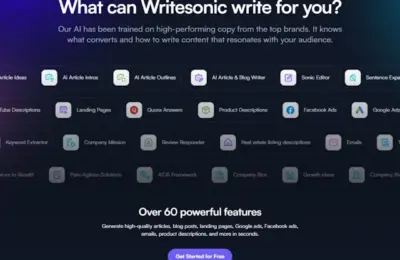
Content velocity is a primary bottleneck for scaling brands. Jasper addresses this challenge by utilizing advanced AI models to generate high-converting copy, blog posts, social media updates, and email campaigns. By analyzing high-performing copy across various mediums, Jasper identifies the most effective phrasing, vocabulary, and sentence structures tailored to a brand’s specific tone of voice. This drastically reduces the time required to move from ideation to final draft.
2. Behavioral Personalization & Sales Targeting
Personalize
Static audience segmentation fails to capture the fluid, ever-changing interests of modern consumers. Personalize is an AI-driven platform that tracks the digital footprints of contacts in real time, monitoring which products and services capture their attention. Utilizing proprietary algorithms, the system identifies each contact’s top three active interests and updates these profiles continuously based on recent site activity. This allows sales and marketing teams to trigger hyper-targeted campaigns precisely when customer intent is highest.
3. Email Marketing & Inbox Optimization
Seventh Sense
With consumers bombarded by hundreds of marketing emails daily, timing is everything. Traditional email scheduling relies on generalized batch-and-blast methods or broad demographic assumptions. Seventh Sense leverages behavioral analytics and machine learning to analyze individual engagement patterns. By determining the exact day, time, and frequency that individual contacts are most likely to open and interact with emails, Seventh Sense maximizes inbox visibility and drives higher conversion rates. The platform integrates seamlessly with enterprise automation ecosystems like HubSpot and Marketo.
4. Natural Language Generation & Subject Line Mastery
Phrasee
Crafting compelling email subject lines is often a game of trial and error. Phrasee revolutionizes this process through advanced Natural Language Generation (NLG). The platform analyzes historical brand data to generate millions of unique, human-sounding copy variations optimized for specific emotional responses and brand voices. Phrasee features an end-to-end closed-loop architecture: as performance data from campaigns is fed back into the model, its predictive capabilities continuously refine themselves, ensuring that future outputs are smarter and more effective.
5. Search Engine Optimization & Topical Authority
HubSpot SEO
Achieving and maintaining high search engine rankings requires a sophisticated understanding of how search engine algorithms categorize digital assets. HubSpot SEO utilizes machine learning to guide content creation teams toward topics that build genuine authority. By structuring content around core subjects and topic clusters—rather than isolated keywords—HubSpot SEO helps brands align with modern search engine ranking criteria, outrank competitors, and capture high-intent organic traffic.
6. Advanced Conversion Rate Optimization (CRO)
Evolv AI
Traditional A/B testing is inherently slow, typically restricted to testing two variables at a time, which can drag optimization cycles out for months. Evolv AI shatters these limitations by enabling simultaneous, multivariate testing of an infinite number of ideas. Its advanced algorithms rapidly identify top-performing concepts, automatically combine them, and iterate continuously to deliver the ultimate user experience at unprecedented speeds.
7. Brand Governance & Content Alignment
Acrolinx
For large enterprises managing distributed content creation across multiple global teams, maintaining a consistent brand voice, tone, and grammatical standard is a monumental challenge. Trusted by industry giants like Google, Adobe, and Amazon, Acrolinx acts as a centralized content alignment platform. Users define corporate guidelines covering tone, style, grammar, and proprietary terminology. Acrolinx then scans and scores existing content in real time, offering actionable suggestions to elevate writing quality and strengthen underperforming pages.
8. Strategic Content Planning & Gap Analysis
MarketMuse
Content strategy should be driven by hard data rather than guesswork. MarketMuse employs sophisticated algorithms to analyze thousands of articles within specific topic categories, mapping out exact keyword targets required to establish topical authority. The platform automatically uncovers content gaps on a website, highlights missed opportunities, and prioritizes new content creation based on its projected impact on search engine rankings.
9. Conversational Commerce & Funnel Management
Copilot
E-commerce success hinges on maintaining uninterrupted, real-time communication with customers across the entire buyer’s journey. Copilot provides a comprehensive suite of AI-driven tools designed to facilitate continuous engagement via messaging channels. From promoting targeted products and recovering abandoned shopping carts to sending automated shipping updates and re-engagement reminders, Copilot ensures brands remain present and responsive at every critical funnel stage.
10. Review Moderation & Social Proof Optimization
Yotpo
User-generated content—specifically product reviews—serves as one of the most powerful conversion drivers in e-commerce. Yotpo harnesses deep learning technology to evaluate customer reviews, extracting key product attributes mentioned by buyers and analyzing overall sentiment. The AI engine automatically surfaces the most relevant reviews from past purchasers in smart, dynamic displays to convert active shoppers. Furthermore, Yotpo automates the labor-intensive process of content moderation by scoring reviews and flagging negative sentiments for human quality control.
11. Autonomous Campaign Management
Albert AI
Albert represents the frontier of autonomous marketing. Operating as a self-learning software suite, Albert ingests vast reservoirs of data to plan, execute, and optimize multi-channel marketing campaigns with minimal human intervention. Marketers provide the creative assets, target markets, and strategic parameters; Albert then analyzes database metrics to isolate the behavioral traits of high-value buyers. The platform runs micro-scale trial campaigns, refines its targeting parameters based on real-time feedback, and scales winning campaigns across digital channels. Crucially, Albert integrates directly into existing marketing technology stacks, maintaining transparent tracking and multi-touch attribution.
Supporting Context & Metrics
The integration of artificial intelligence into marketing workflows is not merely a stylistic preference; it is an economic necessity backed by robust empirical data.
- Efficiency Gains: Organizations utilizing AI-driven content generation and optimization platforms report an average reduction of 40% to 50% in content production time, allowing marketing teams to shift focus from administrative execution to high-level strategic planning.
- Inbox Performance: Studies show that utilizing behavioral send-time optimization tools like Seventh Sense can increase email open rates by 8% to 23%, directly compounding overall campaign return on investment (ROI).
- Conversion Velocity: Multivariate testing platforms such as Evolv AI accelerate optimization cycles by up to 300%, enabling brands to capitalize on shifting consumer trends far faster than competitors relying on legacy A/B testing methodologies.
Official Statements & Industry Perspective
Industry thought leaders and enterprise executives increasingly emphasize that AI is a collaborative amplifier rather than a human replacement.
"Artificial intelligence does not replace human creativity; rather, it removes the cognitive friction of execution. By automating data processing, predictive targeting, and iterative testing, AI empowers marketers to focus on what they do best: storytelling, brand empathy, and visionary strategy."
— Leading Enterprise Marketing Technologist
As the software ecosystem matures, the distinction between "traditional" marketing and "AI-powered" marketing is rapidly dissolving. AI is becoming the foundational baseline of all competitive digital operations.
Future Outlook
Looking ahead over the next decade, the marketing industry will witness even deeper integration of generative and autonomous technologies.
- Hyper-Personalization at Scale: Future AI agents will generate entirely unique website interfaces, dynamic video advertisements, and bespoke email copy tailored in real time to the individual psychological and behavioral profile of a single site visitor.
- Autonomous Multi-Channel Orchestration: Tools modeled after platforms like Albert AI will evolve to autonomously manage end-to-end budgets, dynamically shifting capital between programmatic advertising, social media, search, and email based on predictive macroeconomic and micro-behavioral indicators.
- Ethical AI and Privacy Compliance: As regulations surrounding data privacy (such as GDPR and CCPA) tighten, AI tools will increasingly incorporate privacy-first algorithms, utilizing zero-party and first-party data securely without compromising consumer trust.
Final Saying
The market is flooded with software providers claiming artificial intelligence capabilities, but the curated tools outlined in this report represent battle-tested solutions capable of delivering immediate, measurable value. As the marketing ecosystem continues to evolve at a blistering pace, innovative strategies yet unimagined will inevitably emerge. For now, embracing this comprehensive suite of AI marketing tools provides an essential foundation for any organization striving to maintain a competitive edge in an automated world.
Note: This article contains affiliate links, meaning we make a small commission if you purchase any premium plan through our referral links, at no additional cost to you.