Executive Overview
Are we on the precipice of a white Christian nationalist takeover? For religion scholar and Public Religion Research Institute (PRRI) founder Robert P. Jones, the question is not merely rhetorical—it is an urgent, flashing warning sign. In his latest book, Backslide: Reclaiming a Faith and a Nation After the Christian Turn Against Democracy, Jones draws a chilling historical parallel: "This is our 1933," he writes, explicitly invoking the catastrophic year that democratic Weimar Germany succumbed to the Nazi regime.
Panicked allusions to Nazi Germany have become a frequent fixture of political discourse during and after the Trump eras. However, Jones approaches this comparison from a deeply informed, insider-outsider perspective. Having grown up Southern Baptist in the Deep South and spent decades studying the intricate intersection of race, white supremacy, and American faith, Jones identifies a terrifying echo of history. He points directly to the complicity of Christians in the 1930s—and argues that contemporary white evangelical acquiescence to rising religious authoritarianism threatens to break American democracy beyond repair.
Yet, Backslide is not intended as an elegy for a dying republic. Instead, it serves as a wake-up call and a strategic playbook. Drawing on historical lessons from the German resistance, PRRI polling data, and emerging pushback from alternative Christian communities, Jones insists that the silent majority of non-extremist believers still possess the numbers, the moral authority, and the historical duty to out-organize and push back against the weaponization of their faith.
Detailed Chronology & Historical Parallels: The Ghost of 1933
To understand Jones’s profound alarm, one must examine the historical precedent that anchors his thesis. In Backslide, Jones centers his historical critique on the trajectory of Martin Niemöller, a German Lutheran pastor who initially welcomed aspects of the Nazi movement before realizing the catastrophic mistake he had made.
The Trajectory of Martin Niemöller
In 1933, as Adolf Hitler seized absolute control of Germany, Niemöller began an agonizing journey of resistance. His opposition eventually led to his arrest four years later in 1937, landing him inside the brutal machinery of the Dachau concentration camp, where he remained imprisoned until the fall of the Third Reich in 1945.
Upon returning to Dachau after World War II, Niemöller reflected not just on the horrors of the camp itself, but on the calendar year 1933. He viewed it as a profound personal indictment. From the early rise of the National Socialist movement in the 1920s through three successive elections, Niemöller had actively supported the Nazis. Every day of his imprisonment served as a haunting reminder of the time he had wasted—and the opportunities he had squandered—to avert a national and moral tragedy before it became irreversible.
Applying the Lesson to Contemporary America
Jones does not invoke this history lightly. He builds a methodical, sobering case that the convergence of the second Trump administration, pervasive rhetoric from high-ranking officials—such as Defense Secretary Pete Hegseth—and rock-solid support from white Christian evangelicals has created an escalating crisis of religious authoritarianism.
From aggressive immigration enforcement policies championed earlier this year to explicit Christian nationalist talking points echoing through the halls of federal power, Jones argues that American democracy has entered a state of steep, systemic backsliding. "We are now living in a democratically back-slidden nation," he writes, "abetted by an apostate white Christianity."
Crucially, Jones argues that the greatest hazard today is not merely the vocal minority of extremists driving the movement, but the pervasive apathy of moderate and progressive white Christians who have watched extremism take root and chosen to remain silent out of discomfort or avoidance.
Supporting Context & Metrics: The Numbers Behind the Movement
To contextualize the threat of Christian nationalism, Jones relies on data gathered by the Public Religion Research Institute (PRRI), the nation’s leading research and polling think tank on politics and religion. The empirical reality revealed by these numbers offers both sobering warnings and a mathematical blueprint for resistance.
The Evaporation of Moderate Evangelical Dissent
One of the most alarming metrics highlighted in Jones’s work is the near-total ideological consolidation of white evangelicals behind the MAGA worldview. PRRI polling reveals that roughly 85% of white evangelicals are deeply and consistently aligned with this political movement.
This alignment has manifested most starkly on immigration policies. Jones notes that during the Trump era, white evangelical attitudes toward undocumented immigrants have grown so hardened that constructing a policy "too brutal" for them to support has become virtually impossible.
- Extreme Measures Endorsed: PRRI data demonstrates high levels of evangelical tolerance for aggressive border enforcement, including placing razor wire and barricades in rivers to induce drowning, and establishing internment camps.
- Moral Contradiction: Jones underscores the profound cognitive dissonance of these policy positions among a demographic that claims to follow biblical teachings explicitly commanding care for widows, orphans, and strangers.
The Broader Demographic Landscape
Despite their outsized political influence, white evangelicals represent a shrinking slice of the American demographic pie. According to the 2025 PRRI Census of American Religion, white evangelicals comprise only 13% of the total U.S. population.
Furthermore, while approximately three in ten Americans (roughly 30%) subscribe to a Christian nationalist worldview—a camp encompassing a majority of Republicans and two-thirds of white evangelicals—the country as a whole rejects this worldview by a decisive margin of two to one.
This numeric reality underpins Jones’s strategic optimism: Christian nationalists do not represent a majority of the nation. The true battleground lies not in converting hardened partisans, but in mobilizing the disaffected, the apathetic, and the internally divided middle.
Official Statements & Emerging Resistance
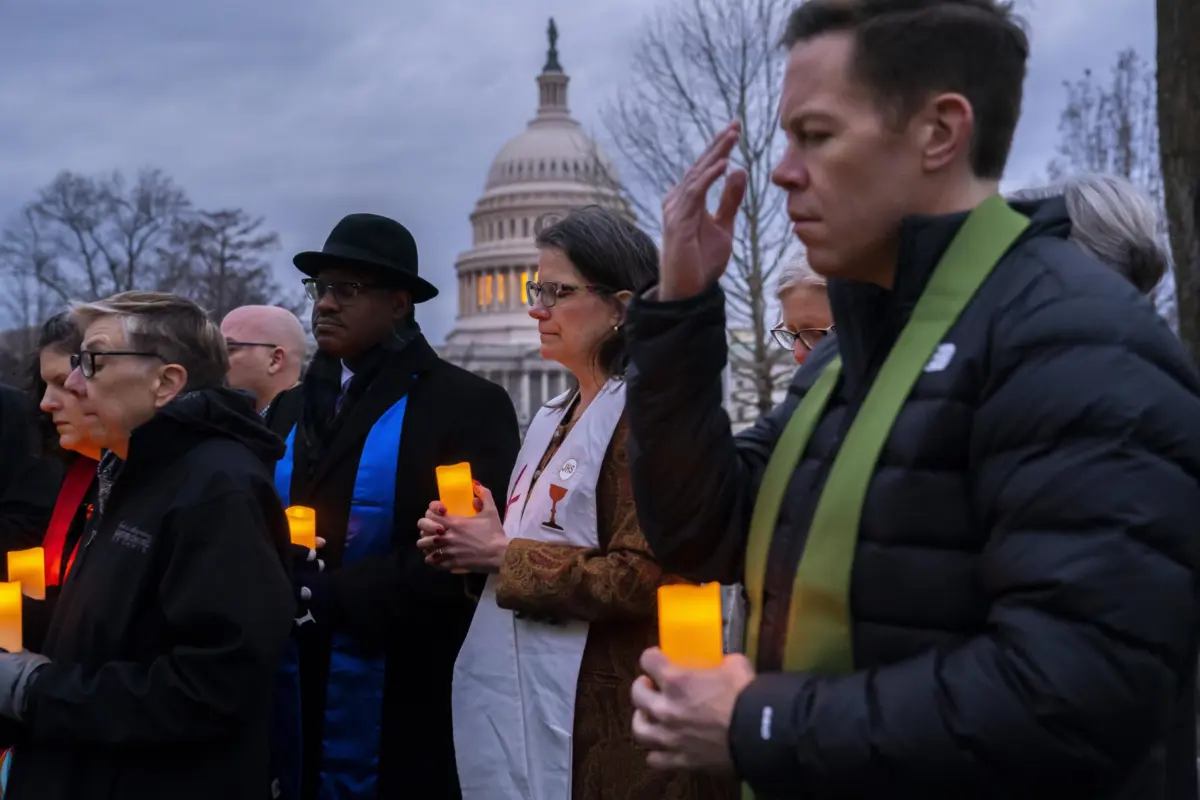
While the upper echelons of several traditional white Christian denominations have spent years looking away, a counter-movement is beginning to claw its way to the surface. Religious leaders, local parishes, and regional church bodies are increasingly drawing bright lines against Christian nationalism.
Institutional Pushback and Denominational Statements
Over the past three years, Jones has addressed more than a hundred predominantly white Christian congregations grappling with a singular, urgent question: How do we resist this in our communities?
This grassroots anxiety is translating into formal institutional action. Five major Christian denominations have either formally adopted or are actively drafting official statements explicitly condemning Christian nationalism. These declarations serve as vital theological guardrails, empowering local pastors and congregational leaders to speak out against extremism without fear of institutional reprisal.
Grassroots Activism on the Ground
The resistance is not confined to paper resolutions; it is manifesting in direct, high-stakes community organizing:
- The Upper Midwest: In cities like Minneapolis and St. Paul, Lutheran and other mainline Protestant communities have mobilized actively to monitor ICE agent movements, shelter immigrant families, and protest aggressive deportation actions.
- The Texas Borderlands: Outside El Paso, a Catholic bishop and local parishes successfully organized to halt the construction of a massive ICE detention center, demonstrating the tangible power of faith-based community defense.
- Mainline and Catholic Divisions: Unlike the monolithic support found among white evangelicals, white mainline Protestants, white Catholics, and Latino evangelicals exhibit deep internal divisions. These fractured spaces provide fertile ground for challenging the Christian nationalist narrative.
Future Outlook: A Playbook for Democratic Defense
When asked about the roadmap for beating back the Christian nationalist takeover, Jones offers a pragmatic, clear-eyed strategy rooted in political reality rather than wishful thinking.
1. Abandoning the "Fool’s Errand" of Converting Extremists
Jones is blunt about the limits of persuasion. Attempting to convince voters who have remained entirely devoted to Donald Trump across three consecutive presidential elections is a waste of precious time and resources. "The only solution," Jones asserts, "is to out-organize and resist that movement and to stand up something else in its wake."
2. Finding a New Theological Voice
For decades, progressive and multiracial faith traditions have produced eloquent, deeply faithful public leaders—from the late Representative John Lewis and Representative Jim Clyburn to Senator Raphael Warnock, pastor of Martin Luther King Jr.’s historic Ebenezer Baptist Church. However, white Christian denominations have historically lagged in producing leaders willing to challenge right-wing religious narratives from a faith-based perspective.
That paradigm is beginning to shift. Emerging political figures, such as Texas state and federal candidates, along with a rising wave of leaders originating from Midwestern mainline Protestant (Presbyterian and Lutheran) traditions, are successfully reclaiming the vocabulary of faith. By speaking out against religious authoritarianism from inside white Christian spaces, these leaders are proving that the language of the Gospel can be decoupled from the politics of exclusion.
3. Reclaiming Christianity for a Pluralistic Democracy
Importantly, Jones’s book is not an apologetic defense of the church, nor does it demand that the millions of Americans who have deconstructed or left the faith in recent decades return to the pews. Jones expresses profound empathy for those who have walked away due to the toxic hypocrisy of modern religious politics.
Instead, Backslide is a call to arms for those who still maintain an attachment to Christianity. It urges them to rescue their faith from the hands of extremists and present an alternative vision—one centered on love, care for the vulnerable, and full compatibility with a pluralistic, multi-ethnic democracy.
As the United States navigates an increasingly volatile political and social landscape, Jones’s message serves as both a sobering historical reminder and an urgent imperative: if a healthier, more inclusive version of American faith is to survive, its adherents can no longer afford the luxury of silence.