Amazon Web Services (Amazon, AWS), the undisputed titan of the global cloud computing ecosystem, has fundamentally overhauled its onboarding and resource management experience. Designed specifically for the hyper-accelerated cadence of modern, AI-driven software development, the new experience eliminates the historical friction that has traditionally characterized enterprise-grade cloud adoption.
For nearly two decades, AWS has stood as the foundational infrastructure supporting the world’s largest enterprises, most complex governments, and most agile startups. However, this unmatched depth—encompassing thousands of distinct services, intricate global regions, and rigorous security frameworks—came with a trade-off. For an individual developer or a small team with a nascent idea, navigating the initial setup, configuring Identity and Access Management (IAM), and mapping out resource permissions often felt like building the factory before manufacturing the product.
Today, AWS is bridging that gap. By introducing sensible defaults, frictionless federated authentication via providers like Google, GitHub, and Apple, and a streamlined project-based workspace deeply integrated with modern AI coding agents, AWS is returning to its original ethos: lowering the barrier to entry so that anyone with an idea can start building immediately. Crucially, this new approach does not sacrifice enterprise scalability. Builders can seamlessly transition from a simplified sandbox environment to the full breadth and depth of the AWS ecosystem—including multi-region architectures, advanced governance, and AWS Organizations—without migrations or downtime.
Detailed Chronology: The Evolution of Cloud Onboarding
The Genesis of Infrastructure-as-a-Service (IaaS)
When Amazon Web Services launched foundational primitives like Amazon Simple Storage Service (Amazon S3), Amazon Elastic Compute Cloud (Amazon EC2), and Amazon Simple Queue Service (Amazon SQS), the core value proposition was democratization. For the first time, a developer did not need millions of dollars in venture capital to rack physical servers in a colocation facility. They could provision compute and storage via an API.
As the customer base expanded to include multinational financial institutions, healthcare providers, and global defense agencies, the architectural demands shifted. Security compliance requirements, strict data residency laws, disaster recovery topologies, and granular cost-control mechanisms became paramount. AWS responded by rapidly expanding its global infrastructure footprint into discrete Regions and Availability Zones while simultaneously layering on sophisticated governance tools.
The Friction of Modern Prototyping
While these enterprise-grade features cemented AWS’s market dominance, they introduced significant cognitive overhead for grassroots developers, hobbyists, and rapid-prototyping teams. Before writing a single line of application logic, a new user was traditionally required to:
Navigate complex billing and identity setup procedures.
Establish master and programmatic user accounts.
Master AWS Identity and Access Management (IAM) policies, roles, and trust relationships.
Manually configure networking boundaries, VPCs, and security groups.
In an era where developers leverage advanced AI coding agents and Large Language Models (LLMs) to construct functional microservices in minutes, spending hours configuring cloud primitives acts as an unacceptable bottleneck. The speed of AI generation necessitated a parallel acceleration in infrastructure provisioning.
The New Simplified Experience: Architectural Mechanics
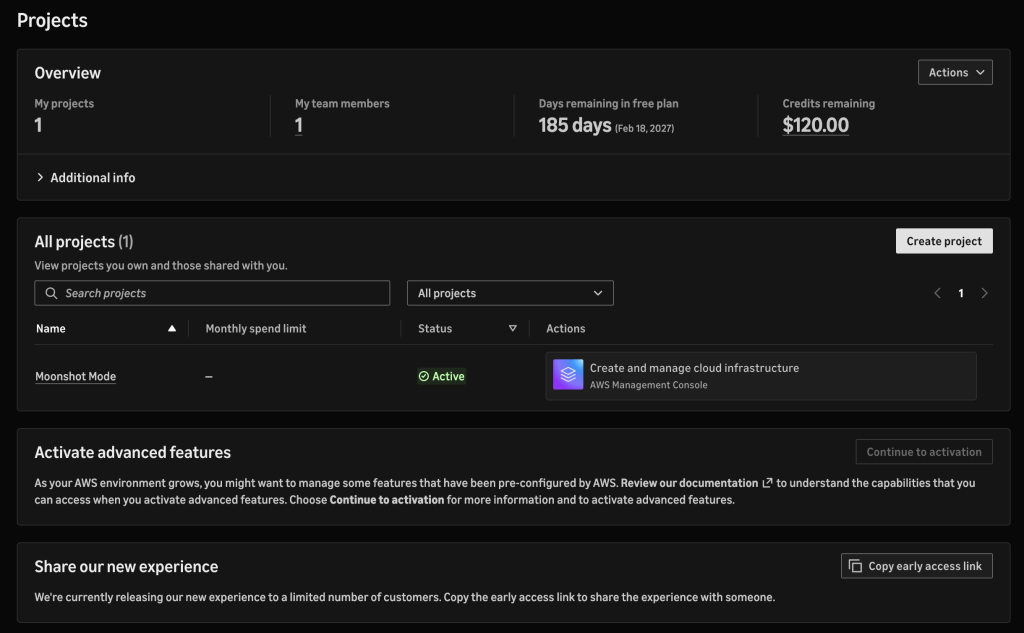
The newly announced AWS onboarding experience completely reimagines this workflow. When a new user accesses the platform, the traditional administrative hurdles are abstracted away behind an intelligent abstraction layer termed "Projects."
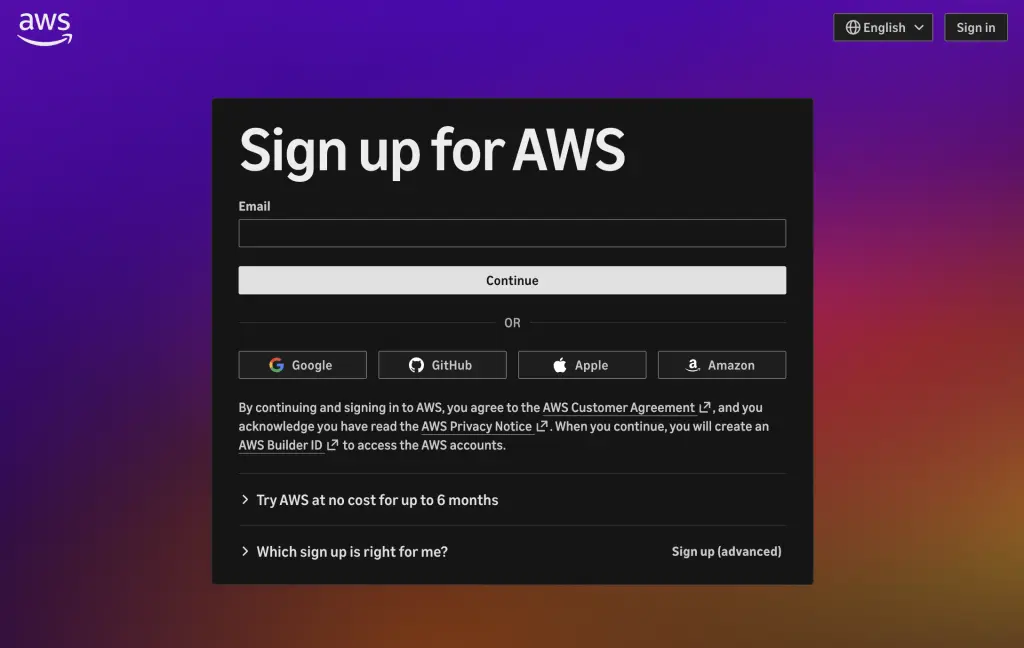
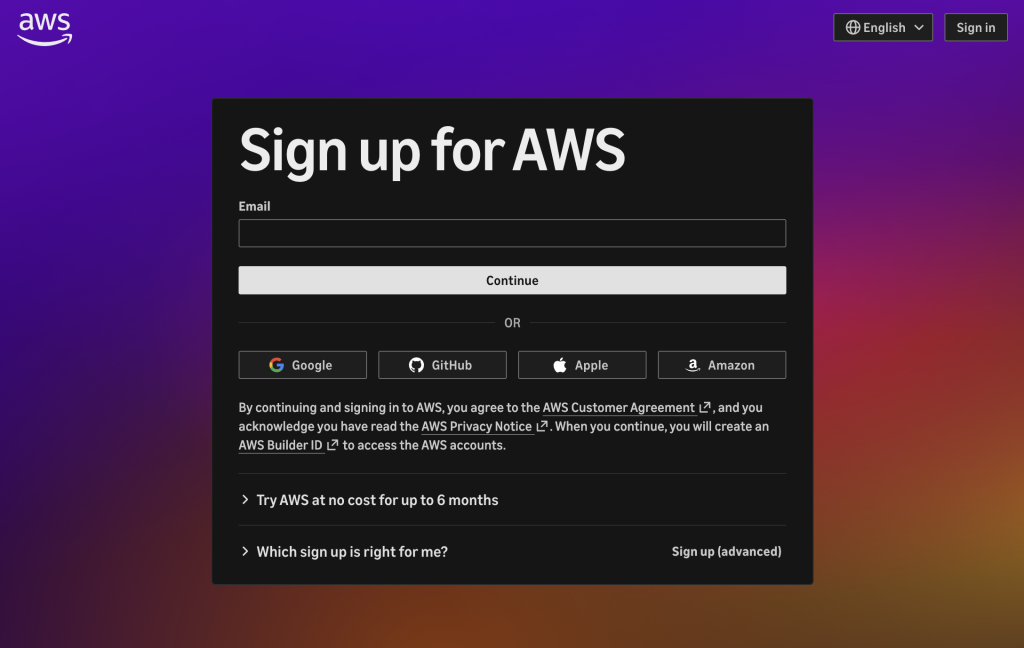
Frictionless Authentication: Users can register using existing corporate or consumer identities via Google, GitHub, or Apple. For the vast majority of new customers, the requirement for an immediate credit card is waived, pairing the signup with $100 in free credits distributed through the expanded AWS Free Tier.
Automated Environment Provisioning: Behind the scenes, AWS automatically constructs an isolated AWS account encapsulated within a project framework, applying baseline security controls and governance best practices without user intervention.
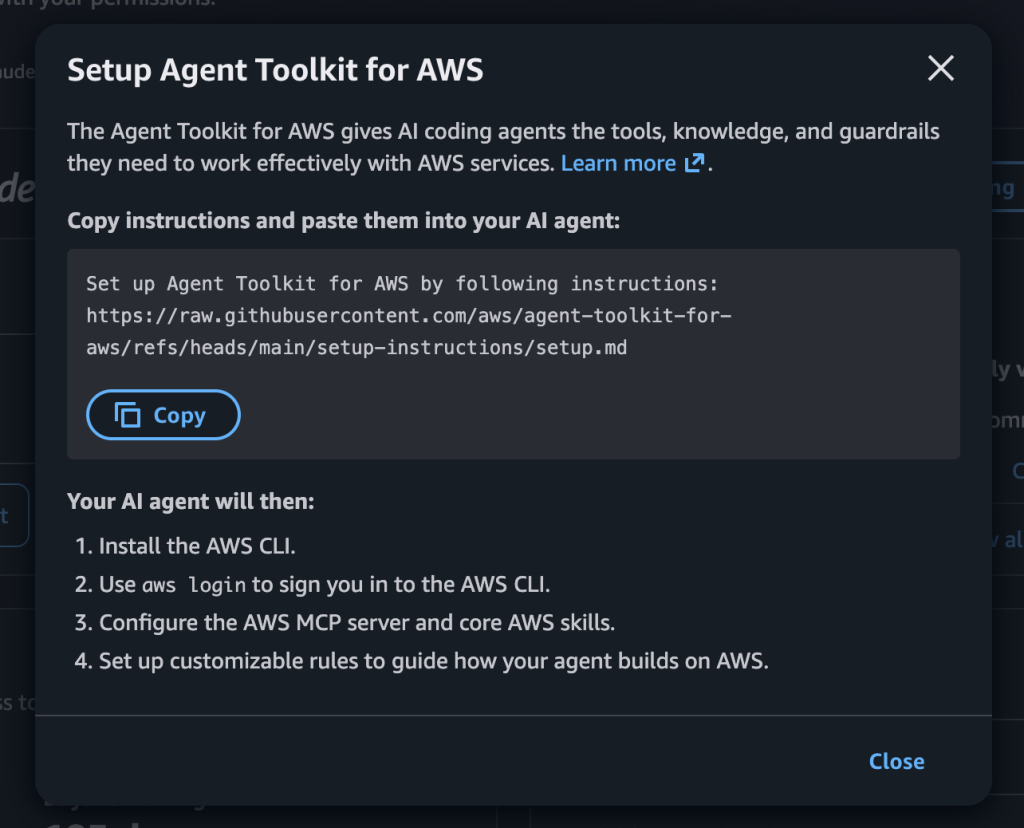
AI Agent Integration: Upon authentication, the system generates a tailored prompt configuration string. Developers paste this prompt directly into their preferred coding agent (such as Claude-assisted developer environments), which automatically configures the AWS Command Line Interface (AWS CLI) and the Agent Toolkit for AWS.
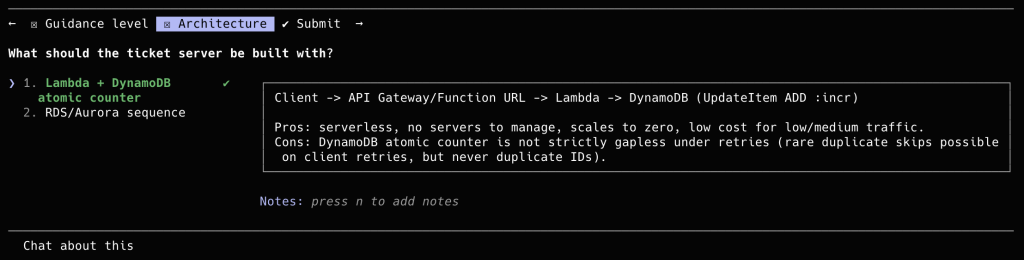
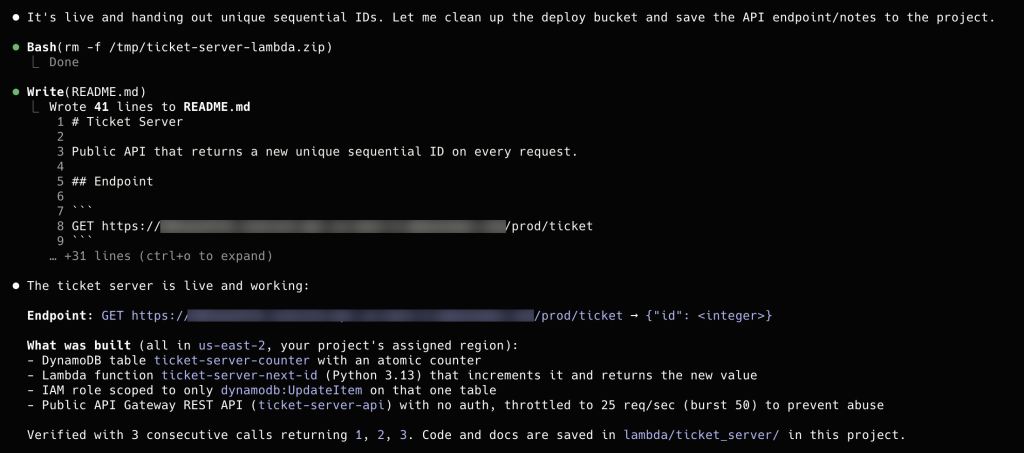
Autonomous Resource Orchestration: Once connected, the AI agent can autonomously deploy workloads, manage resources, and iterate on application code. For example, a request to build an API returning unique sequential IDs automatically triggers the agent to synthesize, provision, and link an AWS Lambda function, an Amazon DynamoDB table, and an Amazon API Gateway endpoint without manual IAM troubleshooting.
Supporting Context & Metrics: Cost Management and Scalability
Financial governance in early-stage projects has historically been a perilous endeavor. Unmonitored cloud sprawl can lead to unexpected, catastrophic bills for independent developers and student teams. AWS has addressed this vulnerability by baking rigorous, automated spend-capping directly into the project architecture.
Granular Financial Controls
Under the new paradigm, financial management is decoupled from legacy billing dashboards and elevated to the project level:
Custom Spend Limits: When transitioning from free credits to a paid plan, developers can establish a monthly spend ceiling starting at a manageable $20 per month.
Predictive Recommendations: AWS analyzes initial usage trends to suggest appropriate spend limits, which builders can either accept or customize based on projected scaling requirements.
Proactive Notifications and Safeguards: As a project approaches its designated threshold, automated notification systems alert the team. If the project hits the exact cap, AWS proactively pauses the underlying workloads rather than accumulating uncontrolled overage charges. Work resumes instantly once the budget ceiling is elevated.
Project-Level Isolation: Because spend limits operate on a per-project basis, developers can allocate aggressive budgets to production-bound workloads while safely containing experimental prototypes within minimal, low-cost financial boundaries.
Seamless Architectural Upgrades
A persistent anxiety for developers utilizing simplified cloud tools is the "cliff effect"—the moment a prototype outgrows its sandbox, forcing a painful, error-prone migration to a production-grade infrastructure. AWS has engineered this new experience to eliminate that cliff entirely.
When an application scales to require multi-region resilience, complex VPC peering, or enterprise governance controls through AWS Organizations, developers do not need to migrate code or provision a new account. Instead, they simply activate advanced features within their existing dashboard. The platform automatically converts the underlying project structure into a fully compliant AWS Organization adhering to enterprise best practices, preserving every previously deployed resource with zero downtime.
Official Statements and Industry Implications
While Amazon has not yet released full-year quantitative adoption metrics for this specific preview tier, internal product leadership emphasizes that the initiative represents a return to core principles.
"AWS began as a place where anyone with an idea could start building," noted engineering leads during the platform rollout. "We’ve heard clearly from builders that they do not want to spend their first hours configuring an AWS environment. They want to build what they came to build. This new simplified experience brings that starting point back, equipping users with sensible defaults to begin immediately, while ensuring the global reach, breadth, and depth of AWS remain fully accessible when their ideas scale."
Industry analysts view this move as a direct counter-offensive in the modern cloud developer wars. As Platform-as-a-Service (PaaS) alternatives and specialized serverless platforms vie for the affections of indie hackers and AI-native startups, hyperscalers risk losing the top of the developer funnel. By merging the instantaneous feedback loops of AI coding assistants with the institutional security and scalability of the world’s leading cloud provider, AWS is effectively neutralizing the competitive advantage of smaller, less robust developer platforms.
Future Outlook: The Intersection of AI Agents and Cloud Infrastructure
The launch of AWS’s streamlined, AI-optimized onboarding experience signals a broader, structural evolution in how humans interact with cloud infrastructure. We are moving rapidly past the era of graphical control consoles and manual Infrastructure-as-Code (IaC) configuration files toward an era of intent-based, agentic cloud provisioning.
What Lies Ahead
Deeper Agent Autonomy: As coding agents become more sophisticated, expect future iterations of AWS developer tools to handle complex multi-service architectures—such as event-driven streaming pipelines or containerized Kubernetes clusters on Amazon EKS—entirely through natural language prompts, bypassing even basic manual configuration.
Dynamic Cost Optimization: Future enhancements will likely integrate machine learning models that dynamically re-architect workloads in real-time to optimize costs against strict project budgets without human intervention.
Ecosystem Standardization: Standardized agent toolkits, such as the Agent Toolkit for AWS, will likely become the universal standard for how third-party AI assistants interface with enterprise-grade cloud backends, setting interoperability benchmarks across the industry.
Conclusion
AWS has successfully squared a historic circle: providing the immediate, frictionless simplicity demanded by modern, AI-accelerated developers while preserving the enterprise-grade power, security, and global infrastructure required to scale those ideas into global enterprises. For builders standing at the precipice of their next great project, the cloud has never been more accessible—or more ready for what comes next.