Executive Overview
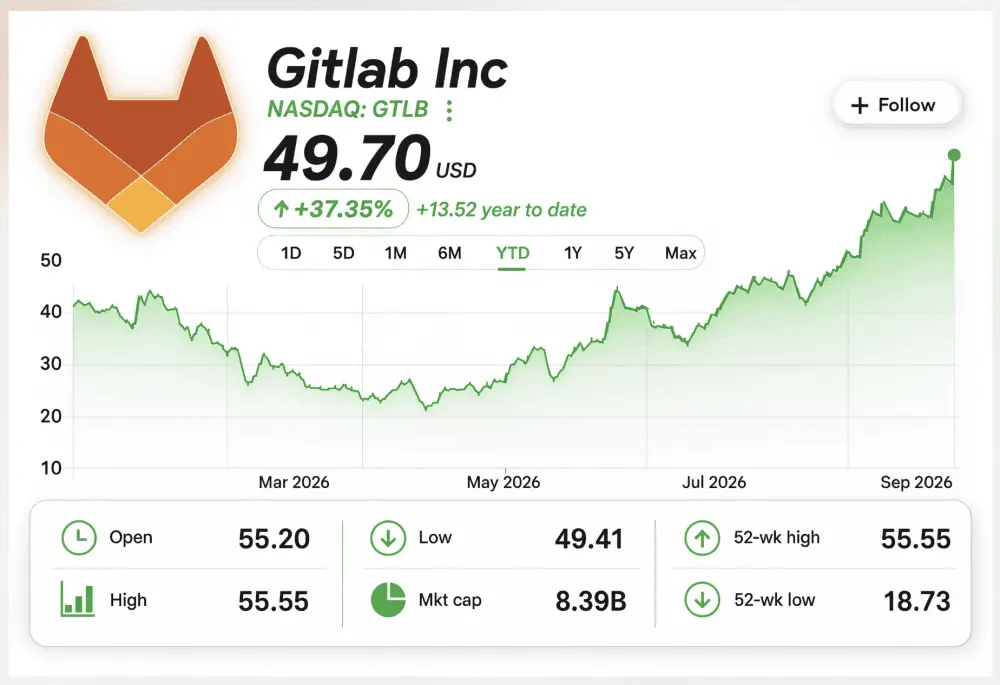
Just four months ago, GitLab was widely perceived across the public markets as one of the most vulnerable casualties of the generative AI boom. Wall Street questioned whether software development automation would render traditional code platforms obsolete, or at least compress their addressable market beyond recognition.
Then came the Q2 FY27 earnings report, released after the market close on September 1. It didn’t just beat expectations—it systematically rewrote the market narrative.
At first glance, the headline numbers told a complex story of acceleration sitting alongside a surprising guidance cut. Reported revenue grew 21% year-over-year to $286.3 million, marking an acceleration from previous quarters, yet management issued a Q3 revenue forecast that sat below the Q2 print. Simultaneously, calculated billings surged 24% (double the previous quarter’s 12%), and gross bookings hit an all-time high in company history.
This apparent disconnect between lagging revenue guidance and surging underlying demand is not a sign of weakness. Instead, it is the deliberate result of a structural pricing overhaul: the rollout of GitLab Flex.
This comprehensive analysis examines how GitLab is transitioning its business model away from rigid per-seat licensing toward a consumption- and flexibility-driven architecture. By analyzing its financial metrics, AI cost pressures, customer acquisition trends, and GAAP-versus-Non-GAAP divergences, we uncover the five critical lessons this quarter holds for software founders and enterprise tech investors alike.
Detailed Chronology & Structural Shifts
1. Revenue Grew 21%, Billings Grew 24%, and Q3 Revenue Guidance Was Lowered
To understand GitLab’s financial print, one must look past standard top-line metrics and examine the mechanics of revenue recognition.
- Reported Revenue: $286.3 million, up 21% from $236.0 million in the prior-year period.
- Calculated Billings: Up 24% year-over-year, doubling the prior quarter’s 12% growth rate.
- Gross Bookings: Reached the largest single quarter in the company’s history.
- Q3 Revenue Guidance: Projected at $281 million to $283 million—below the $286.3 million just reported, representing 15–16% year-over-year growth.
The catalyst for this divergence is revenue recognition timing, intentionally engineered by moving customers onto the new Flex model. Under the traditional self-managed model, roughly 15% of a contract’s value constitutes a license recognized entirely upfront in the first quarter, with the remainder recognized ratably over time.
Under the new Flex framework, the license component is recognized ratably over the contract term because customers dynamically re-elect their product mix on a monthly basis. GitLab’s illustrative modeling for a $100 annual contract shows that the old model landed 36% of the revenue in Q1 (15% license + 21% ratable), whereas the Flex model distributes it evenly at 25% per quarter.
According to CFO modeling guidance, for every $50 million of self-managed available-to-renew (ATR) contracts that convert to Flex in FY27, approximately $5 million of revenue shifts out of FY27 and into future periods, carrying a maximum estimated full-year impact of $13 million. Crucially, bookings, billings, and cash collections remain entirely unaffected; only the GAAP timing shifts.
Furthermore, management noted that this potential Flex headwind has not yet been incorporated into their raised full-year guidance ($1.129 billion to $1.133 billion, up from $1.112 billion to $1.118 billion, representing 18–19% growth). A faster Flex conversion rate signals a healthier, stickier business model, even if it temporarily depresses near-term GAAP revenue growth.
A note on Net ARR metrics: Both the CEO and CFO highlighted that "Net ARR" grew 42%, prompting widespread misinterpretations that total ARR grew at that pace. Total ARR did not grow 42%; rather, the metric refers to net new ARR booked in the quarter (or first-order net ARR). That quarterly addition was 42% larger than the corresponding quarter in the previous year. While it represents robust incremental acceleration, it must not be confused with base ARR growth.
Supporting Context & Metrics
2. Flex Generated Over $20 Million from 130+ Customers in Just Six Weeks
GitLab Flex introduces a unified annual dollar commitment that spans Premium and Ultimate seats, GitLab Credits for agent consumption, and newly shipped capabilities. Customers can seamlessly adjust their product mix monthly without executing formal contract amendments. Usage exceeding the initial commitment is billed on a monthly consumption basis.
In just six weeks on the market, Flex secured commitments exceeding $20 million from more than 130 enterprise customers.

To measure the health of this shift, management directed investors to track Paid Consumption Run Rate, defined as GitLab Credit commitments, Flex commitments, and paid on-demand consumption (excluding promotional trials). This metric exited Q1 at $15 million and surged past $40 million exiting Q2, tracking toward a year-end target exceeding $100 million. Notably, paid consumption for the Duo Agent Platform alone expanded roughly 50% sequentially.
This mirrors a broader industry trend. Cybersecurity giant CrowdStrike experienced similar success with Falcon Flex, which crossed $2.29 billion in ARR and accounted for approximately 39% of total ARR last quarter. The traditional software seat is rapidly losing its crown as the primary growth engine; flexible, multi-product consumption pools are taking its place.
Under the hood, GitLab’s appendix definitions reveal a "Reserved" tier—projected to comprise 80%+ of FY27 Flex revenue—where revenue is recognized ratably as delivered, and unused balances are forfeited monthly. This commit-and-forfeit mechanism rewards engaged, high-consumption customers while penalizing those who over-commit without utilizing their allocations. Meanwhile, Ultimate tiers now account for 59% of total ARR (growing ~35%), and SaaS represents 34% of revenue (growing 36%).
3. Subscription Cost of Revenue Surged 76%: The True Cost of AI
While top-line demand is robust, the gross margin profile tells a story of aggressive AI integration:
- Non-GAAP Gross Margin: 86%, down from 90% a year prior.
- GAAP Gross Margin: 84%, down from 88%.
- Subscription Cost of Revenue: Jumped from $21.8 million to $38.3 million—a 76% year-over-year increase against 21% revenue growth.
Management guided full-year gross margins to 85–87%, attributing the compression to SaaS mix shifts and heavy investments in consumption-driven AI products. Looking at a nine-quarter trend, gross margins have stepped down systematically from 91% down to 86%, with the steepest drop coinciding with the rollout of agent consumption.
How software companies handle AI infrastructure costs varies widely:
- Inference-Buying Companies: Companies like GitLab that purchase external inference (via Anthropic’s Claude, Amazon Bedrock, or Google Vertex) log these expenses directly in COGS, creating a permanent gross margin headwire.
- Infrastructure-Builders: Companies that build proprietary data centers route expenses through capital expenditures (capex), depreciating them over years while leaving gross margins largely untouched.
- Governance-Sellers: Companies that simply sell administrative layers around third-party compute see minimal COGS impact.
GitLab’s model-neutral strategy relies on buying external inference. Despite a 400-basis-point margin compression, an 86% gross margin remains exceptionally strong for an enterprise software company scaling agentic consumption workflows.
4. Customer Base Metrics and Enterprise Expansion
- Customers Over $5,000 ARR: Reached 11,114, representing an 8% year-over-year increase.
- First Orders: Landed approximately 1,700 new customer orders during the quarter.
- Net Retention Rate (NRR): Stood at 117%, marking the first sequential stabilization or increase since 2024, with gross retention remaining firmly above 90%.
The core of GitLab’s growth is happening at the top of the customer pyramid. Enterprise deals exceeding $500,000 grew by an impressive 150%. This demonstrates that while landing smaller accounts remains competitive, the platform’s value proposition for large enterprise clients is compounding rapidly.
5. Operating Margins, GAAP Losses, and Cash Flow Dynamics
The quarter highlighted a stark contrast between GAAP accounting and operational cash generation:
- GAAP Operating Margin: -20% (compared to -8% a year ago), resulting in a $56.9 million GAAP operating loss and a $36.8 million net loss ($0.22 per share).
- Non-GAAP Operating Margin: +15%, generating $42.1 million in Non-GAAP net income ($0.24 per share).
The bridge between these figures involved approximately $99 million in adjustments against $286 million of revenue, driven largely by stock-based compensation and restructuring charges. Operating cash flow dipped to negative $3.1 million (down from positive $49.4 million), driven by a $57.3 million swing in accounts receivable and $14.0 million in one-time payments to unwind the JiHu joint venture.
Despite these friction points, GitLab aggressively repurchased approximately 3.5 million shares for $104.6 million during Q2 ($154.7 million in the first half), backed by a robust balance sheet containing roughly $1.3 billion in cash and marketable securities.
Future Outlook & Key Takeaways for Founders
For B2B software founders and executives navigating their own pricing and business model transitions, GitLab’s Q2 print offers three foundational lessons:
- Preemptively Quantify Pricing Headwinds: GitLab published the exact financial math of its Flex transition ($50 million ATR converts, $5 million revenue shift, $13 million max full-year impact) directly in its investor deck. Giving investors both the deceleration and its precise structural cause simultaneously prevents market panic.
- Define New Operational Metrics Early: When shifting away from traditional seat licenses, companies must establish and publish alternative proxy metrics—such as GitLab’s Paid Consumption Run Rate (surging from $15M to $40M)—to prove that the new economic engine is working before legacy revenue metrics contract.
- Recognize That AI Cost Architecture is Inescapable: Whether an organization routes AI expenses through COGS, capex, or operating expenses, the architectural decision must be made early. Once embedded in the business model, these cost structures become difficult and costly to alter.
As GitLab moves toward its fiscal year-end target of surpassing $100 million in Paid Consumption Run Rate, it has successfully transitioned from a perceived AI casualty into a case study on how legacy B2B platforms can reinvent themselves for the agentic software era.