Executive Overview
By 2026, the corporate procurement landscape has undergone a seismic shift. Virtually every business-to-business (B2B) enterprise of consequence is allocating substantial capital toward artificial intelligence. This spend is no longer experimental or confined to innovation labs; it is deeply embedded in the operational fabric. Companies are footing recurring monthly bills for seats on ChatGPT and Claude, absorbing surging token charges from autonomous coding agents, and watching a new, volatile line item emerge for background agents operating continuously without direct human oversight.
Yet, beneath this massive reallocation of corporate budgets lies a stark and unsettling reality: very few organizations can definitively articulate what this capital is producing.
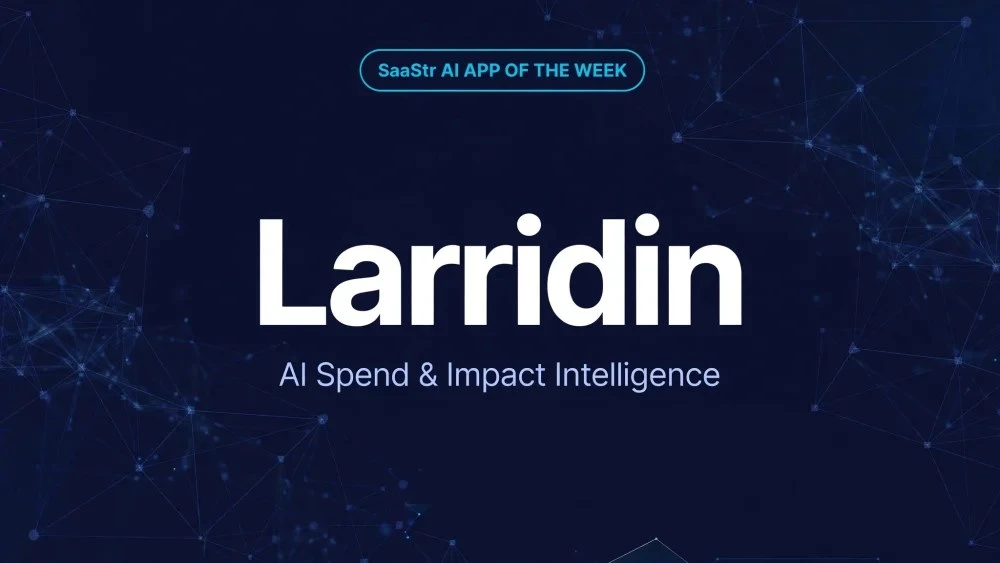
As finance departments wrestle with fragmented invoices, corporate credit card sprawl, and shadow IT, a critical governance gap has formed. Enter Larridin—an Andreessen Horowitz (a16z)-backed enterprise platform purpose-built to solve the AI accountability crisis. Founded by serial entrepreneur Russ Fradin, Larridin bridges the chasm between raw AI consumption and tangible business output. By connecting usage data and financial spend directly to the day-to-day work of human employees and autonomous agents, the platform offers a granular view of adoption, engineering performance, and automated workflow efficiency.
With fresh production data laying bare the staggering cost discrepancies of AI coding tools, and an executive roster featuring seasoned tech veterans, Larridin is positioning itself as an indispensable utility for the modern CFO. This deep dive examines Larridin’s architecture, its eye-opening industry benchmarks, and the broader implications for enterprise AI procurement as organizations prepare for the budgetary challenges of 2027.
Detailed Chronology: From Concept to Enterprise Utility
The trajectory of Larridin is deeply rooted in the hard-earned lessons of its founding team. Russ Fradin, a thirty-year veteran of the startup ecosystem with exits dating back to Flycast Communications in 1996, approaches enterprise software with a scars-and-stripes perspective. His previous ventures—including Dynamic Signal, Adify, and executive tenures at comScore—have heavily informed how Larridin is built and scaled.
The Dynamic Signal Pivot
The intellectual genesis of Larridin’s measurement-first philosophy can be traced back to Fradin’s time leading Dynamic Signal. Roughly eighteen months into the venture, with $5 million to $6 million in Annual Recurring Revenue (ARR) secured and seemingly happy customers, Fradin identified a fatal flaw: the product lacked true structural stickiness. Rather than continuing to push a leaky bucket, he made the difficult decision to walk away from that revenue stream and rebuild. The pivot ultimately birthed a $50M ARR employee communications powerhouse.
This background is crucial to understanding Larridin. A founder who has willingly walked away from millions in non-sticky ARR is uniquely positioned to build a platform whose core value proposition is foundational stickiness—becoming the mission-critical system that executives check week in and week out.
From Discovery Tool to Enterprise Suite
Larridin was officially founded in early 2024, embarking on a stealth development period before opening its doors to early customers in August 2024. Initially conceived as a specialized discovery tool, the platform’s early iterations focused on automated inventories of corporate AI usage. This included mapping "shadow AI"—unsanctioned tools accessed by employees outside the purview of IT—and correlating usage levels with productivity metrics across various departments.
Recognizing the broader macro-shift toward autonomous agents and exploding token bills, Larridin rapidly evolved. The platform expanded its scope beyond basic discovery into a comprehensive four-pillar enterprise suite: Spend Intelligence, AI Impact, Developer Intelligence, and Workflow Intelligence.
Funding and Market Validation
Larridin’s rapid ascent caught the attention of top-tier venture capital. The company secured a $17 million seed funding round led by Andreessen Horowitz (a16z), with partner Alex Rampell taking a seat on the board. The round also drew participation from prominent institutional investors, including Bloomberg Beta, Gradient Ventures, Haystack, Homebrew, and Refract.
Today, the platform counts a growing roster of enterprise clients—including Gainsight, Vertiv, Klaviyo, SurveyMonkey, EcoVadis, TigerConnect, and Sundt—while maintaining rigorous security and compliance certifications, including SOC 2 Type II, GDPR, and HIPAA.
Supporting Context & Metrics: The Real Cost of AI Coding
To understand why Larridin commands enterprise attention, one must examine the empirical data it recently published. In August, the company released its inaugural benchmark report, synthesized from real-world production billing and engineering telemetry.
The $213-a-Week Baseline and the 10x Spread
The benchmark analyzed a sample of software engineers who, over a four-week period ending August 2, 2026, both successfully merged code and incurred billed AI-coding expenses. The findings illuminate a dramatic financial spread that most Chief Financial Officers remain entirely blind to:
- Median Spend (p50): The median engineer accounts for approximately $213 a week in direct AI coding costs.
- Top-Decile Spend (p90): The 90th percentile engineer incurs expenses that translate to nearly $47,000 annually in tokens alone.
For a mid-sized engineering organization comprising 100 developers, the spread between the p25 (low-consumption or low-adoption) and p90 (heavy consumption) engineers represents a seven-figure budget variance. Because these costs are traditionally scattered across disparate provider invoices, corporate credit cards, and individual personal subscriptions, this financial exposure goes largely unmanaged.
Furthermore, managing this spend requires sophisticated intervention. Industry leaders are already taking note; Coinbase’s Kyle Cesmat has highlighted strategies that successfully cut AI inference costs by more than half while overall token usage continued to scale upward—a testament to the necessity of intelligent routing and cost optimization.
Skill, Not Spend: The 2x Output Disparity
Perhaps the most sobering insight for founders and engineering leaders is Larridin’s analysis of output relative to AI spend.
By segmenting engineers into cohorts based on the percentage of their shipped output attributed to AI, Larridin uncovered a vital nuance. When analyzing two distinct AI-native cohorts originating from the same company—utilizing identical tools, paying the same baseline prices, and starting with a weekly spend of roughly $170—a profound performance gap emerged. The more fluent cohort generated double the output of their peers under identical financial and technological conditions.
Key Takeaway for Leadership: Simply pouring more capital into AI tool procurement does not yield linear productivity gains. Increased budget converts to greater output only where foundational fluency already exists. Consequently, there is no universal "ideal" AI budget. Larridin advises enterprises to track their own internal ROI curves and establish strict review triggers where spending levels off, rather than blindly attempting to match industry spending caps.
It is worth noting how Larridin measures output: avoiding vanity metrics like raw lines of code, the platform scores each merged Pull Request (PR) based on model-assessed complexity across five tiers. These scores are automatically discounted for low-quality output and missing tests, then scaled by code churn. While Larridin transparently notes that these relationships are associational—high-output engineers may simply spend more because they ship more volume—the diagnostic value remains unmatched.
The Larridin Architecture: Four Products, One Mission
Larridin’s current market offering is divided into four distinct yet interconnected modules, each targeting a specific layer of the enterprise AI stack:
1. Spend Intelligence
Designed specifically for CFOs and corporate finance teams, this module consolidates token usage, seat licenses, and cloud model costs into a single, unified dashboard. It traces every dollar spent directly back to a specific team, tool, or autonomous agent prior to quarterly budget reviews. Given that agentic spend is currently the fastest-growing and least-understood line item in corporate budgets—frequently failing to map neatly to a traditional user seat or human employee—this visibility is rapidly becoming mandatory.
2. AI Impact
This module connects departmental AI expenditures to the actual hours returned, comparing adoption curves, fluency metrics, and cost-per-AI-hour to guide strategic decisions regarding investment, training, and scaling. Crucially, Larridin applies rigorous mathematical restraint here: AI capacity estimates the human-equivalent work contributed by artificial intelligence, but it is not automatically equated to direct time saved, cash returned, or headcount reductions. This distinction protects leadership teams from inflated vendor claims of "hours saved" that crumble under board-level scrutiny.
3. Developer Intelligence
Tailored for engineering leadership, this module correlates software output, code quality, and delivery speed with AI expenditures, identifying where coding agents accelerate workflows and where developers require additional enablement.
A standout feature within this module is Larridin Router. The Router automatically scores incoming coding requests and intelligently serves a lower-cost model when task complexity permits, leaving complex requests routed to the premium model requested by the developer. Unlike basic model routers, Larridin ties routed sessions directly to downstream output, code quality, defect rates, and cost-per-task. This enables engineering managers to verify whether cost discounts compromised code review integrity. Furthermore, if a developer requires a specific model for a specialized task, they can manually pin that session, ensuring it is reported accurately rather than penalized by automated routing logic.
4. Workflow Intelligence
Focusing on broader enterprise efficiency, Workflow Intelligence maps repeated business tasks from observed user activity, identifying optimal candidates for automation and measuring them against established operational baselines.
Enterprise Case Studies and Strategic Adoption
Forward-thinking enterprises are already leveraging these insights before committing to massive software deployments. For instance, customer intelligence platform Gainsight utilized Larridin to map internal AI tool adoption comprehensively before purchasing its first enterprise-grade Large Language Model (LLM) license.
As leadership notes, procuring expensive enterprise software based solely on a limited proof-of-concept pilot is a perilous trap. Without mapping what employees are already utilizing organically, organizations frequently commit to massive enterprise agreements only to discover that a significant percentage of the workforce continues utilizing unmanaged personal accounts for alternative tools.
Implementation Considerations: Pricing, Privacy, and Friction
While the platform offers undeniable strategic value, prospective enterprise buyers must navigate several operational realities:
- Enterprise Pricing Structure: Larridin operates on an enterprise pricing model with custom quotes. While public pricing is unavailable, industry comparables suggest baseline enterprise tiers frequently begin around the $50,000 annual mark, requiring a formal enterprise sales cycle.
- Employee Monitoring Sensitivities: Adoption tracking relies on lightweight browser plugins and desktop agents. Because this touches employee telemetry, organizations must establish clear role-based access controls, robust authentication protocols, and transparent internal communication. Failure to communicate the scope of measurement transparently can backfire, causing engineers to actively route around corporate tooling.
- Correlation vs. Causation: As Larridin openly acknowledges, telemetry data establishes associations rather than absolute proofs of causation. Leaders must use the platform as a diagnostic compass to locate where spend has stalled, rather than treating the data as an automated management fix.
Future Outlook: The 2027 Budgetary Horizon
As organizations look toward the 2027 fiscal year, the era of frictionless, unmonitored AI experimentation is drawing to a close. Early-stage startups where a technical founder personally reviews every Anthropic invoice may not yet require institutional governance tools. However, for organizations scaling past a few hundred employees—or those where autonomous agent spending is rapidly eclipsing human seat licenses—financial opacity is no longer tenable.
Platforms like Larridin represent the maturation of the enterprise AI market. By shifting the conversation from blind accumulation of tools to measurable, accountable return on investment, they provide the infrastructural glue necessary for sustainable corporate AI adoption.
For industry leaders seeking to engage with these frameworks directly, Larridin is maintaining an active market presence, including serving as a Super Gold sponsor at SaaStr AI 2027 in the SF Bay Area. As finance and engineering leaders converge to solve the token economy’s hardest questions, tools that illuminate the black box of AI spend will define the winners of the next technological wave.