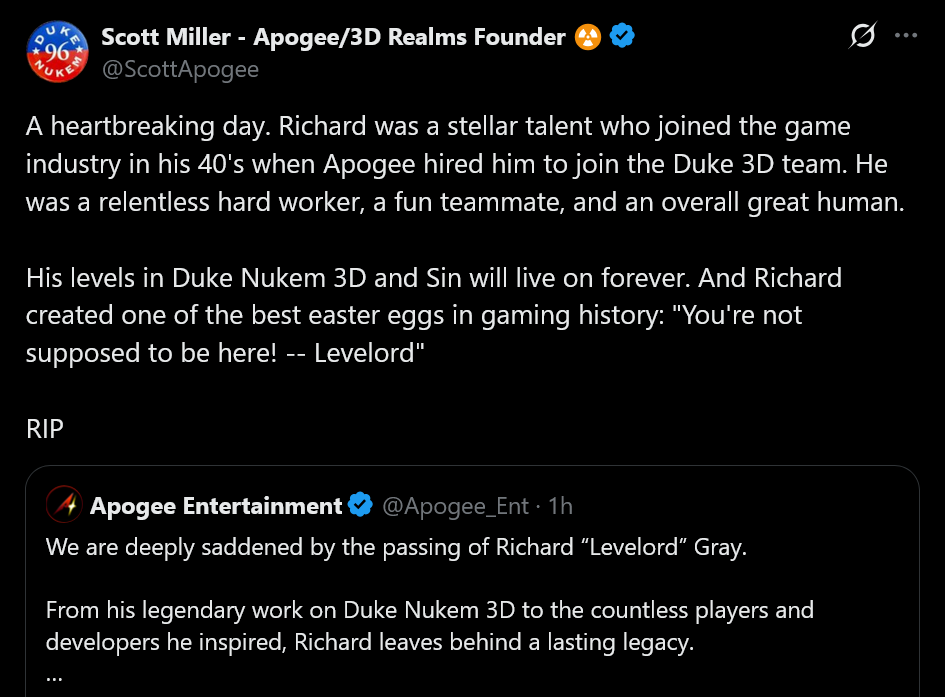
The video game industry is mourning the loss of Richard B. Gray, universally known to generations of first-person shooter fans and developers by his legendary moniker, "Levelord." Gray, whose pioneering map designs, technical wizardry, and razor-sharp wit defined the golden age of the 1990s PC shooter, passed away at the age of 68. His death was confirmed by his wife, Olga, and subsequently shared with the public by Apogee Entertainment, along with an outpouring of grief and tribute from industry icons who worked alongside him.
Gray’s trajectory into the burgeoning PC gaming landscape of the mid-1990s was entirely unorthodox. Entering the professional games industry as a self-taught map maker in his mid-to-late 30s—an age considered late for a developer entering the field at the time—Gray rapidly transformed himself from a passionate enthusiast in the Doom modding scene into a foundational pillar of 3D Realms, Ritual Entertainment, and beyond. Over a career spanning decades, he left his indelible mark on historic titles such as Duke Nukem 3D, Quake: Scourge of Armagon, SiN, Star Trek: Elite Force II, and Counter-Strike: Condition Zero.
Beyond his technical mastery of early 3D engines—where he constantly stretched hardware capabilities using spatial portals, verticality, and complex geometry—Gray is perhaps equally famous for his wicked humor. He cemented his place in gaming folklore by hiding one of the medium’s most iconic Easter eggs, a cheeky note reading "You’re not supposed to be here! — Levelord", accessible only to the most determined players willing to bend the game’s rules. As the broader interactive entertainment community reflects on his passing, peers, collaborators, and fans alike remember Gray not merely as a titan of level design, but as an exceptionally kind, humble, and generous human being who paved the way for modern environmental storytelling.
Detailed Chronology: From the Doom Modding Scene to Industry Stardom
Richard Gray’s entry into game development reads like an inspiring myth from the primordial era of internet modding. While many prominent developers of the early 1990s began their careers as teenagers or early-twenties programmers, Gray was already 35 years old when he built his very first custom level for id Software’s seminal 1993 masterpiece, Doom. Self-identifying as a "late bloomer with games," Gray spent hours meticulously crafting user-generated maps, mastering the nascent tools of the trade, and sharing his work within the vibrant, decentralized online modding communities of the era.
The Apogee Breakthrough and Duke Nukem 3D (1994–1996)
Gray’s intricate, highly detailed Doom maps did not go unnoticed. Scott Miller, founder of Apogee Software (later 3D Realms), caught wind of Gray’s burgeoning talent in 1994 and recognized a rare instinct for spatial composition and player pacing. Miller brought Gray out of the modding underground, relocating him to Dallas, Texas, to join the in-house development team building Duke Nukem 3D.
Released in January 1996, Duke Nukem 3D became a runaway commercial and cultural phenomenon. Running on a heavily modified version of Ken Silverman’s Build engine, the game required a completely new approach to level architecture compared to the flat, orthogonal sectors of Doom. Gray rose to the challenge magnificently. Working on the game’s later episodes, he applied clever design tricks—such as innovative portal usage to simulate overlapping rooms and complex multi-story structures—that forced the engine to operate far beyond its original design parameters. His contributions helped elevate Duke Nukem 3D from a standard corridor shooter into an immersive, interactive playground packed with cinematic flair, environmental interactivity, and interactive strip clubs, movie theaters, and alien-infested urban landscapes.
Hipnotic, Ritual Entertainment, and the Late ’90s Boom
Shortly after the completion of Duke Nukem 3D, Gray sought new horizons. He left 3D Realms to co-found Hipnotic Interactive alongside fellow industry visionaries. Hipnotic was later rebranded as Ritual Entertainment, a studio that would play an instrumental role in shaping the trajectory of action-heavy first-person shooters through the late 1990s and early 2000s.
At Ritual, Gray’s portfolio expanded rapidly as he brought his signature level design philosophy to some of the industry’s most recognizable franchises:
Quake: Scourge of Armagon (1997): Gray served as a key level designer for this critically acclaimed expansion pack to id Software’s groundbreaking Quake, injecting the dark fantasy world with inventive geometry and brutal combat encounters.
SiN (1998): As a premier first-person shooter developed by Ritual, SiN showcased Gray’s ability to craft sprawling, dystopian urban environments that felt lived-in and reactive, even if the game famously launched in a technically rocky state alongside Valve’s Half-Life.
Star Trek: Elite Force II (2003) & Counter-Strike: Condition Zero (2004): Gray continued lending his expert mapping hand to high-profile licensed properties and tactical multiplayer suites, ensuring that level progression remained tight, atmospheric, and fair across varied multiplayer and single-player paradigms.
25 to Life (2006): Later in his professional studio career, Gray worked on tactical crime-action titles, demonstrating a versatile design range that extended far beyond traditional sci-fi and monster-hunting settings.
Supporting Context & Metrics: The Philosophy of the "Levelord"
To understand why Richard Gray earned the revered title "Levelord," one must examine the state of level design during the mid-to-late 1990s. Before specialized tooling suites, procedural generation, and massive multi-disciplinary teams became the industry standard, maps were often constructed by lone visionaries or small cabals of designers who had to act as architects, lighting technicians, scripters, and gameplay balance directors all at once.
Gray excelled in this crucible because he understood human psychology within digital spaces. He knew how to guide a player’s gaze using subtle lighting cues, how to induce genuine tension through tight, claustrophobic corridors, and how to reward curiosity with hidden caches and secrets.
The Ultimate Easter Egg
Among his countless contributions to industry lore, Gray’s most famous calling card remains the hidden message in Duke Nukem 3D. By exploiting the engine’s physics and clipping mechanics in ways the developers never intended—or utilizing cheat codes to clip through boundaries—curious players could breach the outer walls of a specific map only to find a floating text brush bearing the signature phrase:
"You’re not supposed to be here! — Levelord"
This tongue-in-cheek acknowledgment of player ingenuity transformed Gray from an anonymous backend creator into a celebrated personality among the PC gaming cognoscenti. It established a playful contract between developer and player: the game world was bounded, but if you were clever and stubborn enough to break the rules, the creator was waiting there to applaud your rebellion.
Official Statements and Industry Tributes
Following the news of his passing, social media platforms—particularly Bluesky and X (formerly Twitter)—were flooded with tributes from game development legends who had shared offices, late nights, and development trenches with Gray.
Apogee Entertainment shared a poignant statement via their official channels:
"We are deeply saddened by the passing of Richard ‘Levelord’ Gray. From his legendary work on Duke Nukem 3D to the countless players and developers he inspired, Richard leaves behind a lasting legacy. Rest in peace, Levelord."
Scott Miller, founder of Apogee and the man who initially hired Gray in 1994, reflected fondly on his former employee’s work ethic and character in an interview:
"I hired him to work on Duke 3D in 1994, after seeing some of his really impressive Doom levels—he was pretty active in the mod scene. He then moved to Dallas, and worked from our offices. He got along well with everyone and impressed everyone with his dedication and talent. Richard loved to push the engine to its limits and he came up with a lot of fun level design tricks… Richard was also so helpful to anyone who approached him for help getting into the industry or becoming a better designer. He had a terrific sense of humor, too. For example, in Duke 3D he made this hung jury room. A real legend."
John Romero, co-creator of Doom and a contemporary titan of the 90s FPS boom, expressed profound sorrow:
"Devastating news today. Richard ‘Levelord’ Gray was such a great guy. Like many of our friends, I wish I could have hung out with him again. He was full of life, a gentle soul, and an excellent level designer. He was called ‘Levelord’ for a reason… I loved the first episode of [Duke Nukem 3D] but was more drawn in by E2 and E3 that had such distinctive designs. We’re gonna miss you, man. You were one of the best."
Frederik Schreiber, CEO of Slipgate Ironworkers, highlighted Gray’s rare personal humility:
"Richard was, without a doubt, one of the kindest people I’ve ever met in the games industry. Incredibly humble, remarkably intelligent, endlessly creative, and always a pleasure to be around. Despite everything he had accomplished and the enormous influence his work had on my generation of game developers, he never carried himself as anything other than a genuinely good human being."
Cliff Bleszinski, creator of Gears of War, added his voice to the chorus of praise:
"RIP Richard ‘Levelord’ Gray. You broke the mold, fella. Guy paved the way for so many level/environment designers."
Composer Andrew Hulshult remembered Gray’s sharp intellect and mentorship:
"Richard Gray was one of those industry vets I always looked forward to hanging out with when I had the chance. He was VERY smart and I always felt like I learned something just from hanging out with him. I’m thankful Rob and Christine Atkins introduced me to him. R.I.P. friend."
Future Outlook: A Lasting Legacy in Digital Architecture
While Richard Gray’s physical presence has left the gaming world, his fingerprints remain permanently stamped onto the DNA of modern first-person shooters. The principles he championed—tight spatial pacing, environmental storytelling, boundary-pushing engine exploitation, and a willingness to reward player exploration—are standard tenets taught to every contemporary level and environment design student today.
As the industry continues to evolve toward hyper-realistic photogrammetry, massive open worlds, and procedural generation, the intimate, hand-crafted geometry of 1990s shooters feels more precious than ever. Maps like those crafted by Richard "Levelord" Gray remind us that brilliant design is born not merely from raw polygon counts, but from imagination, spatial intelligence, and a deep, infectious love for play.
Gray’s battle with cancer, managed with quiet resilience alongside his wife Olga over recent years, has finally drawn to a close, but the maps he built will continue to run, the secrets he hid will continue to be discovered, and the developers he mentored will continue to pass down his wisdom. Rest in peace, Levelord—you were more than supposed to be here.