Executive Overview
The landscape of cloud-native data engineering and serverless analytics has reached a major inflection point. Amazon Web Services (AWS) has officially announced the general availability of AWS Glue 6.0, its flagship serverless data integration and extract, transform, and load (ETL) service. This release arrives with a powerful value proposition: a sweeping 30% price reduction across the board compared to previous versions, coupled with deep modernization under the hood.
Built on a modernized runtime stack comprising Apache Spark 4.1, Python 3.13, and Scala 2.13, AWS Glue 6.0 introduces comprehensive support for Apache Iceberg v3. By pairing profound cost efficiencies with high-performance query execution and native semi-structured data management—highlighted by the innovative VARIANT data type with shredding support—AWS aims to eliminate the friction points that have traditionally plagued large-scale data lakes.
For data architects, analytics engineers, and enterprise technology leaders, this release signifies more than a routine version bump. It represents a fundamental recalibration of the economics and performance boundaries of open-table formats in serverless environments. Whether dealing with high-throughput real-time streaming ingestion with single-digit millisecond latencies or orchestrating complex multi-terabyte ETL pipelines, AWS Glue 6.0 provides a streamlined, highly performant foundation designed to scale without breaking budgets.
Detailed Chronology: The Evolution to AWS Glue 6.0
To understand the magnitude of AWS Glue 6.0, it is essential to trace the arc of its evolution. Over the past several years, AWS Glue has transformed from a basic metadata catalog and managed Spark runner into a comprehensive, enterprise-grade data fabric orchestration engine.
The Journey of Modernization
In earlier iterations, data engineers wrestled with version fragmentation, rigid schema enforcement, and the performance overhead associated with translating nested semi-structured data (such as JSON logs and event streams) into traditional tabular formats. The rise of open-table formats—specifically Apache Iceberg—fundamentally shifted how organizations conceptualized data lakes, introducing ACID transactions, time travel, and efficient schema evolution to object storage.
Recognizing this paradigm shift, AWS systematically upgraded its runtime engines, introducing support for Spark 3.x series and early versions of Iceberg. However, as enterprise data lakes grew into petabyte-scale domains, bottlenecks persisted around semi-structured data parsing, high memory consumption during shuffles, and the overall cost of compute-heavy ETL workloads.
The Path to 6.0
The development of AWS Glue 6.0 focused heavily on three core pillars:
- Cost Optimization: Addressing enterprise demands for better ROI on cloud data operations by engineering a leaner, more efficient runtime architecture capable of delivering a 30% price reduction.
- Open Standards Alignment: Achieving complete compliance with the Apache Iceberg v3 specification (built on Iceberg 1.11.0) to ensure seamless interoperability across multi-engine query environments (such as Amazon Athena, Amazon EMR, and Redshift).
- Cutting-Edge Runtime Integration: Upgrading the underlying execution engine to Apache Spark 4.1, Python 3.13, and Scala 2.13, ensuring that data pipelines benefit from the latest upstream performance enhancements, garbage collection optimizations, and security patches.
Supporting Context & Technical Metrics: What’s New in Glue 6.0
AWS Glue 6.0 introduces a wealth of architectural improvements designed to maximize throughput, minimize maintenance overhead, and radically simplify ETL authoring.

1. Complete Apache Iceberg v3 Implementation
AWS Glue 6.0 provides what is arguably the most complete Iceberg v3 implementation available on any fully serverless managed Spark service. Built upon Iceberg version 1.11.0, this release introduces deep capabilities designed to optimize storage and query performance.
The VARIANT Data Type and Shredding Support
The headline architectural feature of Glue 6.0 is the introduction of the VARIANT data type complete with native shredding support. Historically, dealing with semi-structured data like nested JSON payloads, unstructured application logs, and high-velocity event streams forced data engineers into a difficult choice:
- Flattening schemas: Leading to wide tables with hundreds of sparse columns, redundant data copies, and brittle pipelines.
- Storing data as strings: Forcing downstream query engines to execute expensive, runtime string-parsing operations that crippled analytical performance.
With VARIANT shredding in AWS Glue 6.0, teams can store, process, and query semi-structured payloads natively within Iceberg tables without flattening schemas. The engine automatically "shreads" the nested components into optimized physical storage layouts, yielding dramatically faster query read performance compared to traditional string-based columns. This eliminates duplicate data copies, custom parsing code, and pipeline breakages caused by upstream schema drift.
2. Modernized Runtime: Spark 4.1, Python 3.13, and Scala 2.13
Performance gains in Glue 6.0 are anchored by its migration to Apache Spark 4.1. This upgrade delivers some of the most significant performance enhancements in the Spark ecosystem’s history, including:
- Advanced Catalyst Optimizer Rules: Smarter predicate pushdown and join reordering that drastically reduce unnecessary data scanning across Amazon S3 data lakes.
- Memory Management Improvements: Tighter integration with modern garbage collection mechanisms and native memory structures, reducing out-of-memory (OOM) errors during heavy shuffle operations.
- Python 3.13 and Scala 2.13 Support: Allowing data scientists and engineers to leverage the latest language syntax, enhanced type safety, and improved execution speeds for PySpark user-defined functions (UDFs) and custom transformations.
3. Real-Time Streaming and Low Latency
For organizations pivoting toward real-time operational analytics, Glue 6.0 introduces enhanced streaming ETL capabilities. By optimizing micro-batch processing and state management on the Spark 4.1 runtime, Glue can now ingest and process streaming data sources—such as Amazon Kinesis and Apache Kafka—with single-digit millisecond latency, bridging the gap between batch data lakes and real-time streaming architectures.
Migration and Getting Started: Seamless Adoption
One of the primary concerns for engineering teams when migrating major framework versions is the operational friction of updating codebases. AWS has designed Glue 6.0 to be remarkably backward-compatible.
Zero API Disruption
Using AWS Glue 6.0 requires no API changes. Organizations can provision or update jobs simply by modifying the existing --glue-version parameter in their infrastructure-as-code scripts, AWS Command Line Interface (AWS CLI) commands, or AWS SDK calls.
  "Name": "my-enterprise-etl-job",
  "Role": "AWSGlueServiceRole-Default",
  "Command":
    "Name": "glueetl",
    "ScriptLocation": "s3://my-bucket/scripts/etl.py",
    "PythonVersion": "3"
  ,
  "DefaultArguments":
    "--glue-version": "6.0"
Streamlined Migration Paths
To assist teams in moving legacy pipelines to the new runtime, AWS provides multiple convenient pathways:

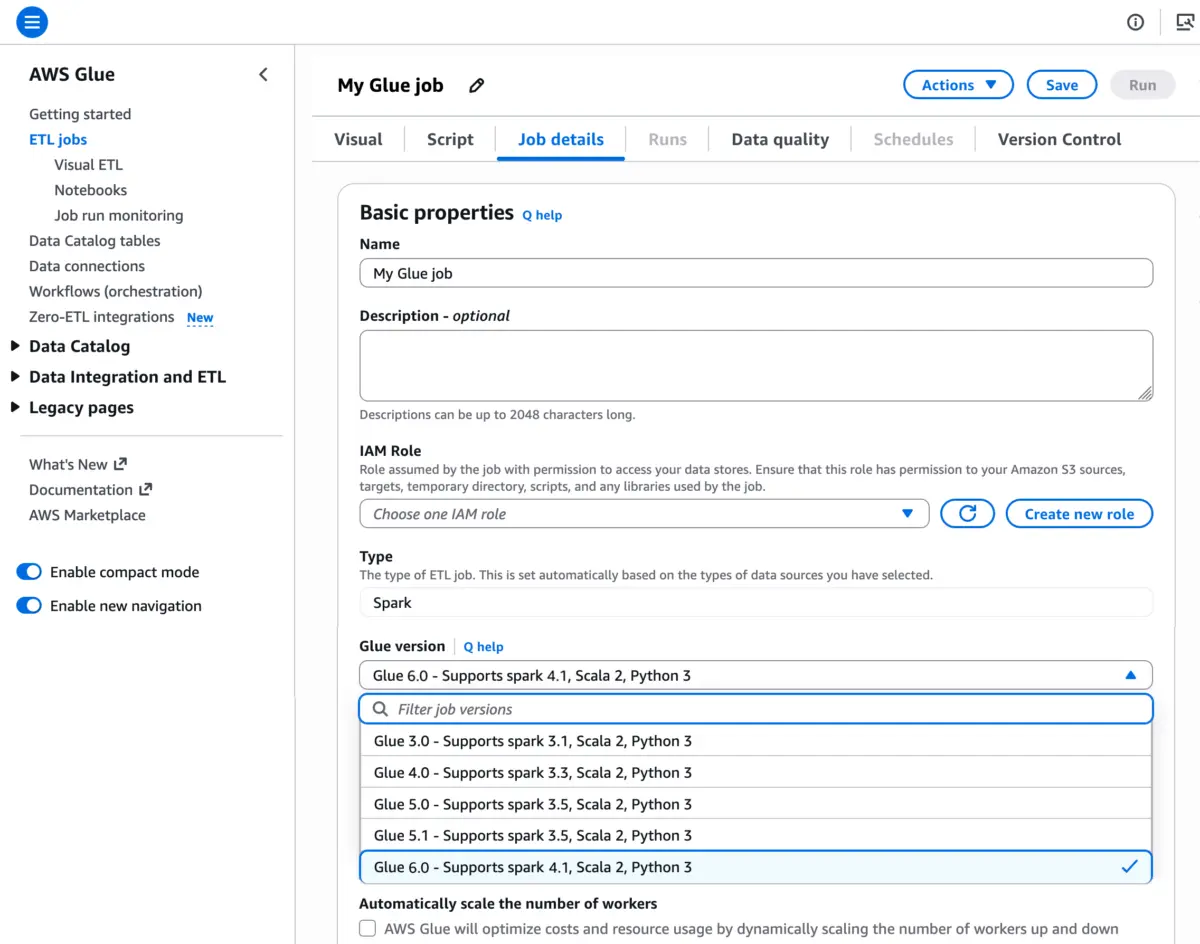
- AWS Glue Studio Console: Data engineers can open any existing job, navigate to the Job Details tab, and select Glue 6.0 – Supports Spark 4.1, Scala 2, Python 3.
- Interactive Notebooks & Jupyter Sessions: Developers utilizing AWS Glue Studio notebooks or interactive Jupyter environments can instantly spin up a 6.0 session by setting the magic command
%glue_version 6.0. - The Spark Upgrade Agent: For large-scale migrations, engineers can deploy the automated Spark upgrade agent within AWS Glue Studio to scan legacy codebases, identify deprecated functions, and recommend or automatically apply necessary syntax adjustments.
Pricing Economics: 30% Savings in a Serverless Model
Cloud cost optimization remains a top priority for enterprise financial operations (FinOps) teams. The introduction of a 30% price reduction across AWS Glue 6.0 alters the total cost of ownership (TCO) calculus for data-intensive organizations.
Understanding the Cost Structure
AWS Glue maintains a transparent, usage-based billing model:
- ETL Jobs and Crawlers: Billed on an hourly rate, calculated by the second, based on the number of Data Processing Units (DPUs) consumed during data discovery, transformation, and loading execution. The 30% price drop applies directly to these DPU-hour rates.
- AWS Glue Data Catalog: Billed via a simplified monthly fee for storing and accessing metadata. To encourage early adoption and small-to-mid-sized workloads, AWS maintains generous free tiers:
- The first 1 million objects stored in the Data Catalog are completely free.
- The first 1 million metadata accesses are completely free.
By slashing DPU execution costs by nearly a third, AWS enables enterprises to run heavier workloads, execute more frequent incremental updates, and expand their data lakehouse footprints without escalating cloud infrastructure budgets.
Future Outlook: The Horizon of Serverless Data Architecture
The launch of AWS Glue 6.0 is more than an incremental update—it is a clear indicator of where modern cloud data engineering is headed. As data volumes continue to explode and unstructured or semi-structured formats become the corporate norm, the demand for friction-free, cost-optimized, and standards-compliant infrastructure has never been higher.
What Lies Ahead?
Looking forward, several trends are poised to shape the ecosystem:
- Deeper AI and LLM Integration: With the inclusion of modern development tooling—such as the AWS MCP Server and AI-driven plugin integrations—developers can increasingly query documentation, troubleshoot pipeline errors, and generate orchestration scripts directly through natural language workflows.
- Ubiquitous Open Table Formats: The definitive embrace of Apache Iceberg v3 signals that proprietary file formats are steadily yielding to open standards. Organizations adopting Glue 6.0 position themselves to seamlessly share data across diverse analytical engines (such as Athena, EMR, Redshift, and third-party tools) without data duplication.
- Autonomous Data Pipelines: As runtime engines become leaner and more intelligent (via Spark 4.1 optimizations), the boundary between real-time streaming and batch processing will continue to dissolve. We can anticipate future Glue iterations to feature even deeper auto-tuning capabilities, minimizing the need for manual DPU sizing and memory tuning.
Conclusion
AWS Glue 6.0 establishes a new benchmark for serverless data integration. By coupling a 30% price reduction with the advanced capabilities of Apache Spark 4.1, Python 3.13, and a complete Apache Iceberg v3 specification featuring VARIANT shredding, AWS has delivered a compelling toolset for modern data teams.
Whether migrating existing pipelines via the automated Spark upgrade agent or greenfielding real-time streaming architectures in AWS Glue Studio, enterprises now possess a faster, more cost-effective pathway to unlocking actionable insights from their data lakes.