Executive Overview
In a significant leap forward for cloud operations, Amazon Web Services (AWS) has announced the public preview of the AWS Well-Architected Agent. This groundbreaking, AI-powered service is designed to fundamentally shift how organizations govern, evaluate, and optimize their cloud environments. Rather than relying on traditional, manual architecture reviews, static checklists, and periodic audits, the Well-Architected Agent evaluates an enterprise’s infrastructure with the nuanced perspective of an experienced cloud architect.
Operating across more than 65 AWS services, the agent continuously ingests and correlates utilization metrics, resource configurations, and complex application topologies. It synthesizes this deep operational data against the established pillars of the AWS Well-Architected Framework: operational excellence, security, reliability, performance efficiency, and cost optimization. Crucially, the agent goes beyond mere diagnostics. By aligning its evaluations with an organization’s unique business goals—and by surfacing cross-pillar trade-offs—it delivers context-aware, prioritized recommendations paired with ready-to-implement remediation packages.
Available initially to AWS customers with an active support plan, the public preview marks a watershed moment in cloud management. It bridges the gap between high-level architectural standards and day-to-day engineering execution, promising to drastically reduce the administrative burden of cloud governance while accelerating secure, cost-effective innovation.
Detailed Chronology: The Evolution of Cloud Architecture Reviews
To understand the profound impact of the AWS Well-Architected Agent, it is necessary to examine the evolution of cloud architecture evaluation over the past decade and trace how this new capability came to fruition.
The Era of Manual Assessments and Static Tooling
When AWS introduced the Well-Architected Framework in 2014, it provided a vital set of foundational principles and best practices for building secure, high-performing, resilient, and efficient cloud infrastructure. However, operationalizing these principles historically required a substantial human investment. Cloud architects, DevOps engineers, and security leads had to manually walk through lengthy questionnaires within the AWS Well-Architected Tool, cross-referencing their actual infrastructure configurations against theoretical best practices.
While the AWS Well-Architected Tool democratized access to cloud expertise, it suffered from inherent limitations:

- Point-in-Time Evaluations: Assessments were typically conducted annually, quarterly, or during major milestone reviews. Consequently, environments could drift significantly from best practices between assessment cycles.
- Siloed Insights: Reviews often focused on specific workloads or teams, making it difficult to maintain a holistic view of an entire multi-account, multi-region enterprise footprint.
- Remediation Friction: Identifying architectural gaps was only half the battle; translating high-level findings into concrete code changes, CLI commands, or console actions remained a manual, error-prone endeavor for development teams.
The Rise of AI-Driven Observability and Remediation
Recognizing these bottlenecks, AWS engineering teams began exploring how generative AI and autonomous systems could augment cloud management. The goal was to build a native service that could operate continuously, understand business intent, and bridge the gap between architectural analysis and code-level remediation.
The development of the Well-Architected Agent represents the convergence of several technological pillars within AWS:
- Advanced Telemetry and Topology Mapping: The ability to ingest real-time configuration data, utilization metrics, and inter-service dependencies at scale.
- Context-Aware Machine Learning: Leveraging advanced language models and inference engines capable of reasoning about complex cloud architectures and business constraints.
- Actionable Remediation Frameworks: Designing an agentic workflow that not only points out flaws but actively generates updated Infrastructure as Code (IaC) templates, CLI scripts, and console navigation paths to fix them.
The culmination of this research is the Well-Architected Agent preview, which shifts cloud management from a reactive, periodic chore into a proactive, continuous optimization loop.
Supporting Context & Metrics: How the Well-Architected Agent Works
The architecture of the AWS Well-Architected Agent is engineered to handle enterprise-scale complexity while maintaining granular precision. To deploy and leverage the service effectively, cloud teams must understand its core operational workflow, configuration mechanics, and integration capabilities.
Core Capabilities and Architectural Mechanics
The agent functions as an automated, tireless cloud consultant embedded directly within your AWS environment. Its operation is governed by three primary capabilities:
- Autonomous, Multi-Pillar Analysis: The agent evaluates resources against best practices derived from decades of AWS operational experience. It looks past isolated metrics, correlating CPU utilization, network latency, storage throughput, and IAM policies to understand the true behavior of workloads.
- Business-Goal Alignment: Unlike generic optimization tools that chase absolute cost reduction at the expense of performance or security, the Well-Architected Agent weighs trade-offs. By understanding an organization’s declared goals—such as prioritizing strict regulatory compliance over rapid feature delivery, or maximizing cost savings for non-production environments—the agent tailors its recommendations accordingly.
- Frictionless Remediation Delivery: Every finding generated by the agent includes a comprehensive implementation package. Engineers are not left to interpret abstract guidelines; they receive precise code snippets, updated templates, or automated execution paths.
Step-by-Step Implementation Workflow
Getting started with the AWS Well-Architected Agent involves a structured, secure onboarding process designed to protect sensitive enterprise data while granting the agent necessary visibility.
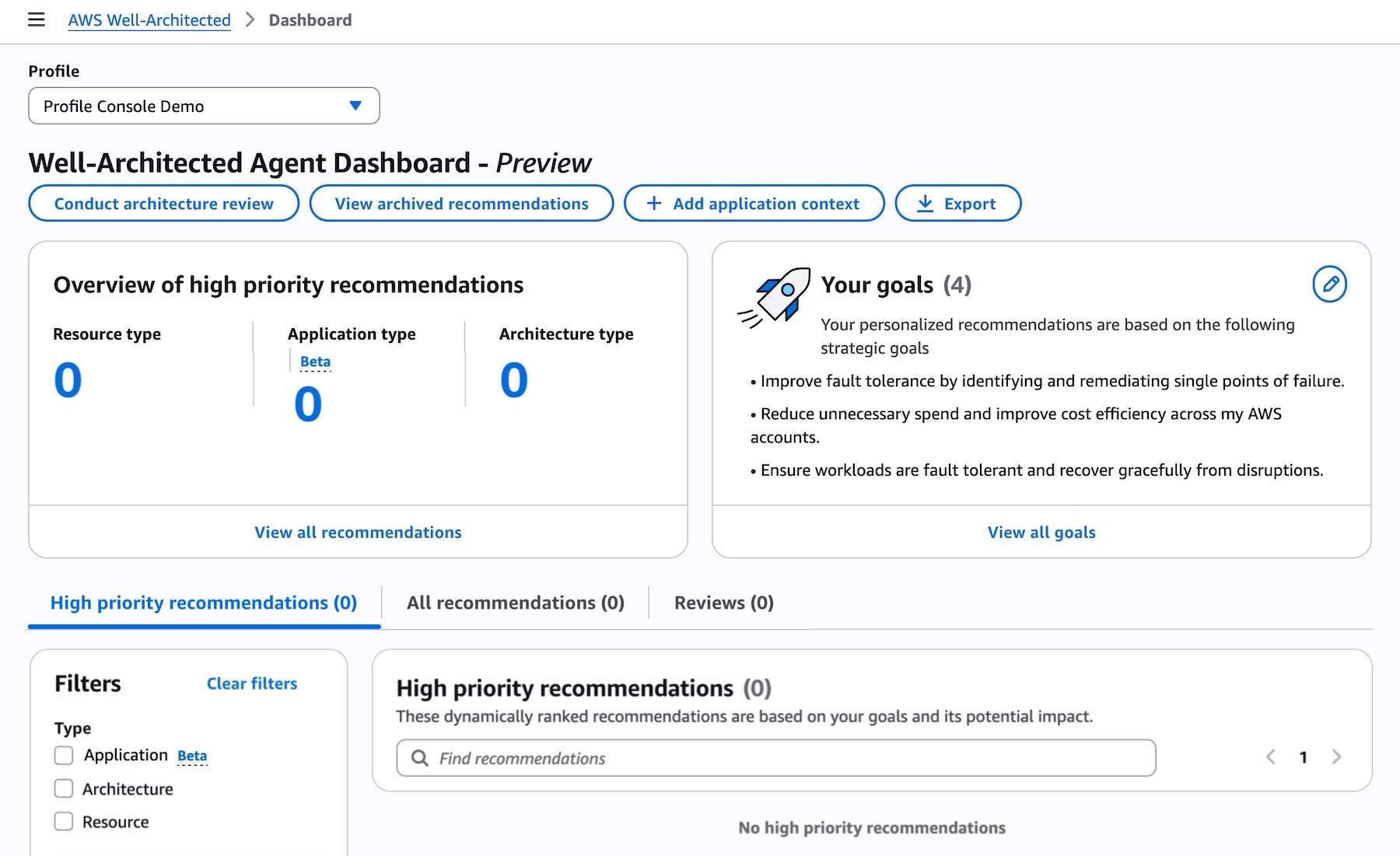
1. Creating an Agent Profile
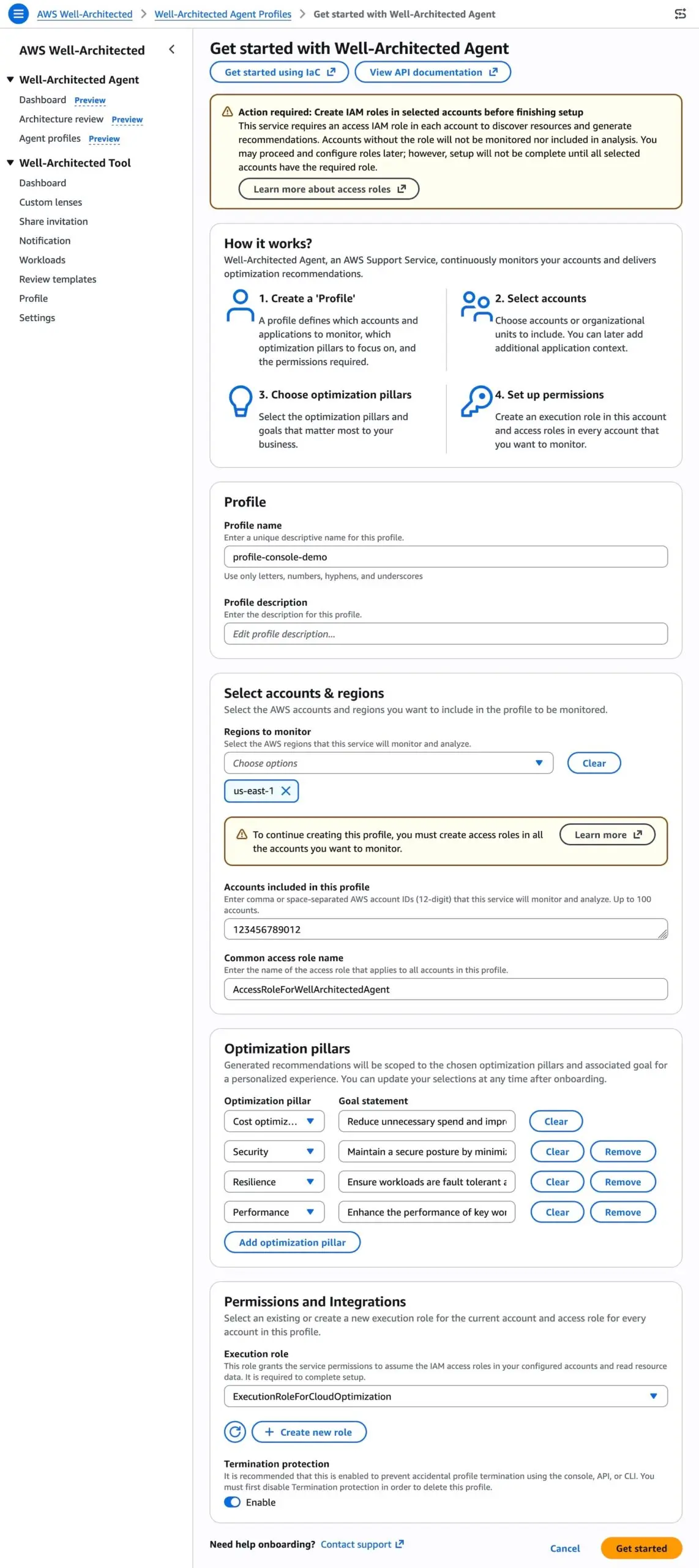
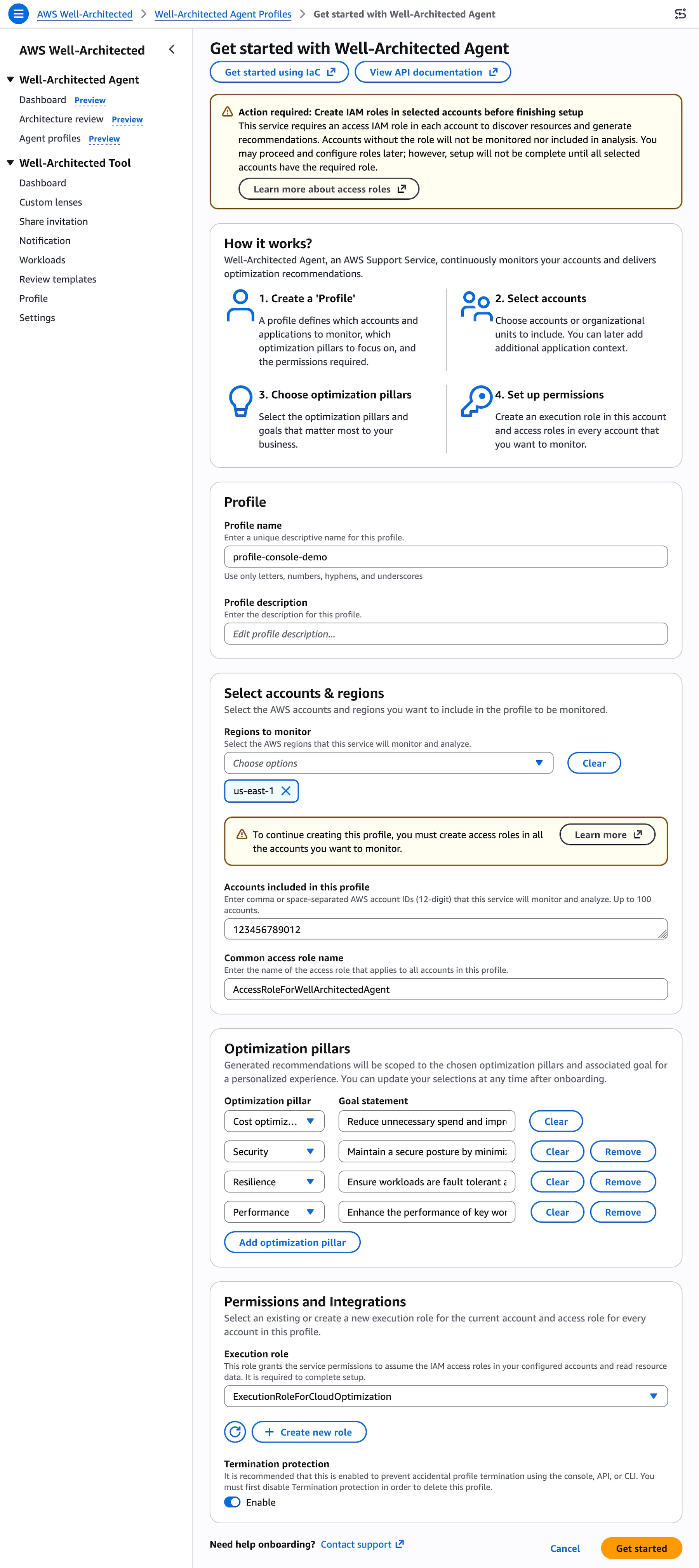
Administrators begin within the AWS Well-Architected console by selecting Get started with Well-Architected Agent. This step involves defining the operational boundaries of the agent:
- Scope Selection: Specify which AWS accounts, organizational units (OUs), or specific AWS Regions the agent is authorized to monitor.
- Pillar Focus: Choose which optimization pillars—cost, performance, resilience, or security—take precedence for the organization.
- Goal Definition: Set specific targets and thresholds for each selected pillar.
To ensure secure access, administrators provision customer-managed IAM roles. These roles grant the agent read-only access to resource configurations, utilization metrics, and application topology without exposing sensitive application payloads. Once configured, the agent initializes, generating its first wave of holistic recommendations within 24 hours.
2. Pre-Deployment Infrastructure Reviews via IaC
One of the most powerful features of the Well-Architected Agent is its ability to analyze workloads before they are deployed to production. Development teams can upload Infrastructure as Code (IaC) projects packaged as .zip files directly into the dashboard. Supported frameworks include:
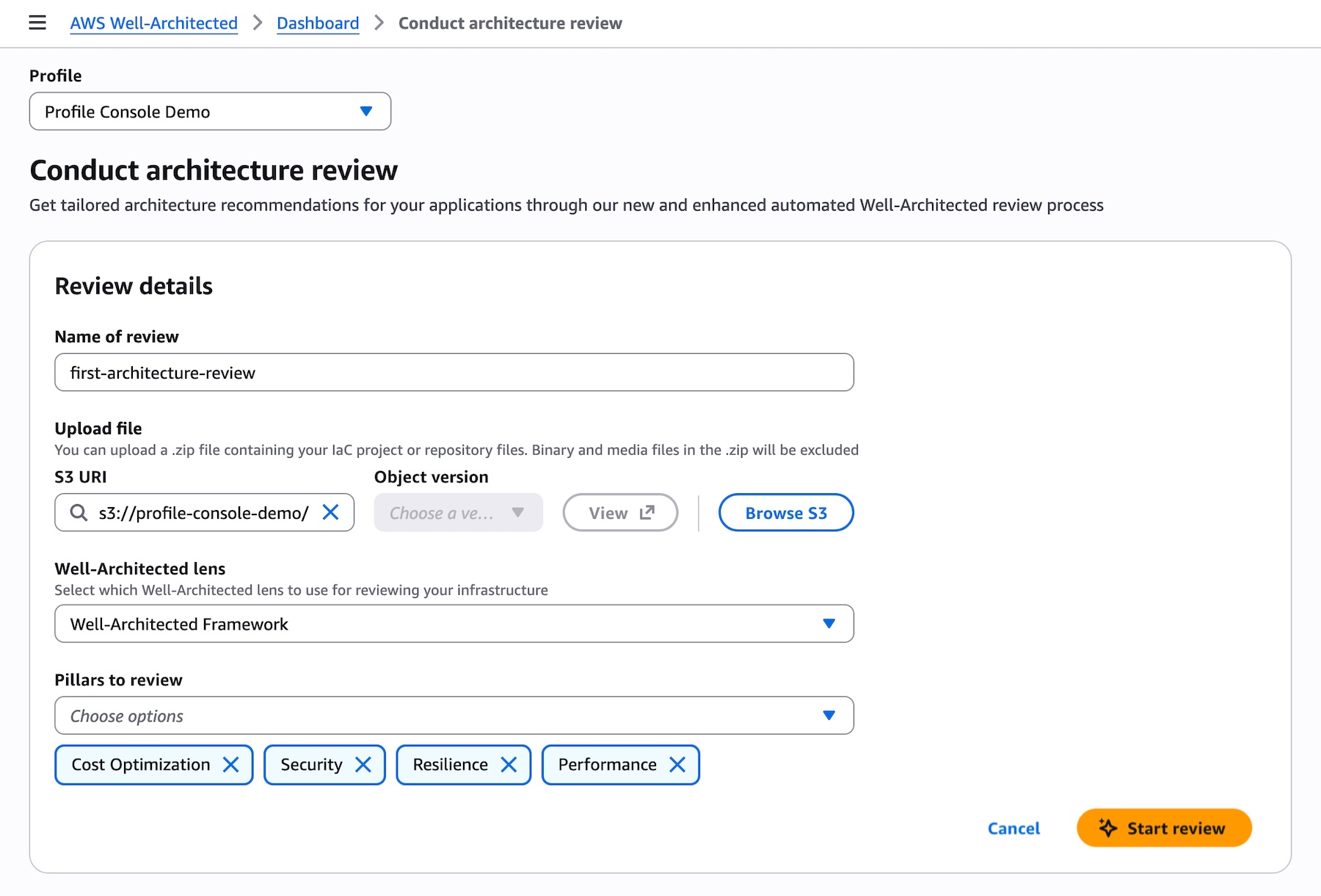
- Terraform (HashiCorp)
- AWS CloudFormation
- AWS Cloud Development Kit (CDK)
By selecting the appropriate Well-Architected lens, teams can catch architectural misconfigurations, security vulnerabilities, and cost inefficiencies at the design stage—long before resources are provisioned in the cloud.
3. Defining Application Context
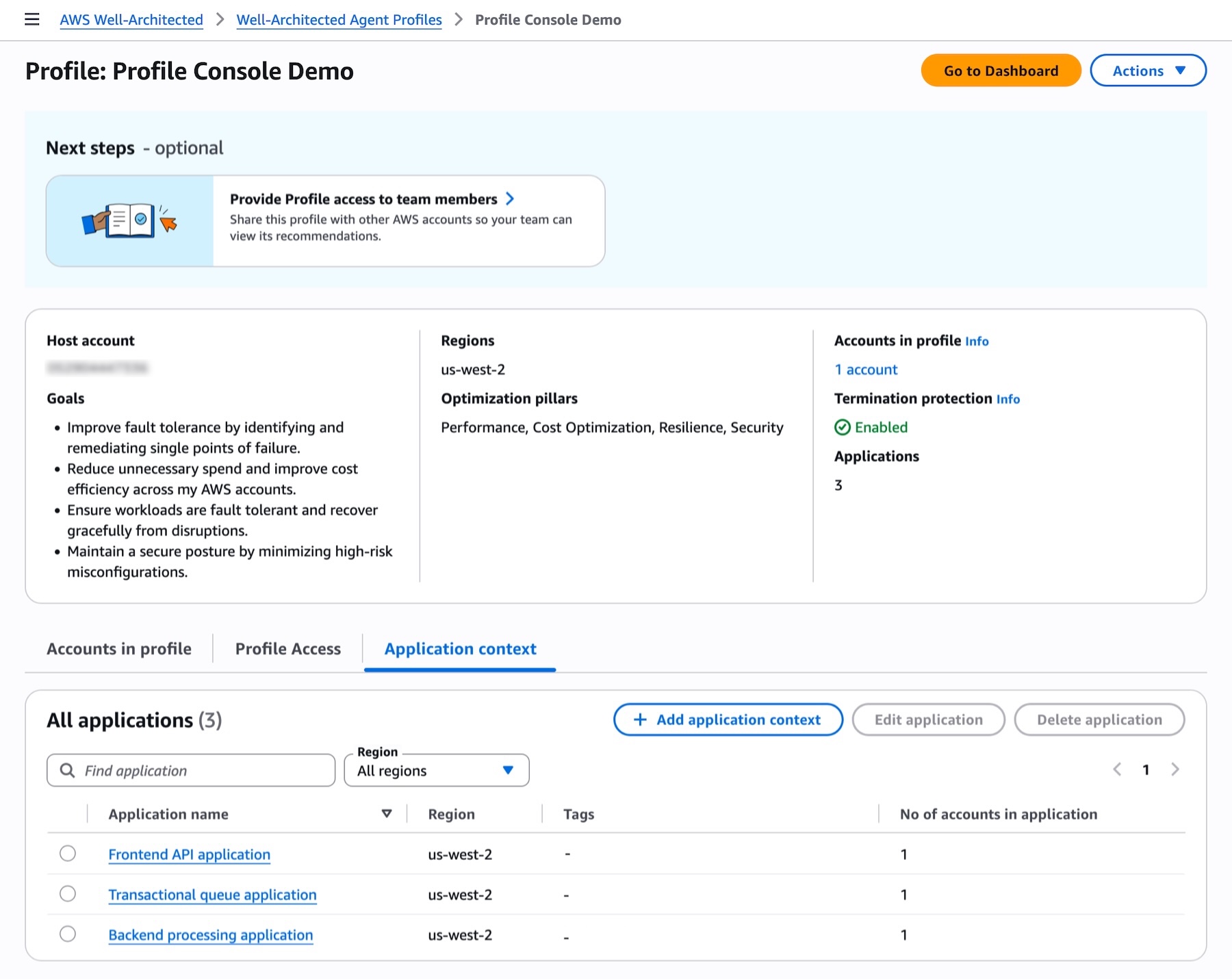
Generic resource scanning often results in "noise"—recommendations that may make sense technically but lack business relevance. The Well-Architected Agent addresses this through Application Context. By navigating to the dashboard and selecting Add application context, administrators can group resources by application name, AWS accounts, Regions, services, and custom resource tags. This contextual overlay ensures that recommendations are filtered, prioritized, and presented with a clear understanding of the application’s criticality and purpose.
4. Reviewing Prioritized Recommendations and Executing Remediation
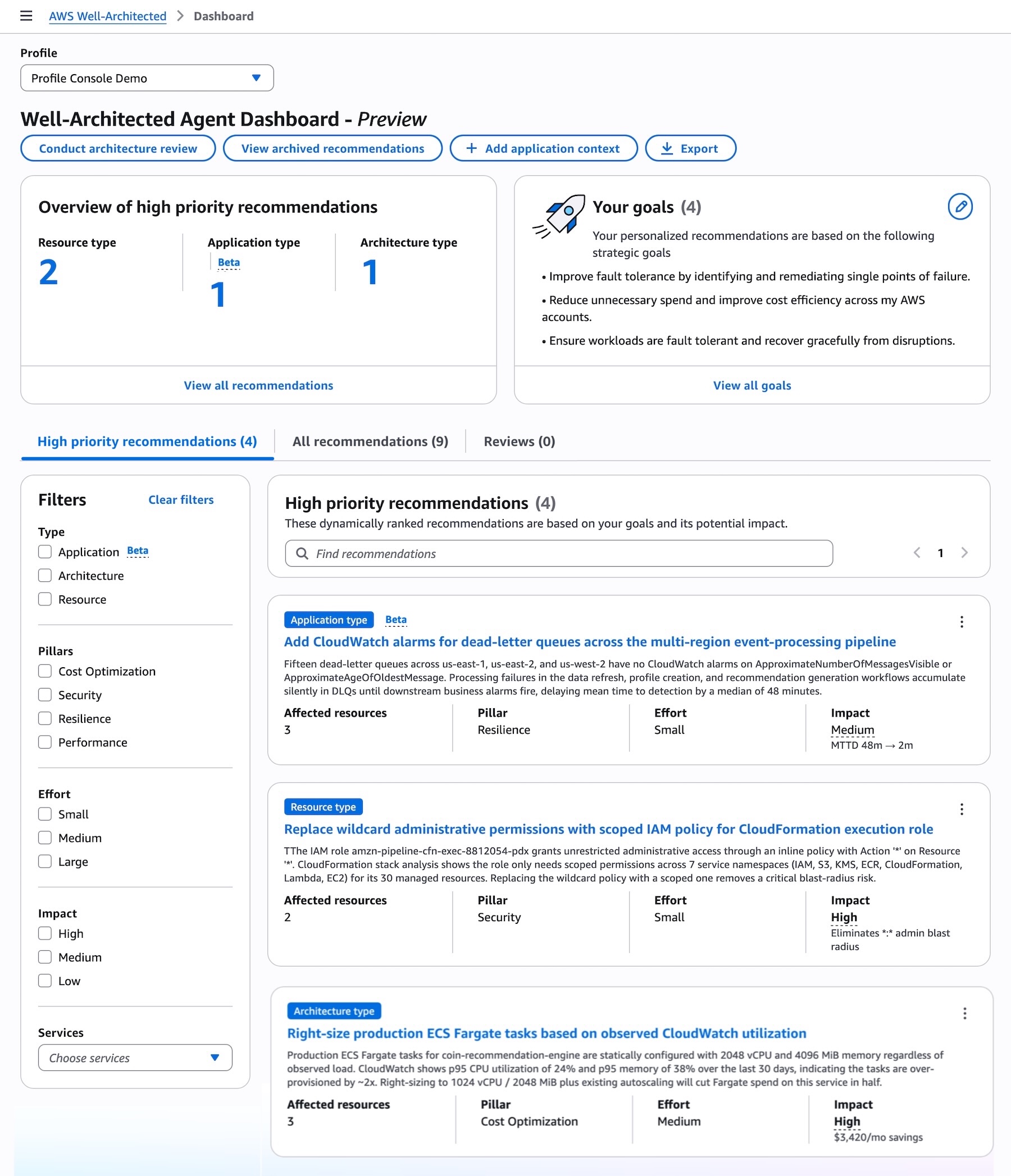
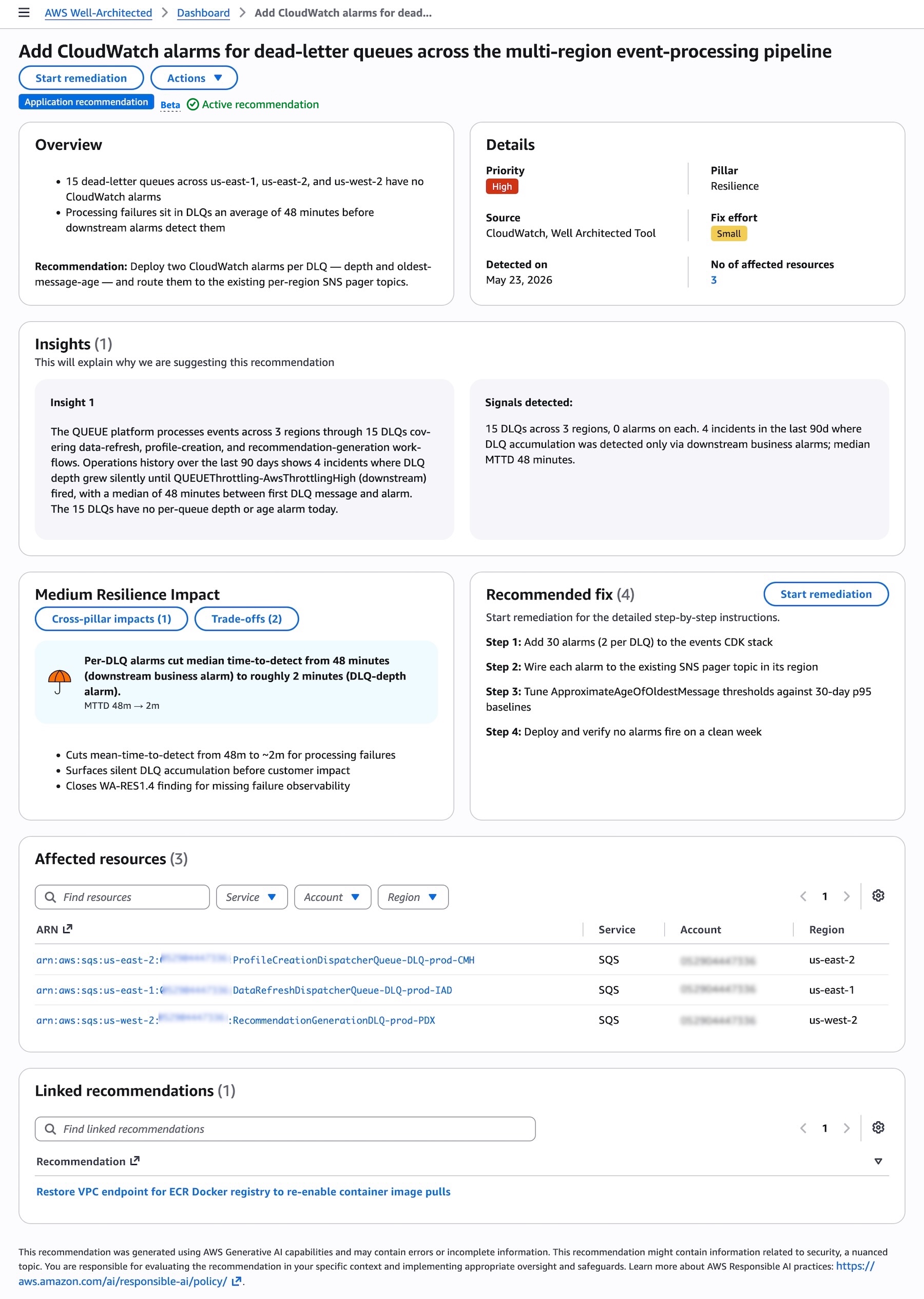
Once the analysis is complete, the agent presents a prioritized list of findings. Selecting an individual recommendation reveals:
- Detailed Insights: An explanation of why the agent flagged the resource.
- Impact and Trade-off Analysis: A breakdown of how implementing the fix will affect other pillars (e.g., explaining that increasing redundancy for resilience will result in a modest cost increase).
- Affected Resources: A precise inventory of every resource impacted by the finding.
When ready, engineers select Start remediation. Depending on the resolution type, the agent offers multiple paths to resolution:
- Console Instructions: Step-by-step guidance for manual adjustments via the AWS Management Console.
- CLI Commands: Copy-and-paste AWS CLI commands for rapid execution.
- Updated IaC Templates: For teams utilizing infrastructure-as-code, the agent generates exact code diffs (such as updated AWS CDK functions or CloudFormation snippets) that can be copied directly into the codebase and committed via standard CI/CD pipelines.
Furthermore, through the integration of the AWS MCP Server and developer plugins, engineering teams can interact with the agent programmatically, querying documentation and pulling recommendations directly into their preferred AI-assisted coding environments.
Official Statements and Industry Perspective
The introduction of the Well-Architected Agent addresses a longstanding pain point in enterprise cloud computing: the tension between speed of delivery and architectural rigor.
Industry analysts and cloud architects have long pointed out that while cloud providers offer thousands of advanced features, keeping an enterprise estate fully aligned with best practices is a Sisyphean task. Human operators simply cannot maintain a real-time, comprehensive mental model of a sprawling microservices architecture spanning dozens of accounts.
By framing the Well-Architected Agent as an "experienced cloud architect in software form," AWS is signaling a major evolution in its support and advisory offerings. Delivered via AWS Support and available to customers with active support plans, the service represents a fusion of automated tooling and institutional expertise.
Early feedback from preview participants highlights the value of the agent’s trade-off analysis. In complex cloud environments, optimizing for cost often inadvertently compromises resilience, while tightening security can introduce performance latency. By explicitly surfacing these trade-offs and ranking recommendations against declared business goals, the Well-Architected Agent empowers engineering leads to make informed, risk-adjusted decisions rather than blindly following generic rules.
Future Outlook: The Autonomous Cloud Operations Horizon
The public preview of the AWS Well-Architected Agent in key commercial regions—including US East (N. Virginia), US East (Ohio), and US West (Oregon), with workload onboarding available globally—is merely the opening salvo in a broader industry transformation toward autonomous cloud management.
As generative AI and agentic systems mature, several future trajectories emerge:
- Closed-Loop Remediation: While current workflows require human validation to apply IaC updates or CLI commands, future iterations may offer policy-driven, automated closed-loop remediation for low-risk, high-certainty findings (such as patching open security groups or right-sizing idle test instances).
- Deepened CI/CD Integration: Deeper integration with developer tooling will likely see Well-Architected checks embedded directly into pull request workflows, rejecting non-compliant infrastructure code before it ever reaches a staging environment.
- Custom Enterprise Lenses: Organizations will increasingly train and tune agent profiles against internal enterprise governance standards, regulatory frameworks, and proprietary architectural patterns, creating a bespoke AI governance engine tailored to specific industry verticals.
For now, the AWS Well-Architected Agent stands as a vital tool for organizations seeking to tame cloud complexity. By combining deep telemetry, multi-pillar awareness, and actionable remediation packages into a unified, AI-driven interface, AWS has redefined what it means to build, run, and scale securely in the cloud.