Published: February 7, 2018
Author: Rachel Leah (Enriched & Expanded Edition)
Executive Overview
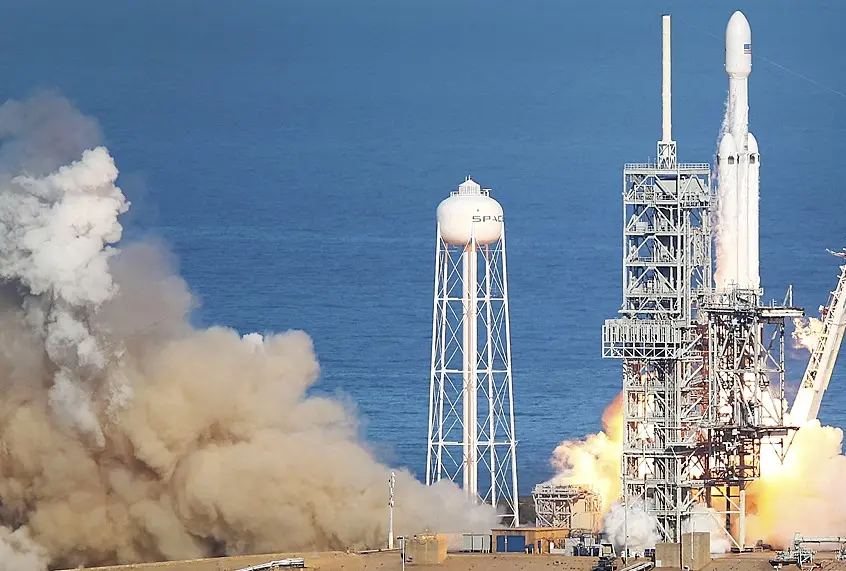
On Tuesday, February 6, 2018, the aerospace landscape was fundamentally redrawn. From historic Launch Complex 39A at the Kennedy Space Center in Florida—the very ground that once bore Apollo missions toward the Moon—Elon Musk’s private aerospace manufacturer, SpaceX, successfully executed the maiden flight of the Falcon Heavy.
Billed as the most powerful operational rocket in the world by a factor of two, the heavy-lift vehicle roared into the Florida sky, carrying an unusual, high-profile payload: a midnight-cherry Tesla Roadster belonging to Musk himself, complete with a spacesuit-clad mannequin nicknamed "Starman" at the wheel.
While the engineering marvel of returning two of the rocket’s three reusable first-stage boosters to synchronized, simultaneous touchdown at Cape Canaveral captivated the global tech community, another cultural phenomenon took center stage on social media. As the Falcon Heavy ascended into the upper atmosphere, live, high-definition video feeds broadcasted back to Earth displayed the unmistakable, breathtaking curvature of our home planet.
Almost instantly, the internet erupted. Millions cheered not just for a milestone in commercial space exploration, but in anticipation of a cultural reckoning. For years, the internet had played host to a rapidly growing resurgence of flat-Earth conspiracy theories. With pristine, unbroken live footage streaming from space, observers posed a rhetorical yet burning question: Will the live footage finally put the flat-Earth conspiracy to rest?
This article explores the monumental launch of the Falcon Heavy, the technological architecture that made it possible, the immediate social media fallout regarding the shape of our planet, and why, despite overwhelming empirical proof, the psychological fortresses of conspiracy theory-driven communities remain stubbornly unassailable.
Detailed Chronology: The Launch of a Heavyweight Titan
The Build-Up to Launch Complex 39A
For years, the Falcon Heavy existed in the public consciousness as an exercise in audacious ambition and repeated schedule delays. Musk himself frequently admitted that the engineering challenges of strapping three Falcon 9 rocket cores together—creating 27 Merlin engines capable of generating more than 5 million pounds of thrust at liftoff—were vastly more complex than initially anticipated.
By early February 2018, however, anticipation reached a fever pitch. Space enthusiasts from around the globe converged on the Space Coast, turning beaches and highways into makeshift grandstands. They waited for a window that opened at 1:30 PM EST. Following minor holds for upper-level winds, the countdown resumed.
Liftoff and Ascent
At 3:45 PM EST, the countdown hit zero. The sheer acoustics of 27 Merlin engines igniting simultaneously rattled windows miles away and shook the Florida wetlands. Slowly at first, and then with breathtaking acceleration, the Falcon Heavy punched a hole through the cloud deck.
Viewers watching the live webcast were treated to multi-angle camera views that captured the violent vibrations of max-Q (maximum aerodynamic pressure), the staging milestones, and the separation of the side boosters.
Roughly two and a half minutes into flight, in what can only be described as a sci-fi visual realized in real life, the two side boosters peeled away from the center core. While the center core continued its grueling journey to test high-energy re-entry limits
over the Atlantic Ocean, the two side boosters executed a meticulously choreographed flip maneuver. They boosted back toward Cape Canaveral Space Force Station, descending in tandem through the Florida sky, deploying their landing legs, and touching down on Landing Zones 1 and 2 with an almost surreal precision. Dual sonic booms echoed across the coast, signaling a roaring success for SpaceX’s reusability program.
Starman’s Journey into the Great Unknown
Meanwhile, the second stage continued its ascent, successfully placing its eccentric payload—the Tesla Roadster—into a heliocentric orbit that would eventually carry it past the orbit of Mars.
As the second stage coasted through the vacuum of space, cameras mounted to the vehicle beamed back a live, continuous feed. There sat Starman, casually resting his arm on the door, with the glowing, blue-and-white marble of Earth turning slowly in the background. It was a marketing stunt of astronomical proportions, blending corporate branding with deep-space exploration, and it provided an unprecedented visual record of our planet’s geometry.
Supporting Context & Metrics: Engineering Marvels vs. Empirical Reality
To understand why the Falcon Heavy launch became a cultural flashpoint, one must examine both the hardware involved and the psychological backdrop of the debate it inadvertently inflamed.
The Falcon Heavy Metrics
- Total Thrust at Liftoff: ~5.1 million pounds (roughly equivalent to eighteen 747 aircraft at full power).
- Payload Capacity to Low Earth Orbit (LEO): 63,800 kilograms (140,660 lbs).
- Payload Capacity to Mars: 16,800 kilograms (37,000 lbs).
- Core Architecture: Three modified Falcon 9 first-stage boosters tied together, featuring 27 Merlin 1D engines.
The Resurgence of Flat-Earth Ideology
In an era defined by instantaneous global communication, democratization of information has paradoxically fostered niche misinformation ecosystems. Over the decade preceding the 2018 launch, communities dedicated to the belief that the Earth is a flat disc rather than an oblate spheroid experienced a notable revival.
Flat-Earth proponents rely on a core set of foundational tenets, entirely divorced from centuries of navigational, mathematical, and astronomical observations:
- The Disc Model: The planet is envisioned as a flat circle, with the Arctic situated at the center and a massive wall of ice (Antarctica) forming a jagged ring around the perimeter to hold the oceans in.
- The Denial of Gravity: Many flat-Earth theories dismiss gravity, attributing the sensation of falling to the upward acceleration of the flat disc through space, propelled by "dark energy."
- The Global Cabal: All space agencies (NASA, SpaceX, ESA, Roscosmos) are viewed as elements of a vast, multi-billion-dollar international conspiracy designed to fabricate space travel, manipulate public perception, and conceal the "true nature" of creation.
For this community, any photographic or video evidence showing a spherical Earth is summarily dismissed as CGI (Computer-Generated Imagery), fisheye lens distortion, or outright government propaganda.
Official Statements and Social Media Reactions
The juxtaposition between hard science and internet pseudoscience generated immediate, viral commentary across digital platforms.
Elon Musk and SpaceX Control Room
Inside SpaceX’s launch control center, jubilation reigned. Musk himself took to Twitter shortly after orbital insertion, posting the iconic live-stream still with the caption:
"View from SpaceX Launch Control. Apparently, there is a car in orbit around Earth."
When questioned about the purpose of launching a sports car instead of a traditional, utilitarian dead-weight mass simulator, Musk offered a characteristically whimsical perspective: "Test flights of new rockets usually mimic mass simulators of concrete or steel. That’s boring. Of course, boring is sometimes consistent, but we wanted to try something that made us feel. The imagery of a normal car infinitely cruising through space is something that we hope gets people excited about the future of humanity in the stars."
The Internet Reacts: Poking Fun at the Flat-Earth Community
As the live feeds broadcast the curvature of the Earth over the stark blackness of space, Twitter users wasted no time directing their commentary toward flat-Earth believers.
- User @sepsis13 posted: "Suck it Flat Earthers. #Starman"
- User @thatguysky13 noted: "Look you can see the curvature of the Earth, I bet the flat Earthers are pissed."
- Comedian and internet personality Dave Days tweeted: "Flat earth officially debunked… with style @SpaceX #FlatEarth"
Concurrently, a wave of sarcastic posts flooded feeds:
- User @darink shared a pristine shot of the globe with the caption: "Look at that flat earth."
Despite the tidal wave of digital mockery, seasoned observers of online conspiracy culture knew the truth: physical evidence rarely penetrates tightly knit ideological echo chambers.
Future Outlook: The Persistent Divide in an Age of Information
The successful launch of the Falcon Heavy fundamentally transformed the commercial space industry, proving that heavy-lift reusability was not just a theoretical dream, but an operational reality. It paved the way for subsequent interplanetary architecture, heavy satellite deployments, and NASA’s Artemis-supporting logistics.
Yet, looking back from our present vantage point, the cultural legacy of the February 6, 2018 launch offers a sobering lesson about human psychology.
Did the live footage of Starman floating above the curved horizon of the Earth convince a single flat-Earth truther to abandon their beliefs? Evidence from sociological studies on belief perseverance suggests the answer is a resounding no. When an ideology is constructed on the premise that all contradictory evidence is inherently part of a grand deception, even the most visceral, high-definition panoramic views from the edge of space are seamlessly integrated into the conspiracy framework. To the true believer, the live feed was simply another Hollywood production, rendered with higher fidelity.
Ultimately, the Falcon Heavy launch accomplished something extraordinary. It united millions across the globe in a moment of shared awe, pushed the boundaries of what private enterprise can achieve in the cosmos, and provided some of the most iconic imagery in the history of space exploration. Whether it convinced the skeptics matters little in the grand ledger of human progress; the rockets will continue to fly, the earth will continue to turn on its spherical axis, and humanity will continue reaching outward into the dark.