Executive Overview
To the casual observer, modern software development teams operate like finely tuned machines. Project management dashboards glow with green completion indicators. Code reviews flow continuously through GitHub repositories. Documentation platforms house terabytes of institutional knowledge, while automated deployment pipelines ship code to production with the push of a button. Every individual tool appears to be performing its designated function with optimal efficiency.
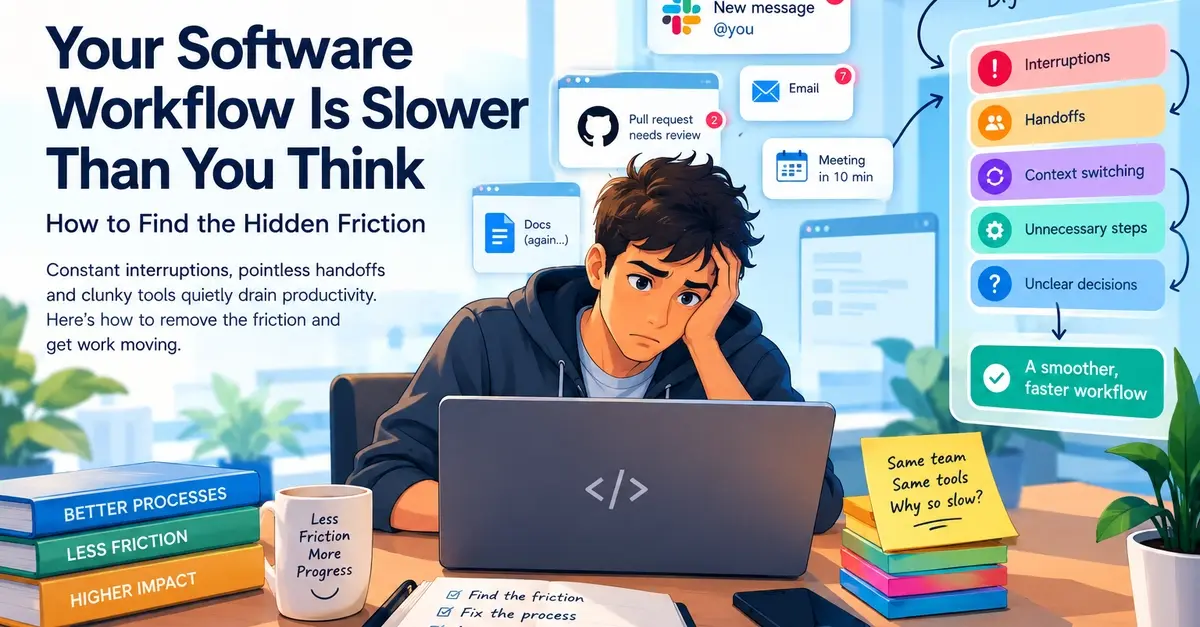
Yet, peel back the polished surface of daily operations, and a starkly different reality emerges. Developers spend a staggering amount of their day hunting for scattered information, hopping frantically between dozens of browser tabs and desktop applications, repeatedly updating overlapping systems, waiting idly for bureaucratic approvals, and desperately trying to reconstruct the mental context they had carefully established prior to the latest interruption.
For years, corporate leadership and engineering managers have misdiagnosed this malaise, assuming that the underlying problem stems from the developers themselves, the methodologies they employ, or a simple deficiency in tooling. Consequently, organizations reflexively dump more software into the ecosystem—introducing yet another dashboard for visibility, an automation platform to handle manual tasks, or an extra communication channel to accelerate collaboration.
Often, this approach backfires. The root issue is rarely a lack of tools; rather, it is workflow friction: the silent, cumulative resistance, unnecessary delays, and heavy mental overhead involved in moving a piece of work smoothly from conception to completion. For CTOs, engineering leads, and productivity architects aiming to genuinely elevate output without burning out talent, learning to diagnose and dismantle workflow friction is no longer optional—it is a strategic imperative.
Detailed Chronology: How Friction Infiltrates the Engineering Lifecycle
To understand how modern development environments grow so convoluted, one must examine the evolutionary lifecycle of a standard software engineering task. The degradation of workflow rarely happens overnight; it accumulates steadily through incremental compromises.
Phase 1: The Illusion of Efficiency on Paper
At the inception of a project, workflows are mapped with utopian clarity. A product manager drafts a user story, a developer picks it up, writes the code, submits a pull request, passes automated testing, and deploys. On paper, cycle time looks immaculate.
Phase 2: The Onset of the Information and Tool Quagmire
As codebases scale and teams expand, complexity introduces cracks. Information begins to fragment. Specifications live in a wiki, architectural decisions are buried in Slack threads, and customer feedback is trapped in a support ticketing system. When a developer receives a critical bug report, the friction begins long before a single line of code is written:
- The engineer opens the issue tracker to locate the ticket.
- They realize the reproduction steps are missing, forcing a search across legacy documentation.
- They sift through archived conversation threads to find missing context from the original QA report.
- They ping a colleague on chat for clarification, waiting minutes or hours for a response.
- They manually update the ticket status to reflect current investigation.
Only after this exhaustive scavenger hunt—which can easily consume 45 minutes—does the actual debugging begin. If the debugging process takes 20 minutes, the pre-debugging friction has already inflated the task duration by over 200%.
Phase 3: The Accumulation of Technical and Process Debt
As teams notice these delays, they layer on localized fixes. They add a custom Slack bot, a new status tag in Jira, or a mandatory pre-approval checklist. Each patch introduces its own cognitive load. Over time, the developer’s journey transforms from a straight line into an obstacle course of context switches, redundant handoffs, and rigid bureaucratic gates.
Supporting Context & Metrics: The Anatomy of Workflow Inefficiency
To effectively combat workflow friction, organizations must move beyond vanity metrics—such as counting completed tickets or measuring active keyboard time—and analyze the qualitative experience of the complete developer journey.
The Hidden Cost of Context Switching
Context switching is arguably the most insidious driver of workflow friction. When an engineer transitions between a code editor, an issue tracker, documentation, chat apps, email, and performance monitoring dashboards multiple times an hour, they are paying a severe cognitive penalty.
Every time a developer is pulled away from a complex coding problem to answer a quick ping or check a deployment status, they sacrifice more than just the minutes spent responding. They lose their "flow state"—the deep mental model of the codebase required to solve intricate logic puzzles. Reconstructing that mental model often requires 15 to 30 minutes of deep re-immersion.
Mapping the Six Symptoms of Workflow Friction
Engineering leaders can identify friction within their organizations by mapping observed behaviors back to their root systemic causes:
| What You Notice on the Ground | Potential Underlying Systemic Cause |
|---|---|
| Developers repeatedly ask for the same information | Fragmented knowledge bases, poor information flow, and lack of searchability. |
| Work pauses between completed tasks | Handoff friction, unclear ownership, or waiting for downstream queues. |
| People keep reopening the same 10 applications | Severe context-switching friction and lack of unified workspaces. |
| Tickets are repeatedly returned or corrected | Ambiguous initial requirements, weak definitions of done, and rework loops. |
| A simple change requires several bureaucratic approvals | Decision friction, risk-averse culture, and over-engineered governance. |
| The team maintains custom scripts to bridge tool gaps | Tool mismatch, where software forces humans to adapt rather than supporting the process. |
The Five Pillars of Workflow Inefficiency
When auditing an organization, leaders should categorize friction points into five distinct operational buckets:
- Information Friction: Can team members instantly locate the documentation, code rationale, or architectural decisions they need without interrogating multiple colleagues across siloed channels?
- Handoff Friction: What happens when work transitions across boundaries—from product to engineering, engineering to QA, or dev to operations? Poor handoffs introduce missing context and stalled momentum.
- Context-Switching Friction: How frequently are engineers yanked out of deep work? Evaluate both the raw volume of switches and their cognitive weight.
- Decision Friction: Are teams paralyzed waiting for sign-offs? Scrutinize whether approval gates actively mitigate critical risks or simply serve as bureaucratic safety blankets.
- Tool Friction: Are software platforms serving the engineers, or are engineers spending half their day writing scripts, workarounds, and manual syncs just to keep the tools functioning together?
Official Perspectives & Industry Frameworks
Industry experts and engineering psychologists increasingly emphasize that organizational productivity cannot be unlocked simply by pushing developers to type faster. The focus must pivot entirely toward smoothing out the holistic developer journey.
The "Remove, Simplify, Standardize, Automate" Principle
A common trap for engineering management is attempting to solve process failures by throwing automation at them. However, automating a chaotic, broken process only results in accelerating chaos. Industry veterans advocate for a strict developmental hierarchy before writing a single line of internal automation code:
$$textRemove longrightarrow textSimplify longrightarrow textStandardize longrightarrow textAutomate$$
- Remove: Eliminate unnecessary steps, redundant reports, and unused approval gates entirely. If an artifact is produced and nobody reads it, stop generating it.
- Simplify: Streamline the remaining steps so they require minimum cognitive overhead.
- Standardize: Establish clear, repeatable baselines across squads so that team members moving between projects do not encounter reinventions of the wheel.
- Automate: Only after the process is lean, clean, and predictable should you write scripts or deploy automation platforms to handle the heavy lifting.
Optimizing the Journey, Not the Task
Specialized metric frameworks argue against optimizing isolated micro-tasks. For instance, if a team aggressively optimizes code review turnaround times down to 10 minutes, but those reviews are rushed and lead to a massive bottleneck in downstream QA and staging environments, the overall system gains zero net velocity.
True productivity analysis demands looking at end-to-end flow: measuring how long it takes for a user story to journey from an initial idea safely into the hands of production users, while keeping developer cognitive load and frustration metrics low.
Future Outlook: The Path Forward for Engineering Leadership
As software systems grow increasingly distributed, AI-assisted coding tools multiply, and remote work structures mature, the organizations that win won’t necessarily be those with the biggest budgets for enterprise software licenses. They will be the ones that master the art of friction reduction.
Conducting a Practical Workflow Audit
Engineering leaders looking to enact meaningful change should avoid massive, disruptive enterprise transformation initiatives. Instead, they should execute localized, practical audits:
- Choose One Recurring Workflow: Select a single, high-frequency process—such as handling emergency production hotfixes or onboarding a new microservice.
- Map the Intended Process: Document how it should work according to company wikis and management theory.
- Observe Reality: Shadow an engineer in real-time as they execute the workflow, noting every hesitation, search query, tab switch, and wait state.
- Prioritize by Impact: Target the friction points that cause the most cumulative cognitive fatigue and calendar drag, rather than simply fixing the loudest complaints.
- Implement One Small Change: Introduce a targeted remedy—such as centralizing documentation or removing a redundant approval sign-off—and measure the impact on team morale and cycle time.
Conclusion
Workflow friction is rarely born from a single catastrophic failure; it accumulates through a thousand paper cuts—an extra notification here, a manual database update there, another redundant approval meeting, and another fragmented search query. Individually, these micro-frustrations seem harmless. Collectively, they suffocate innovation, exhaust engineering talent, and throttle delivery speed.
The foundational principle for the modern engineering organization is clear: Do not merely optimize the task; examine the entire journey. Because a development workflow does not have to be completely broken to be stealthily draining your team’s time, attention, and creative energy.