Executive Overview
While the cultural reckoning of the #MeToo movement has largely concentrated on the gleaming, high-profile corridors of Hollywood, elite media outlets, and Washington political offices, a parallel crisis of workplace misconduct has been quietly unfolding in the blue-collar operational hubs of corporate America.
At telecommunications giant Comcast, former call center and dispatch employees have stepped forward to expose what they describe as a deeply entrenched culture of sexual harassment, managerial indifference, and severe, systemic retaliation against those who dare to report abuse.
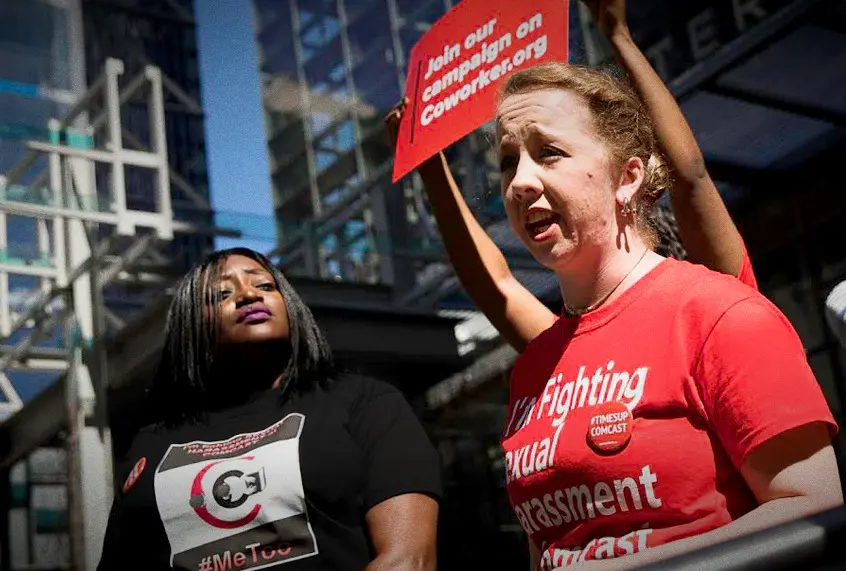
In May 2018, former Comcast sales representative Laterrica Perry and former dispatch representative Rylinda Rhodes traveled to the corporation’s Philadelphia headquarters to deliver a petition hosted on Coworker.org. Garnering more than 4,000 signatures—including dozens from current and former Comcast employees and customers—the petition serves as a direct indictment of CEO Brian Roberts and corporate leadership. It demands immediate, substantive institutional reform to protect workers from predators and the administrative blowback that follows reporting misconduct.
For Perry and Rhodes, the journey to corporate accountability has been marked by personal devastation, professional displacement, and psychological trauma. Their stories shed light on the stark vulnerabilities faced by hourly workers, particularly women of color, who lack the immediate safety nets, public platforms, and legal resources available to their white-collar counterparts.
Despite repeated denials of wrongdoing by corporate spokespeople and a refusal by executives to meet with the petitioners, these women remain steadfast. Their fight is not merely about past grievances; it is an urgent structural challenge to how major conglomerates police their own work environments and treat the people who power their daily operations.
Detailed Chronology of Events and Retaliation
The Case of Laterrica Perry: Memphis, Tennessee
The ordeal for 30-year-old Laterrica Perry began in July 2017 at a Comcast sales and call center facility in Memphis, Tennessee. According to Perry, her immediate supervisor subjected her to a sustained campaign of inappropriate behavior, which included unwanted sexual advances, explicit comments, and persistent pressure to engage in a romantic relationship.
When Perry rebuffed these advances, the situation quickly escalated from harassment to professional sabotage. Her supervisor allegedly began punishing her professionally, denying her critical sick time and withholding a professional letter of recommendation necessary for career advancement within the company.
Realizing internal channels were her only recourse, Perry took the courageous step of filing an anonymous report with Comcast Human Resources. She provided contemporaneous physical evidence, including text message logs and call records, substantiating her supervisor’s predatory conduct.
Yet, the corporate response was agonizingly slow. Perry claims that HR took nearly three months—not firing the supervisor until October 2017. During the intervening months, she alleges that the manager continued to exert influence, actively tarnishing her professional reputation among colleagues and management.
The cumulative toll of the harassment, combined with the stress of the corporate investigation, left Perry with a clinical diagnosis of Post-Traumatic Stress Disorder (PTSD). She was forced to take medical disability leave through March 2018. The transition to disability status brought a devastating reduction in her income, forcing her to make a severe financial sacrifice: executing a hardship withdrawal from her 401(k) retirement account simply to cover basic living expenses.
"I’ve been having regular therapy sessions, my psychiatrist helps, and being medically regulated has helped me for the most part," Perry shared.
However, the harassment and institutional retaliation did not end with the supervisor’s termination. While awaiting an official separation package from the company following her medical leave, Perry learned on April 30, 2018, that she had been formally fired.
Rather than receiving a clear explanation or standard documentation regarding her departure, Perry experienced what she viewed as procedural intimidation. "The only information I got was via e-mail saying that they had proceeded with the actual separation, but I didn’t get the actual package that showed why I was separated," she explained. "I received everything, as far as my COBRA coverage, my 401(k) information. The only thing that I had not received is the explanation for my termination. I kind of felt like that was something suspicious."
The Case of Rylinda Rhodes: A Legacy of Misconduct
For Rylinda Rhodes, Perry’s struggles were a painful echo of her own protracted battles with the telecommunications giant. Rhodes, who worked across four different Comcast call centers between 2007 and 2012 as a dispatch representative, alleges that she encountered sexual harassment in nearly every facility she was assigned to.
The defining incident of her tenure occurred when a male coworker entered her office and physically groped her breasts. When Rhodes formally complained about the assault, the response from management was swift, but directed entirely at her. Rather than addressing the predatory behavior of the employee, management trivialized her grievances, accusing her of being "too sensitive" and dismissing her concerns as overreactions.
The psychological erosion was profound. "The shame and embarrassment came from feeling powerless that this happened," Rhodes recalled. "I listened to what my supervisors and managers said, like, ‘hey, you’re sensitive,’ and I started believing that I was the problem. That was one of the hardest things to go through. Then I realized, ‘No, you are not too sensitive,’ ‘No, you’re not a prude.’ … There are rules set in place to prevent this and they did not follow the rules."
During the period when Comcast was ostensibly investigating her claims, Rhodes was placed on short-term medical leave to deal with mounting trauma and anxiety, during which she engaged in talk therapy. While she was away from the office on medical leave, management pressured her to apply for other jobs within the company. Ultimately, on August 1, 2012, Rhodes was terminated. The official reason provided in her termination letter cited health reasons—a justification she viewed as a convenient pretext to purge a whistleblower from the payroll. Rhodes subsequently filed a formal lawsuit against Comcast.
Supporting Context, Metrics, and the #MeToo Landscape
Bridging the Blue-Collar and White-Collar Divide
The public outcry led by Perry and Rhodes highlights a critical blind spot in the broader cultural discourse surrounding sexual harassment. While the initial wave of the #MeToo movement successfully toppled high-ranking executives, anchors, producers, and politicians, it frequently overlooked the precarious realities of hourly and blue-collar workers.
Data from the Equal Employment Opportunity Commission (EEOC) underscores the magnitude of the problem in the information and telecommunication sectors. Between 2005 and 2015, approximately 1,200 formal charges of sexual harassment were filed with the EEOC within the information industry alone—a sector dominated by massive infrastructural corporations like Comcast.
Unlike corporate executives or Hollywood stars who command robust severance packages, high-priced legal representation, and portable reputations, call center and dispatch workers operate in rigid, hierarchical environments. For many of these employees—disproportionately women and women of color—reporting harassment carries immediate economic perils, including the loss of hourly wages, health insurance, and retirement security.
Comcast’s Broader Corporate Scrutiny
Comcast and its subsidiary, NBCUniversal, have faced an unprecedented wave of public scrutiny regarding workplace misconduct. The media empire was already reeling from high-profile scandals involving its flagship news division when multiple women came forward with severe allegations of sexual misconduct against Today show host Matt Lauer, leading to his abrupt termination. Shortly thereafter, veteran NBC News anchor Tom Brokaw faced independent allegations of inappropriate workplace behavior.
Against this corporate backdrop, the activism of former call center workers like Perry and Rhodes represents a grassroots challenge to a media giant struggling to manage its internal culture across all tiers of employment.
Official Corporate Responses and Accountability
The Corporate Stance
In response to the mounting public pressure and investigative reporting by outlets such as Jezebel and Salon, Comcast corporate leadership has maintained a posture of zero tolerance paired with absolute denial of systemic failures.
Jenni Moyer, Senior Director of Corporate Communications at Comcast, issued a definitive statement defending the company’s ethics and operational policies:
"Sexual harassment, or harassment of any kind, is not tolerated at Comcast. The company was founded on a foundation of respect, integrity and trust. We have strong policies against sexual and other forms of harassment and encourage employees to report any harassing behavior. Any allegation of harassment is taken very seriously."
Despite these assurances, corporate executives declined to meet with Perry, Rhodes, and their supporters when they arrived at the Philadelphia headquarters to deliver their petition in May 2018.
The Activists’ Assessment of Corporate Willingness to Change
The refusal of Comcast executives to grant an audience to the petitioners has yielded differing perspectives among the women spearheading the campaign.
Rylinda Rhodes views the delivery of the petition as an undeniable moral victory, regardless of the executives’ closed doors. "It’s still a win. It lets them know people are watching and coming forth," Rhodes stated. "It’s also for the ones that are still suffering. To know they are not alone. We are just getting started. All women should have the freedom to be their authentic self and not a scared version because of sexual harassment."
Conversely, Laterrica Perry harbors deep skepticism regarding the corporation’s capacity for genuine self-reflection and reform. "I have doubts that Comcast will be open to meeting with us and be open to resolving the issue that they have with sexual harassment," Perry admitted.
Future Outlook: Empowering the Voiceless
Despite the personal costs—including lost wages, drained retirement accounts, damaged professional reputations, and ongoing psychological recovery—neither woman regrets stepping forward.
For Perry, the silver lining of her ordeal lies in her ability to act as a catalyst for others. "What I’m doing is giving a voice to the voiceless. I’m also empowering people to step forward and say if something happens to them, whether it be at Comcast or any other corporation," she noted. Looking ahead, Perry plans to dedicate her efforts to building support systems and resource networks for victims of workplace harassment who remain unaware of their legal rights or where to seek post-incident assistance.
Rhodes shares this forward-looking mission, emphasizing that the primary objective of her advocacy is to dismantle the shame and isolation that keep victims trapped in silence. "The most important thing about this is sharing this to give hope to whoever is out there that feels lost, that feels like it was their fault, that feels shame and blame," Rhodes emphasized. "I want them to know it is not their fault and that there are things that they could do to feel better and to be better. This does not have to define the rest of their lives."
As the pressure mounts on corporate giants to clean up their internal operations, the courageous stand taken by the former employees of Comcast serves as an enduring reminder that the fight for dignity, safety, and accountability in the workplace belongs to every worker, regardless of where they sit on the corporate ladder.