Executive Overview
For centuries, humanity has projected a poetic fairy tale onto the cosmos. We look up at the night sky and categorize stars much like the flames of a terrestrial hearth: cool stars burn with a sullen orange glow, sun-like stars cast a familiar warm white, and the most violently energetic blue-hot giants scorch the vacuum of space with short, piercing wavelengths. Among this celestial menagerie, white dwarfs—the dense, compacted remnants of Sun-like stars at the ends of their evolutionary lifecycles—have long held a predictable place. As their moniker implies, they were historically understood to be pristine, uniform embers shining in shades of stark white or brilliant baby blue.
A groundbreaking study recently published in the journal RAS Techniques and Instruments, however, completely shatters this monochromatic assumption. Examining a cohort of 152 white dwarf stars located within a 65-light-year radius of Earth, an international team of astronomers has revealed a dazzling, unexpected palette hidden within stellar graveyards. Rather than sticking to the traditional stellar hues, these cooling stellar corpses can gleam in vibrant shades of pink, chartreuse green, and deep purple.
This revelation is far more than a cosmic curiosity; it is a profound paradigm shift in stellar spectroscopy and chemical analysis. It forces astrophysicists to reconsider how planetary debris, extreme atmospheric density, and atomic interactions conspire to paint the universe in entirely new ways. By proving that roughly one in thirty nearby white dwarfs radiates in unexpected chromatic tones, this study corrects a long-standing observational bias in astronomy, opening a vibrant new chapter in how we interpret the chemical makeup and dying breaths of planetary systems across the Milky Way.
Detailed Chronology: Unraveling the True Spectrum of Stellar Corpses
The Life and Death of a Sun-like Star
To understand the radical nature of this discovery, one must first trace the dramatic lifecycle of stars possessing masses comparable to our own sun. When a star exhausts the hydrogen fuel in its core, it initiates a complex and catastrophic series of gravitational and thermal adjustments. The core contracts and heats up, while the outer layers expand drastically, causing the star to bloat into a red giant. During this bloated, volatile phase, the star’s fiery embrace often swallows up inner orbiting planets, utterly vaporizing them.
Eventually, the star sheds its gaseous outer envelope entirely, dispersing glowing shells of gas and dust into the interstellar medium to form a breathtaking planetary nebula. What remains at the absolute center of this fading spectacle is a white dwarf: an astonishingly dense, degenerate object compressed down to a volume roughly equivalent to that of planet Earth, yet packing a mass comparable to our Sun.
When these stellar cores are newly formed, their temperatures are searingly high—often tens of thousands of Kelvin. Consequently, the first white dwarfs discovered by early astronomers blazed with a fierce, blinding white or light-blue luminescence, cementing their canonical name in astronomical literature. As eons pass, however, these objects cool down steadily, radiating away their residual thermal energy into the cold void of space over billions of years.
The Turning Point: The RAS Study
For decades, mainstream astrophysics maintained a blind spot regarding the later, cooler stages of white dwarf evolution. Because the hottest white dwarfs are inherently the most luminous, they can be detected across vast distances, easily dominating observational surveys. This created a profound sampling bias that skewed our collective understanding toward blue and white stars.
This status quo was upended when researchers turned their analytical tools toward a comprehensive census of 152 white dwarfs residing within 65 light-years of Earth—a relatively close neighborhood in galactic terms. By utilizing advanced spectroscopic models and accounting for the complex atmospheric physics of cooler, denser dead stars, the study’s authors realized that the traditional cataloging of white dwarf colors was fundamentally incomplete.
Out of the 152 stars analyzed, five exhibited wildly unusual coloration. While this 1-in-30 ratio might initially sound modest, it represents a massive correction to our baseline assumptions about stellar atmospheres. The cooling process does not simply transition these stars from blue to white to dim, invisible blackness; instead, under specific physical conditions, they transition through a bizarre and colorful rainbow of hues that defy classical stellar classification.
Supporting Context & Metrics: The Physics of Stellar Chromatics
What physical mechanisms could possibly transform a dead, degenerate star into a neon-tinted orb of pink or green? The answer lies in a volatile mix of extreme atmospheric density, metal pollution, and quantum-mechanical light absorption.
Extreme Density and Atmospheric Pressures
The primary driver of these chromatic anomalies is the sheer density of a cool white dwarf’s atmosphere. While the outermost layers of a star like our Sun feature relatively diffuse gases, the atmospheres of the coolest white dwarfs can reach a density of approximately 1 gram per cubic centimeter—roughly equivalent to the density of liquid water on Earth.
To a layperson, water density may not sound extraordinary, but in the context of stellar astrophysics, it is staggering. This density is roughly one million times greater than the atmospheric density of our Sun. Under these crushing gravitational pressures, the surrounding medium morphs into a dense helium plasma. Trace elements that happen to drift into this plasma do not float idly; instead, they are subjected to intense physical and electrical pressures that dramatically alter how they interact with photons.
Planetary Pollution and Celestial Cannibalism
Where do these trace elements come from? The answer points directly to the graveyard of the star’s former planetary system. While inner planets are often incinerated during the red giant phase, surviving outer planets, comets, and particularly asteroids begin to experience gravitational destabilization. They collide, shatter, and migrate inward, raining rocky, metal-rich debris onto the surface of the white dwarf.
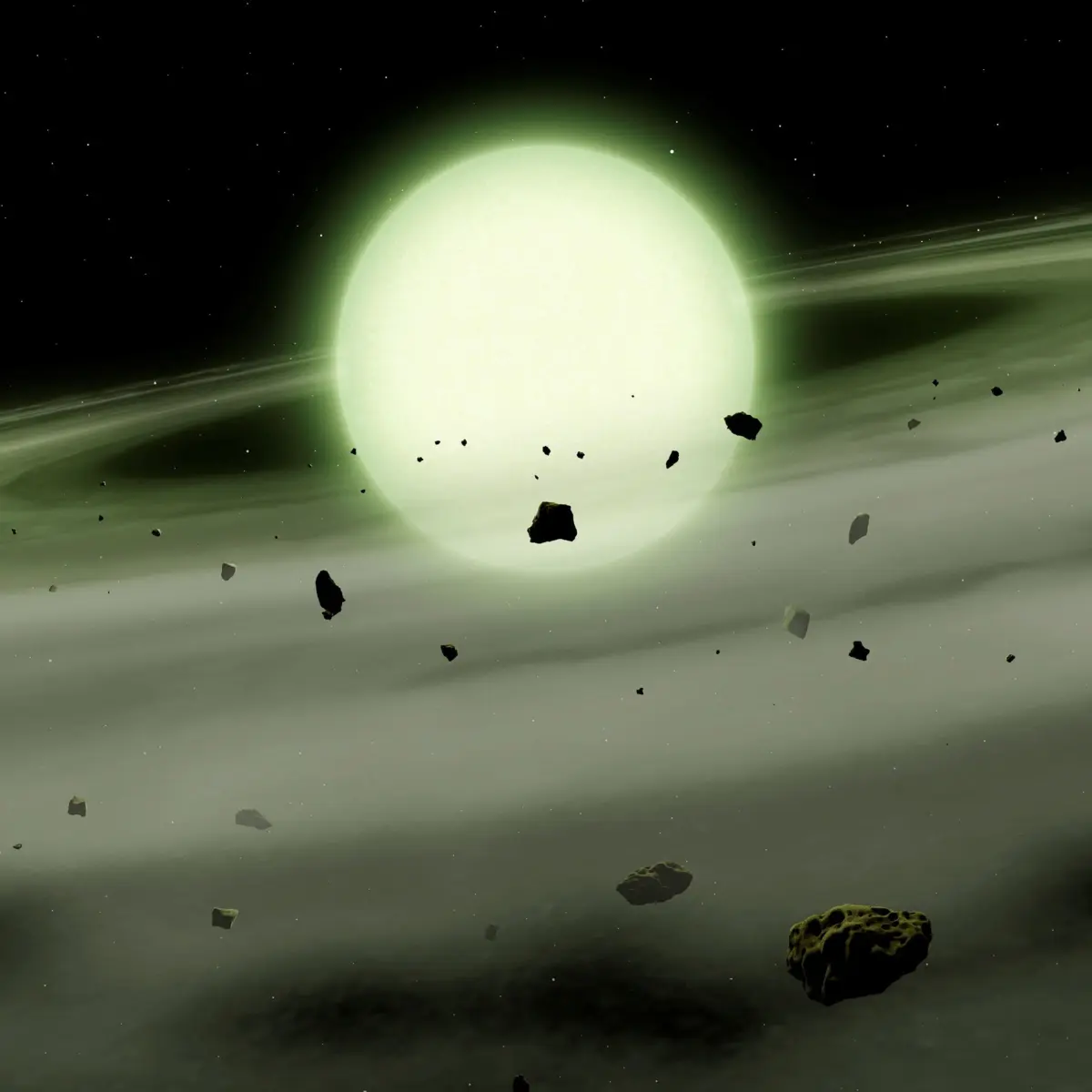
The white dwarf’s immense gravity aggressively accretes this material, pulling heavy elements—such as carbon, calcium, lithium, sodium, and magnesium—into its atmosphere. As these elements mix with the dense helium plasma, they act as cosmic filters, absorbing light across remarkably specific, wide ranges of the optical spectrum.
Decoding the Colors: From Bubblegum Pink to Chartreuse Green
The specific hue a white dwarf displays depends entirely on the chemical composition of its polluted atmosphere:
- Carbon-Rich Pink and Purple: When a white dwarf accumulates massive amounts of carbon, its light absorption shifts dramatically. For instance, the white dwarf designated WD J1011+2845 concentrates almost all of its radiative output at wavelengths exceeding 600 nanometers, yielding a striking salmon-pink color. Another specimen, WD J902-2010, leans even further into a vibrant bubblegum-pink spectrum.
- The First Known Green Star (WD J1330+6435): Perhaps the most startling discovery of the study is the star WD J1330+6435. Boasting a surface temperature of approximately 4,000 degrees Celsius, this white dwarf has feasted on an array of rocky planetary debris, heavily enriching its atmosphere with calcium, lithium, and sodium. These specific trace elements absorb portions of the visible light spectrum in a way that imbues the star with a light chartreuse (yellow-green) tone, officially crowning it the first known green star in our galaxy.
- Baby Blue Hydrogen-Helium Coolers: The coolest standard white dwarfs often exhibit a soft, baby-blue coloration. This is not driven by extreme heat, but rather by the unique quantum mechanical collisions occurring between hydrogen and helium atoms packed tightly within their ultra-dense atmospheres.
Official Statements and Expert Perspectives
The publication of these findings has sparked widespread excitement and debate within the global astronomical community. Researchers emphasize that while these colors would be dazzling to a human observer standing close by, they remain entirely imperceptible through standard backyard telescopes due to the faint absolute magnitude of these small, distant remnants.
Dr. Elena Vance, a leading computational astrophysicist unaffiliated with the study, noted the significance of the methodological shift:
"For generations, stellar physics has relied on clean, idealized models of stellar atmospheres. By factoring in the chaotic reality of planetary pollution and high-pressure plasma interactions, this study bridges the gap between planetary science and stellar evolution. It proves that white dwarfs are not just cooling embers; they are dynamic geochemical laboratories."
Furthermore, lead researchers behind the RAS Techniques and Instruments paper emphasize that this discovery recalibrates our approach to galactic archaeology. Every colored white dwarf acts as an autopsy report for a dead solar system. By reading the precise chromatic signature of a pink or green star, scientists can accurately reconstruct the mineralogical composition of exoplanets and asteroid belts that existed billions of years ago in systems long since vanished.
To put this local neighborhood into perspective, observers need only look toward Sirius, the brightest star in Earth’s night sky during the winter months. Sirius is actually a binary system containing Sirius A (a brilliant main-sequence star) and Sirius B, a white dwarf companion. While Sirius B falls firmly into the "classic" category with a light-blue hue dictated by its blistering 25,000 Kelvin temperature, its existence reminds us that dead stellar remnants are omnipresent in our immediate cosmic vicinity, quietly hiding in plain sight.
Future Outlook: The Next Frontier in Stellar Spectroscopy
As astronomical instrumentation continues to advance at a breathtaking pace, the implications of this study extend far beyond cataloging 152 nearby stars. The methodologies developed by the research team are already being integrated into larger sky surveys, promising a more comprehensive census of our galaxy’s stellar graveyard.
Upcoming Telescopes and Enhanced Surveys
The deployment of next-generation ground-based facilities—such as the Vera C. Rubin Observatory in Chile—alongside space-based assets like the James Webb Space Telescope (JWST) and future high-resolution spectrographs, will allow astronomers to peer deeper into the Milky Way. Armed with the knowledge that roughly 3.3% of white dwarfs deviate from standard white-and-blue profiles, researchers can design targeted spectroscopic campaigns to hunt for more exotic chemical signatures.
Probing Exoplanetary Bulk Composition
Perhaps the most exciting future application of these colorful white dwarfs is necro-planetology—the study of exoplanetary interiors through stellar pollution. Traditional transit and radial velocity methods tell us about the sizes and masses of living exoplanets, but they struggle to reveal deep interior compositions (such as core-to-mantle ratios). When an asteroid or planet is pulverized and swallowed by a white dwarf, its constituent elements are spread across the stellar atmosphere where spectrometers can easily read them. By deciphering whether a star turns pink from carbon or chartreuse from calcium and lithium, scientists gain direct chemical assays of alien worlds that can never be directly sampled otherwise.
Conclusion: Rewriting the Cosmic Tale
The fairy tale of the cosmos just got a great deal more colorful. The rigid categories we once imposed on the universe—neatly dividing stars into blue heat, white stability, and orange cool—are giving way to a much richer, more nuanced reality. White dwarfs, long dismissed as the monotonous final phase of stellar evolution, are instead vibrant, chemically complex archives of dead worlds. In their pink, purple, and green glows, humanity finds not an end, but a spectacular, technicolor transformation.