Executive Overview
For the past decade and a half, the software-as-a-service (SaaS) and broader business-to-business (B2B) sectors operated under a rigid, almost unquestioned operational doctrine. The math was simple, predictable, and deeply entrenched: for every $200,000 to $300,000 in new annual recurring revenue (ARR) generated, a company needed to add one full-time employee to the payroll.
This hiring multiplier served as the gravitational pull for financial planning. Corporate boards routinely approved hiring targets against it, Chief Financial Officers built complex, multi-year financial models around it, and venture capitalists poured hundreds of billions of dollars into early-stage startups specifically to fund aggressive, headcount-heavy scaling strategies.
Today, that foundational metric describes the median legacy B2B or SaaS company—but it no longer applies to the market leaders.
As we look across the tech landscape, a new vanguard of public and private enterprises has shattered this baseline. Companies like Anthropic, Palantir, AppLovin, and Cloudflare are operating at multiples ranging from 5x to 35x the traditional median. Crucially, they are achieving these staggering efficiency gains while simultaneously growing their top-line revenue faster than their slower-moving, labor-heavy competitors.
This report examines the structural shift away from human-capital-intensive scaling, the data behind the new revenue-per-employee paradigms, and what CFOs, founders, and boards must factor into their 2027 strategic plans.
Detailed Chronology: The Breakdown of the Traditional Hiring Ratio
The uncoupling of revenue growth from linear headcount expansion did not happen overnight. It was catalyzed by a convergence of macroeconomic pressures, beginning with the capital market corrections of 2022 and 2023, and supercharged by the rapid maturation of generative artificial intelligence and autonomous software agents through 2025 and 2026.
2022–2023: The Macroeconomic Wake-Up Call
As zero-interest-rate policies (ZIRP) came to an abrupt halt, B2B companies faced immediate pressure to protect cash flow and extend runways. Organizations that had over-hired during the pandemic boom were forced to re-evaluate their operational bloat. During this period, executive teams discovered that trimming middle management and general-and-administrative (G&A) overhead did not automatically impair product delivery or revenue velocity. In fact, many companies noticed an increase in organizational agility and execution speed once unnecessary layers of bureaucracy were removed.
2024–2025: The Lean Operational Playbook
With capital remaining disciplined throughout 2024 and 2025, pioneering firms began experimenting with aggressive structural efficiency. Private equity firms and specialized tech operators—such as Bending Spoons—demonstrated that mature software assets could absorb severe headcount reductions (ranging up to 75% of acquired workforces) while maintaining core product stability and driving up operating margins above 50%.
Concurrently, internal adoption of AI coding assistants, automated customer relationship management (CRM) workflows, and generative sales enablement tools began to compound.
2026: The AI-Agent Inflection Point
By 2026, the shift crossed a critical threshold. The market moved past simple code-completion tools into the era of autonomous operational agents. Companies stopped viewing AI merely as a productivity booster for individual workers and began deploying multi-agent systems capable of handling end-to-end workflows—from outbound prospecting and quote-to-cash cycles to technical support triage and financial reconciliation.
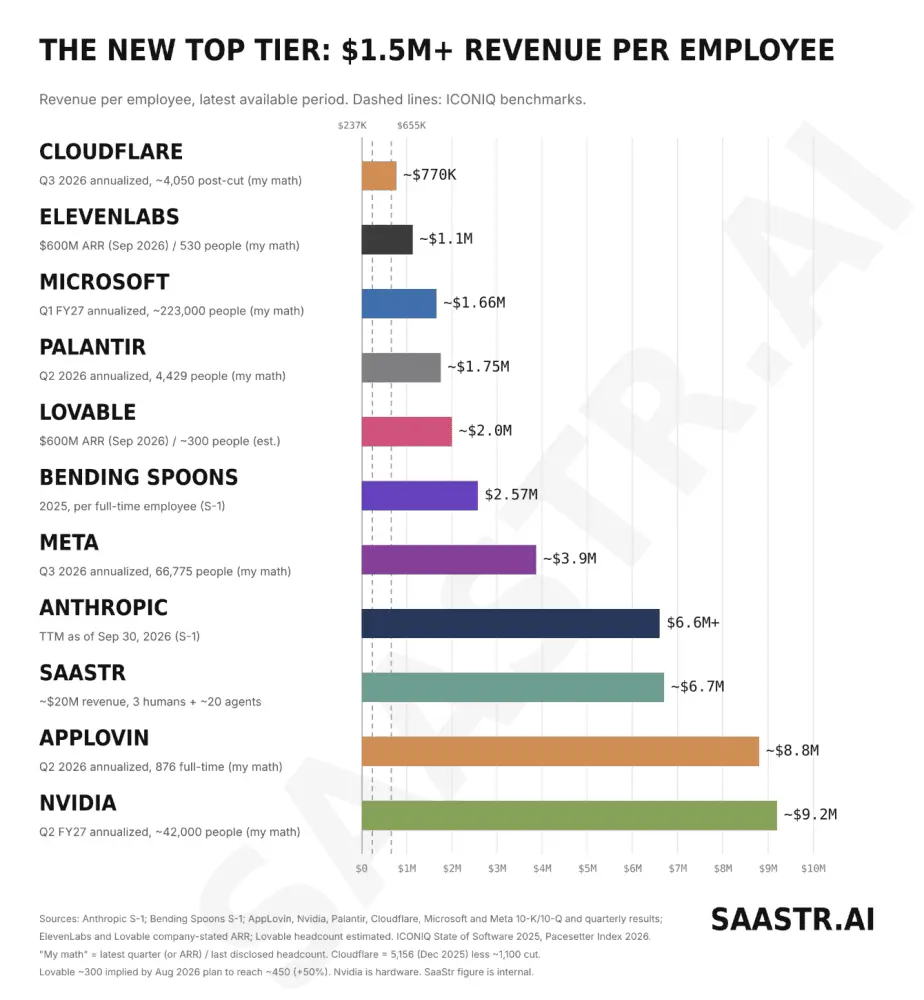
The result is a bifurcated market: the median firm continues to add one human per $237K of new revenue, while market leaders generate anywhere from $1.75M to $9M in revenue per employee.
Supporting Context & Metrics: Benchmarks of the New Economy
To understand how drastically the operational baseline has shifted, we must examine the data across different tiers of the B2B ecosystem.
The Baseline: ICONIQ Capital Benchmarks
According to historical and current baseline benchmarks, the typical, slower-growing B2B company generates approximately $237,000 per employee. Meanwhile, elite growth companies operating under older scaling models typically hovered around $655,000 per employee. Today, even that "elite" tier looks conservative compared to the outliers of the current market cycle.
AppLovin: Software Scale With Under 900 People
AppLovin stands as one of the most extreme software examples of this new economic reality. During the second quarter of 2026, the company posted $1.92 billion in revenue—a 53% year-over-year increase—accompanied by an astronomical 84% adjusted EBITDA margin.

To put that financial engine in perspective, AppLovin operated at year-end 2025 with just 876 full-time employees, alongside a tiny auxiliary group of part-time workers and interns. On an annualized basis, this equates to roughly $8.8 million in revenue per full-time employee. Following the strategic divestiture of its consumer apps business in 2025, AppLovin doubled down entirely on its proprietary ad-tech platform, proving that multi-billion-dollar software ecosystems no longer require massive global workforces to manage infrastructure and client acquisition.
Anthropic: Tripling Headcount While Scaling Revenue Exponentially
As an AI-native powerhouse, Anthropic’s trajectory offers a fascinating look at how hyper-growth interacts with workforce scaling. According to its S-1 filing, Anthropic’s trailing-twelve-month (TTM) revenue per employee surpassed $6.6 million as of September 30, 2026, up sharply from $1.4 million just one year prior. First-half 2026 revenue surged to $16.3 billion, compared to $1.2 billion in the first half of 2025.
Crucially, Anthropic did hire aggressively during this window—its total workforce tripled year-over-year. However, the hiring was highly targeted. Technical roles shifted from 61% down to 56% of total headcount as sales, finance, and specialized research expanded. Administrative and clerical overhead, by contrast, remained virtually flat. Anthropic is currently generating between 2x and 4x the revenue per employee that tech giants like Google and Meta achieved at comparable developmental stages (adjusted for inflation).
Palantir: The Efficiency of the Foundry Model
Palantir continues to cement its reputation as an enterprise software juggernaut with exceptional margin control. In Q3 2026, Palantir reported $2.31 billion in revenue—a 96% year-over-year jump—with a 62% adjusted operating margin. U.S. commercial revenue hit $984 million (up 148%), officially surpassing its U.S. government revenue stream for the first time.
Across its 4,634 full-time employees, Palantir’s quarterly performance annualizes to roughly $2.0 million per employee. Notably, headcount increased by a mere 205 people from year-end 2025, even as quarterly revenue nearly doubled. For comparison, Q3 2025 annualized revenue per employee stood at approximately $1.07 million on a base of 4,414 workers.
Cloudflare and Atlassian: Traditional SaaS Proves the Lean Model
The structural transformation is not restricted to AI-native startups or advertising platforms. Legacy B2B cloud leaders have demonstrated that disciplined workforce optimization can unlock immediate acceleration.
- Cloudflare: At the close of 2025, Cloudflare maintained a headcount of 5,156 full-time employees before executing a roughly 20% workforce reduction in May. Rather than stalling growth, the company’s year-over-year revenue expansion accelerated from 34% to 36%, and then to 39% in subsequent quarters. Revenue per employee jumped roughly 40% from ~$496K to ~$690K. Internal utilization of AI tooling surged over 600% within three months, allowing the company to hold G&A expenses down 14% year-over-year while boosting sales and marketing investments.
- Atlassian: Following a targeted reduction of approximately 1,600 employees in March (spanning more than 900 R&D roles), Atlassian’s cloud revenue climbed 31% to $1.213 billion five months later—shattering its initial 23% guidance. Net revenue retention consistently held above 120%.
Bending Spoons and SaaStr: Micro-Teams and Autonomous Agents
At the extreme end of the efficiency spectrum, Italian digital products company Bending Spoons saw its revenue per full-time employee climb from $1.12 million in 2023 to $1.64 million in 2024, and finally to $2.57 million in 2025, accompanied by an adjusted operating margin of 51.2%. More than 90% of its code pull requests are now written or co-written by AI, supporting an aggressive M&A playbook that trims up to 75% of staff from acquired targets like WeTransfer.
Meanwhile, media and events firm SaaStr operates at an unprecedented micro-scale: on track for $20 million in revenue with just 3 human workers supported by roughly 20 production-grade AI agents. This amounts to approximately $6.7 million per human. In this environment, AI agents manage nearly 90% of outbound SDR workflows, along with first-touch communications, renewals, invoicing, collections, and commission calculations. Human team members act primarily as supervisors, reviewers, and relationship managers for complex, non-standard enterprise deals.
Official Statements & Industry Perspectives
Industry observers and executive leadership teams have increasingly voiced the sentiment that the traditional "body-count" metric of success is obsolete.
"The old paradigm where organizational headcount was viewed as a primary badge of honor or a direct proxy for corporate scale is dead," notes enterprise software analyst consensus. "Boards are no longer asking how many people you hired to hit your ARR milestone; they are interrogating your revenue-per-employee ratios and evaluating your capacity to scale through software leverage and autonomous systems."
Financial operators emphasize that the margin expansion made possible by this transition fundamentally alters valuation multiples. Companies that decouple revenue growth from headcount growth insulate themselves against wage inflation, reduce management overhead, and retain the financial flexibility to weather macroeconomic volatility without disruptive emergency restructurings.
Future Outlook: Implications for 2027 Strategic Planning
As executive teams finalize their operational budgets and strategic roadmaps for 2027, the divergence between median performers and market leaders demands a fundamental rethinking of resource allocation.
Key Planning Takeaways for 2027
- Abandon Linear Headcount Modeling: CFOs must sever the assumption that hitting revenue targets requires proportional hiring. Financial models should incorporate software-driven leverage factors across every department.
- Audit G&A and Administrative Bloat: As demonstrated by Anthropic and Cloudflare, the most efficient scaling companies keep administrative, clerical, and general management headcounts virtually flat while expanding revenue-generating functions.
- Invest in Agentic Workflow Infrastructure: Moving beyond basic productivity tools, companies must integrate autonomous software agents into core operational workflows—including sales development, customer success, billing, and technical triage.
- Redefine Team Roles Toward Supervision: As automated agents assume execution duties, the role of human workers shifts toward quality control, strategic oversight, complex relationship management, and edge-case resolution.
Where Lean Cuts Have Proven Most Effective
- General & Administrative (G&A): Streamlining finance, legal, and back-office overhead through automated data processing and enterprise software integrations.
- Middle Management: Flattening organizational hierarchies to accelerate decision-making velocity and improve executive-to-frontline visibility.
- Routine R&D and QA: Utilizing AI-assisted code generation and automated testing frameworks to maintain high product shipping cadences with smaller engineering pods.
While the median B2B company will inevitably continue hiring at traditional ratios due to legacy inertia, the market leaders have proven that a new path exists. For companies entering 2027, the mandate is clear: embrace structural leverage, optimize human capital for high-value judgment, and scale revenue not by multiplying bodies, but by multiplying intelligence.