Executive Overview
Few brands evoke as much potent nostalgia from the early-2000s internet boom as LimeWire. Once the undisputed titan of peer-to-peer (P2P) file sharing—simultaneously celebrated by digital rebels and vilified by the copyright machinery of the music industry—the platform vanished into legal obsolescence more than a decade ago.
However, the brand’s intellectual property has undergone one of the most radical corporate and technological reinventions in digital history. Today, LimeWire has re-emerged not as a conduit for pirated MP3s, but as a cutting-edge generative AI studio and Web3 publishing platform.
Positioned at the intersection of artificial intelligence, blockchain tokenomics, and the creator economy, the modern iteration of LimeWire enables users to generate, publish, monetize, and trade digital assets seamlessly. By bridging advanced image synthesis models (such as Stable Diffusion and DALL-E) with automated NFT minting on networks like Polygon and Algorand, LimeWire has transformed from a decentralized file-sharing utility into an integrated ecosystem for digital creators.
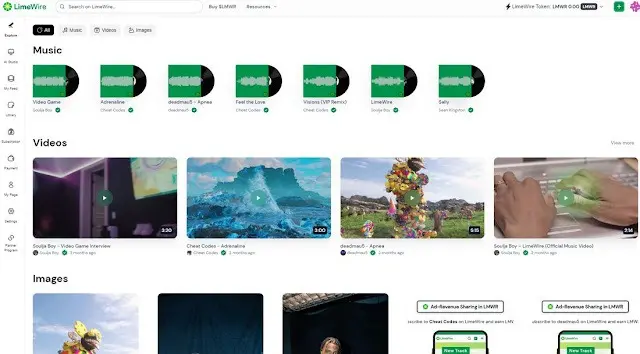
Prominent artists—including Deadmau5, Soulja Boy, and Sean Kingston—have already tested the ecosystem, publishing AI-driven music, video, and image assets. This in-depth report explores the technological architecture, monetization mechanics, subscription models, and future roadmap that define LimeWire’s ambitious second act.
Detailed Chronology
The Genesis and Fall of the Original LimeWire (2000–2010)
- 2000: Mark Gorton founds LimeWire as a peer-to-peer file-sharing client built on the Java platform, utilizing the Gnutella network. It rapidly gains market share, eventually rivaling and surpassing Napster in daily active users following Napster’s court-mandated shutdown.
- 2006–2010: The Recording Industry Association of America (RIAA) wages a relentless legal battle against LimeWire, culminating in the landmark Arista Records LLC v. Lime Group LLC case. US District Judge Kimba Wood rules that LimeWire and Gorton induced copyright infringement, leading to a staggering $105 million settlement in 2010 and the permanent cessation of the P2P software.
The Rebirth and Web3 Pivot (2022–Present)
- 2022: Entrepreneurs Julian and Paul Zehetmayr acquire the LimeWire brand with a vision to repurpose it as a digital collectibles marketplace. The initial relaunch focuses heavily on music NFTs, securing early buy-in from mainstream musicians.
- Early 2023: Recognizing the seismic shift toward generative artificial intelligence, LimeWire pivots aggressively, introducing the LimeWire AI Studio. This marks the transition from a pure NFT secondary marketplace into an end-to-end AI creation suite.
- Late 2023–2024: The platform rolls out support for state-of-the-art AI models, including Stable Diffusion 2.1, Stable Diffusion XL, and DALL-E 2. Simultaneously, it launches its native utility token, LMWR, integrated across crypto exchanges such as Kraken, ByBit, and Uniswap to fuel ecosystem transactions and ad-revenue sharing.
Supporting Context & Metrics: The Mechanics of the LimeWire AI Studio
To understand LimeWire’s value proposition in the crowded generative AI market, one must examine its core technical offerings, monetization pipelines, and pricing tiers.
AI Image Generation and Multimodal Styling
The LimeWire AI Studio is engineered to accommodate users of all skill levels, from absolute beginners to professional digital artists. By integrating industry-standard foundational models, the platform gives users access to:
- Stable Diffusion 2.1 and XL: Offering high-fidelity outputs, advanced prompt adherence, and vast style customization.
- DALL-E 2 Integration: Bringing OpenAI’s robust text-to-image capabilities directly into the LimeWire interface.
Unlike single-purpose generators, LimeWire emphasizes aesthetic versatility. Users can dynamically switch between rendering styles—including cinematic, pixel art, anime, analog film, and digital illustration—using integrated samplers to fine-tune resolution, detail, and contrast. Furthermore, the platform is actively developing its proprietary AI model, signaling a transition away from complete reliance on third-party APIs.
Automated Blockchain Minting (NFT Integration)
One of LimeWire’s core differentiators is the frictionless conversion of generated media into tradeable digital assets. Upon publishing a creation to LimeWire Studio, the platform automatically mints the work as an NFT on either the Polygon or Algorand blockchain.
This infrastructure endows every piece of AI art, music, or video with a verifiable digital signature, establishing provenance and authentic ownership. Creators retain absolute sovereignty over their distribution strategy:
- Public Releases: Content is discoverable by the broader community, allowing enthusiasts to collect and trade the underlying NFTs on secondary markets. Creators earn an automated 2.5% royalty every time their digital asset changes hands.
- Exclusive Subscriber-Only Drops: Creators can gate content behind paywalls, offering intimate, members-only drops for dedicated fans who subscribe to their channels.
The LMWR Token Economy and Ad Revenue Share
LimeWire has constructed a circular economic model designed to reward content creators directly. Unlike traditional social media platforms where algorithmic ad revenue is tightly controlled by corporate gatekeepers, LimeWire operates on a transparent revenue-sharing mechanism:
- Ad Revenue Split: Creators receive up to 70% of all ad revenue generated when other users view their published images, music, or videos on the platform.
- LMWR Payouts: Earnings are distributed monthly in LMWR tokens, LimeWire’s native cryptocurrency. These tokens can be liquidated on major exchanges (such as Kraken, ByBit, and Uniswap) or reinvested directly back into the platform to purchase additional prompt credits.
Subscription Pricing Tiers and Credits
LimeWire operates on a freemium SaaS model, scaling its processing power, credit allotments, and revenue shares according to user subscription levels:
| Tier | Monthly Price | Monthly Credits | Estimated Image Generations | Ad Revenue Share | Key Perks |
|---|---|---|---|---|---|
| Free | $0 | 10 Credits | ~20 images/day | 50% | Basic tools, community access |
| Basic | $9.99 | 1,000 Credits | Up to 2,000 | 50% | Pro badge, faster generation, ad-free |
| Advanced | $29.00 | 3,750 Credits | Up to 7,500 | 60% | Early access to new AI models |
| Pro | $49.00 | 5,000 Credits | Up to 10,000 | 70% | Maximum revenue share, priority queue |
| Elite | $99.00 | 11,250 Credits | Up to 22,500 | 70% | Ultimate allocation, full creation history |
Official Statements and Industry Perspective
The strategic evolution of LimeWire has drawn significant commentary from both tech analysts and the leadership team steering the platform’s renaissance.
In corporate briefs outlining the platform’s pivot, co-founders Julian and Paul Zehetmayr emphasized that the goal was never merely to exploit brand nostalgia, but to solve a fundamental economic problem plaguing digital creators: the monetization gap in generative AI.
"When we acquired LimeWire, our vision was to build a space where creativity meets true digital ownership," leadership notes in platform release documents. "Generative AI has unlocked unprecedented creative potential, but creators have largely been left without viable pathways to monetize their work directly. By merging state-of-the-art AI tooling with automated Web3 minting and a transparent ad-revenue model powered by LMWR, we are building a sustainable economy for the next generation of digital artists."
Industry analysts point out that while early skepticism surrounded the use of the legacy LimeWire brand, the implementation of blockchain-backed provenance and high-profile artist endorsements (such as Deadmau5 and Soulja Boy) has lent the platform unexpected institutional credibility. By transitioning the debate away from copyright infringement—the hallmark of its 2000s iteration—and toward creator empowerment and licensed AI training frameworks, LimeWire has successfully reframed its corporate narrative.
Future Outlook
As the generative artificial intelligence market matures, LimeWire’s roadmap points toward aggressive multi-modal expansion. While image generation has served as the anchor for the platform’s initial traction, upcoming developmental milestones include:
- AI Music Generation Tools: Allowing audio producers and hobbyists to compose, mint, and monetize original AI-generated soundscapes and tracks directly within the studio.
- AI Video Generation Suites: Capitalizing on the rapid breakthroughs in text-to-video diffusion models to offer high-definition video creation capabilities to creators and filmmakers.
- Proprietary AI Models: Reducing dependency on third-party open-source or commercial models by training LimeWire’s own custom neural networks, optimized specifically for commercial asset trading and NFT minting.
Conclusion
LimeWire’s transformation from an outlawed P2P file-sharing protocol into an authorized, blockchain-integrated AI studio is one of the most fascinating corporate evolutions of the digital age. By democratizing access to advanced generative art tools, automating NFT provenance on Polygon and Algorand, and returning up to 70% of ad revenue to creators via LMWR tokens, LimeWire has positioned itself as an innovator in the Web3 creator economy.
Whether an aspiring digital artist experimenting with the free tier or a professional designer scaling up to the Elite subscription, users today find a platform uniquely structured to reward imagination. As LimeWire prepares to roll out its anticipated audio and video generation tools, the platform stands as a testament to the fact that digital brands—much like the content they host—can be entirely reinvented for a new era.