Executive Overview
For years, human-AI interaction has been trapped in a rigid, transactional loop. Ever since the widespread adoption of modern large language models, the blueprint has remained unchanged: a user types a prompt, an AI generates a response, and the human drives every subsequent step. While powerful, this model treats the artificial intelligence as a passive oracle rather than an active collaborator.
Enter Claude Cowork—a human-friendly, agentic AI platform developed by Anthropic that shatters this paradigm. Evolving directly from Claude Code, an internal developer tool originally engineered for Anthropic’s own engineering teams, Cowork wraps an advanced agentic engine in a desktop-accessible environment. It replaces intimidating command-line interfaces with visible file trees, real-time action plans, and transparent progress tracking.
Unlike traditional chatbots that require constant hand-holding, Cowork possesses three defining capabilities that fundamentally alter its operational profile: autonomous planning and execution, persistent memory, and intelligent tool use. According to AI strategist and consultant Isar Meitis—who co-created a comprehensive guide on the platform alongside Michael Stelzner—these features bridge the chasm between simple text generation and autonomous business execution. By integrating deeply with local files, cloud platforms, and third-party software APIs, Cowork allows individuals and enterprises to deploy sophisticated, multi-step workflows that drastically reduce manual operational overhead.
Detailed Chronology: From Developer Terminal to Desktop Powerhouse
The journey of Claude Cowork represents a classic tale of developer-driven innovation spilling over into mainstream business utility. Understanding its evolution helps contextualize why this platform behaves differently than traditional software solutions.
Phase 1: The Genesis of Claude Code
Initially, Anthropic engineers faced the same productivity bottlenecks as software developers everywhere: writing boilerplate code, debugging, navigating complex directory structures, and managing terminal scripts. To solve this, they built an internal developer tool known as Claude Code. This command-line agent was designed to read local codebases, execute shell commands, run tests, and autonomously build software features from high-level developer prompts.
Phase 2: The Grassroots Discovery and User Friction
As word of Claude Code spread organically outside of Anthropic’s internal engineering circles, power users and technical marketers realized that the underlying engine was capable of far more than just writing Python or JavaScript. It could manipulate local files, analyze disparate datasets, coordinate multi-app workflows, and manage complex operational pipelines.
However, a massive barrier to entry remained: the terminal. For non-technical business owners, marketers, and executive assistants, interacting via a command-line interface was intimidating and error-prone. Demand surged for a consumer-grade graphical user interface (GUI) that preserved the raw capability of the agentic engine while offering safety, visibility, and ease of use.
Phase 3: The Birth of Claude Cowork
Anthropic responded by packaging the agentic core into Claude Cowork. By moving the interface to a desktop application, the platform introduced several structural upgrades:
- Visual Directory Integration: Users can link local folders with a simple point-and-click interface, establishing secure operational boundaries for the AI.
- Real-Time Plan Tracking: Rather than executing tasks in a black box, Cowork generates a structured plan, displaying steps and crossing them off in real time as actions are completed.
- Granular Transparency: Users can audit every file modification, external API call, and automated decision made by the agent.
The Anatomy of Agentic AI: Core Capabilities
To fully grasp how Claude Cowork transforms business workflows, it is necessary to examine the three pillars that separate true agentic systems from legacy conversational models.
+-------------------------------------------------------------------+
                 THE TRIAD OF AGENTIC CAPABILITIES
+-------------------------------------------------------------------+
| 1. Autonomous Planning & Execution                                |
|    - Defines goals, builds task maps, executes without oversight  |
+-------------------------------------------------------------------+
| 2. Persistent Memory                                              |
|    - Reads/writes markdown files across sessions (brand guides)   |
+-------------------------------------------------------------------+
| 3. Contextual Tool Use                                            |
|    - Knows WHEN and HOW to pull transcripts, update CRMs, etc.   |
+-------------------------------------------------------------------+
1. Autonomous Planning and Execution
In standard conversational AI, the human is the cognitive engine of the operation. You prompt the AI, evaluate the output, correct its course, and provide the next prompt. Cowork reverses this dynamic. You establish the overarching goals, operational constraints, and accessible data sources. The AI then synthesizes a step-by-step strategic plan, displays it to the user, and systematically executes each phase without requiring micro-management at every turn.
2. Persistent Memory
Legacy chat interfaces suffer from corporate amnesia; every new session starts with a blank slate, requiring users to re-upload brand guidelines, tone-of-voice documents, and process workflows. Cowork circumvents this by utilizing local markdown files for persistent memory. It can read and write to these documents across sessions, meaning institutional knowledge—such as historical client profiles, proposal templates, and step-by-step standard operating procedures (SOPs)—remains permanently accessible and self-updating.
3. Intelligent Tool Use
Many modern platforms integrate external tools, but they often require the user to explicitly invoke them. Cowork exercises situational awareness. It understands when to execute a tool and how to chain multiple tools together. For example, it recognizes precisely when it needs to pull a meeting transcript from a note-taking application like Fathom, cross-reference it with a prospect’s LinkedIn profile via a web browser, update a CRM record, and draft a tailored follow-up email.
Real-World Applications: Content Operations and Sales Automation
The practical utility of these agentic systems becomes glaringly apparent when examining end-to-end business workflows. Isar Meitis highlights two primary use cases that demonstrate the immense time-savings unlocked by Cowork: content creation and enterprise sales proposals.
Case Study A: The Autonomous Content Engine
Content marketing requires continuous ideation, market research, and multi-channel distribution. Using Cowork, Meitis established an automated pipeline that operates as follows:
- Research & Trend Analysis: Claude monitors top-performing content creators within a specific niche to identify emerging topics and engagement trends across platforms.
- Cross-Referencing Proprietary Archives: The AI cross-references these external trends against Meitis’s proprietary archive—including past podcast episodes, YouTube transcripts, and community call recordings.
- Asset Generation: It identifies authentic quotes and insights where Meitis has previously addressed the trending topic, automatically drafting platform-optimized posts, generating image assets, and cutting short-form video clips.
- Human-in-the-Loop Review: All generated materials are compiled into an organized review folder. Nothing goes live without explicit human sign-off.
Case Study B: Streamlining Sales Proposals
In a typical B2B sales cycle, a discovery call concludes with a commitment to draft a bespoke proposal—a manual administrative hurdle that often takes hours. With Cowork integrated into the tech stack, the workflow is compressed from two hours to ten minutes:
- Transcript Extraction: Upon the conclusion of a discovery call, Cowork extracts and analyzes the transcript to capture explicit client pain points, budgetary constraints, and project scopes.
- Deep Research: The system automatically researches the prospect’s company, examines industry landscape reports, and reviews historical proposal documents stored in local directories.
- Drafting and CRM Updates: Claude drafts a comprehensive, highly customized proposal. Once Meitis reviews and tweaks the document, the system automatically formats the PDF, uploads it to Google Drive, updates the CRM record, and generates a draft email with the proposal attached for final transmission.
Implementation Framework: How to Build Automations
Deploying agentic AI successfully requires moving away from casual prompting and adopting a structured software-development mindset. Experts recommend a disciplined, multi-step implementation process.
Step 1: Task Identification
Begin by targeting frequent, highly repetitive administrative tasks that consume disproportionate amounts of time or drain team morale. Once identified, describe the task to Claude using the language one would use to brief a human consultant. This initial brief should explicitly define:
- The operational role the AI is assuming.
- The broader company and market context.
- The frequency and schedule of the task.
- The precise data sources and expected output destinations.
Step 2: Authoring Product Requirements Documents (PRDs)
AI excels at execution when provided with exhaustive, unambiguous instructions. Vague prompts lead to wasted processing tokens and suboptimal outputs.
To build robust guardrails, leverage Claude itself to conduct a requirements interview. Provide the AI with a high-level concept, and direct it to interview you by asking roughly 40 targeted questions over a 30- to 60-minute session. Based on your answers, Claude synthesizes a comprehensive 25- to 40-page PRD. Users do not need to read every word of this voluminous document; because the content stems directly from their own spoken or written answers, the substance is inherently validated. Requesting an executive summary of the PRD is usually sufficient to proceed safely.
Step 3: Prioritizing the Minimum Viable Product (MVP)
Rather than attempting to automate an entire enterprise department on day one, use the PRD to isolate a high-impact, low-complexity entry point. In the sales proposal example, the foundational MVP was simply converting a raw call transcript into a structured written proposal. Advanced integrations—such as automated CRM syncing and direct email dispatch—can be layered in subsequent development iterations.
Subsequent sessions should build iteratively upon previous successes. By prompting the platform with questions like, "Where are we in the development process, what do you suggest is our next step, and why?", users maintain strategic oversight while letting the agent manage tactical dependencies.
Supporting Context & Metrics: The State of AI Adoption
As organizations rush to integrate agentic systems like Claude Cowork into their daily operations, broader market research highlights both the urgency and the isolation felt by modern professionals navigating this transition.
According to recent data highlighted in comprehensive industry research, the vast majority of professionals are pioneering their own artificial intelligence strategies without institutional guidance:
- 85% of marketers and business operators learn AI entirely through independent experimentation.
- Only 7% of organizations provide formal, structured internal training for AI tools.
- More than 50% of working professionals out-of-pocket fund their own AI software subscriptions and tools.
This DIY approach underscores why human-friendly agentic platforms like Claude Cowork are gaining rapid traction. By removing the need for complex command-line programming and traditional software engineering degrees, tools with intuitive graphical interfaces democratize advanced automation, allowing everyday business operators to build enterprise-grade workflows independently.
Establishing Connectivity: The Four Integration Tiers
For an AI agent to execute tasks autonomously across an entire tech stack, it requires secure, reliable access to external software and local directories. Claude Cowork implements a structured hierarchy of connection methodologies, ensuring security while maximizing utility.
+-------------------------------------------------------------------+
                 HIERARCHY OF CONNECTIONS
+-------------------------------------------------------------------+
| Tier 1: Native Connectors                                         |
|    - Google Drive, SharePoint, Notion, Asana, Monday.com          |
+-------------------------------------------------------------------+
| Tier 2: Vendor-Published MCPs (Model Context Protocol)            |
|    - Standardized open-source APIs developed by software vendors  |
+-------------------------------------------------------------------+
| Tier 3: Custom MCPs Built by Claude                               |
|    - Written via API docs; credentials safely stored in Keychain  |
+-------------------------------------------------------------------+
| Tier 4: Chrome Browser Extension                                  |
|    - GUI fallback: clicks, navigates, and fills forms like a human|
+-------------------------------------------------------------------+
Local File Containment
Before connecting cloud tools, users should establish a centralized local file structure. Isar Meitis recommends creating a primary root folder named ClaudeCowork with dedicated subfolders for distinct projects. Connecting the AI at the root level provides a natural containment boundary, granting the agent access only to the files and subdirectories required for the immediate task while shielding sensitive system files.
1. Native Connectors
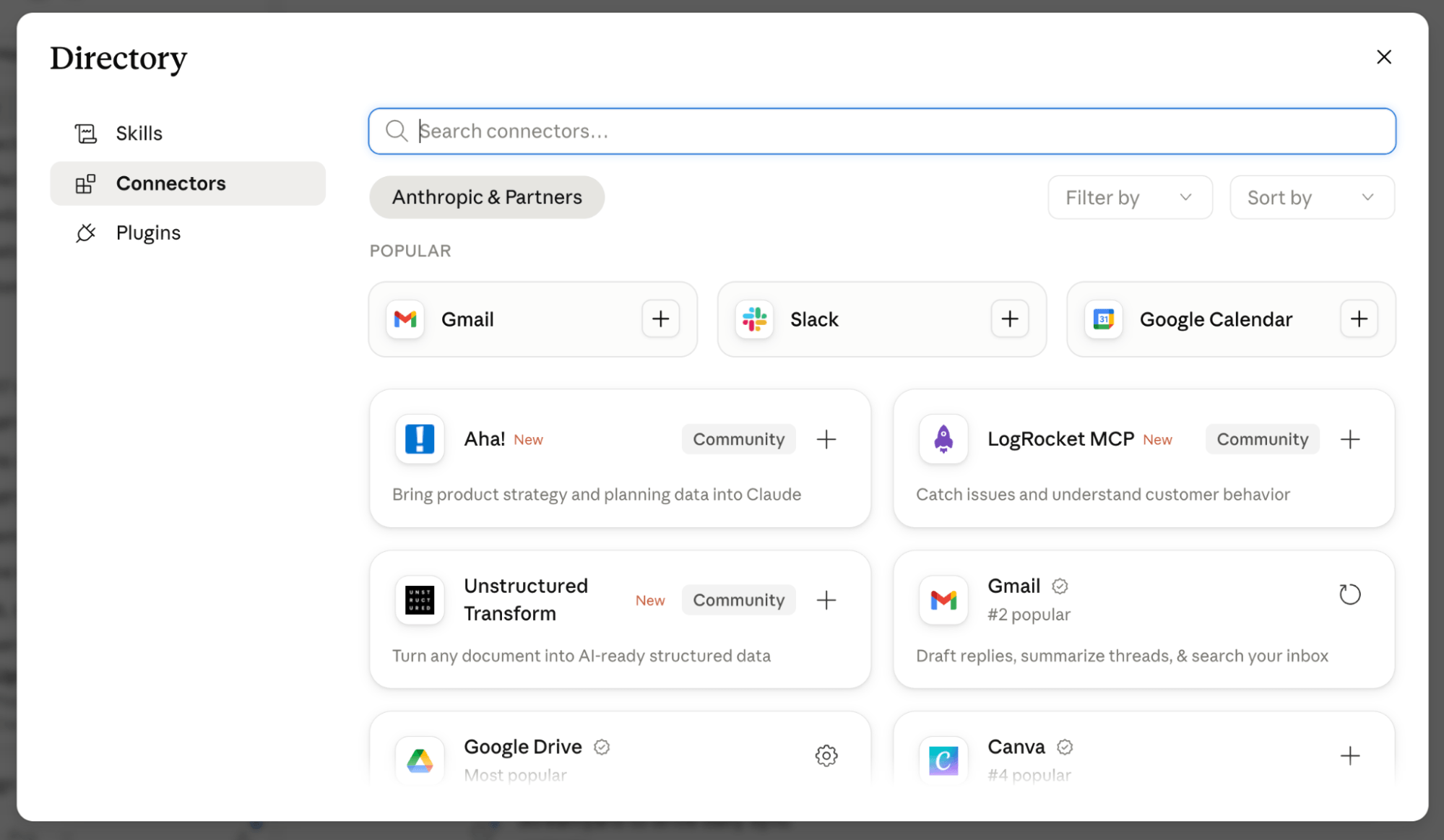
Anthropic has engineered pre-built, thoroughly tested native connectors for major enterprise software ecosystems. These include platforms such as Google Drive, Microsoft SharePoint, Notion, ClickUp, Asana, and Monday.com. These native links should always serve as the primary integration option due to their stability and security.
2. Vendor-Published Model Context Protocols (MCPs)
Introduced by Anthropic, the Model Context Protocol (MCP) functions much like a universal USB standard for software integrations. On one side, developers build an API integration once; on the other, the standardized protocol allows AI agents to interface with the tool instantaneously. If a software vendor has published an official MCP, it represents a secure and well-documented connection pathway.
3. Custom MCPs Built by Claude
When an off-the-shelf MCP does not exist for a legacy or niche software tool, Claude can engineer its own custom solution. By supplying the platform with standard API documentation and describing the required operational functions, Claude will write the custom MCP and generate a markdown file detailing its utilization. To maintain security, API keys and sensitive credentials can be stored securely within operating system keychains (such as macOS Keychain), ensuring the AI executes actions without ever gaining direct visibility into raw secret keys.
4. The Chrome Browser Extension
For proprietary platforms or web-based applications entirely devoid of formal APIs or integrations, the Claude Chrome Browser Extension acts as a powerful fallback. The agent operates the browser directly—opening tabs, clicking interface buttons, navigating menus, and filling form fields just as a human operator would. Security is strictly maintained: the AI will never attempt to bypass password fields or enter master credentials. When encountering a login screen, it pauses execution, prompts the human user to authenticate, and seamlessly resumes its automated workflow upon authorization.
Future Outlook: The Shift Toward Fully Autonomous Operations
The introduction of platforms like Claude Cowork signals a profound structural shift in how knowledge work is conducted. We are transitioning away from an era where humans act as software operators—manually copying data between tabs, formatting reports, and triggering isolated scripts—and moving toward an era of orchestrated delegation.
In this emerging landscape, human professionals increasingly function as managers and creative directors of fleets of specialized AI agents. As persistent memory systems grow more sophisticated and cross-platform protocols like MCP become ubiquitous, the friction of enterprise automation will continue to evaporate.
For businesses and independent operators alike, the competitive advantage will no longer belong to those who can type the fastest prompts, but to those who can master the architecture of requirements, design resilient workflows, and exercise sound strategic judgment over autonomous systems. Those who embrace this agentic shift early will find themselves operating at a scale and velocity previously reserved for organizations ten times their size.